
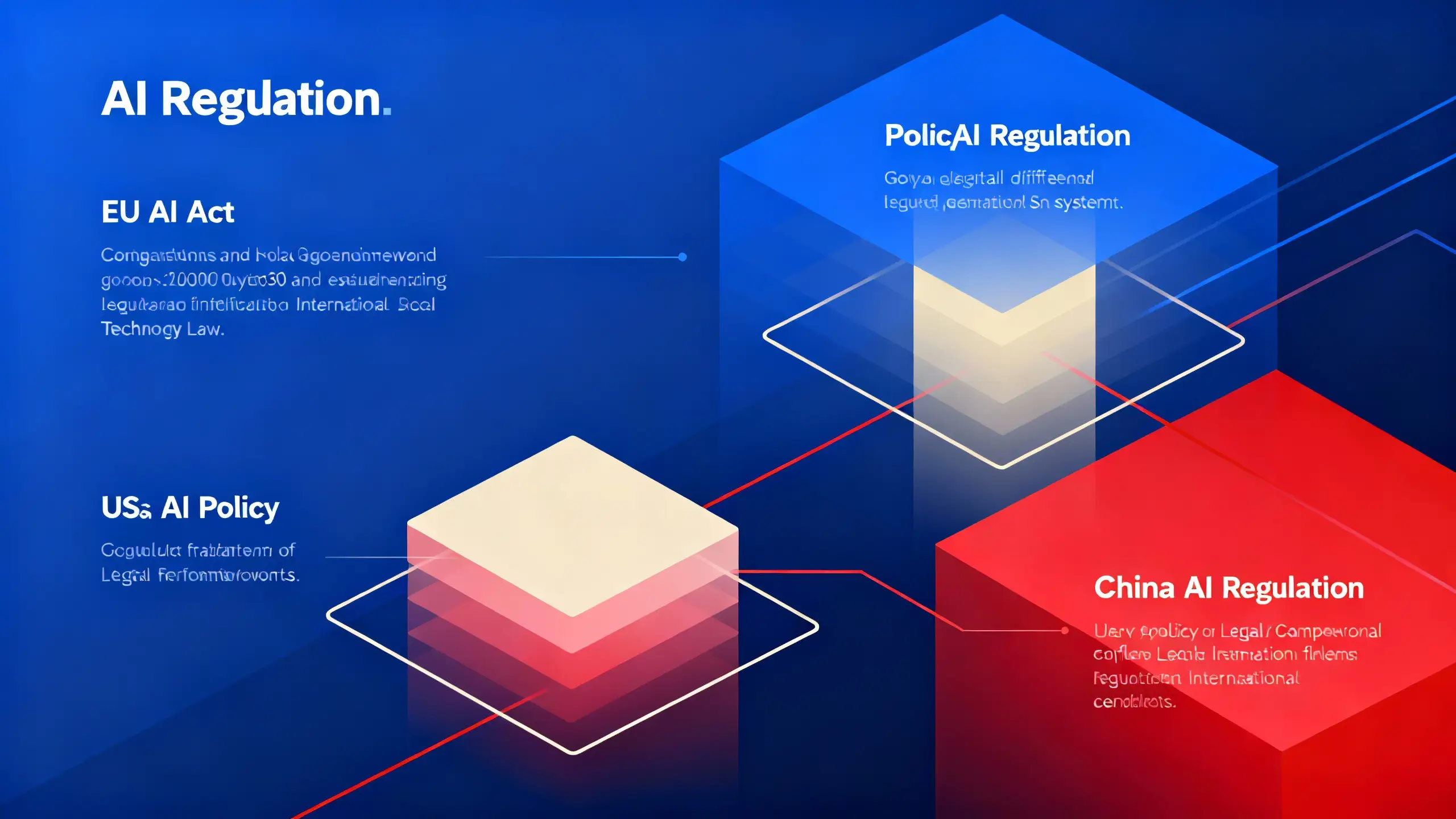
The global regulatory landscape for artificial intelligence has reached a transformative moment in 2026, with three major frameworks—the European Union's AI Act, the United States' comprehensive federal AI governance, and China's AI oversight regulations—creating fundamentally different approaches to AI regulation. These frameworks reflect not just different legal traditions and policy priorities, but competing visions for how AI should be developed, deployed, and governed in the 21st century. The European Union emphasizes risk-based regulation with strict requirements for high-risk AI systems, the United States focuses on sector-specific oversight with emphasis on innovation and competitiveness, while China prioritizes state control and data sovereignty with comprehensive monitoring requirements.
According to analysis from the Stanford Institute for Human-Centered Artificial Intelligence, these three regulatory approaches have created a fragmented global AI market where companies must navigate different compliance requirements in different regions.
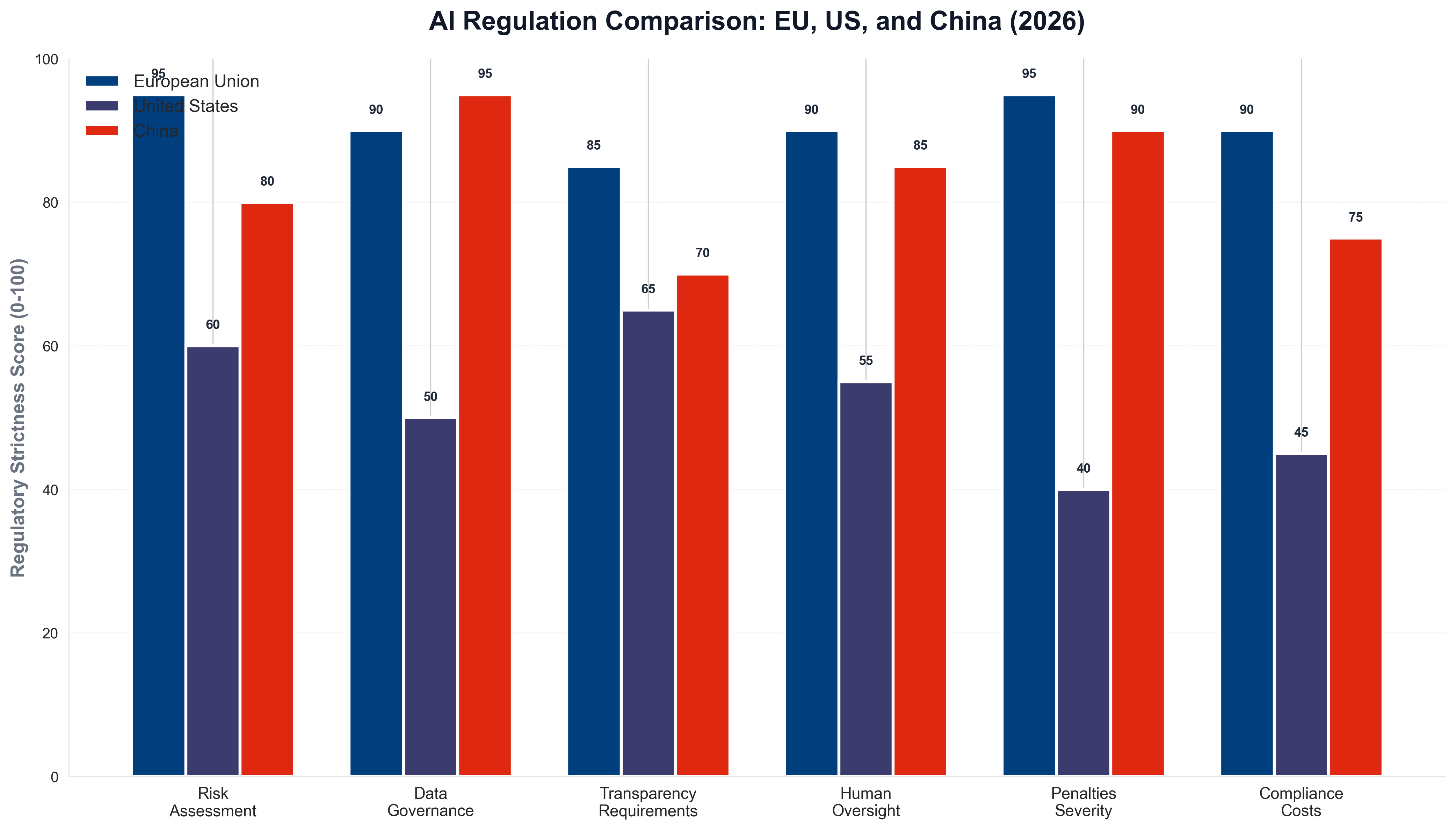
The regulatory comparison chart illustrates the significant differences in regulatory strictness across key dimensions, with the EU showing the highest overall strictness, particularly in risk assessment and penalties, while the US maintains a more flexible approach that balances regulation with innovation. The EU's AI Act, fully implemented in 2026, requires extensive documentation, risk assessments, and human oversight for AI systems classified as high-risk, affecting applications in healthcare, transportation, education, and law enforcement. The United States has taken a more decentralized approach, with federal agencies establishing sector-specific rules while maintaining flexibility for innovation. China's regulations emphasize data localization, algorithmic transparency requirements, and state oversight of AI development and deployment.
The implications of these regulatory differences extend far beyond compliance costs. Companies developing AI systems must now consider regulatory requirements from the earliest stages of development, as retrofitting AI systems to meet regulatory requirements can be prohibitively expensive or technically impossible. The regulatory frameworks also reflect different cultural values and policy priorities: Europe emphasizes privacy and fundamental rights, the United States balances innovation with safety, and China prioritizes state security and technological sovereignty. These differences create both challenges and opportunities for the global AI industry.
The European Union's AI Act: Risk-Based Regulation
The European Union's AI Act, which became fully enforceable in 2026, represents the world's most comprehensive AI regulation framework. The Act takes a risk-based approach, categorizing AI systems into four risk levels: minimal risk, limited risk, high risk, and unacceptable risk. AI systems classified as high-risk face extensive requirements including mandatory risk assessments, data governance standards, transparency obligations, human oversight requirements, and accuracy and robustness standards. Systems classified as unacceptable risk, such as social scoring by governments or real-time biometric identification in public spaces, are prohibited entirely.
According to the European Commission's AI Act implementation guide, high-risk AI systems must undergo conformity assessments before being placed on the market, requiring documentation of the system's intended purpose, training data, algorithms, and risk mitigation measures. The Act also establishes requirements for general-purpose AI models, including large language models, requiring transparency about training data, capabilities, and limitations. Companies developing or deploying high-risk AI systems must maintain detailed records and ensure human oversight, with penalties for non-compliance reaching up to 7% of global annual revenue or €35 million, whichever is higher.
The EU's approach emphasizes fundamental rights protection, requiring that AI systems respect privacy, non-discrimination, and human dignity. The Act includes specific provisions for biometric identification, requiring explicit consent and prohibiting real-time remote biometric identification in public spaces except for narrowly defined law enforcement purposes. The regulation also addresses algorithmic transparency, requiring that users be informed when they're interacting with AI systems and that AI-generated content be clearly labeled.
The AI Act's impact extends beyond Europe, as companies selling AI systems in the EU market must comply regardless of where they're based. This extraterritorial effect has prompted many global AI companies to adopt EU-compliant practices as their default, effectively making the EU's regulatory standards a de facto global standard for many AI applications. However, the Act's strict requirements have also raised concerns about innovation, with some critics arguing that compliance costs could disadvantage European AI companies compared to competitors in less regulated markets.
The United States: Sector-Specific Federal Governance
The United States has taken a fundamentally different approach to AI regulation, establishing sector-specific federal oversight rather than comprehensive horizontal regulation. In 2026, multiple federal agencies have established AI governance frameworks tailored to their specific domains: the Food and Drug Administration regulates AI in medical devices, the Federal Aviation Administration oversees AI in aviation, the National Highway Traffic Safety Administration governs autonomous vehicles, and the Equal Employment Opportunity Commission addresses AI in hiring and employment decisions.
According to the White House's AI Policy Framework 2026, the federal approach emphasizes innovation and competitiveness while addressing specific risks through targeted regulation. The framework includes voluntary AI safety standards developed by the National Institute of Standards and Technology (NIST), requirements for federal agencies to conduct AI impact assessments, and guidelines for AI procurement by government agencies. Unlike the EU's comprehensive regulation, the U.S. approach allows for more flexibility and innovation, with companies able to develop and deploy AI systems more quickly in many sectors.
The U.S. regulatory landscape also includes state-level AI regulations, creating additional complexity for companies operating across multiple states. California, for example, has established requirements for AI transparency in consumer interactions, while New York has implemented regulations for AI use in hiring decisions. This patchwork of state and federal regulations creates compliance challenges but also allows for regulatory experimentation and innovation at the state level.
The United States has also emphasized international competitiveness in its AI policy, with initiatives to maintain U.S. leadership in AI development and deployment. The federal government has invested heavily in AI research and development, established partnerships with private sector companies, and worked to ensure that AI regulation doesn't unduly burden innovation. This approach reflects concerns that overly strict regulation could disadvantage U.S. companies in global competition, particularly against Chinese AI companies that benefit from state support and less restrictive domestic regulations.
China's AI Oversight: State Control and Data Sovereignty
China's approach to AI regulation emphasizes state control, data sovereignty, and technological self-reliance. The country's AI governance framework, fully implemented in 2026, requires that AI systems comply with socialist core values, respect national security interests, and maintain data within China's borders. The regulations establish comprehensive oversight of AI development and deployment, with requirements for algorithmic transparency, content moderation, and state monitoring of AI systems.
According to analysis from the Center for Strategic and International Studies, China's AI regulations require that AI systems used in critical information infrastructure must undergo security assessments and obtain government approval before deployment. The regulations also establish requirements for algorithmic recommendation systems, requiring transparency about recommendation logic and providing users with options to opt out of personalized recommendations. Content generation AI systems must comply with content moderation requirements, ensuring that generated content aligns with Chinese laws and socialist values.
China's approach to AI regulation reflects the country's broader strategy of technological sovereignty and reducing dependence on foreign technology. The regulations include requirements for data localization, with certain types of data required to be stored and processed within China. The country has also established standards for AI development that prioritize domestic technology and reduce reliance on foreign AI systems. This approach supports China's goal of becoming a global leader in AI while maintaining state control over technology development and deployment.
The regulations also address social stability and public opinion management, requiring that AI systems used for content generation, recommendation, or social media must include mechanisms for monitoring and controlling public discourse. These requirements reflect China's emphasis on maintaining social harmony and preventing the spread of information that could undermine state authority or social stability. The regulations create a comprehensive framework for state oversight of AI systems that could influence public opinion or social behavior.
Comparative Analysis: Key Differences and Similarities
The three major AI regulatory frameworks share some common goals—ensuring AI safety, protecting privacy, and preventing discrimination—but differ significantly in their approaches and priorities.
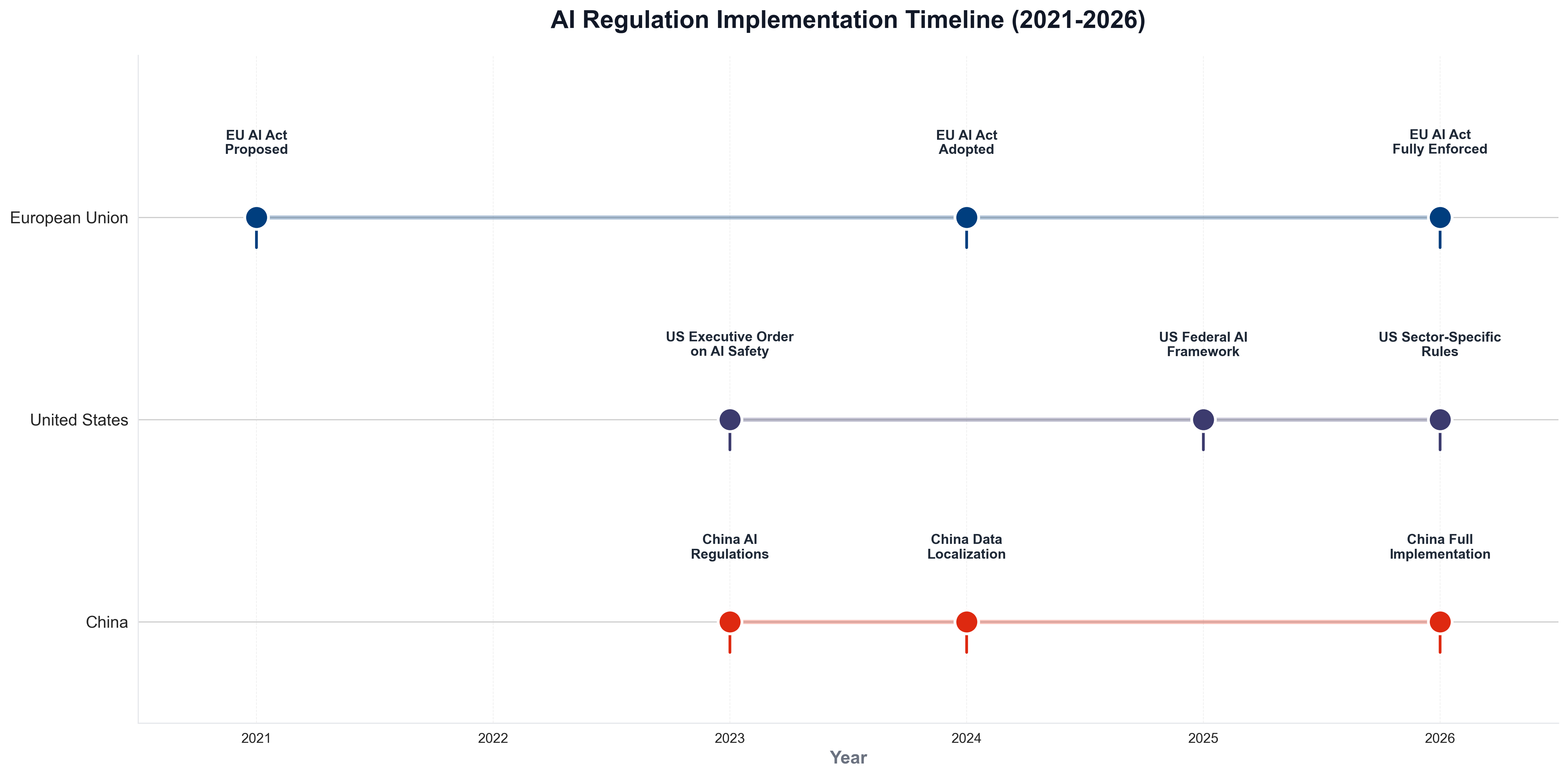
The implementation timeline shows the progression of AI regulation across the three major jurisdictions, with the EU taking the lead in comprehensive regulation, followed by China's implementation of oversight requirements, and the US establishing sector-specific frameworks over a similar timeframe. The EU emphasizes comprehensive risk-based regulation with strict requirements and significant penalties, creating a high-compliance environment that prioritizes fundamental rights protection. The United States takes a sector-specific, innovation-friendly approach that balances safety with competitiveness and allows for regulatory flexibility. China prioritizes state control and data sovereignty with comprehensive oversight requirements that support national security and technological independence.
According to research from the Brookings Institution, these differences create both challenges and opportunities for global AI companies. Companies must navigate different compliance requirements in different markets, increasing development and operational costs. However, the differences also create opportunities for regulatory arbitrage, where companies can choose to develop and deploy AI systems in markets with more favorable regulatory environments. This dynamic is particularly relevant for AI startups and smaller companies that may lack resources to comply with multiple regulatory frameworks simultaneously.
The regulatory differences also reflect different cultural values and policy priorities. Europe's emphasis on fundamental rights and privacy reflects the region's strong tradition of data protection and human rights. The United States' focus on innovation and competitiveness reflects American values of entrepreneurship and market-driven development. China's emphasis on state control and data sovereignty reflects the country's approach to internet governance and technological development, prioritizing national security and social stability.
Impact on Innovation and Competition
The different regulatory approaches have significant implications for AI innovation and global competition. The EU's strict regulatory requirements have raised concerns about innovation, with some critics arguing that compliance costs and regulatory uncertainty could disadvantage European AI companies. However, the EU's approach also creates opportunities for companies that can successfully navigate the regulatory requirements, as the high compliance bar can serve as a competitive moat for compliant companies.
According to analysis from the European AI Alliance, European AI companies have adapted to the regulatory environment by focusing on trustworthy AI and ethical AI development, positioning themselves as leaders in responsible AI innovation. The regulatory requirements have also created new markets for AI compliance services, risk assessment tools, and ethical AI consulting. However, some European AI startups have reported challenges in raising capital and competing globally due to regulatory compliance costs and uncertainty.
The United States' more flexible regulatory approach has supported innovation, with American AI companies continuing to lead in many AI sectors. However, the lack of comprehensive federal regulation has also created uncertainty and compliance challenges, as companies must navigate multiple sector-specific regulations and state-level requirements. The U.S. approach has also raised concerns about AI safety and consumer protection, with critics arguing that the current regulatory framework doesn't adequately address emerging AI risks.
China's regulatory approach supports the country's goal of technological self-reliance and reducing dependence on foreign AI technology. The regulations create advantages for domestic Chinese AI companies while creating barriers for foreign companies seeking to operate in China. However, the regulatory requirements also create compliance costs and operational challenges for Chinese AI companies, potentially affecting their competitiveness in global markets.
Compliance Challenges for Global AI Companies
Global AI companies face significant challenges in navigating the different regulatory frameworks. Companies must understand and comply with multiple sets of regulations, each with different requirements, enforcement mechanisms, and penalties. This creates substantial compliance costs, as companies must invest in legal expertise, compliance systems, and regulatory monitoring across multiple jurisdictions.
According to research from the International Association of Privacy Professionals, global AI companies report spending 15-25% of their AI development budgets on compliance and regulatory activities.
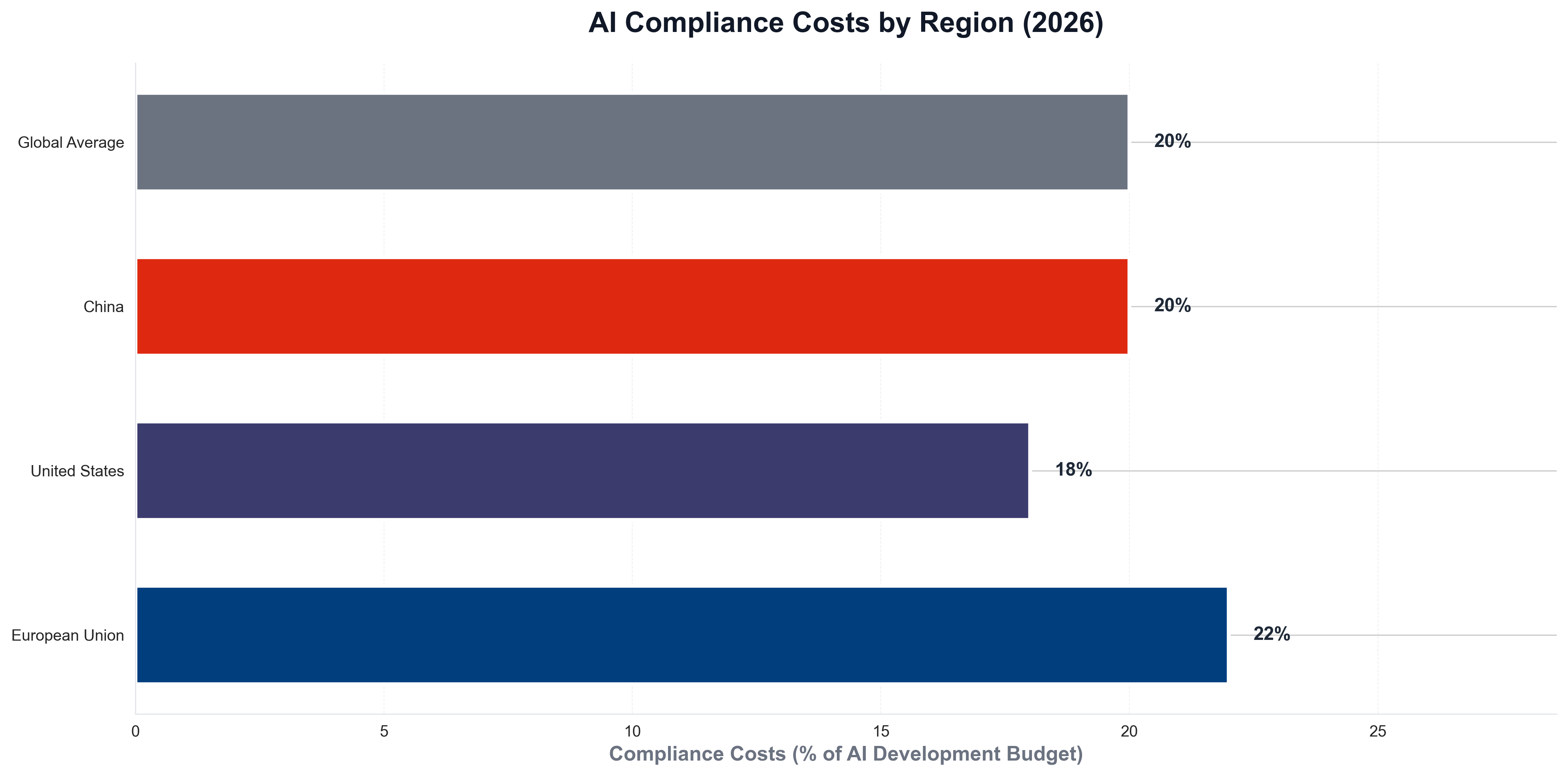
The compliance costs chart demonstrates the significant financial burden of regulatory compliance, with companies in the EU facing the highest compliance costs as a percentage of their AI development budgets, reflecting the region's more comprehensive regulatory requirements. These costs include legal consultation, compliance system development, risk assessments, documentation, and ongoing monitoring. The compliance burden is particularly challenging for smaller AI companies and startups, which may lack the resources to navigate multiple regulatory frameworks simultaneously.
The regulatory differences also create technical challenges, as AI systems may need to be modified or developed differently for different markets. For example, an AI system that complies with EU requirements may need significant modifications to meet U.S. or Chinese regulatory standards. This can require maintaining multiple versions of AI systems or developing systems that can be configured differently for different markets, increasing development and maintenance costs.
The compliance challenges also create strategic considerations for AI companies, as they must decide which markets to prioritize and how to structure their global operations. Some companies may choose to focus on markets with more favorable regulatory environments, while others may invest heavily in compliance to access all major markets. These strategic decisions can significantly affect a company's competitive position and growth trajectory.
Future Directions: Convergence or Divergence?
The future of global AI regulation remains uncertain, with questions about whether regulatory frameworks will converge toward common standards or continue to diverge. Some experts predict that regulatory convergence will occur over time, as countries learn from each other's experiences and work to harmonize standards for global AI companies. Others predict continued regulatory divergence, as countries prioritize different values and policy objectives in their AI governance.
According to forecasts from the World Economic Forum, international organizations including the United Nations, OECD, and G7 are working to establish common principles for AI governance that could serve as a foundation for regulatory convergence. These efforts focus on areas of broad agreement, including AI safety, transparency, and human oversight, while allowing for differences in implementation based on national contexts and priorities.
The development of international AI standards could also support regulatory convergence, as common technical standards could facilitate compliance across multiple jurisdictions. Organizations including the International Organization for Standardization (ISO) and the Institute of Electrical and Electronics Engineers (IEEE) are developing AI standards that could be adopted by multiple countries, creating a foundation for regulatory harmonization.
However, fundamental differences in values and policy priorities may prevent full regulatory convergence. The EU's emphasis on fundamental rights, the U.S. focus on innovation, and China's prioritization of state control reflect deep-seated differences in political systems, legal traditions, and cultural values that may be difficult to reconcile. These differences suggest that while some convergence may occur in technical standards and best practices, significant regulatory differences are likely to persist.
Conclusion: Navigating a Fragmented Regulatory Landscape
The global AI regulatory landscape in 2026 reflects fundamentally different approaches to AI governance, with the European Union, United States, and China creating distinct frameworks that prioritize different values and policy objectives. These differences create both challenges and opportunities for global AI companies, requiring sophisticated compliance strategies and strategic decision-making about market priorities and operational structure.
The regulatory frameworks also reflect broader questions about the future of AI governance, including how to balance innovation with safety, privacy with functionality, and national interests with global cooperation. As AI systems become more powerful and pervasive, these questions will become increasingly important, shaping not just the AI industry but society more broadly.
For companies, developers, and policymakers, understanding these regulatory differences is essential for navigating the global AI market successfully. The ability to comply with multiple regulatory frameworks, adapt to different market requirements, and anticipate regulatory changes will be critical competitive advantages in the evolving global AI landscape. As AI regulation continues to evolve, staying informed about regulatory developments and their implications will be essential for success in the global AI market.