

6G networks are emerging as the next evolution of wireless technology, with major countries and companies investing billions in research and development to deploy networks that will be 100 times faster than 5G and enable revolutionary applications. China has launched the world's first 6G test network, achieving data transfer speeds of over 1 terabit per second using terahertz frequencies. South Korea has established a comprehensive 6G research program with plans to deploy commercial 6G networks by 2028. The United States, Japan, and European countries are also investing heavily in 6G research, recognizing the technology's potential to transform industries and create new economic opportunities. These developments represent the foundation of a connectivity revolution that will enable applications including holographic communication, immersive extended reality, and ubiquitous artificial intelligence.
According to analysis from the International Telecommunication Union, 6G networks will operate in frequency bands ranging from 100 GHz to 3 THz, enabling unprecedented data transfer speeds and capacity.
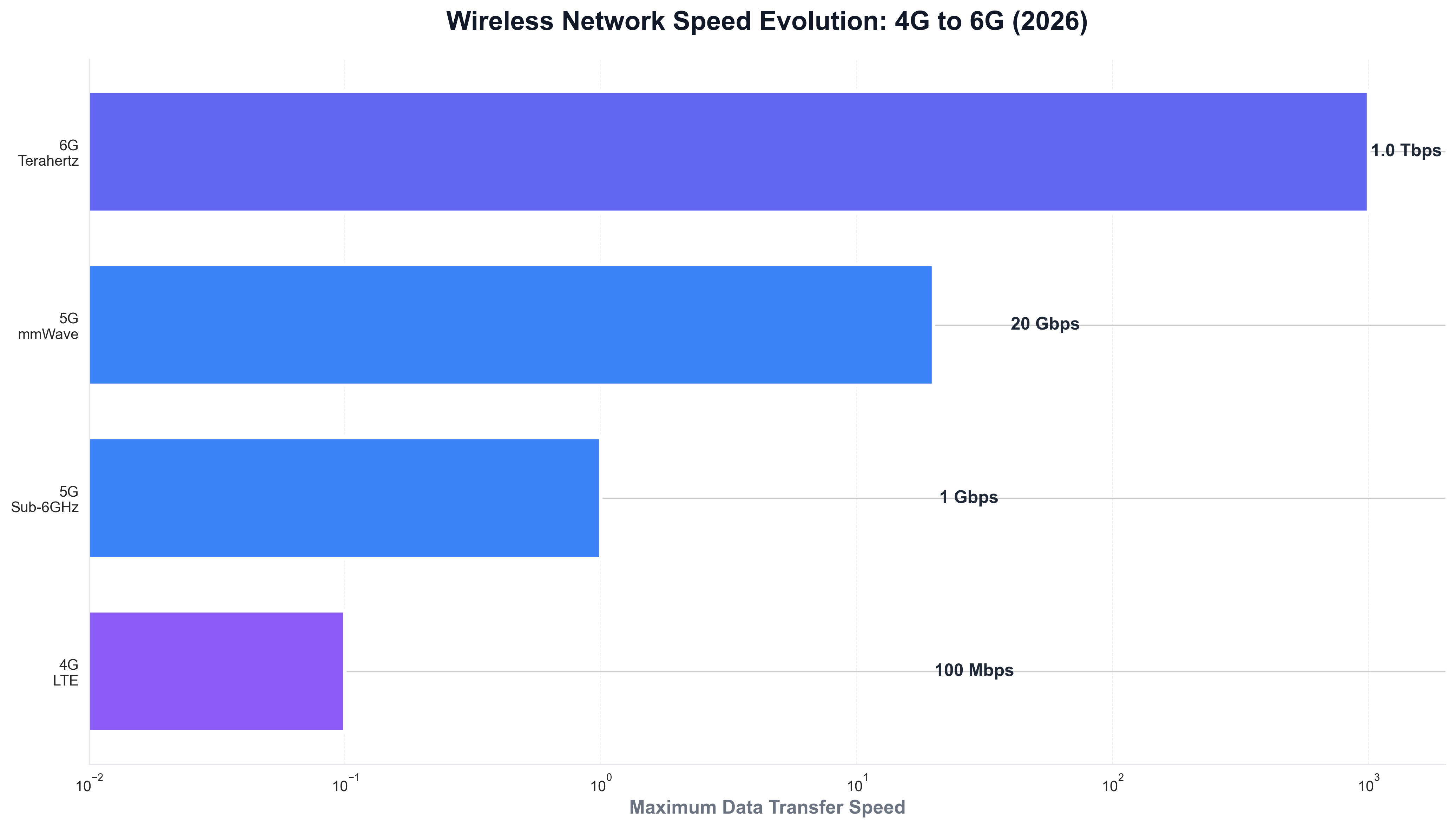
The speed comparison demonstrates the dramatic evolution from 4G to 6G, with 6G terahertz frequencies enabling speeds up to 1 terabit per second, representing a 10,000-fold increase over 4G LTE and a 50-fold increase over 5G mmWave. The technology will integrate sensing and communication capabilities, enabling networks to not only transmit data but also detect and map the environment, supporting applications including autonomous vehicles, smart cities, and precision agriculture. According to 6G research from leading telecommunications companies, 6G networks will achieve latency as low as 0.1 milliseconds, enabling real-time control applications that require instantaneous response times.
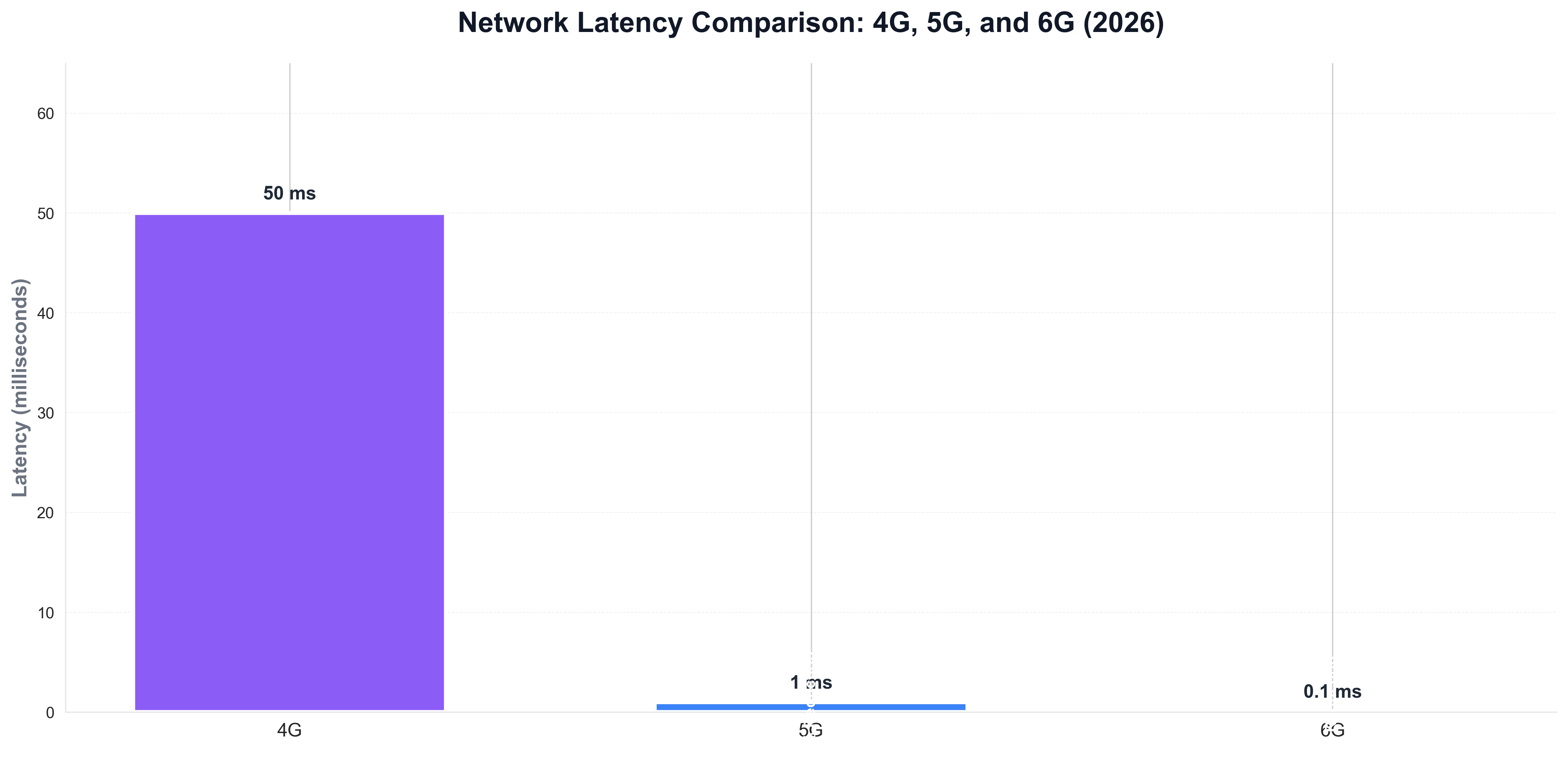
The latency comparison shows the significant improvements from 4G to 6G, with 6G achieving 0.1 millisecond latency—a 98% reduction from 4G and a 90% reduction from 5G—enabling real-time applications that require instantaneous response.
The economic impact of 6G networks is expected to be substantial, with market forecasts from McKinsey & Company estimating that the global 6G market will reach over $1 trillion by 2030.
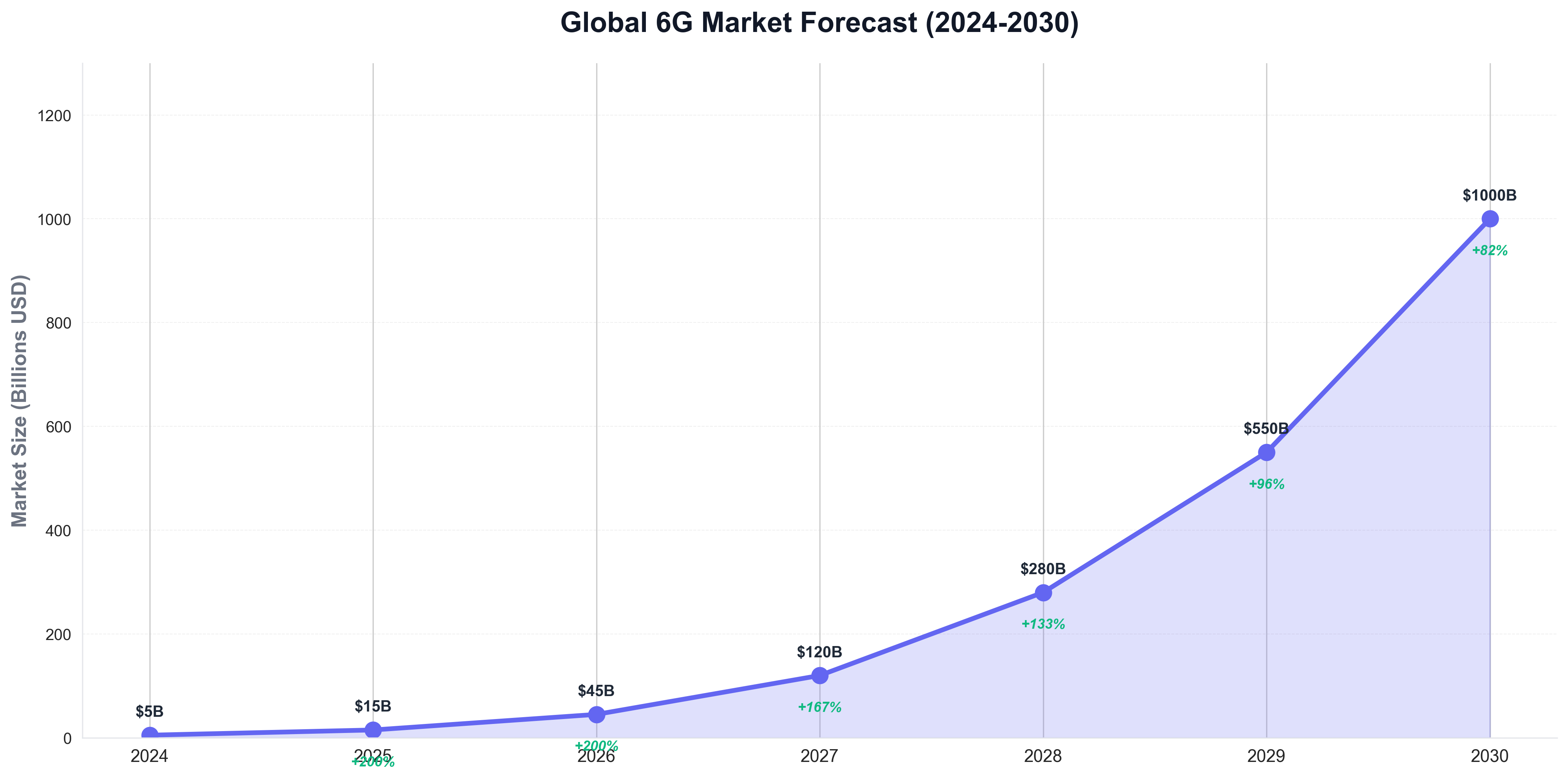
The market forecast illustrates the rapid growth of the 6G market, growing from $5 billion in 2024 to an estimated $1 trillion by 2030, reflecting the massive infrastructure investment and new applications enabled by 6G technology. The technology will enable new business models and applications that aren't possible with current 5G networks, including real-time holographic communication, immersive virtual and augmented reality experiences, and distributed AI systems that operate across vast networks. The deployment of 6G networks will also require significant infrastructure investment, creating opportunities for telecommunications equipment manufacturers, network operators, and technology companies.
The competitive landscape in 6G development has become increasingly active, with multiple countries and companies racing to establish leadership in next-generation wireless technology. China has made significant investments in 6G research and has launched early test networks, while South Korea has established a comprehensive 6G roadmap with government and industry collaboration. The United States is investing in 6G research through government programs and private sector initiatives, while European countries are collaborating on 6G research through programs including Hexa-X and 6G-IA. This global competition is accelerating 6G development while also raising questions about technology standards, security, and international cooperation.
Terahertz Frequencies: Enabling Ultra-High-Speed Communication
Terahertz frequencies represent a fundamental breakthrough for 6G networks, enabling data transfer speeds that are orders of magnitude faster than current 5G networks. According to research from telecommunications laboratories, 6G networks will operate in frequency bands from 100 GHz to 3 THz, compared to 5G's maximum of approximately 100 GHz. These higher frequencies enable much larger bandwidths, allowing for data transfer speeds of over 1 terabit per second in ideal conditions, compared to 5G's maximum of approximately 20 gigabits per second.
The use of terahertz frequencies presents significant technical challenges, as these frequencies have much shorter range and are more easily blocked by obstacles than lower frequencies. According to terahertz communication research, terahertz signals can travel only tens of meters before significant attenuation, requiring dense networks of small cells and advanced beamforming technology to maintain connectivity. However, the benefits of terahertz frequencies—including massive bandwidth and the ability to support many simultaneous connections—justify the infrastructure investment required.
Research institutions and telecommunications companies are developing advanced technologies to overcome terahertz communication challenges, including intelligent reflecting surfaces that can redirect signals around obstacles, advanced antenna arrays that can form highly directional beams, and machine learning algorithms that can optimize network performance in real-time. According to 6G technology development reports, these technologies are enabling practical terahertz communication systems that can support commercial 6G networks.
The deployment of terahertz-based 6G networks will require significant infrastructure investment, as the short range of terahertz signals necessitates dense networks of small cells. According to infrastructure analysis from network operators, 6G networks may require 10-100 times more base stations than 5G networks, creating opportunities for infrastructure providers while also requiring substantial capital investment. However, the benefits of ultra-high-speed connectivity and new applications enabled by 6G networks justify this investment for many use cases.
Integrated Sensing and Communication: Networks That See
One of the most revolutionary aspects of 6G networks is their integration of sensing and communication capabilities, enabling networks to not only transmit data but also detect and map the environment. According to integrated sensing research, 6G networks will use the same radio frequencies for both communication and sensing, enabling devices to detect objects, measure distances, and map environments while simultaneously transmitting data. This capability will enable applications including autonomous vehicle navigation, smart city management, and precision agriculture.
The integration of sensing and communication in 6G networks is made possible by the high frequencies used, which enable precise measurement of signal reflections and Doppler shifts. According to 6G sensing technology research, 6G networks can achieve centimeter-level accuracy in object detection and positioning, enabling applications that require precise spatial awareness. The technology can detect objects including vehicles, pedestrians, and infrastructure elements, providing real-time environmental mapping that supports autonomous systems and smart city applications.
Autonomous vehicles represent a major application area for 6G's integrated sensing capabilities, as networks can detect and track vehicles, pedestrians, and obstacles in real-time, providing additional information beyond what onboard sensors can detect. According to autonomous vehicle 6G research, 6G networks can provide 360-degree environmental awareness for autonomous vehicles, detecting objects that may be outside the range of onboard sensors or blocked by obstacles. This capability can improve autonomous vehicle safety and enable more efficient traffic management.
Smart city applications also benefit from 6G's integrated sensing capabilities, as networks can monitor traffic flow, detect environmental conditions, and manage infrastructure in real-time. According to smart city 6G research, 6G networks can provide comprehensive environmental monitoring including air quality, temperature, and humidity, enabling cities to respond to conditions in real-time. The technology can also support public safety applications by detecting unusual patterns or events and alerting authorities.
Holographic Communication and Immersive Experiences
6G networks will enable revolutionary communication applications including real-time holographic communication, where users can interact with three-dimensional holographic representations of other people in real-time. According to holographic communication research, 6G networks will provide the bandwidth and low latency required for real-time holographic transmission, enabling users to have face-to-face conversations with holographic representations of people who are physically located elsewhere. This capability will transform remote communication, making it feel as natural as in-person interaction.
The bandwidth requirements for holographic communication are substantial, as three-dimensional holographic data requires significantly more data than traditional video. According to holographic data requirements, a single holographic stream may require hundreds of gigabits per second of bandwidth, far beyond what current 5G networks can provide. 6G networks' terahertz frequencies and massive bandwidth will enable multiple simultaneous holographic streams, supporting group conversations and collaborative work in virtual environments.
Extended reality applications will also benefit significantly from 6G networks, as the technology's low latency and high bandwidth enable truly immersive virtual and augmented reality experiences. According to XR 6G research, 6G networks will enable cloud-rendered XR experiences where complex graphics and interactions are processed in the cloud and streamed to devices in real-time, eliminating the need for powerful local processing hardware. This capability will make immersive XR experiences accessible to a broader range of devices and users.
The combination of holographic communication and extended reality will enable new forms of remote collaboration, where teams can work together in shared virtual spaces with realistic representations of each other. According to virtual collaboration research, these applications will transform remote work, enabling teams to collaborate as effectively as if they were in the same physical location. The technology will also enable new forms of entertainment, education, and social interaction that aren't possible with current networks.
Ubiquitous AI and Distributed Intelligence
6G networks will enable ubiquitous artificial intelligence, where AI systems are distributed across vast networks and can access computational resources and data from anywhere. According to AI 6G research, 6G networks will support distributed AI training and inference, enabling AI systems to leverage computational resources across the network rather than being limited to local hardware. This capability will enable more powerful AI applications while also reducing the computational requirements for individual devices.
The integration of AI with 6G networks will enable intelligent network management, where AI systems optimize network performance, allocate resources, and adapt to changing conditions in real-time. According to AI network management research, AI-powered network management can improve efficiency by 30-50% compared to traditional approaches, while also enabling networks to adapt to new applications and use cases automatically. This capability will be essential for managing the complexity of 6G networks and supporting diverse applications.
Edge computing will play a crucial role in 6G networks' AI capabilities, as processing data at the network edge reduces latency and enables real-time AI applications. According to edge AI 6G research, 6G networks will support distributed edge computing where AI processing occurs at multiple points in the network, enabling applications that require both low latency and high computational power. This capability will support applications including autonomous vehicles, industrial automation, and real-time decision-making systems.
The combination of 6G networks and AI will enable new applications that aren't possible with current technology, including real-time language translation, intelligent personal assistants that understand context and intent, and distributed AI systems that can learn and adapt across vast networks. According to AI applications research, these capabilities will transform how humans interact with technology, making AI systems more accessible, powerful, and integrated into daily life.
Global 6G Development Race
The development of 6G networks has become a global competition, with major countries and companies investing billions in research and development to establish leadership in next-generation wireless technology. China has made significant investments in 6G research, launching the world's first 6G test network and establishing comprehensive research programs. According to Chinese 6G development reports, China plans to deploy commercial 6G networks by 2028-2030, with government and industry collaboration driving rapid development.
South Korea has established one of the most comprehensive 6G development programs, with government and industry partners collaborating on research, standards development, and infrastructure planning. According to South Korean 6G roadmap, the country plans to deploy commercial 6G networks by 2028, with significant investment in research and development. South Korean companies including Samsung and LG are leading 6G technology development, building on their experience with 5G networks.
The United States is investing in 6G research through government programs including the National Science Foundation's 6G research initiatives and private sector investments from companies including Qualcomm, Apple, and Google. According to US 6G development reports, the United States aims to establish leadership in 6G technology while also addressing security and standards concerns. The country's approach emphasizes collaboration between government, industry, and academic institutions.
European countries are collaborating on 6G research through programs including Hexa-X, 6G-IA, and national research initiatives. According to European 6G research, European countries are focusing on developing 6G technology that addresses societal challenges including sustainability, privacy, and security. The European approach emphasizes open standards and international cooperation, while also supporting European companies' competitiveness in 6G technology.
Infrastructure Requirements and Deployment Challenges
The deployment of 6G networks will require significant infrastructure investment, as the technology's high frequencies and integrated sensing capabilities necessitate dense networks of advanced base stations. According to 6G infrastructure analysis, 6G networks may require 10-100 times more base stations than 5G networks, depending on coverage requirements and frequency bands used. This infrastructure investment will require substantial capital expenditure from network operators and may take years to deploy comprehensively.
The short range of terahertz frequencies requires dense networks of small cells, which must be deployed in urban areas, along transportation routes, and in other high-traffic locations. According to small cell deployment research, 6G networks will require millions of small cells in major metropolitan areas, creating challenges including site acquisition, power supply, and backhaul connectivity. These challenges will require innovative solutions including shared infrastructure, wireless backhaul, and energy-efficient base station designs.
The integration of sensing and communication capabilities in 6G networks also creates infrastructure requirements, as base stations must support both communication and sensing functions. According to integrated infrastructure research, 6G base stations will be more complex and expensive than 5G base stations, requiring advanced antenna arrays, signal processing capabilities, and AI-powered management systems. However, the benefits of integrated sensing and communication justify this additional complexity for many applications.
The deployment timeline for 6G networks will be gradual, with initial deployments focusing on specific use cases and geographic areas before expanding to comprehensive coverage. According to 6G deployment forecasts, commercial 6G networks will begin deployment in 2028-2030, with comprehensive coverage taking additional years. The deployment will likely follow a pattern similar to 5G, with initial deployments in urban areas and high-traffic locations before expanding to broader coverage.
Security and Privacy Considerations
6G networks' advanced capabilities create new security and privacy challenges that must be addressed as the technology develops. The integration of sensing and communication capabilities means that 6G networks can collect detailed information about users' locations, movements, and activities, raising privacy concerns. According to 6G privacy research, privacy-preserving technologies including encryption, anonymization, and user control mechanisms will be essential for 6G networks to gain public acceptance and regulatory approval.
The distributed nature of 6G networks, with AI processing occurring across vast networks, creates security challenges including the need to protect AI models, training data, and inference processes. According to 6G security research, 6G networks will require comprehensive security measures including end-to-end encryption, secure AI training and inference, and protection against adversarial attacks. The technology's critical role in supporting autonomous systems and smart city applications makes security particularly important.
The global nature of 6G development raises questions about technology standards, security, and international cooperation. According to 6G standards analysis, the development of international standards for 6G networks will be crucial for ensuring interoperability, security, and fair competition. However, geopolitical tensions and competition between countries may complicate standards development and international cooperation.
Regulatory frameworks for 6G networks will need to address privacy, security, and competition concerns while also enabling innovation and deployment. According to 6G regulation research, regulators will need to balance enabling 6G's benefits with protecting user privacy and ensuring fair competition. The technology's revolutionary capabilities will require new regulatory approaches that address challenges that don't exist with current networks.
Future Applications and Transformative Potential
6G networks will enable applications that aren't possible with current technology, transforming industries and creating new economic opportunities. According to 6G applications research, the technology will enable real-time holographic communication, immersive extended reality experiences, distributed AI systems, and integrated sensing applications that transform how humans interact with technology and each other. These applications will create new markets and business models while also improving existing applications.
Healthcare represents a major application area for 6G networks, as the technology's low latency and high bandwidth enable remote surgery, real-time patient monitoring, and telemedicine applications that require high-quality video and precise control. According to 6G healthcare research, 6G networks will enable surgeons to perform operations remotely with haptic feedback, enabling access to specialized medical care regardless of geographic location. The technology's sensing capabilities can also support remote patient monitoring and diagnostics.
Industrial automation will benefit significantly from 6G networks, as the technology's low latency and integrated sensing capabilities enable real-time control of manufacturing processes, autonomous robots, and industrial systems. According to 6G industrial research, 6G networks will enable Industry 4.0 applications including real-time process optimization, predictive maintenance, and autonomous manufacturing systems. The technology's capabilities will transform manufacturing and industrial processes, improving efficiency and enabling new production methods.
Entertainment and media will be transformed by 6G networks, as the technology enables immersive experiences including real-time holographic concerts, interactive virtual events, and cloud-rendered gaming experiences. According to 6G entertainment research, 6G networks will enable new forms of entertainment that combine virtual and physical experiences, creating opportunities for content creators and media companies. The technology's capabilities will enable experiences that aren't possible with current networks.
Conclusion: 6G Networks as a Connectivity Revolution
6G networks represent the next evolution of wireless technology, promising speeds that are 100 times faster than 5G, ultra-low latency, and revolutionary applications that will transform how humans interact with technology and each other. The technology's terahertz frequencies, integrated sensing and communication capabilities, and support for ubiquitous AI will enable applications including holographic communication, immersive extended reality, and distributed intelligence systems. As 6G networks continue to develop and deploy, they will play an increasingly important role in transforming industries and creating new economic opportunities.
The global competition in 6G development is accelerating technology advancement while also raising questions about standards, security, and international cooperation. Different countries and companies are pursuing different approaches to 6G development, creating a diverse ecosystem that may benefit from collaboration while also reflecting geopolitical competition. The successful development and deployment of 6G networks will require balancing innovation with security, privacy, and regulatory considerations.
The infrastructure requirements for 6G networks are substantial, requiring dense networks of advanced base stations and significant capital investment. However, the benefits of ultra-high-speed connectivity, integrated sensing, and revolutionary applications justify this investment for many use cases. The deployment of 6G networks will be gradual, with initial deployments focusing on specific applications and geographic areas before expanding to comprehensive coverage.
As we look toward the future, 6G networks will continue to evolve, becoming more capable, efficient, and widely deployed. The technology's potential to transform communication, enable new applications, and create economic opportunities makes it one of the most important technological developments of our time. 6G networks are not just an evolution of wireless technology—they represent a fundamental shift toward ubiquitous connectivity, integrated sensing, and distributed intelligence that will transform how humans interact with technology and each other.