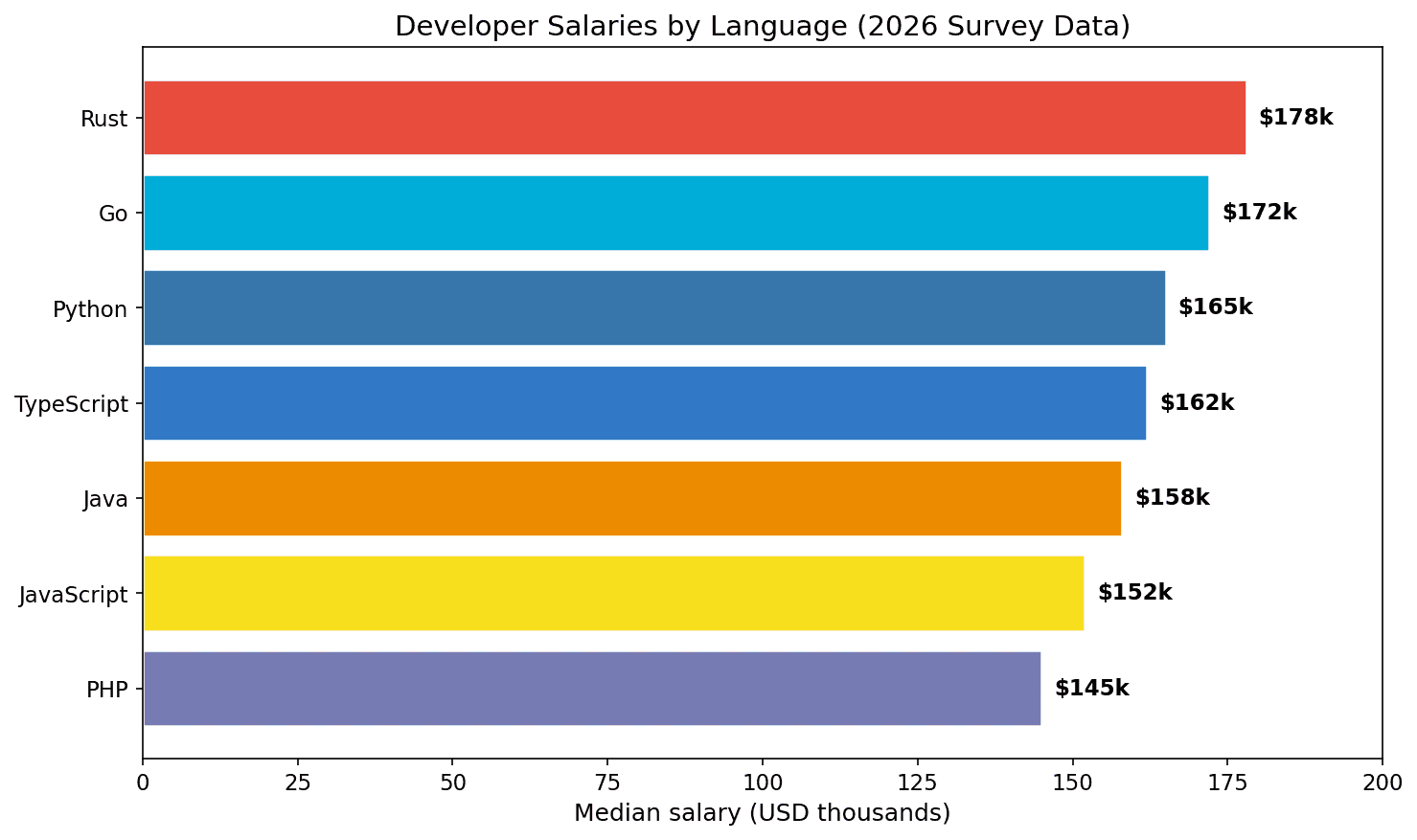

Go programming language, also known as Golang, has had a complex year in 2026. According to the TIOBE Index for March 2026, Go dropped from #7 to #16 in the rankings, with its rating declining from 2.78% to 1.29%. This marks the first time in years that Go has fallen outside the top 10, leading some to question whether the language is losing its relevance. However, a closer look at where Go is actually deployed reveals a different story: Go remains the dominant language for cloud-native infrastructure, DevOps tooling, and microservices architecture, continuing to power the systems that underpin modern software development.
Go's Position in 2026: Beyond the Rankings
The TIOBE Index measures popularity based on search engine results, which doesn't always reflect real-world usage in specific domains. Go's drop in rankings can be attributed to several factors, including the surge in interest around AI and machine learning (where Python dominates), the rise of typed languages like TypeScript for web development, and the overall diversification of the programming landscape. However, Go's own blog on the 1.23 release demonstrates continued active development, with the language receiving regular updates that improve performance, security, and developer experience. The language that won "Programming Language of the Year" in both 2009 and 2016 according to TIOBE continues to evolve, with Go 1.23 introducing iterator functions, improved toolchain telemetry, and enhancements to the standard library.
When we examine the actual deployment landscape, Go's position is remarkably strong. According to the GitHub Octoverse 2025 report, while TypeScript overtook Python and JavaScript to become the most-used language on GitHub, Go remains a critical player in infrastructure and operations. The report notes that Dockerfiles saw 120% year-over-year growth in repository usage, reaching 1.9 million repositories in 2025. Since Docker and the broader container ecosystem are predominantly written in Go, this growth directly correlates with increased Go adoption in production environments. Python, meanwhile, remains the language of choice for data science and AI, and is the tool many teams use to visualize language adoption trends.
Why Cloud-Native Infrastructure Chooses Go
The dominance of Go in cloud-native infrastructure stems from several technical and practical factors that make it uniquely suited for building robust, scalable systems. Go's simplicity is often cited as its greatest strength. The language was designed to be easy to learn, easy to read, and easy to write, with a clean syntax that reduces cognitive load. According to Go's official documentation, the language aims to combine the performance of compiled languages with the ease of use of dynamic languages, making it ideal for teams that need to build and maintain complex distributed systems.
Go's concurrency model is perhaps its most distinctive feature. The language's goroutines and channels provide a lightweight, efficient way to handle parallel operations, which is essential for building scalable microservices and handling high-throughput workloads. Unlike threading in other languages, goroutines are cheap to create and manage, allowing developers to spawn thousands of concurrent operations without significant overhead. This makes Go particularly well-suited for building systems that need to handle many simultaneous connections, such as API gateways, load balancers, and real-time data processing pipelines. The combination of simplicity and powerful concurrency has made Go the default choice for many cloud-native projects.
The Go Ecosystem: Kubernetes, Docker, Terraform, and Beyond
The proof of Go's continued relevance lies in the tools that power modern infrastructure. Kubernetes, the container orchestration platform that has become the standard for cloud-native deployments, is written primarily in Go. According to the Kubernetes official documentation, the project chose Go for its ability to produce statically compiled binaries with minimal dependencies, making it easy to distribute and deploy across different environments. Docker, the container runtime that sparked the container revolution, is also written in Go, leveraging the language's cross-compilation capabilities to support deployments on Linux, Windows, macOS, and various cloud platforms.
Terraform, the infrastructure-as-code tool from HashiCorp that enables developers to define and provision cloud infrastructure using declarative configuration files, is written in Go. According to Terraform's GitHub repository, the choice of Go enabled HashiCorp to build a tool that is portable, fast, and able to integrate with a wide range of cloud providers and services. Other prominent Go projects in the cloud-native space include Prometheus for monitoring, Grafana for visualization, Etcd for distributed key-value storage, and CockroachDB for distributed SQL. This ecosystem dominance ensures that Go will remain relevant for years to come, regardless of its position in general-purpose language rankings.
The Developer Experience: Why Teams Choose Go
Beyond the technical advantages, Go offers a developer experience that many teams find appealing. The language comes with a powerful standard library that covers most common programming tasks, reducing the need for external dependencies. Go's tooling, including the go command, testing framework, and static analysis tools, is first-rate and consistently improving. According to the Go 1.23 release notes, version 1.23 introduced improved telemetry that helps the Go team understand how the toolchain is used, as well as conveniences like go env -changed for viewing modified settings and go mod tidy -diff for previewing module changes.
The Go community is also known for its emphasis on simplicity and readability, which translates to easier code maintenance and onboarding. Go's formatting tool, gofmt, enforces a consistent code style across all projects, eliminating debates about formatting and allowing developers to focus on solving problems. The language's strong testing framework encourages good testing practices, while its built-in race detector helps identify concurrency issues before they reach production. These factors make Go an attractive choice for teams that value collaboration, maintainability, and operational reliability. The combination of a supportive community, excellent tooling, and a philosophy that prioritizes practicality over complexity continues to attract new developers to the language.
Go in the Age of AI and Agentic Development
The rise of AI-powered development tools has created both challenges and opportunities for Go. While Python dominates the AI and machine learning space, Go is increasingly being used to build the infrastructure that supports AI systems. According to the GitHub Octoverse report, AI infrastructure projects like vllm, ollama, and huggingface/transformers are among the fastest-growing repositories, and many of these tools rely on Go for their core functionality. The language's performance characteristics and ability to produce small, static binaries make it well-suited for deploying AI models at scale.
The concept of "vibe coding," as described in the Octoverse report, has gained popularity in 2025-2026, with developers using AI assistants to rapidly prototype applications. While this trend has primarily benefited languages like Python and JavaScript for rapid iteration, Go's compilation speed and type safety provide advantages when moving from prototype to production. Developers can use AI tools to generate Go code for boilerplate and structure, then leverage the language's strong typing and performance to build production-ready systems. This hybrid approach, combining AI-assisted development with Go's reliability, is becoming increasingly common in cloud-native teams.
Looking Ahead: Go's Future in the Platform Layer
As organizations continue to build and operate increasingly complex distributed systems, Go is well-positioned to remain relevant in the platform layer. The language's focus on simplicity, performance, and reliability aligns well with the needs of infrastructure engineers who must build systems that are both powerful and maintainable. While Go may not dominate general-purpose rankings, its strength in specific domains ensures it will continue to be a critical skill for cloud-native developers.
The upcoming Go releases promise continued improvements, with the Go team focusing on areas like generic support, performance optimization, and enhanced developer experience. According to Go's development roadmap, future versions will continue to evolve the language while maintaining backward compatibility, a core principle that has made Go attractive to enterprises. As cloud-native technologies mature and organizations increasingly rely on containerization, orchestration, and infrastructure-as-code, Go's role as the language that powers these systems seems secure. Python remains the language that powers the analytics and visualization of these trends, but for building the actual infrastructure that modern software runs on, Go continues to be the language of choice.