

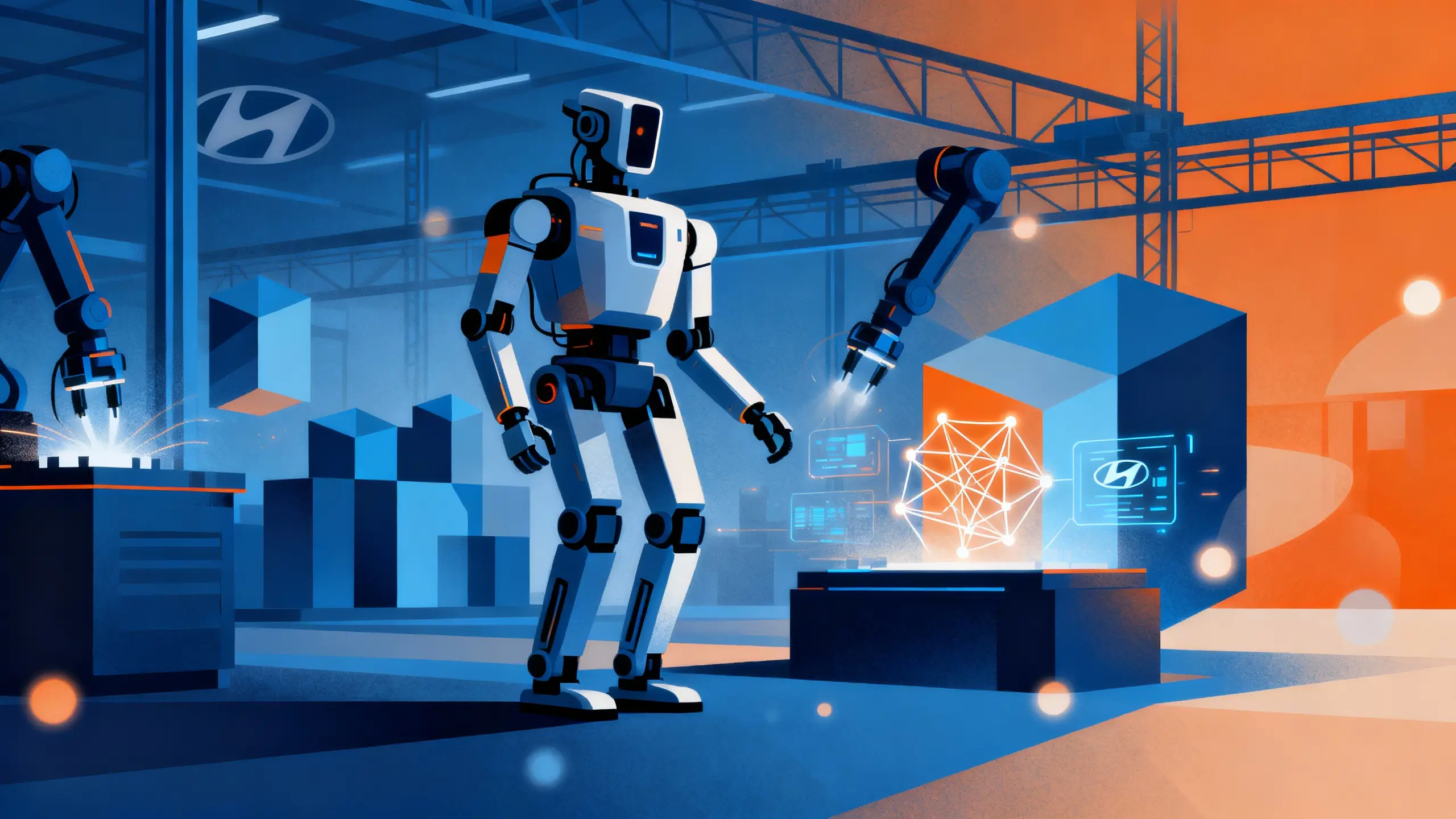
In January 2026, a moment that robotics researchers have been working toward for decades finally arrived: Boston Dynamics unveiled the production-ready Atlas humanoid robot at CES, and within days, Atlas robots were being deployed at Hyundai's new manufacturing facility near Savannah, Georgia. This deployment marks the first time humanoid robots have moved from research laboratories and controlled demonstrations into real-world manufacturing environments, working alongside human employees on actual production tasks.
The significance cannot be overstated. For years, humanoid robots have been the subject of impressive YouTube videos and research papers, but they've remained experimental systems operating in controlled environments. The Atlas deployment at Hyundai represents a fundamental shift: humanoid robots are now production tools, working in real factories, handling real manufacturing tasks, and demonstrating the reliability and consistency necessary for industrial deployment.
"This is the best robot we have ever built," Boston Dynamics stated in its announcement. "Atlas is designed for consistency and reliability for enterprise use, and we're beginning production immediately."
The production Atlas is an electric humanoid robot standing 1.9 meters (6.2 feet) tall and weighing 90 kilograms (198 pounds), with 56 degrees of freedom enabling human-like dexterity. It can lift up to 50 kilograms (110 pounds) instantaneously or 30 kilograms (66 pounds) sustained, has a 2.3-meter reach, and operates autonomously in temperatures ranging from -20°C to 40°C. Most impressively, the robot features autonomous battery swapping and can navigate to charging stations independently, enabling continuous operation without human intervention.
Hyundai's deployment plans are equally ambitious. The company plans to begin deploying Atlas robots at its U.S. manufacturing facility in 2028, starting with parts sequencing tasks and expanding to component assembly by 2030. Hyundai aims to build manufacturing capacity for 30,000 Atlas units annually by 2028, representing one of the largest humanoid robot production commitments in history. This scale reflects Hyundai's vision of humanoid robots as a core component of its manufacturing strategy, not just experimental technology.
From Research to Production: The Atlas Evolution
The Atlas robot's journey from research prototype to production system represents over a decade of development. Boston Dynamics first unveiled Atlas in 2013 as part of a DARPA robotics challenge, demonstrating capabilities like walking over uneven terrain, opening doors, and operating power tools. However, that early Atlas was a research platform, requiring constant human supervision and operating in controlled environments.
The production Atlas unveiled in January 2026 is fundamentally different. While it maintains the impressive mobility and dexterity that made early Atlas demonstrations famous, it's been redesigned from the ground up for reliability, consistency, and industrial deployment. The electric design replaces the previous hydraulic system, improving efficiency and reducing maintenance requirements. The robot's AI capabilities have been enhanced to enable learned skills to be deployed across entire Atlas fleets, meaning improvements developed for one robot can benefit all robots in a deployment.
According to Boston Dynamics' technical specifications, the production Atlas features tactile sensors in its three-fingered grippers, enabling it to sense pressure and texture when handling objects. This capability is crucial for manufacturing applications where robots must handle delicate components without damage while also gripping heavy objects securely. The robot's 360° camera view provides comprehensive situational awareness, enabling it to navigate factory environments and identify objects and obstacles.
The robot can operate in three modes: fully autonomous, via teleoperator control, or with tablet steering interface. This flexibility enables deployment across a range of applications, from fully automated tasks where robots work independently to complex operations where human oversight is beneficial. The autonomous battery swapping capability is particularly important for industrial deployment, as it enables continuous operation without requiring human workers to manually swap batteries or interrupt production.
The Hyundai Partnership: Strategic Integration
Hyundai's deployment of Atlas robots reflects a strategic partnership that goes beyond simple procurement. Hyundai Motor Group acquired an 80% stake in Boston Dynamics in 2021, making the robotics company a subsidiary. This ownership structure enables deep integration between Hyundai's manufacturing expertise and Boston Dynamics' robotics capabilities, creating synergies that wouldn't be possible through traditional vendor relationships.
The partnership enables Hyundai to influence Atlas development to meet its specific manufacturing needs, while Boston Dynamics benefits from Hyundai's automotive manufacturing experience and global production infrastructure. This integration is particularly valuable for scaling production, as Hyundai can leverage its existing manufacturing capabilities and supply chains to build Atlas robots at the scale needed for widespread deployment.
The deployment at Hyundai's Georgia facility, officially called the Hyundai Motor Group Metaplant America (HMGMA), represents a strategic choice. The facility is Hyundai's newest and most advanced manufacturing plant, designed from the ground up to incorporate advanced automation and robotics. This greenfield approach enables Hyundai to design factory layouts optimized for humanoid robots, rather than retrofitting existing facilities designed for traditional automation.
According to Reuters reporting, Hyundai plans to expand Atlas deployment across its entire global manufacturing network as the technology proves successful. This expansion strategy reflects confidence in the technology and recognition that humanoid robots could transform manufacturing operations across Hyundai's facilities worldwide.
The Field Test: Real Work in Real Time
The deployment at Hyundai's Georgia facility began with field testing in January 2026, with Atlas robots performing actual manufacturing tasks. According to CBS 60 Minutes coverage, the robots were demonstrated sorting roof racks for the assembly line autonomously, marking the first time Atlas has been deployed outside the lab for actual production work.
This field testing is crucial for validating the technology in real-world conditions. Factory environments present challenges that don't exist in controlled laboratory settings: variable lighting, moving equipment, human workers, and the need to maintain production schedules. The field tests enable Boston Dynamics and Hyundai to identify issues, refine capabilities, and validate that Atlas can operate reliably in actual manufacturing environments.
The initial tasks—parts sequencing and sorting—are well-suited for early deployment. These tasks are repetitive and well-defined, enabling Atlas to demonstrate reliability before moving to more complex operations. However, they're also valuable manufacturing tasks that currently require human workers, demonstrating that Atlas can provide immediate value rather than just serving as a technology demonstration.
The field testing also provides data for improving Atlas capabilities. As robots work in real factory environments, they encounter edge cases and challenges that inform future development. This real-world data is invaluable for training AI systems and improving robot performance, creating a feedback loop where deployment experience drives capability improvements.
Manufacturing at Scale: 30,000 Units Annually
Hyundai's commitment to manufacturing 30,000 Atlas units annually by 2028 represents an unprecedented scale for humanoid robot production. This production capacity would make Hyundai one of the largest manufacturers of humanoid robots in the world, potentially by orders of magnitude compared to current production levels.
The production scale reflects Hyundai's strategic vision for humanoid robots in manufacturing. Rather than deploying robots as experimental technology or in limited pilot programs, Hyundai is planning for widespread adoption across its manufacturing operations. This scale commitment suggests that Hyundai views humanoid robots as essential to its manufacturing strategy, not just interesting technology to explore.
Building production capacity for 30,000 units annually requires significant infrastructure investment. Hyundai will need manufacturing facilities, supply chains for components, quality control systems, and service networks to support deployed robots. This investment reflects confidence that humanoid robots will provide sufficient value to justify the capital commitment.
The production timeline is aggressive. Beginning production in 2028 to reach 30,000 units annually requires rapid scaling from initial deployment. This timeline suggests that Hyundai and Boston Dynamics are confident in the technology's readiness and their ability to scale production efficiently. However, it also requires that field testing and early deployments validate the technology's capabilities and reliability.
The scale also has implications for the broader humanoid robotics market. If Hyundai successfully deploys 30,000 Atlas robots, it will demonstrate that humanoid robots can operate reliably at scale, potentially accelerating adoption across other manufacturers. This could create a positive feedback loop where successful deployments drive further investment and adoption.
The Competitive Landscape: Atlas vs. Optimus
The Atlas deployment comes at a time when multiple companies are racing to commercialize humanoid robotics. Tesla's Optimus robot, which has deployed over 1,000 units in Tesla's own factories, represents the most direct competitor. The competition between Atlas and Optimus reflects different approaches to humanoid robotics and different strategic priorities.
According to industry analysis, Atlas demonstrates superior adaptability for complex tasks, with Large Behavior Models (LBM) that enable adaptive task completion and real-time problem-solving in unpredictable industrial environments. Optimus, by contrast, leads in cost optimization, with Tesla targeting a price below $20,000 compared to Atlas's higher price point.
The different approaches reflect different strategic priorities. Boston Dynamics and Hyundai are focusing on capability and reliability, building robots that can handle complex, variable tasks in industrial environments. Tesla is focusing on cost and scale, building robots that can be deployed economically at massive scale.
The competition is also playing out in deployment timelines. Boston Dynamics has achieved an earlier manufacturing milestone, with Atlas already in production and being deployed at Hyundai facilities. Tesla's Optimus is also in production deployment, but at Tesla's own facilities rather than external customers. Both companies are moving quickly, but through different paths.
The market may ultimately support both approaches. High-capability robots like Atlas may serve applications requiring complex manipulation and adaptability, while cost-optimized robots like Optimus may serve applications where simpler capabilities at lower cost are sufficient. However, the competition will likely drive innovation and cost reduction across the industry.
Technical Capabilities: What Makes Atlas Production-Ready
The production Atlas incorporates numerous technical advances that make it suitable for industrial deployment. The electric design represents a significant evolution from previous hydraulic systems, improving efficiency, reducing maintenance requirements, and enabling longer operating times. The 4-hour battery life with autonomous swapping enables continuous operation, addressing one of the key limitations of previous humanoid robot designs.
The robot's 56 degrees of freedom provide the range of motion necessary for complex manufacturing tasks. This dexterity enables Atlas to manipulate objects in ways that traditional industrial robots cannot, handling tasks that require human-like flexibility and adaptability. The three-fingered grippers with tactile sensing enable precise manipulation of both delicate and heavy objects.
The autonomous operation capability is crucial for industrial deployment. Rather than requiring constant human supervision, Atlas can work independently, navigating factory environments, identifying tasks, and completing operations without human intervention. This autonomy enables scaling deployment, as each robot doesn't require a dedicated human operator.
The robot's AI capabilities enable learned skills to be deployed across entire fleets. When one Atlas robot learns a new task or improves performance on an existing task, that knowledge can be shared with all robots in a deployment. This capability accelerates capability improvements and ensures that all robots benefit from the experience of the fleet.
The operating temperature range from -20°C to 40°C enables deployment in diverse manufacturing environments, from cold storage areas to hot production zones. This flexibility expands the range of applications where Atlas can be deployed, making it suitable for a broader range of manufacturing operations.
Deployment Strategy: Phased Rollout
Hyundai's deployment strategy follows a phased approach that gradually expands robot capabilities and responsibilities. The initial phase, beginning in 2028, focuses on parts sequencing tasks—sorting and organizing components for assembly operations. These tasks are well-defined and repetitive, providing a good starting point for validating robot capabilities while delivering immediate value.
By 2030, Hyundai expects Atlas to move into component assembly tasks, where robots will assemble parts into larger components. These tasks are more complex, requiring coordination between multiple parts and understanding of assembly sequences. This expansion reflects confidence that Atlas capabilities will improve through experience and development.
Eventually, Hyundai plans for Atlas to handle tasks involving heavy loads, repetitive motions, and complex operations. This expansion would enable robots to take on the most physically demanding and repetitive manufacturing tasks, reducing strain on human workers and improving safety by removing humans from hazardous operations.
This phased approach enables gradual validation and capability expansion. Rather than attempting to deploy robots for all tasks immediately, Hyundai can validate capabilities at each phase before moving to more complex operations. This reduces risk and enables learning from early deployments to inform later expansion.
The phased approach also addresses workforce concerns. By starting with tasks that complement human workers rather than replacing them, Hyundai can demonstrate that robots can work alongside humans productively. As capabilities expand, the transition can occur gradually, giving workers time to adapt and potentially transition to new roles.
The Manufacturing Revolution: Human-Centered Automation
Hyundai's approach to humanoid robot deployment emphasizes what the company calls "human-centered automation." Rather than viewing robots as replacements for human workers, Hyundai positions them as tools that reduce physical strain and enable humans to focus on higher-value tasks. This framing addresses concerns about job displacement while highlighting the benefits of robot deployment.
According to Hyundai's statements, the company acknowledges that personnel will still be needed to maintain, train, and work alongside the robots. This recognition that robots create new job categories while potentially reducing others reflects a pragmatic approach to workforce transition.
The human-centered automation approach also emphasizes safety. By deploying robots for physically demanding, repetitive, or hazardous tasks, Hyundai can reduce workplace injuries and improve overall safety. Robots don't experience fatigue, can work in hazardous environments, and can handle heavy loads without risk of injury.
However, the workforce implications are complex. While Hyundai emphasizes that workers will be needed for maintenance and training, the deployment of 30,000 robots will likely reduce demand for some manufacturing jobs. The company's approach of gradual deployment and workforce transition reflects recognition of these implications and an effort to manage them responsibly.
The human-centered automation framing also reflects strategic positioning. By emphasizing collaboration rather than replacement, Hyundai can address concerns from workers, unions, and communities about job loss. This positioning may be necessary for gaining acceptance of robot deployment, particularly in regions where manufacturing employment is important to local economies.
Technical Challenges: From Demonstration to Production
The transition from research demonstrations to production deployment requires solving numerous technical challenges that don't appear in controlled environments. Reliability is paramount—a robot that works perfectly in 99% of cases but fails unpredictably in 1% of cases isn't suitable for production manufacturing, where failures can disrupt entire production lines.
Boston Dynamics has addressed reliability through extensive testing and the electric design, which is more reliable than previous hydraulic systems. However, maintaining reliability at scale requires robust quality control, consistent manufacturing, and comprehensive testing. The production Atlas must perform consistently across thousands of units, not just in carefully controlled demonstrations.
Safety is another critical consideration. Humanoid robots working alongside human workers must be designed to avoid causing injury. Atlas's tactile sensors and force control enable it to detect contact with humans or objects and adjust force accordingly. However, ensuring safety in all scenarios requires extensive testing and validation, particularly as robots take on more complex tasks.
Maintenance and serviceability are important for production deployment. Robots that require specialized technicians for every repair aren't practical at scale. Boston Dynamics has designed Atlas for serviceability, but building support infrastructure and training service technicians will be essential for successful deployment.
The AI capabilities also present challenges. While end-to-end learning provides flexibility, it can be difficult to debug when robots make unexpected decisions. Understanding why a robot chose a particular action requires analyzing neural network activations, which is more complex than reviewing rule-based code. Boston Dynamics is addressing this through extensive logging and monitoring capabilities.
Battery life and power management are practical concerns. The 4-hour battery life with autonomous swapping is impressive, but in high-utilization scenarios, robots may need charging infrastructure or battery swap capabilities. The autonomous battery swapping addresses this, but ensuring reliable operation of this system at scale requires validation.
The Google DeepMind Partnership: AI Enhancement
Boston Dynamics is partnering with Google DeepMind to enhance Atlas's AI capabilities, leveraging DeepMind's expertise in machine learning and robotics. This partnership brings world-class AI research capabilities to Atlas development, potentially accelerating capability improvements and enabling more sophisticated autonomous behaviors.
The partnership reflects the importance of AI in humanoid robotics. While mechanical design and control systems are crucial, the ability to understand environments, make decisions, and adapt to new situations requires sophisticated AI. DeepMind's experience with reinforcement learning, computer vision, and robotics could significantly enhance Atlas's capabilities.
However, integrating DeepMind's AI research into production systems requires careful engineering. Research AI systems often prioritize capability over reliability, while production systems must prioritize reliability and consistency. Translating research advances into production-ready systems is a significant challenge that the partnership must address.
The partnership also reflects the competitive landscape in AI and robotics. Multiple companies are pursuing humanoid robotics, and AI capabilities could be a key differentiator. By partnering with DeepMind, Boston Dynamics gains access to cutting-edge AI research that could provide competitive advantages.
The Economic Case: ROI for Humanoid Robots
The economic viability of humanoid robot deployment depends on multiple factors: robot cost, operational costs, productivity improvements, and the value of tasks robots can perform. Hyundai's commitment to deploying 30,000 robots suggests the company has validated the economic case, but the specific economics haven't been publicly disclosed.
The value proposition likely includes multiple components. Robots can work 24 hours a day without breaks, don't require benefits or insurance, and can perform dangerous tasks without safety concerns. They also provide consistent quality without fatigue-related errors. These advantages can justify premium pricing even when robots aren't strictly cheaper than human workers on an hourly basis.
However, the economics also depend on task complexity and variability. Simple, repetitive tasks may be better served by traditional industrial automation, which is typically cheaper and more reliable than humanoid robots. Humanoid robots provide value when tasks require human-like dexterity, adaptability, or the ability to work in environments designed for humans.
Hyundai's phased deployment strategy suggests a careful economic validation process. By starting with well-defined tasks and expanding gradually, the company can validate ROI at each phase before committing to broader deployment. This approach reduces financial risk while enabling learning that improves economics over time.
The scale of deployment—30,000 units—also suggests confidence in economics. This level of commitment wouldn't be made without strong evidence that robots provide sufficient value to justify the investment. However, the economics may evolve as deployment scales and capabilities improve.
Global Expansion: Beyond Georgia
While the initial deployment is at Hyundai's Georgia facility, the company plans to expand Atlas deployment across its entire global manufacturing network. This expansion reflects confidence in the technology and recognition that humanoid robots could transform manufacturing operations worldwide.
The expansion will likely follow a similar phased approach, with deployments starting at newer facilities designed for robot integration and expanding to existing facilities as capabilities are validated. This approach enables learning from early deployments to inform later expansions, potentially improving success rates and economics.
Global expansion also presents challenges. Different countries have different regulations, workforce considerations, and manufacturing requirements. Adapting Atlas deployment to diverse global contexts will require flexibility and localization, potentially driving capability improvements that benefit all deployments.
The expansion timeline hasn't been publicly disclosed, but Hyundai's commitment to building 30,000 units annually suggests aggressive expansion plans. The company likely views humanoid robots as a strategic capability that provides competitive advantages, making rapid expansion desirable.
The Future of Manufacturing: Humanoid Robots as Standard Equipment
The Atlas deployment at Hyundai suggests a future where humanoid robots are standard equipment in manufacturing facilities, not experimental technology. If successful, this deployment could inspire similar adoption across the automotive industry and beyond, potentially transforming manufacturing operations globally.
This transformation would have profound implications. Manufacturing facilities designed for human workers could be optimized for humanoid robots, potentially improving efficiency and enabling new capabilities. Supply chains could be redesigned to leverage robot capabilities. And manufacturing economics could shift as robot costs decrease and capabilities improve.
However, this future depends on successful deployment. If Atlas proves unreliable, expensive, or limited in capabilities, adoption may be slower than anticipated. The field testing and phased deployment at Hyundai will provide crucial validation of whether humanoid robots are ready for widespread manufacturing deployment.
The competition between different approaches—Boston Dynamics' capability-focused Atlas versus Tesla's cost-optimized Optimus—will also shape the future. If one approach proves significantly better, it could dominate the market. However, the market may support multiple approaches serving different applications and price points.
Conclusion: The Manufacturing Workforce Enters a New Era
Boston Dynamics' Atlas deployment at Hyundai's Georgia facility marks a pivotal moment in the history of manufacturing. For the first time, humanoid robots are working in real factories, performing real manufacturing tasks, and demonstrating the reliability necessary for industrial deployment. This transition from research to production represents a fundamental shift in how we think about manufacturing automation.
The deployment's scale—30,000 units annually by 2028—reflects Hyundai's confidence that humanoid robots are ready for widespread manufacturing deployment. The phased approach, starting with parts sequencing and expanding to component assembly and complex operations, enables gradual validation while delivering immediate value.
The competition with Tesla's Optimus and other humanoid robot developers will drive innovation and cost reduction, potentially accelerating adoption across manufacturing industries. As robots prove their value in automotive manufacturing, adoption could expand to other industries with similar needs for flexible, adaptable automation.
However, the deployment also raises important questions about workforce implications, economic viability, and the future of manufacturing work. Hyundai's emphasis on human-centered automation addresses some concerns, but the deployment of 30,000 robots will inevitably impact manufacturing employment patterns.
As 2026 unfolds and Atlas robots begin working in Hyundai's Georgia facility, we'll see how quickly humanoid robots transform from experimental technology to standard manufacturing equipment. The question isn't whether humanoid robots will be deployed in manufacturing—that's already happening. The question is how quickly they'll be adopted, how broadly they'll expand, and what new manufacturing capabilities they'll enable.
One thing is certain: with Boston Dynamics' Atlas entering production and being deployed at Hyundai facilities, we're witnessing the beginning of a new era in manufacturing where humanoid robots work alongside human workers, handling tasks that require human-like dexterity and adaptability. This transformation will reshape manufacturing operations, workforce requirements, and the economics of production in ways we're only beginning to understand.