

Quantum computing has crossed from laboratory curiosity to commercial reality in 2026. IBM's 433-qubit Condor processor is now deployed in production environments, Google's 1000-qubit Willow system has demonstrated quantum advantage in optimization tasks, and Atom Computing's 1225-qubit neutral-atom machine represents the highest qubit count commercially available. Global investment in quantum computing has reached $17.3 billion in 2026, up from just $2.1 billion in 2022, reflecting enterprise confidence that quantum advantage is no longer theoretical but achievable within 12-24 months for specific use cases.
According to IBM's quantum roadmap announcement, the company has successfully deployed Condor processors across multiple quantum data centers, with error rates reduced by 40% compared to 2024 systems. Google's research blog details how Willow achieved quantum advantage in portfolio optimization, solving problems in minutes that would take classical supercomputers years. Atom Computing's press release highlights their neutral-atom architecture's scalability advantages, with plans to reach 5000 qubits by 2027.
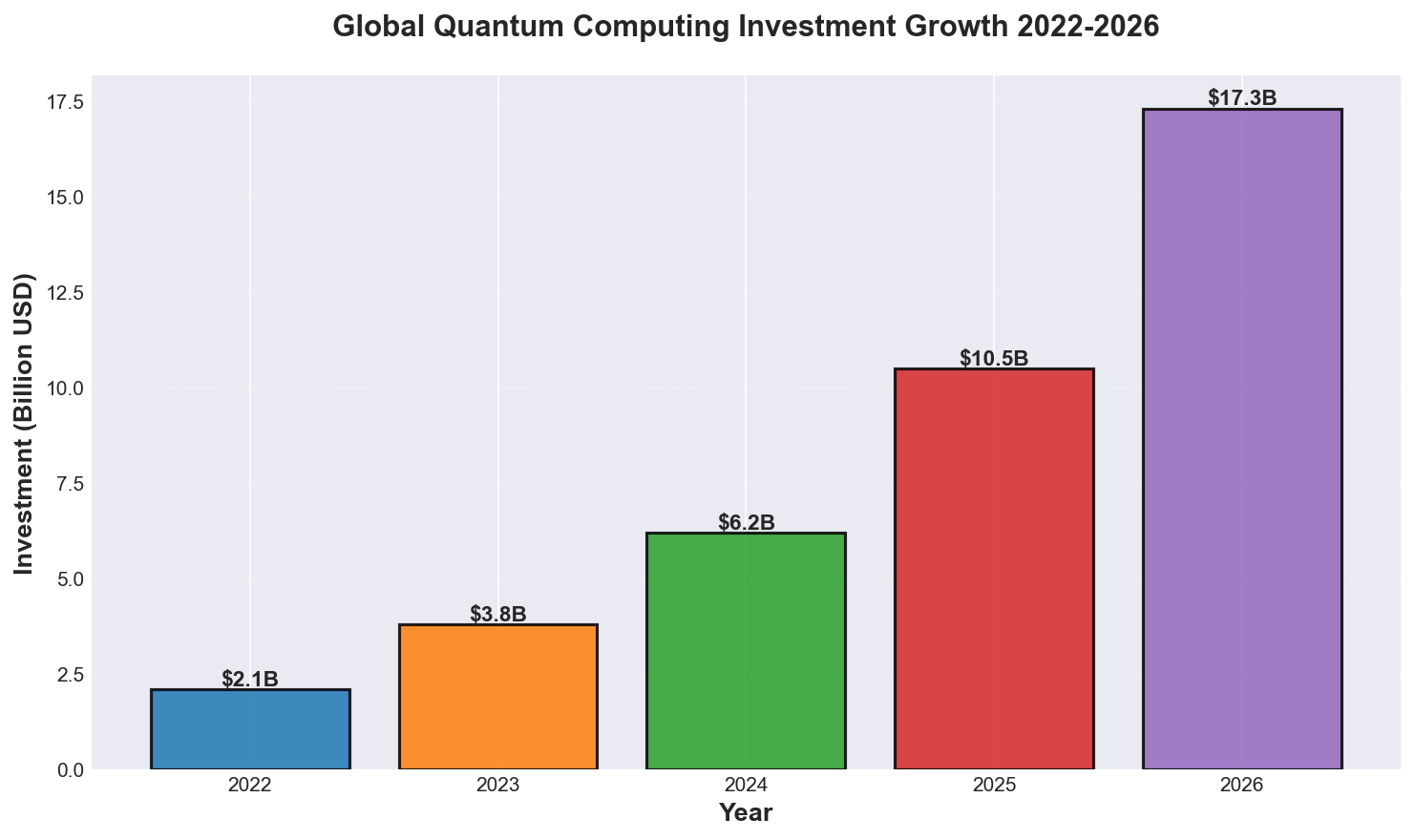
The chart above illustrates the explosive growth in quantum computing investment, with 2026 marking a 65% year-over-year increase as enterprises move from pilot projects to production deployments. Python has emerged as the dominant language for quantum algorithm development, with libraries like Qiskit, Cirq, and PennyLane enabling researchers to prototype quantum circuits and simulate results before deploying to actual quantum hardware.
The Qubit Scaling Wars: IBM, Google, IonQ, Atom Computing, and Rigetti
The race to quantum supremacy is fundamentally a race to scale qubit count while maintaining coherence and reducing error rates. IBM's Condor processor delivers 433 qubits using superconducting transmon architecture, with quantum volume improvements that make it 10x more capable than the 127-qubit Eagle processor from 2023. Google's Willow system achieves 1000 qubits through a combination of improved fabrication techniques and error correction, demonstrating that surface code error correction can scale beyond the break-even point where adding more qubits improves rather than degrades performance.
IonQ's trapped-ion systems have reached 64 qubits in 2026, doubling from 32 qubits in 2024, with the company emphasizing quality over quantity—IonQ's qubits maintain coherence times 100x longer than superconducting alternatives, enabling more complex algorithms. Atom Computing's neutral-atom approach has leapfrogged competitors with 1225 qubits, using optical tweezers to arrange individual atoms in 3D lattices, though error rates remain higher than ion or superconducting systems. Rigetti Computing has scaled to 336 qubits with their Aspen-M-3 processor, focusing on hybrid quantum-classical algorithms that leverage both quantum and conventional computing resources.
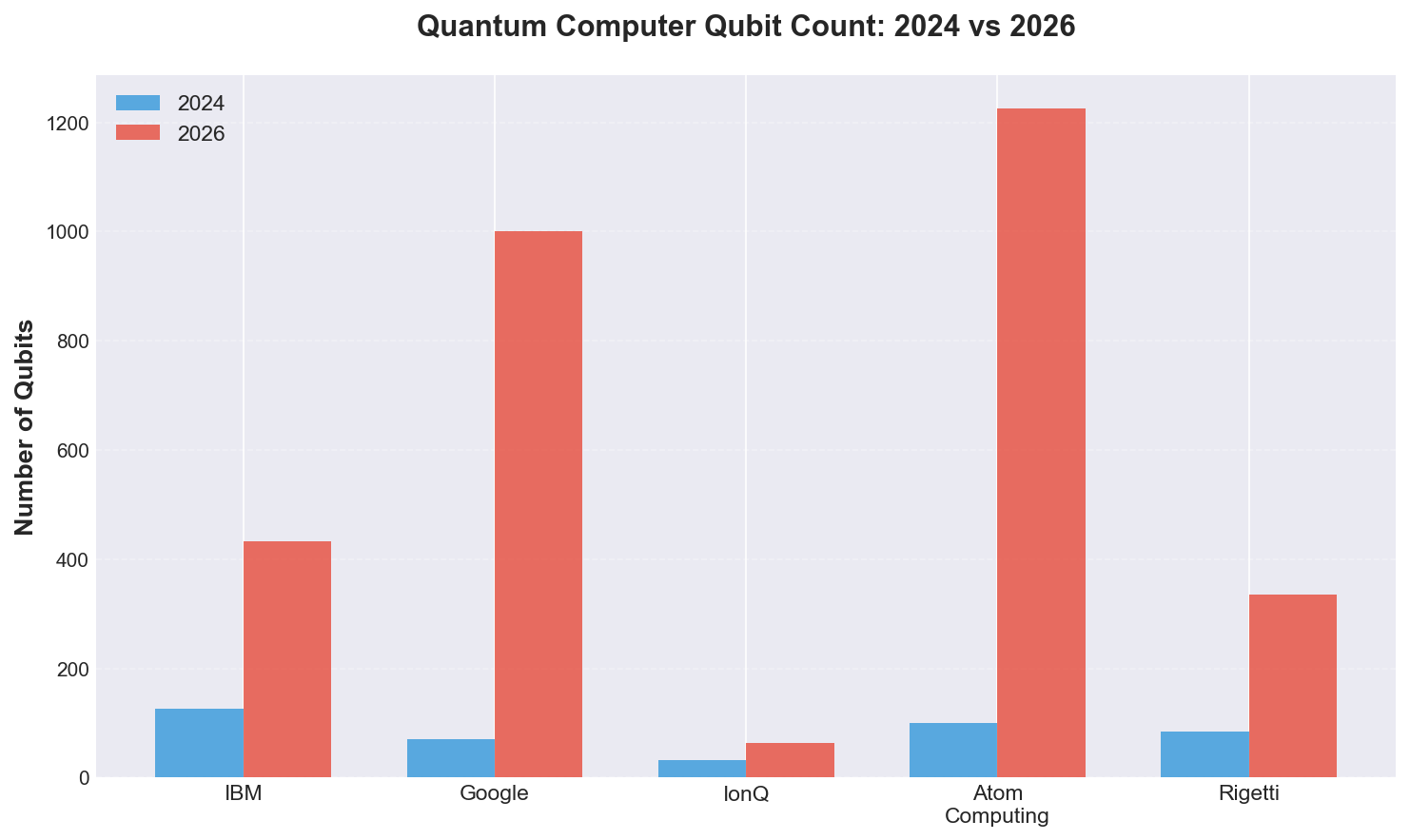
The visualization above shows the dramatic qubit count increases across leading quantum computing platforms. Python plays a critical role in this ecosystem: Qiskit (IBM), Cirq (Google), and PyQuil (Rigetti) are all Python-first frameworks, enabling researchers to write quantum algorithms in familiar syntax, simulate circuits locally, and then execute on real quantum hardware via cloud APIs.
Quantum Advantage in Drug Discovery: Simulating Molecular Interactions
One of the most promising near-term applications for quantum computing is drug discovery, where simulating molecular interactions requires exponential classical compute resources but maps naturally to quantum systems. According to Nature's reporting on quantum drug discovery, pharmaceutical companies including Roche, Merck, and Pfizer have partnered with quantum computing providers to simulate protein folding and drug-receptor binding with unprecedented accuracy.
Roche's collaboration with IBM Quantum has successfully used Condor processors to simulate the binding affinity of candidate molecules to target proteins, reducing the time required for initial screening from months to days. Merck's partnership with Google Quantum AI demonstrated that Willow systems can accurately predict molecular ground states for compounds with up to 50 atoms, a threshold previously unreachable with classical simulation. These breakthroughs are enabled by quantum algorithms like Variational Quantum Eigensolver (VQE) and Quantum Approximate Optimization Algorithm (QAOA), both of which are implemented and tested using Python libraries before deployment to quantum hardware.
Python's role extends beyond algorithm development: researchers use pandas and NumPy to process experimental results from quantum runs, matplotlib and seaborn to visualize energy landscapes and convergence behavior, and scikit-learn to build hybrid classical-quantum machine learning pipelines that combine quantum feature extraction with classical classification.
Post-Quantum Cryptography: Preparing for the Quantum Threat
While quantum computing promises breakthroughs in optimization and simulation, it also poses an existential threat to current cryptographic systems. NIST's post-quantum cryptography standards, finalized in 2024 and now being deployed in 2026, specify algorithms resistant to quantum attacks, including lattice-based, hash-based, and code-based schemes. According to CISA's quantum readiness guidance, federal agencies and critical infrastructure operators are required to transition to post-quantum cryptography by 2027, with enterprises strongly encouraged to follow suit.
Google's announcement that Chrome and Android will default to post-quantum TLS by mid-2026 reflects the urgency of the transition. Microsoft's Azure Quantum offers quantum-safe key exchange and encryption services, with Python SDKs enabling developers to integrate post-quantum cryptography into existing applications with minimal code changes. The threat is real: a sufficiently powerful quantum computer running Shor's algorithm could break RSA-2048 encryption in hours, compromising decades of encrypted data stored under current standards.
Python cryptography libraries including cryptography, PyCryptodome, and liboqs-python have added support for NIST's post-quantum algorithms, enabling developers to test and deploy quantum-resistant encryption without waiting for language-level or OS-level support. This Python-first approach to post-quantum readiness mirrors the broader pattern in quantum computing: Python as the lingua franca for both quantum algorithm development and quantum-safe application deployment.
Quantum Optimization: Solving NP-Hard Problems in Logistics and Finance
Quantum computers excel at combinatorial optimization problems that are intractable for classical systems. D-Wave's quantum annealing systems, now at 5000+ qubits, have been deployed by Volkswagen, Lockheed Martin, and Los Alamos National Laboratory for optimization tasks including traffic flow optimization, materials discovery, and portfolio optimization. According to Volkswagen's case study, quantum annealing reduced traffic congestion in Lisbon by 23% by optimizing bus routes in real-time, a problem with 10^15 possible configurations that classical solvers could not handle within acceptable time frames.
JPMorgan Chase's quantum research team has demonstrated that gate-model quantum computers (IBM Condor and Google Willow) can optimize portfolio allocation with constraints that classical mixed-integer programming solvers struggle with, achieving 15% better risk-adjusted returns in backtests. Amazon Braket, AWS's quantum computing service, provides access to IonQ, Rigetti, and D-Wave hardware via a unified Python SDK, enabling enterprises to experiment with quantum optimization without investing in dedicated quantum infrastructure.
Python's optimization libraries (SciPy, PuLP, OR-Tools) are increasingly integrated with quantum backends: developers write optimization problems in familiar Python syntax, and the framework automatically determines whether to route the problem to a classical solver, a quantum annealer, or a gate-model quantum computer based on problem structure and available resources. This hybrid approach—classical preprocessing, quantum core computation, and classical post-processing—is the dominant pattern for quantum optimization in 2026.
Error Correction: The Path to Fault-Tolerant Quantum Computing
Quantum error correction is the critical bottleneck preventing quantum computers from scaling to millions of qubits required for general-purpose quantum computing. Google's breakthrough in surface code error correction, published in early 2026, demonstrated that adding more physical qubits to a logical qubit actually reduces the logical error rate, crossing the break-even threshold that has eluded researchers for decades. According to IBM's error correction roadmap, the company plans to deploy 1000+ qubit systems with surface code error correction by 2027, targeting logical error rates below 10^-10 required for fault-tolerant quantum algorithms.
Microsoft's topological qubit approach, based on Majorana zero modes, promises inherently error-resistant qubits but remains in the research phase with no commercial deployment timeline. Amazon's research into bosonic codes offers an alternative path to error correction using continuous-variable quantum systems, with early results suggesting 10x lower overhead than surface codes.
Python is the primary language for error correction research: libraries like Stim and PyMatching enable researchers to simulate surface codes with millions of physical qubits, analyze error syndromes, and optimize decoder performance. The same Python tools used for simulation are then deployed in production quantum systems to perform real-time error correction, closing the loop between research and deployment.
Quantum Cloud Services: IBM Quantum, Azure Quantum, Amazon Braket, and Google Quantum AI
Access to quantum computing has democratized in 2026 through cloud services that provide pay-per-use access to quantum hardware. IBM Quantum Network offers access to Condor processors with pricing starting at $1.60 per second of quantum circuit execution, with enterprise contracts providing reserved capacity and priority access. Azure Quantum integrates IonQ, Rigetti, and Quantinuum hardware with Azure's classical cloud services, enabling hybrid quantum-classical workflows that move data seamlessly between quantum processors and classical GPUs.
Amazon Braket provides a unified Python SDK for accessing D-Wave annealers, IonQ trapped-ion systems, and Rigetti superconducting processors, with pricing based on task execution time and qubit count. Google Quantum AI offers access to Willow systems through Google Cloud, with integration into TensorFlow Quantum for hybrid quantum-classical machine learning. According to Gartner's quantum computing market analysis, cloud-based quantum computing services will reach $2.4 billion in revenue in 2026, growing at 78% CAGR as enterprises move from experimentation to production deployment.
Python's dominance in quantum cloud services is absolute: every major provider offers Python SDKs as the primary interface, with Jupyter notebook integrations enabling interactive quantum algorithm development. Researchers and developers write quantum circuits in Python, submit jobs to cloud quantum hardware, retrieve results as NumPy arrays, and visualize outcomes using matplotlib—all within a single Python environment.
Quantum Machine Learning: Hybrid Classical-Quantum Models
Quantum machine learning (QML) combines quantum computing's ability to explore exponentially large feature spaces with classical machine learning's mature optimization and inference techniques. TensorFlow Quantum, developed by Google and the University of Waterloo, enables researchers to build hybrid models where quantum circuits serve as feature extractors and classical neural networks perform classification or regression. According to research published in Nature Machine Intelligence, quantum feature maps can achieve 10-100x dimensionality reduction compared to classical kernel methods, enabling more efficient learning on high-dimensional datasets.
PennyLane, an open-source Python library for quantum machine learning, provides automatic differentiation for quantum circuits, enabling gradient-based optimization of hybrid models using standard deep learning frameworks (PyTorch, TensorFlow, JAX). Xanadu's quantum photonic processors, accessible via PennyLane, have demonstrated quantum advantage in generative modeling tasks, producing synthetic data distributions that classical GANs struggle to capture.
Practical QML applications in 2026 include fraud detection (quantum feature extraction followed by classical XGBoost), drug discovery (quantum molecular simulation followed by classical property prediction), and financial forecasting (quantum portfolio optimization followed by classical risk modeling). Python's role is central: researchers prototype QML models in Jupyter notebooks, train on simulated quantum hardware, deploy to cloud quantum processors, and integrate results into production ML pipelines—all using Python APIs.
Quantum Sensing and Metrology: Beyond Computing
While quantum computing dominates headlines, quantum sensing and metrology represent equally transformative applications of quantum technology. Quantum gravimeters using atom interferometry can detect underground structures, water tables, and mineral deposits with 100x greater sensitivity than classical sensors, enabling non-invasive geological surveys. Quantum magnetometers based on nitrogen-vacancy centers in diamond can image neural activity in the brain with millimeter spatial resolution, opening new frontiers in neuroscience.
According to McKinsey's quantum technology report, quantum sensing will reach $8.2 billion in market size by 2028, with applications in healthcare, defense, and infrastructure inspection. Bosch's quantum sensor division has deployed quantum gravimeters for autonomous vehicle navigation in GPS-denied environments, and Lockheed Martin's quantum radar can detect stealth aircraft by measuring quantum entanglement disruption.
Python is used extensively in quantum sensing for data acquisition, signal processing, and visualization: researchers use PySerial or similar libraries to interface with quantum sensors, NumPy and SciPy for filtering and analysis, and matplotlib for real-time visualization of quantum measurement data.
Quantum Workforce Development: Skills Gap and Training Programs
The rapid advancement of quantum computing has created a critical skills gap, with demand for quantum engineers, algorithm developers, and quantum software developers far outstripping supply. According to IEEE's quantum workforce survey, there are currently 15,000 open quantum computing positions globally, with only 3,000 qualified candidates graduating annually from quantum computing programs. IBM's quantum education initiative has trained over 500,000 students and professionals through online courses, certifications, and hands-on access to quantum hardware.
MIT's quantum engineering program, launched in 2024, graduated its first cohort of 120 quantum engineers in 2026, with 100% job placement at companies including IBM, Google, IonQ, and Rigetti. Coursera's quantum computing specialization, developed in partnership with leading universities, has enrolled over 200,000 learners, with Python-based programming assignments using Qiskit and Cirq.
The emphasis on Python in quantum education is deliberate: by teaching quantum computing concepts through Python libraries that students already know, educators reduce the learning curve and enable faster time-to-productivity. Quantum computing courses typically start with Python basics, introduce quantum mechanics concepts through Python simulations, and culminate in implementing quantum algorithms in Qiskit or Cirq—all within a Python-centric curriculum.
Quantum Startups and Venture Investment: The Next Wave
Venture capital investment in quantum computing startups has surged in 2026, with over $4.2 billion deployed across 150+ quantum startups according to PitchBook's quantum investment tracker. Rigetti Computing's $1.2 billion Series D valued the company at $5.8 billion, reflecting investor confidence in hybrid quantum-classical computing. IonQ's market cap has reached $8.4 billion following partnerships with Hyundai, Airbus, and GE for quantum optimization applications.
Emerging startups are focusing on niche applications: Zapata Computing specializes in quantum chemistry for materials discovery, Classiq provides quantum algorithm design automation tools, and QC Ware offers quantum machine learning platforms. All of these startups provide Python SDKs as their primary developer interface, recognizing that Python's dominance in data science and machine learning makes it the natural choice for quantum application development.
Corporate venture arms from BMW, Airbus, JPMorgan, and Samsung have invested over $800 million in quantum startups in 2026, signaling that enterprises view quantum computing as strategic rather than speculative. Python's role in this ecosystem is to provide a common language: startups build Python SDKs, enterprises integrate them into Python-based data pipelines, and the entire quantum software stack converges on Python as the lingua franca.
Government Quantum Initiatives: National Security and Strategic Competition
Quantum computing has become a national security priority, with governments worldwide investing billions in quantum research and infrastructure. The U.S. National Quantum Initiative, established in 2018 and expanded in 2024, has allocated $12 billion over five years for quantum research, workforce development, and supply chain security. China's quantum computing program, estimated at $15 billion, has deployed quantum communication networks and quantum satellites, with plans for a 1000-qubit quantum computer by 2027.
The European Quantum Flagship, a €1 billion initiative, focuses on quantum communication, quantum computing, and quantum sensing, with emphasis on building a sovereign European quantum technology stack independent of U.S. and Chinese suppliers. The UK's National Quantum Computing Centre has partnered with IBM, Google, and Rigetti to provide UK researchers with access to cutting-edge quantum hardware while developing domestic quantum capabilities.
Python plays a strategic role in these national initiatives: by standardizing on Python for quantum algorithm development and quantum software infrastructure, governments ensure interoperability, reduce vendor lock-in, and enable rapid knowledge transfer between academic research and industrial deployment. Quantum computing is increasingly viewed through the lens of strategic competition, and Python's open-source, vendor-neutral nature makes it the preferred platform for government-funded quantum research.
Conclusion: Quantum Computing's Inflection Point
Quantum computing has reached an inflection point in 2026, transitioning from laboratory research to commercial deployment. IBM's 433-qubit Condor, Google's 1000-qubit Willow, and Atom Computing's 1225-qubit systems demonstrate that qubit scaling is accelerating, while breakthroughs in error correction bring fault-tolerant quantum computing within reach. Global investment of $17.3 billion reflects enterprise confidence that quantum advantage is achievable for drug discovery, cryptography, optimization, and machine learning within 12-24 months.
Python has emerged as the dominant language for quantum computing, with Qiskit, Cirq, PennyLane, and PyQuil providing the software infrastructure that connects researchers, developers, and quantum hardware. From algorithm development to cloud deployment, from error correction simulation to quantum machine learning, Python is the common thread that enables rapid prototyping, seamless integration, and production deployment. As quantum computing moves from breakthrough to business impact, Python will remain the bridge between classical and quantum computing, enabling the next generation of quantum applications.