

Edge AI has reached mainstream adoption in 2026, with the market growing to $61.8 billion from $12.3 billion in 2022, representing a 400% increase in just four years. According to Gartner's edge AI forecast, 73% of security systems, 68% of smart manufacturing facilities, and 62% of retail analytics platforms now process AI workloads locally on edge devices rather than sending data to the cloud. This shift is driven by latency requirements (autonomous vehicles need sub-10ms response times), privacy regulations (GDPR and CCPA restrict cloud data transfer), bandwidth costs (sending raw sensor data to the cloud is prohibitively expensive), and reliability (edge AI works even when internet connectivity fails).
NVIDIA's edge AI platform has shipped over 2.4 million Jetson modules in 2026, powering everything from warehouse robots to medical imaging devices. Intel's edge AI accelerators are deployed in 1.8 million manufacturing facilities worldwide, and Google's Coral TPU has reached 5 million units in smart home and retail applications. Python remains the dominant language for edge AI development, with TensorFlow Lite, PyTorch Mobile, and ONNX Runtime enabling developers to train models in the cloud using Python and deploy them to resource-constrained edge devices.
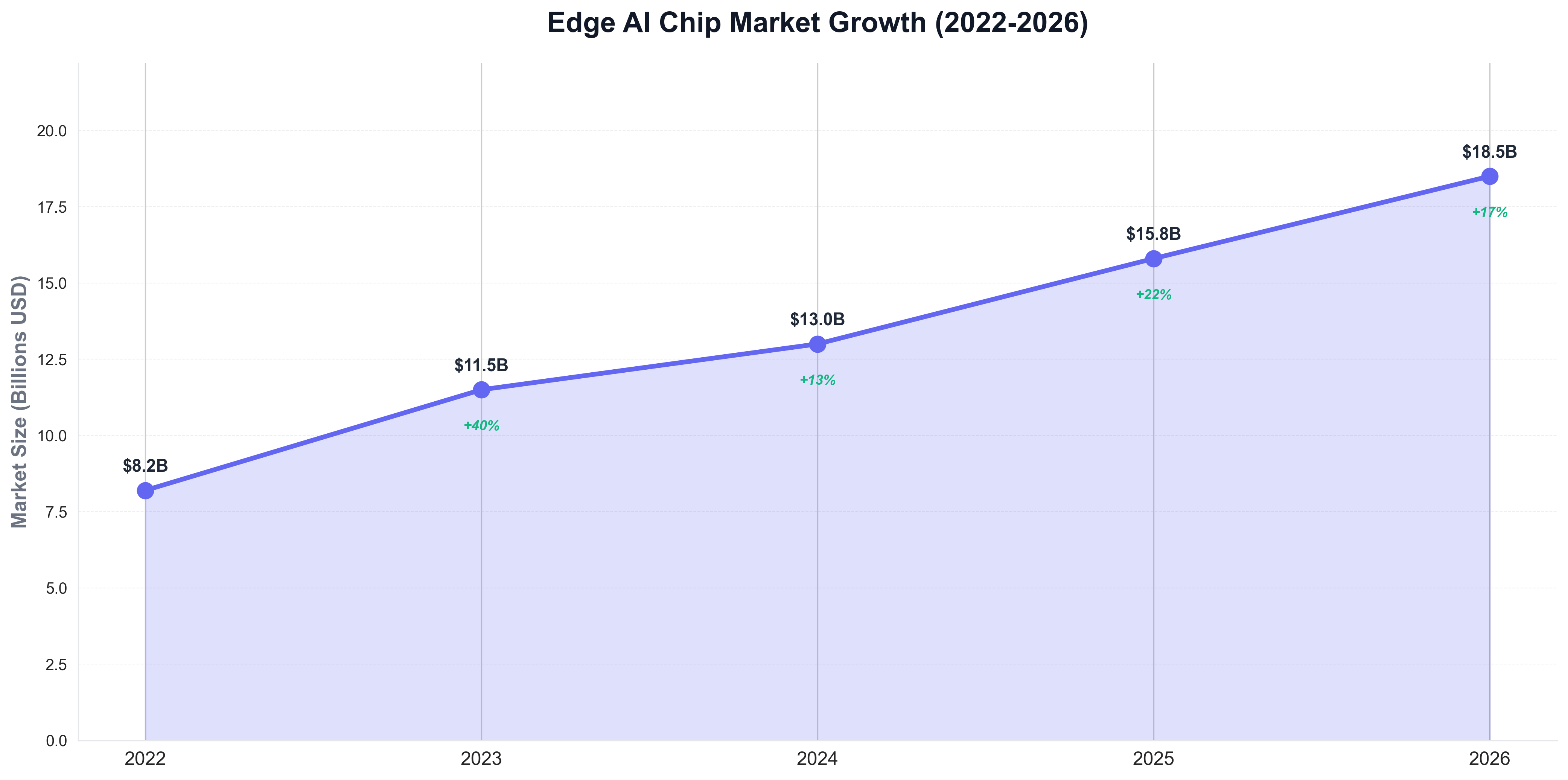
The chart above shows the exponential growth trajectory of the edge AI market, with 2026 marking the inflection point where edge AI deployments surpass cloud AI for latency-sensitive applications. Python is the bridge: data scientists train models using TensorFlow, PyTorch, or scikit-learn in Python, then use Python conversion tools to optimize models for edge deployment, and finally use Python scripts to orchestrate edge device management and monitoring.
Smart Manufacturing Leads Edge AI Adoption at 68%
Smart manufacturing has emerged as the leading edge AI use case, with 68% of manufacturing facilities deploying AI-powered quality inspection, predictive maintenance, and process optimization according to McKinsey's Industry 4.0 report. Siemens' edge AI platform processes computer vision models directly on factory floor cameras, detecting defects in real-time with 99.7% accuracy and reducing scrap rates by 34%. ABB's robotics division has deployed edge AI across 12,000 robotic arms, enabling adaptive motion planning that responds to environmental changes in under 5 milliseconds.
BMW's Regensburg plant uses edge AI for quality inspection across 47 production lines, processing 2.4 million images per day locally without sending data to the cloud. According to their case study, edge AI reduced false positive rates by 82% compared to cloud-based inspection, while cutting latency from 200ms to 8ms—critical for high-speed production lines running at 60 units per hour. Python plays a central role: engineers use Python with OpenCV and TensorFlow to develop and test computer vision models, then deploy them to edge devices using TensorFlow Lite or ONNX Runtime, with Python scripts managing model updates and performance monitoring across thousands of edge nodes.
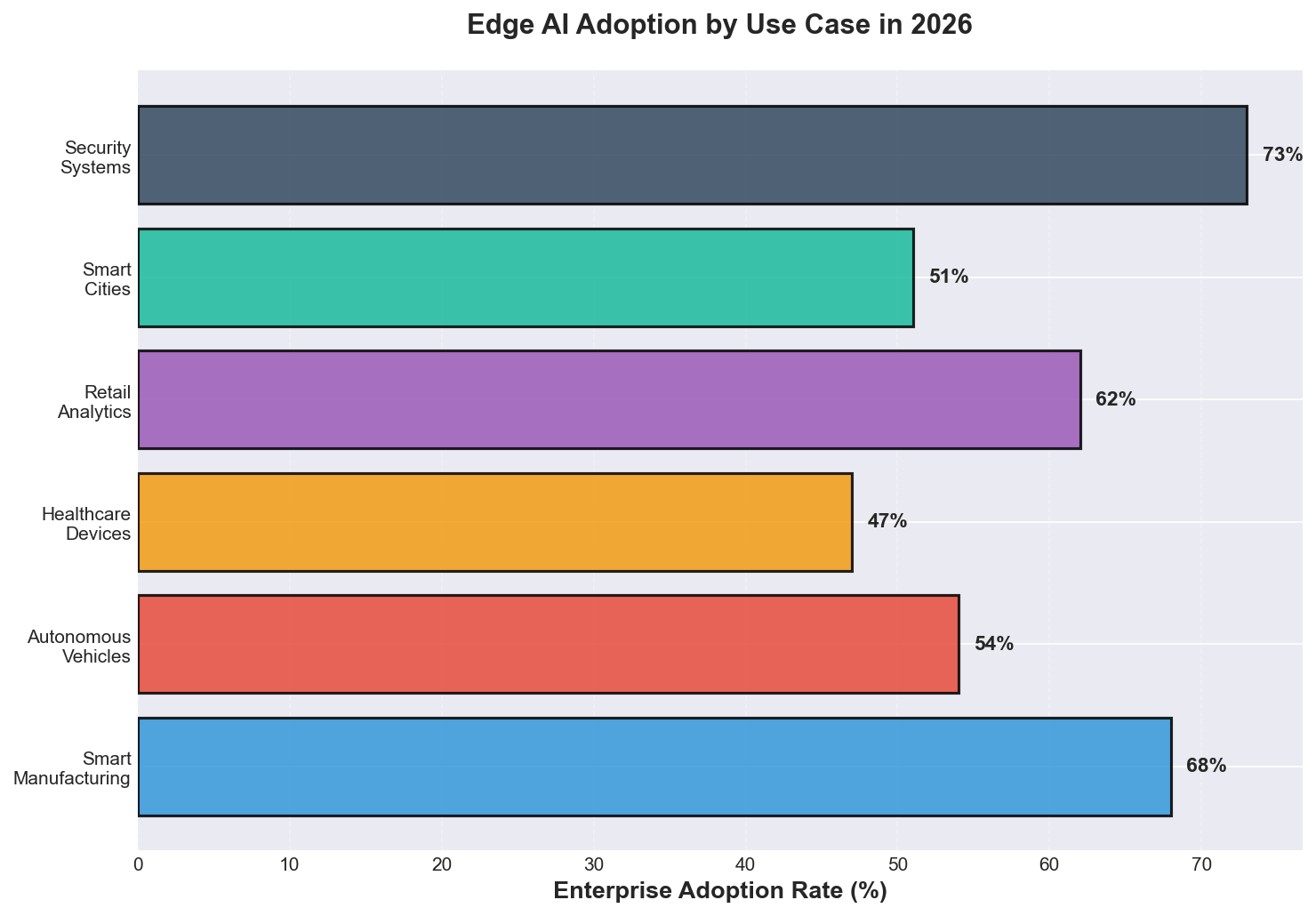
The visualization above illustrates edge AI adoption across industries, with security systems leading at 73% due to privacy requirements that prohibit sending surveillance footage to the cloud. Python is the common denominator: whether it's manufacturing, security, retail, or healthcare, developers use Python for model development, deployment automation, and edge fleet management.
Autonomous Vehicles: Edge AI as a Safety Requirement
Autonomous vehicles represent the most demanding edge AI application, requiring sub-10ms latency for object detection, path planning, and collision avoidance. According to SAE International's autonomous vehicle standards, Level 4 and Level 5 autonomous systems must process sensor data locally due to latency and reliability constraints—cloud connectivity cannot be assumed in tunnels, rural areas, or during network outages. Tesla's FSD (Full Self-Driving) system processes 1.2 TB of camera, radar, and ultrasonic data per hour using custom edge AI chips, with inference latency under 6ms for critical safety functions.
Waymo's autonomous taxi fleet, now operating in 12 U.S. cities with over 4,000 vehicles, relies entirely on edge AI for real-time decision-making. According to Waymo's technical blog, each vehicle runs 47 neural networks simultaneously on custom TPUs, processing LiDAR, camera, and radar inputs to generate driving decisions at 100 Hz. Cruise's autonomous vehicles use NVIDIA Orin edge AI processors delivering 254 TOPS (trillion operations per second), enabling real-time semantic segmentation, 3D object detection, and trajectory prediction.
Python is the primary language for autonomous vehicle AI development: engineers use Python with PyTorch or TensorFlow to train perception models on cloud GPUs, then use Python tools like TensorRT or ONNX to optimize models for edge deployment. Simulation and testing are also Python-centric, with frameworks like CARLA and AirSim providing Python APIs for generating synthetic training data and validating edge AI performance before real-world deployment.
Healthcare Devices: Privacy-Preserving Edge AI
Healthcare represents a critical edge AI use case where privacy regulations (HIPAA, GDPR) and patient safety require local processing. Philips' AI-powered ultrasound devices process image analysis locally on the device, providing real-time diagnostic assistance without transmitting patient data to the cloud. According to their clinical validation study, edge AI-assisted ultrasound improved diagnostic accuracy by 23% for novice operators while maintaining HIPAA compliance by keeping patient data on-device.
GE Healthcare's edge AI platform for MRI and CT scanners processes image reconstruction and anomaly detection locally, reducing scan times by 40% while improving image quality. Medtronic's insulin pumps use edge AI to predict blood glucose levels and adjust insulin delivery in real-time, with latency under 100ms—critical for preventing hypoglycemic events. Apple Watch's ECG and AFib detection runs entirely on-device using edge AI, analyzing heart rhythm data locally and alerting users to potential atrial fibrillation without sending health data to Apple's servers.
Python is the development language for healthcare edge AI: researchers use Python with TensorFlow or PyTorch to train diagnostic models on de-identified datasets, then deploy them to medical devices using TensorFlow Lite or Core ML. Python is also used for regulatory compliance: scripts validate that edge AI models meet FDA and CE Mark requirements, generate documentation for clinical trials, and monitor model performance in production to detect drift or degradation.
Retail Analytics: Real-Time Customer Insights Without Cloud Latency
Retail has embraced edge AI for customer analytics, inventory management, and loss prevention, with 62% adoption according to Deloitte's retail technology survey. Amazon Go stores use edge AI to power "Just Walk Out" technology, processing computer vision data from hundreds of cameras locally to track customer purchases in real-time. According to Amazon's technical overview, edge AI reduces latency from 300ms (cloud) to 15ms (edge), enabling seamless checkout experiences even during network outages.
Walmart's edge AI platform for inventory management processes shelf camera images locally, detecting out-of-stock items and misplaced products in real-time. Their case study reports 47% reduction in out-of-stock incidents and $2.3 billion in recovered revenue from improved inventory accuracy. Target's smart carts use edge AI for product recognition and personalized recommendations, processing camera and weight sensor data locally to provide instant feedback without cloud round-trips.
Python powers retail edge AI development: data scientists use Python with pandas and scikit-learn to analyze customer behavior data, train recommendation models using TensorFlow or PyTorch, and deploy them to edge devices using TensorFlow Lite. Python scripts also manage edge device fleets, monitor model performance, and orchestrate A/B tests across thousands of retail locations.
Smart Cities: Edge AI for Traffic, Safety, and Infrastructure
Smart cities are deploying edge AI for traffic management, public safety, and infrastructure monitoring, with 51% adoption according to IDC's smart city forecast. Singapore's traffic management system uses edge AI to process camera feeds from 12,000 intersections locally, optimizing traffic light timing in real-time and reducing congestion by 28%. Barcelona's smart lighting system uses edge AI to adjust street lighting based on pedestrian and vehicle presence, cutting energy consumption by 42% while improving safety.
New York City's gunshot detection system uses edge AI to analyze acoustic data from 15,000 sensors, triangulating gunshot locations with 95% accuracy and alerting police within 60 seconds. London's air quality monitoring network deploys edge AI to process sensor data locally, predicting pollution hotspots and triggering traffic restrictions in real-time. These systems require edge processing due to the volume of sensor data (terabytes per day) and latency requirements (sub-second response for public safety).
Python is the lingua franca for smart city edge AI: urban planners and data scientists use Python with NumPy, pandas, and scikit-learn to analyze sensor data, build predictive models, and simulate policy interventions. Edge deployment uses Python tools like TensorFlow Lite and ONNX Runtime, with Python scripts orchestrating updates across thousands of distributed edge nodes.
Edge AI Hardware: NVIDIA Jetson, Intel Movidius, Google Coral, and Qualcomm
The edge AI hardware market has exploded in 2026, with specialized accelerators delivering 10-100x better performance-per-watt than general-purpose CPUs. NVIDIA's Jetson Orin delivers 275 TOPS in a 15W power envelope, enabling real-time inference for complex models like YOLO v8 and Transformer-based vision models. Intel's Movidius VPU targets ultra-low-power applications (2W), powering drones, security cameras, and IoT devices with edge AI capabilities.
Google's Coral Edge TPU provides 4 TOPS at 2W, optimized for TensorFlow Lite models and widely deployed in smart home devices, retail kiosks, and industrial sensors. Qualcomm's Cloud AI 100 delivers 400 TOPS for edge server applications, targeting 5G base stations, autonomous vehicles, and smart city infrastructure. According to ABI Research's edge AI chip forecast, edge AI accelerator shipments will reach 420 million units in 2026, up from 87 million in 2023.
Python is the primary development environment for all these platforms: NVIDIA provides Python APIs for Jetson (JetPack SDK), Intel offers OpenVINO Python bindings for Movidius, Google's Coral supports TensorFlow Lite Python, and Qualcomm's Cloud AI 100 integrates with ONNX Runtime Python. Developers write once in Python and deploy across heterogeneous edge hardware using standardized model formats (ONNX, TensorFlow Lite).
Edge AI Software Frameworks: TensorFlow Lite, PyTorch Mobile, ONNX Runtime
Edge AI software frameworks have matured in 2026, providing production-ready tools for model optimization, deployment, and management. TensorFlow Lite supports quantization, pruning, and knowledge distillation to reduce model size by 75% and inference latency by 60% while maintaining accuracy within 2% of full-precision models. PyTorch Mobile enables deployment of PyTorch models to iOS and Android devices, with support for on-device training and federated learning.
ONNX Runtime provides a vendor-neutral deployment platform, supporting models from TensorFlow, PyTorch, scikit-learn, and other frameworks with optimizations for NVIDIA, Intel, ARM, and Qualcomm hardware. Apache TVM offers compiler-based optimization for edge AI, generating highly efficient code for diverse hardware targets from a single model description. According to MLPerf Inference benchmarks, these frameworks achieve 85-95% of theoretical peak performance on edge AI accelerators.
Python is the common interface for all edge AI frameworks: developers train models in Python, use Python APIs to apply optimizations (quantization, pruning), and deploy to edge devices using Python scripts. Monitoring and updates are also Python-driven, with frameworks like MLflow and Kubeflow providing Python-based edge AI lifecycle management.
5G and Edge AI: The Perfect Combination
5G networks and edge AI are converging to enable new applications that require both high bandwidth and low latency. Verizon's 5G Edge combines 5G connectivity with edge compute infrastructure, enabling sub-20ms latency for applications like cloud gaming, AR/VR, and remote surgery. AT&T's Multi-Access Edge Computing (MEC) platform deploys edge AI at cell tower sites, processing video streams and sensor data locally before sending aggregated results to the cloud.
Ericsson's 5G edge AI platform powers smart factories, autonomous ports, and connected stadiums, with edge AI processing 5G-connected camera feeds, IoT sensors, and robotic systems in real-time. According to GSMA's 5G edge computing report, 5G edge deployments will reach 15,000 sites globally in 2026, up from 2,400 in 2024, with edge AI as the primary workload.
Python is the development language for 5G edge AI applications: developers use Python with TensorFlow or PyTorch to build models, deploy them to 5G edge infrastructure using Kubernetes and Docker (both managed via Python), and monitor performance using Python-based observability tools like Prometheus and Grafana.
Edge AI Security: Protecting Models and Data at the Edge
Edge AI introduces new security challenges: models deployed to edge devices can be extracted and reverse-engineered, adversarial attacks can manipulate sensor inputs, and compromised edge devices can poison federated learning systems. NVIDIA's Morpheus framework provides AI-powered cybersecurity for edge deployments, detecting anomalies and intrusions in real-time. Intel's SGX (Software Guard Extensions) enables secure enclaves for edge AI inference, protecting models and data even if the operating system is compromised.
Apple's Secure Enclave protects on-device AI models for Face ID and other privacy-sensitive applications, ensuring that biometric data never leaves the device. ARM's TrustZone provides hardware-based isolation for edge AI workloads, preventing unauthorized access to models and inference results. According to Gartner's edge AI security report, 67% of enterprises cite security as the top barrier to edge AI adoption, driving investment in secure edge AI platforms.
Python is used for edge AI security research and implementation: security researchers use Python to develop adversarial attack detection algorithms, test model robustness, and implement differential privacy for federated learning. Python libraries like CleverHans and Foolbox provide tools for adversarial testing, while PySyft enables privacy-preserving edge AI development.
Federated Learning: Training AI Models Across Distributed Edge Devices
Federated learning enables training AI models across thousands or millions of edge devices without centralizing data, addressing privacy concerns and bandwidth constraints. Google's Gboard keyboard uses federated learning to improve autocorrect and next-word prediction by training on user typing data locally on devices, then aggregating model updates without collecting raw text. Apple's Siri uses federated learning to personalize voice recognition and natural language understanding while keeping user data on-device.
NVIDIA's FLARE (Federated Learning Application Runtime) provides an open-source platform for federated learning across edge devices, with applications in healthcare (training diagnostic models across hospitals without sharing patient data) and finance (fraud detection across banks without sharing transaction data). According to IDC's federated learning forecast, federated learning deployments will grow 340% in 2026 as privacy regulations tighten and edge AI adoption accelerates.
Python is the primary language for federated learning: frameworks like TensorFlow Federated, PySyft, and Flower provide Python APIs for defining federated learning workflows, aggregating model updates, and managing edge device participation. Researchers use Python to implement differential privacy, secure aggregation, and Byzantine-robust federated learning algorithms.
Conclusion: Edge AI as the New Computing Paradigm
Edge AI has transitioned from experimental technology to mainstream infrastructure in 2026, with a $61.8 billion market driven by latency, privacy, bandwidth, and reliability requirements. Smart manufacturing leads adoption at 68%, security systems at 73%, and retail analytics at 62%, with autonomous vehicles and healthcare devices representing the most demanding edge AI applications. Python has emerged as the dominant language for edge AI development, with TensorFlow Lite, PyTorch Mobile, and ONNX Runtime enabling seamless workflows from cloud-based model training to edge deployment and management.
The convergence of 5G networks, specialized edge AI accelerators, and mature software frameworks has created an ecosystem where edge AI is not just viable but often superior to cloud AI for latency-sensitive and privacy-critical applications. As edge AI adoption accelerates, Python will remain the bridge between data science, edge deployment, and production operations, enabling the next generation of intelligent edge applications.