

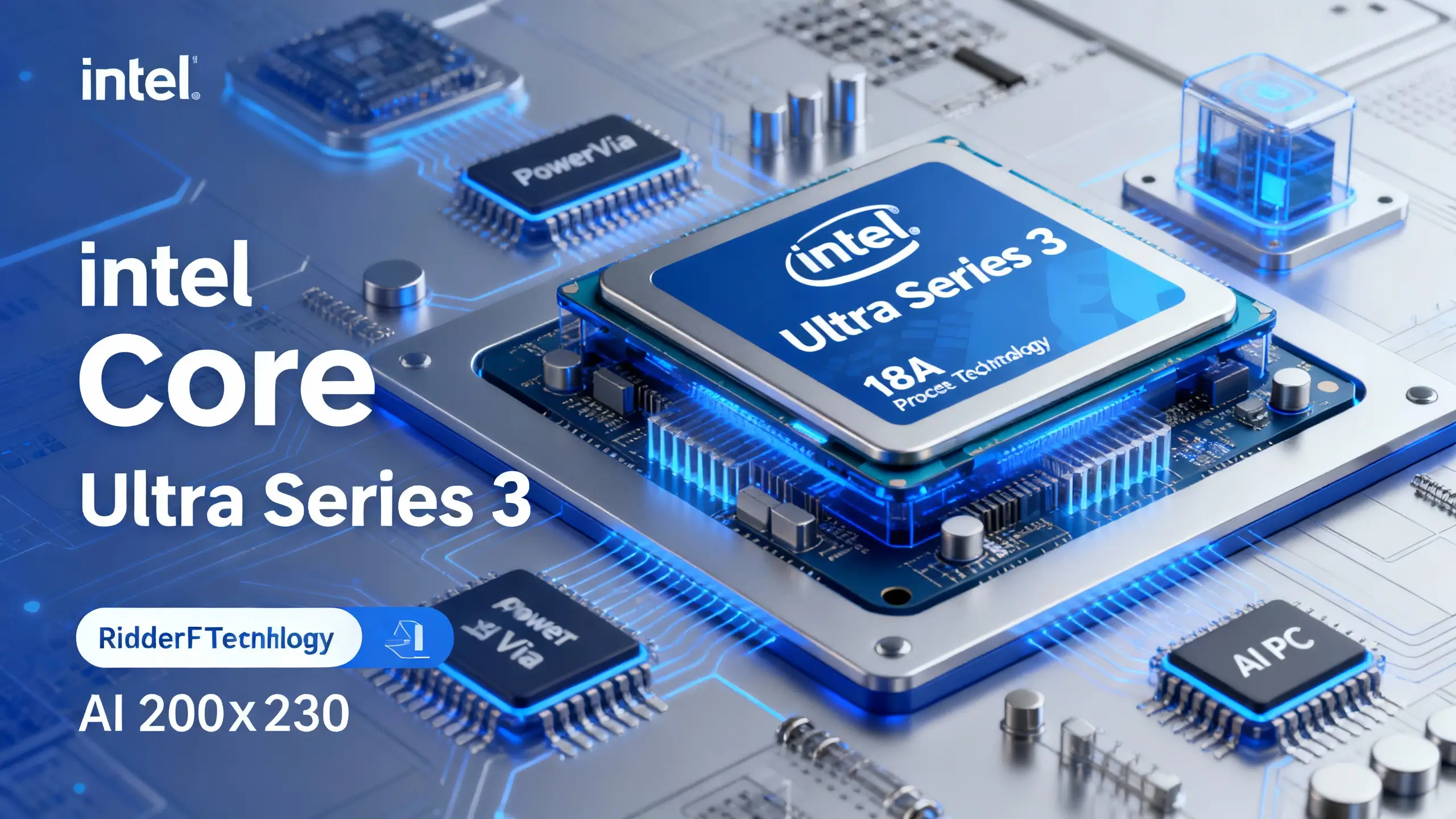
Intel's Core Ultra Series 3 processors, announced at CES 2026, represent a historic milestone as the first AI PC platform built on Intel's 18A process technology—described as "the most advanced semiconductor process ever developed and manufactured in the United States." The 18A process features RibbonFET gate-all-around transistors and PowerVia backside power delivery, delivering 30% better chip density and 15% better performance per watt compared to Intel 3.
According to Intel's announcement, the flagship Core Ultra X9 388H features 16 cores (4 P-cores + 8 E-cores + 4 LP E-cores), 12 Xe-cores, and 50 NPU TOPS, achieving 60% better multithreaded performance, 77% faster gaming performance, and up to 27 hours of battery life compared to previous generations. The series includes 14 SKUs across five product families, with availability starting January 27, 2026, powering over 200 PC designs.
The 18A process represents a die shrink from 3nm to 2nm, featuring denser RibbonFET transistors and back-side power delivery. According to The Register's coverage, this delivers a 30% increase in transistor density compared to prior generations, enabling more powerful and efficient processors in smaller form factors.
For the first time, Series 3 processors are certified for embedded and industrial edge applications including robotics, smart cities, automation, and healthcare. According to Intel's announcement, these edge variants deliver up to 1.9x higher LLM performance and up to 4.5x higher throughput on vision language action models, enabling sophisticated AI workloads at the edge.
The 18A Process Breakthrough: RibbonFET and PowerVia
Intel's 18A process represents a significant leap in semiconductor technology, featuring two breakthrough innovations: RibbonFET gate-all-around (GAA) transistors and PowerVia backside power delivery. According to Intel's 18A platform brief, together these innovations deliver up to 15% better performance per watt and up to 30% better chip density compared to Intel 3.
RibbonFET transistors represent the most substantial transistor innovation since FinFET was introduced in 2011. According to Intel's 18A platform brief, RibbonFET uses gate-all-around architecture, providing better electrostatic control and enabling higher performance at lower power consumption. This architecture is crucial for advanced AI workloads that require both performance and efficiency.
PowerVia backside power delivery is equally revolutionary. According to Intel's 18A platform brief, PowerVia moves power delivery to the backside of the chip, freeing up space on the front side for signal routing. This innovation improves power delivery efficiency and enables higher transistor density, both crucial for advanced AI processors.
The 18A process is manufactured at Intel's Fab 52 in Chandler, Arizona. According to Intel's announcement, production began in 2025, with Core Ultra Series 3 entering production in 2025 and Xeon 6+ server processors expected to launch in the first half of 2026. This manufacturing capability is significant for U.S. semiconductor independence.
However, the 18A process also represents significant manufacturing challenges. According to Intel's 18A platform brief, the process requires advanced lithography, materials science, and manufacturing techniques. These challenges highlight the complexity of advanced semiconductor manufacturing and the importance of continued innovation.
The 18A process also demonstrates Intel's commitment to process leadership. According to Intel's 18A platform brief, Intel is positioning 18A as a competitive process node for foundry customers, enabling the company to compete with TSMC and Samsung in advanced semiconductor manufacturing. This positioning is crucial for Intel's IDM 2.0 strategy.
Core Ultra X9 388H: Flagship Performance and Specifications
The Core Ultra X9 388H is Intel's flagship processor in the Series 3 lineup, featuring 16 cores (4 Performance-cores + 8 Efficient-cores + 4 Low Power E-cores), 12 Xe-cores, and 50 NPU TOPS. According to Intel's specifications, the processor runs at up to 5.1 GHz max turbo, with 25W base power and up to 80W maximum turbo power.
The X9 388H's performance is impressive across multiple workloads. According to NotebookCheck's analysis, early Geekbench 6 results show the processor achieving 3,057 points in single-core performance (8.7% faster than AMD Ryzen AI Max+ 395) and 17,687 points in multi-core performance (comparable to AMD's flagship). This performance is achieved despite a lower 45W default TDP compared to AMD's 55W.
The processor's graphics performance is also notable. According to Intel's specifications, the Intel Arc B390 GPU features 12 Xe3 cores running at 2.5 GHz max frequency, delivering 122 TOPS (Int8) for AI workloads. This capability makes the processor suitable for AI PCs that need both CPU and GPU performance.
However, the X9 388H uses a hybrid architecture with compute and GPU tiles. According to The Register's coverage, the compute tile is manufactured on Intel's 18A process, while the GPU tile is manufactured on TSMC's N3E process. This hybrid approach allows Intel to leverage the best of both manufacturing capabilities.
The processor's memory support is also advanced. According to Intel's specifications, the X9 388H supports up to 96 GB LPDDR5X 9600 MT/s, enabling high-bandwidth memory for AI workloads. This capability is crucial for running large language models and other memory-intensive AI applications.
Performance Improvements: 60% Multithreaded, 77% Gaming
Intel's Core Ultra Series 3 delivers significant performance improvements over previous generations. According to Intel's announcement, the series achieves 60% better multithreaded performance, 77% faster gaming performance, 10% better single-threaded performance per watt, and 50% improvement in multithreaded performance per watt compared to Lunar Lake and Arrow Lake processors.
These performance improvements are significant because they demonstrate the value of the 18A process. According to The Register's coverage, the 30% increase in transistor density enables more cores and higher frequencies, while the improved power efficiency enables better performance within the same power envelope. This combination is crucial for AI PCs that need both performance and battery life.
The gaming performance improvement is particularly notable. According to Intel's announcement, the 77% faster gaming performance is achieved through improved GPU architecture and higher memory bandwidth. This capability makes Series 3 processors suitable for gaming laptops that also need AI capabilities.
However, performance improvements also depend on software optimization. According to Intel's announcement, over 100 independent software vendors are optimizing over 300 AI-accelerated features specifically for Intel Core Ultra processors. This optimization is crucial for realizing the full potential of the hardware.
The performance improvements also highlight the importance of process technology. According to The Register's coverage, the 18A process enables higher transistor density and better power efficiency, both crucial for advanced AI workloads. This capability positions Intel as a leader in AI PC performance.
50 NPU TOPS: Exceeding Copilot+ Requirements
Intel's Core Ultra Series 3 delivers up to 50 NPU TOPS, exceeding Microsoft's 40+ TOPS requirement for Copilot+ PC certification. According to ASUS's analysis, the processors deliver up to 180 platform TOPS of AI performance when combining CPU, GPU, and NPU capabilities, representing a significant jump from the previous Series 2 generation's 120 platform TOPS.
This NPU performance is significant because it enables faster local AI inference. According to PCWorld's coverage, the enhanced AI compute power enables more responsive on-device AI features without requiring cloud connectivity, improving privacy and reducing latency. This capability is crucial for AI applications that need real-time responsiveness.
The NPU performance also enables new AI applications. According to PCWorld's coverage, Core Ultra-based systems support on-device AI features like Recall timeline search, Paint Cocreator, and Live captions through Windows Studio Effects. These features demonstrate the value of dedicated AI acceleration.
However, NPU performance is just one component of AI performance. According to ASUS's analysis, the combination of CPU, GPU, and NPU enables comprehensive AI acceleration, with different components optimized for different AI workloads. This comprehensive approach is crucial for diverse AI applications.
The NPU performance also highlights the importance of software optimization. According to Intel's announcement, over 100 ISVs are optimizing AI features for Core Ultra processors, ensuring that the hardware capabilities are fully utilized. This optimization is crucial for demonstrating the value of AI PCs.
First Embedded and Industrial Edge Certification
For the first time, Intel's Core Ultra Series 3 processors are certified for embedded and industrial edge applications including robotics, smart cities, automation, and healthcare. According to Intel's announcement, these edge variants feature industrial-grade specifications including extended temperature ranges, deterministic performance, and 24x7 reliability.
This edge certification is significant because it expands the addressable market for Core Ultra processors. According to Intel's edge processors page, the Series 3 delivers up to 1.9x higher LLM performance, up to 2.3x better performance per watt per dollar on end-to-end video analytics, and up to 4.5x higher throughput on vision language action models. These capabilities enable sophisticated AI workloads at the edge.
The edge variants also feature industrial durability. According to Intel's edge processors page, Series 3 supports extended temperature ranges, configurable TDP options (from 15W for fanless designs up to 65W), and includes Intel Silicon Integrity Technology and FSEDP to accelerate functional-safety development for robots and autonomous mobile robots. These features are crucial for industrial applications.
However, edge certification also requires additional validation. According to Intel's edge processors page, the processors must meet industrial standards for reliability, temperature range, and functional safety. This validation is crucial for industrial adoption but adds complexity to the certification process.
The edge certification also highlights the importance of AI at the edge. According to Intel's announcement, edge AI enables real-time decision-making, reduced latency, and improved privacy by processing data locally. These advantages are crucial for applications like robotics, smart cities, and healthcare.
200+ PC Designs: Broad Market Adoption
Intel's Core Ultra Series 3 will power over 200 PC designs from global partners, with availability starting January 27, 2026. According to Intel's announcement, early designs include the Dell XPS 14 and 16, demonstrating strong manufacturer support for the new processors.
This broad adoption is significant because it demonstrates market confidence in the 18A process. According to Ars Technica's coverage, the 200+ PC designs represent a diverse range of form factors, from ultra-thin laptops to gaming systems to workstations. This diversity is crucial for market success.
The broad adoption also highlights Intel's manufacturing capability. According to Intel's announcement, Intel is able to produce sufficient volume to support 200+ PC designs, demonstrating that the 18A process is ready for mass production. This capability is crucial for meeting market demand.
However, broad adoption also requires software support. According to Intel's announcement, over 100 ISVs are optimizing AI features for Core Ultra processors, ensuring that software is ready for the hardware launch. This software support is crucial for demonstrating the value of AI PCs.
The broad adoption also demonstrates Intel's market position. According to Ars Technica's coverage, Intel maintains strong relationships with PC manufacturers, enabling rapid adoption of new processors. This market position is crucial for maintaining leadership in the AI PC market.
U.S. Semiconductor Manufacturing: Strategic Importance
Intel's 18A process represents a significant achievement for U.S. semiconductor manufacturing, being described as "the most advanced semiconductor process ever developed and manufactured in the United States." According to Intel's announcement, production takes place at Intel's Fab 52 in Chandler, Arizona, demonstrating U.S. capability in advanced semiconductor manufacturing.
This U.S. manufacturing capability is significant for strategic reasons. According to Intel's 18A platform brief, the 18A process is central to Intel's IDM 2.0 strategy and its "systems foundry" approach, which aims to support the AI computing era with advanced packaging capabilities. This strategy is crucial for U.S. semiconductor independence.
The U.S. manufacturing capability also enables supply chain security. According to Intel's announcement, producing advanced semiconductors in the United States reduces dependence on foreign manufacturing, which is important for national security and economic stability. This capability is crucial for critical applications.
However, U.S. manufacturing also faces challenges. According to Intel's 18A platform brief, advanced semiconductor manufacturing requires significant investment in facilities, equipment, and talent. These challenges highlight the importance of continued support for U.S. semiconductor manufacturing.
The U.S. manufacturing capability also demonstrates Intel's commitment to domestic production. According to Intel's announcement, Intel is investing in U.S. manufacturing facilities and capabilities, positioning the company as a leader in domestic semiconductor production. This commitment is crucial for U.S. semiconductor leadership.
The Future of AI PCs: Process Leadership and Innovation
Intel's Core Ultra Series 3 represents a significant step forward in AI PC technology, with 18A process leadership, comprehensive AI acceleration, and broad market adoption. The performance improvements, edge certification, and U.S. manufacturing capability position Intel as a leader in the AI PC market.
However, the success of AI PCs will depend on several factors. According to Intel's announcement, AI PC adoption requires compelling applications, software optimization, and continued innovation. These factors are crucial for widespread adoption of AI PCs.
The future of AI PCs also depends on process leadership. According to Intel's 18A platform brief, Intel is positioning 18A as a competitive process node for foundry customers, enabling the company to compete with TSMC and Samsung. This positioning is crucial for maintaining process leadership.
The AI PC market is also evolving rapidly. According to Intel's announcement, the market is seeing increased competition, with Intel, AMD, and Qualcomm all introducing AI processors. This competition is healthy for consumers, driving innovation and better performance.
The future of AI PCs also depends on edge computing. According to Intel's announcement, edge AI enables real-time decision-making, reduced latency, and improved privacy. These advantages are crucial for applications like robotics, smart cities, and healthcare.
Conclusion: Redefining AI PC Performance
Intel's Core Ultra Series 3 represents a historic milestone in semiconductor technology, being the first AI PC platform built on Intel's 18A process—the most advanced semiconductor process ever developed and manufactured in the United States. The RibbonFET and PowerVia innovations, combined with comprehensive AI acceleration and edge certification, position Intel as a leader in the AI PC market.
The series' ability to deliver 60% better multithreaded performance, 77% faster gaming performance, and up to 27 hours of battery life demonstrates the value of process leadership. The 50 NPU TOPS, exceeding Copilot+ requirements, enables faster local AI inference and more responsive on-device AI features.
However, the success of AI PCs will depend on compelling applications, software optimization, and continued innovation. The market is evolving rapidly, with increased competition driving innovation and better performance. The future of AI PCs looks promising, with Intel's Core Ultra Series 3 leading the way.
As AI PCs continue to evolve, we can expect even better performance, efficiency, and capabilities. Intel's commitment to process leadership, comprehensive AI acceleration, and U.S. manufacturing positions it well for the future of AI computing. The Core Ultra Series 3 is just the beginning of what's possible with advanced semiconductor processes.
The transformation of computing through AI acceleration and process leadership is underway, and Intel's Core Ultra Series 3 is at the forefront of this revolution. Whether this leadership continues will depend on continued innovation, software development, and market adoption. One thing is certain: AI PCs are here to stay, and Intel's 18A process is leading the charge.