

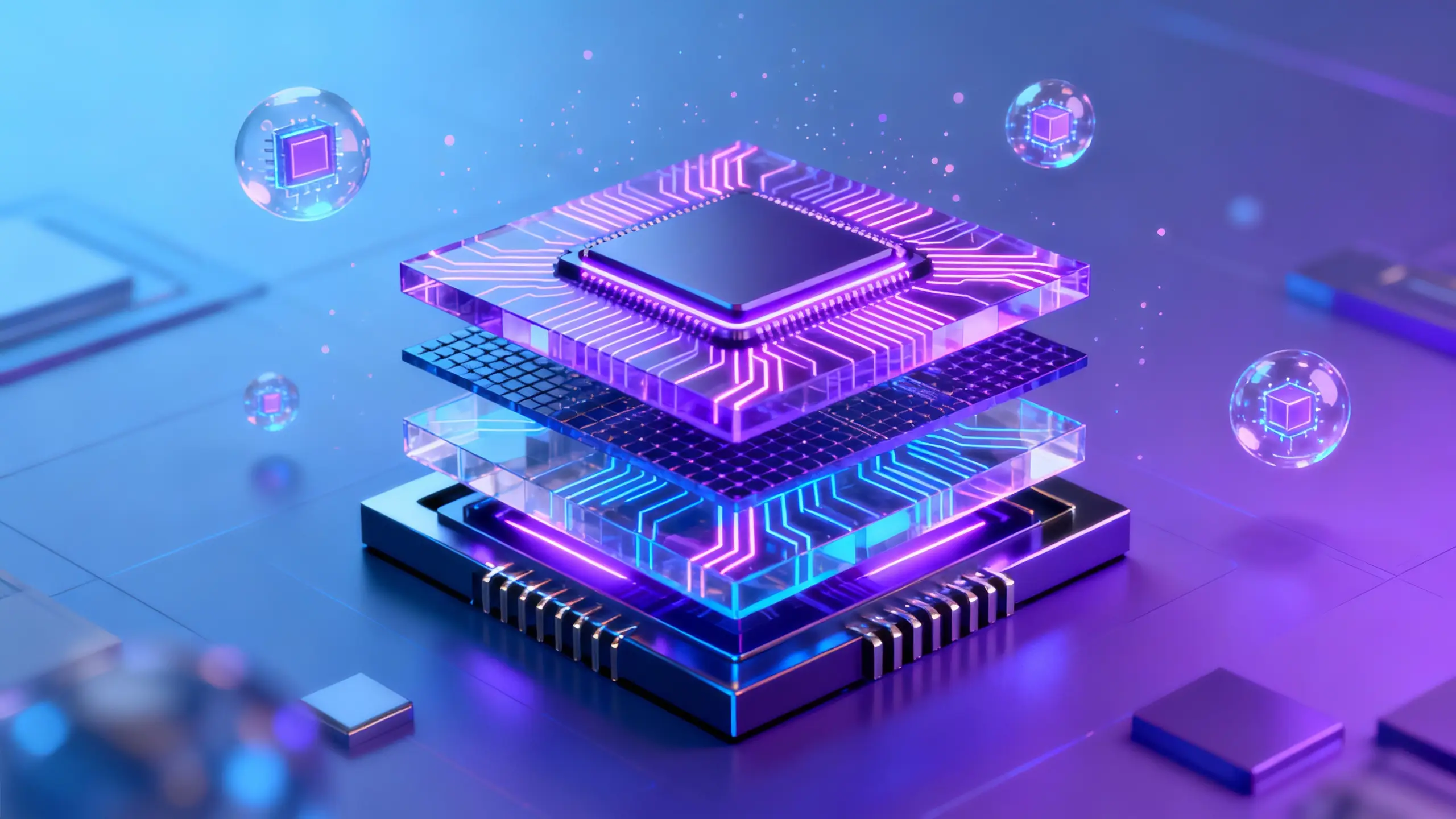
MIT researchers have developed a revolutionary 3D chip stacking technology that could solve one of computing's most persistent problems: the "memory wall" that forces data to travel long distances between logic and memory components, consuming massive amounts of energy in the process. The breakthrough, which combines logic and memory in vertically integrated "memory transistors," could cut energy use in power-hungry AI processes by orders of magnitude and enable supercomputer-level AI performance in laptops and wearable devices.
The innovation addresses a critical challenge as US data centers are projected to consume 9% of the country's electricity by 2030, up from 4% in 2023, with much of this growth driven by artificial intelligence applications. According to MIT Energy Initiative research, a single hyperscale data center can consume as much electricity as 50,000 homes, and the International Energy Agency projects global data center electricity generation will grow from 460 TWh in 2024 to over 1,000 TWh in 2030.
The MIT approach solves the memory wall problem by stacking memory and logic components directly on top of each other, rather than placing them far apart on a flat surface. This vertical integration dramatically shortens data paths, reducing the energy lost during data movement—a problem that has become increasingly severe as AI models grow larger and require more frequent data transfers between memory and processing units.
According to MIT's announcement, the technology uses indium oxide for the logic layer and ferroelectric hafnium-zirconium-oxide for memory, enabling efficient stacking without damaging existing components. The memory transistors combine both logic and memory functions in a single nanoscale device, operating at low voltages with fast switching speeds. This approach could enable "orders-of-magnitude improvements in computing power for applications in AI, logic, and memory," according to MIT Associate Professor Jeehwan Kim.
The Memory Wall Problem: Why Data Movement Consumes So Much Energy
The memory wall represents one of computing's fundamental bottlenecks. Traditional chip architectures separate logic circuits (which perform computations) from memory circuits (which store data), forcing data to travel long distances between these components. This separation creates a performance and energy efficiency problem that has become increasingly severe as computing power has scaled faster than memory bandwidth.
According to research from SemiEngineering, computing power has scaled at 3.0× every two years over the past 20 years, but memory bandwidth and interconnect speeds have not kept pace. This mismatch creates a critical bottleneck where memory access becomes significantly more expensive than computation itself, limiting efficient scaling of AI chips.
The problem is particularly severe for large language models and other AI applications. As model sizes grow exponentially, memory accesses become the dominant cost rather than computational operations. The von Neumann bottleneck—the gap between processor and memory—creates expensive data movement that constrains performance and energy efficiency.
In traditional chip architectures, data must travel from memory to processing units, be computed, and then travel back to memory. This movement consumes energy at every step: reading from memory, transmitting data through interconnects, and writing back to memory. For AI workloads that require frequent access to large datasets, this data movement can consume more energy than the actual computation.
The memory wall problem has become so severe that some researchers estimate data movement can consume 10 to 100 times more energy than computation itself in AI systems. This inefficiency is a major driver of the growing energy consumption in data centers, where AI workloads are becoming increasingly common.
MIT's Solution: Vertical Integration of Logic and Memory
MIT's breakthrough addresses the memory wall problem through vertical integration. Rather than placing logic and memory components far apart on a flat surface, the researchers stack them directly on top of each other, dramatically shortening data paths and reducing energy consumption.
The core innovation is a "memory transistor" that combines both logic and memory functions in a single nanoscale device. According to EngTechnica's analysis, this device uses indium oxide for the logic layer, which can be deposited at low temperatures to avoid damaging existing circuitry, topped with a thin layer of ferroelectric hafnium-zirconium-oxide for memory storage.
This vertical integration enables memory and logic to be positioned adjacent to each other, minimizing the distance data must travel. Instead of data traveling across a chip's surface from memory to logic and back, it can move vertically between stacked layers, dramatically reducing both distance and energy consumption.
The approach also eliminates the need for bulky silicon wafer substrates in each layer, which traditionally slowed communication between functional semiconducting layers. According to MIT's research, the team deposits high-quality semiconducting material directly on top of each other, enabling better and faster communication and computation between layers.
The technology operates at low voltages with fast switching speeds, making it suitable for both high-performance computing and energy-constrained devices. Early prototypes demonstrate that the stacked devices switch quickly and operate efficiently compared to typical memory transistors, while boosting computation speed.
Energy Efficiency Gains: Orders of Magnitude Improvement
The energy efficiency gains from MIT's 3D chip stacking approach are substantial. According to Mirage News reporting, hardware tests and simulations show that the 3D chip design outperforms 2D chips by roughly an order of magnitude in energy efficiency.
This improvement comes from eliminating the energy wasted during data movement. In traditional architectures, data must travel long distances between memory and logic components, consuming energy at every step. By stacking these components vertically, MIT's approach reduces data travel distance to the thickness of a few layers, dramatically reducing energy consumption.
The energy savings are particularly significant for AI workloads, which require frequent data movement between memory and processing units. Large language models, for example, must repeatedly access model parameters stored in memory, perform computations, and store intermediate results. This constant data movement is a major source of energy consumption in current AI systems.
By reducing data movement energy, MIT's approach could enable AI systems that are both more powerful and more energy-efficient. This is crucial as AI models continue to grow larger and require more computational resources. The ability to run these models more efficiently could reduce data center energy consumption while enabling more capable AI systems.
However, the energy efficiency gains must be balanced against the complexity of 3D chip manufacturing. Stacking multiple layers requires careful thermal management, as heat generated in lower layers must be dissipated through upper layers. The manufacturing process is also more complex than traditional 2D chip fabrication, potentially increasing costs.
The Data Center Energy Crisis: 9% of US Electricity by 2030
MIT's breakthrough addresses a critical and growing problem: the energy consumption of data centers. According to MIT Energy Initiative research, US data centers consumed more than 4% of the country's total electricity in 2023, with projections showing this could rise to 9% by 2030.
The growth is driven largely by artificial intelligence applications, which require massive computational resources. Training large language models, running inference workloads, and processing AI data all consume substantial electricity. As AI adoption accelerates, data center energy consumption is growing rapidly.
Globally, the situation is similarly concerning. According to International Energy Agency projections, electricity generation for data centers is projected to grow from 460 TWh in 2024 to over 1,000 TWh in 2030 and 1,300 TWh in 2035. This growth represents a significant portion of global electricity demand and creates challenges for both energy supply and environmental sustainability.
The scale of individual data centers is also staggering. A single hyperscale data center can consume as much electricity as 50,000 homes, and there are now over 10,000 data centers worldwide, with more than 5,000 located in the United States. New facilities are being built continuously to meet growing demand.
The energy sources powering these data centers also raise concerns. According to the IEA, renewables currently supply about 27% of electricity consumed by data centers globally, with coal providing 30%, natural gas 26%, and nuclear 15%. While renewables are expected to meet nearly half of additional electricity demand growth over the next five years, fossil fuels still play a significant role.
MIT's 3D chip stacking technology could help address this energy crisis by making AI systems more efficient. If the technology can reduce energy consumption by an order of magnitude for AI workloads, it could significantly slow the growth of data center energy demand, even as AI adoption accelerates.
Technical Architecture: Indium Oxide and Ferroelectric Memory
MIT's 3D chip stacking technology relies on careful materials engineering to enable efficient vertical integration. The approach uses indium oxide for the logic layer and ferroelectric hafnium-zirconium-oxide for memory, creating a stackable architecture that maintains performance while reducing energy consumption.
Indium oxide is chosen for the logic layer because it can be deposited at low temperatures—below 400°C—without damaging existing circuitry. This low-temperature deposition is crucial for 3D stacking, as higher temperatures would damage layers that have already been fabricated. The ability to add new layers without damaging existing ones enables the vertical integration that makes the technology possible.
Ferroelectric hafnium-zirconium-oxide (HZO) serves as the memory component. This material can store data in its polarization state, enabling non-volatile memory that retains data even when power is removed. The ferroelectric properties also enable fast switching speeds, making the memory suitable for high-performance applications.
According to MIT's Ferroelectric Materials & Devices Group research, the approach leverages materials already used in mass production microelectronics, which could accelerate technological adoption. By using materials that are already part of standard chip manufacturing processes, MIT's approach may be easier to integrate into existing production lines than technologies requiring entirely new materials.
The combination of indium oxide logic and ferroelectric HZO memory creates a memory transistor that combines both functions in a single device. This integration eliminates the need for separate memory and logic components, reducing the distance data must travel and the energy consumed during data movement.
However, the materials engineering also creates challenges. Ferroelectric materials can be sensitive to processing conditions, and maintaining their properties through multiple stacking steps requires careful control. The integration of different materials also requires careful attention to thermal expansion, electrical properties, and other material characteristics.
Applications: From Data Centers to Wearable Devices
MIT's 3D chip stacking technology has applications across a wide range of computing devices, from massive data centers to small wearable devices. The energy efficiency gains could enable more powerful AI systems in energy-constrained environments while reducing the environmental impact of data centers.
For data centers, the technology could significantly reduce energy consumption for AI workloads. Large language model training and inference, which currently consume massive amounts of electricity, could become more efficient, reducing both operational costs and environmental impact. The ability to run more computations with less energy could also enable data centers to support larger AI models without proportional increases in energy consumption.
For laptops and mobile devices, the technology could enable AI capabilities that were previously only possible in data centers. According to MIT's announcement, the approach could enable "AI hardware in laptops or wearable devices with supercomputer-level performance and data center-scale storage capacity." This could bring advanced AI features to consumer devices without requiring constant cloud connectivity.
For edge computing, the energy efficiency gains could enable more sophisticated AI processing in devices with limited power budgets. Internet of Things devices, autonomous vehicles, and other edge applications could benefit from more efficient AI processing, enabling new capabilities while maintaining battery life.
However, the applications also depend on manufacturing scalability. 3D chip stacking is more complex than traditional 2D chip fabrication, potentially increasing costs. The technology must be manufacturable at scale and cost-effective for widespread adoption, particularly in consumer devices where cost sensitivity is high.
Manufacturing Challenges: Scaling 3D Chip Production
While MIT's 3D chip stacking technology offers significant advantages, it also presents manufacturing challenges that must be addressed for widespread adoption. The vertical integration approach requires more complex fabrication processes than traditional 2D chip manufacturing.
One challenge is thermal management. In 3D stacked chips, heat generated in lower layers must be dissipated through upper layers, creating thermal bottlenecks that could limit performance or require additional cooling solutions. Managing heat in 3D stacks is more complex than in 2D chips, where heat can be dissipated across a larger surface area.
Another challenge is yield and reliability. Stacking multiple layers increases the number of potential failure points, potentially reducing manufacturing yield. Each additional layer creates new opportunities for defects, misalignment, or material issues that could render the entire stack unusable.
The manufacturing process is also more complex. Depositing multiple layers with precise alignment, maintaining material properties through multiple processing steps, and ensuring electrical connections between layers all add complexity to the fabrication process. This complexity could increase manufacturing costs and time.
However, MIT's approach may have advantages in manufacturability. By using materials already common in chip manufacturing—indium oxide and ferroelectric HZO—the technology may be easier to integrate into existing production lines than approaches requiring entirely new materials or processes.
The low-temperature deposition process for indium oxide also helps, as it reduces the risk of damaging previously fabricated layers. This could improve yield and reliability compared to approaches requiring high-temperature processing steps.
The Competitive Landscape: Other Approaches to the Memory Wall
MIT's 3D chip stacking approach is one of several technologies addressing the memory wall problem. Other approaches include compute-in-memory architectures, wafer-scale integration, and dataflow-optimized systems, each with different advantages and trade-offs.
Compute-in-memory (CIM) architectures perform computations directly within memory, eliminating the need for data movement between separate compute and memory units. This approach can reduce latency and power consumption by keeping computation and data together, but it may sacrifice flexibility compared to traditional architectures.
Wafer-scale integration creates massive chips that integrate hundreds of thousands of cores and massive on-chip memory onto single wafers. This approach addresses off-chip communication bottlenecks by keeping data local to processing units, but it faces challenges with yield and manufacturing complexity.
Dataflow-optimized architectures use specialized dataflow approaches to minimize data movement and improve energy efficiency. These systems are optimized for specific workloads but may be less flexible than general-purpose architectures.
MIT's 3D chip stacking approach offers a different balance of advantages. It maintains the flexibility of traditional architectures while reducing data movement through vertical integration. The approach could be more general-purpose than compute-in-memory or dataflow systems, potentially enabling broader adoption.
However, the competitive landscape is evolving rapidly. As AI workloads become more important, chip manufacturers are investing heavily in memory wall solutions. MIT's approach will need to demonstrate clear advantages in performance, energy efficiency, and manufacturability to gain widespread adoption.
The Path to Commercialization: From Research to Production
MIT's 3D chip stacking technology is still in the research phase, with full system integration remaining future work. The path from research breakthrough to commercial product typically takes years and requires addressing manufacturing, reliability, and cost challenges.
The research was published in Nature and presented at the International Electron Devices Meeting, demonstrating that the technology has reached a level of maturity suitable for academic publication. However, moving from research prototype to commercial product requires significant additional development.
Key steps on the path to commercialization include:
Manufacturing process development: The fabrication process must be refined for high-volume production, with attention to yield, reliability, and cost. This typically requires collaboration with semiconductor manufacturers who have expertise in production processes.
Integration with existing systems: The technology must be integrated with existing chip architectures and software ecosystems. This requires ensuring compatibility with current programming models, operating systems, and applications.
Reliability and testing: Commercial chips must meet stringent reliability requirements, particularly for applications where failures could have serious consequences. Extensive testing is needed to validate long-term reliability.
Cost optimization: Manufacturing costs must be reduced to levels suitable for commercial products. This may require process optimization, yield improvement, and economies of scale.
However, MIT's approach may have advantages in commercialization. The use of materials already common in chip manufacturing could facilitate integration with existing production lines. The low-temperature processing could also improve yield and reduce manufacturing complexity.
Environmental Impact: Reducing AI's Carbon Footprint
MIT's 3D chip stacking technology could have significant environmental benefits by reducing the energy consumption of AI systems. As AI adoption accelerates and data center energy consumption grows, technologies that improve efficiency become increasingly important for environmental sustainability.
If the technology can reduce AI energy consumption by an order of magnitude, it could significantly slow the growth of data center energy demand. This could reduce greenhouse gas emissions, particularly if data centers continue to rely on fossil fuels for a portion of their electricity.
The environmental benefits extend beyond direct energy savings. More efficient AI chips could enable the same computational capabilities with smaller data centers, reducing the land use, water consumption, and other environmental impacts associated with data center construction and operation.
However, the environmental benefits depend on how the technology is deployed. If energy efficiency gains simply enable larger AI models or more AI applications without reducing total energy consumption, the environmental benefits may be limited. The technology must be part of a broader strategy to improve AI efficiency and reduce environmental impact.
Conclusion: A Breakthrough That Could Transform Computing
MIT's 3D chip stacking technology represents a significant breakthrough in addressing the memory wall problem that has constrained computing performance and energy efficiency for decades. By vertically integrating logic and memory components, the technology dramatically reduces data movement and energy consumption, potentially enabling orders-of-magnitude improvements in efficiency.
The timing is critical. As US data centers are projected to consume 9% of the country's electricity by 2030, with much of this growth driven by AI, technologies that improve efficiency become essential. MIT's approach could help address this energy crisis while enabling more powerful AI systems in a wider range of devices.
However, the path from research breakthrough to commercial product is long and challenging. Manufacturing complexity, reliability requirements, and cost considerations all must be addressed before the technology can achieve widespread adoption. The use of materials already common in chip manufacturing and low-temperature processing may provide advantages, but significant development work remains.
The competitive landscape is also evolving rapidly, with multiple approaches to the memory wall problem under development. MIT's approach will need to demonstrate clear advantages in performance, energy efficiency, and manufacturability to gain market acceptance.
As the technology develops, we'll see whether 3D chip stacking can deliver on its promise of orders-of-magnitude energy efficiency improvements. If successful, it could transform not just AI computing, but computing more broadly, enabling more powerful systems with lower energy consumption and environmental impact.
One thing is certain: with data center energy consumption growing rapidly and AI workloads becoming increasingly important, solutions to the memory wall problem are urgently needed. MIT's 3D chip stacking technology represents a promising approach that could help address these challenges while enabling new capabilities in AI and computing.
The breakthrough demonstrates that fundamental rethinking of chip architecture can yield dramatic improvements in efficiency. As computing continues to evolve and AI becomes more central to technology, innovations like MIT's 3D chip stacking will be essential for maintaining progress while managing energy consumption and environmental impact.