

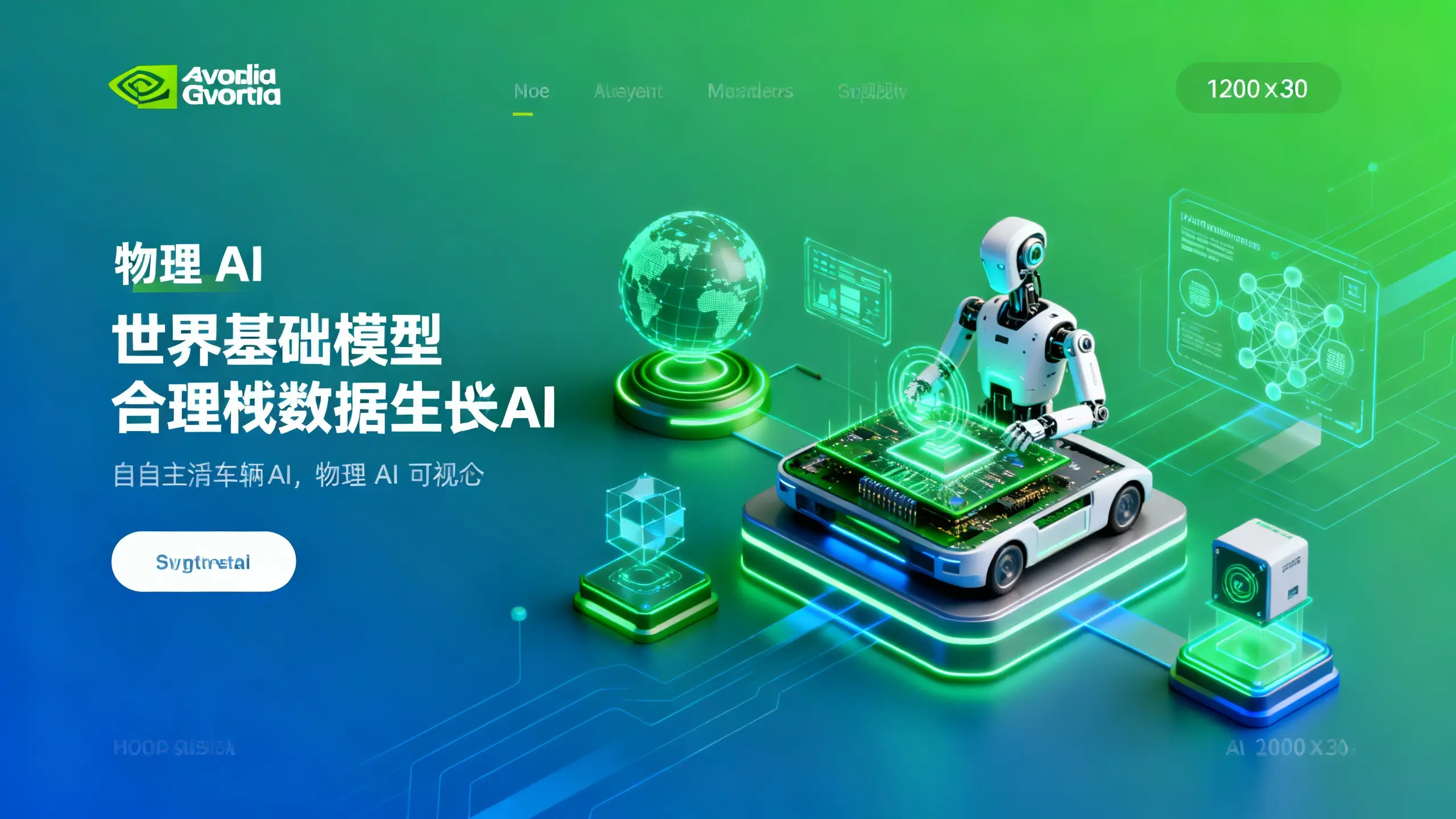
NVIDIA's Cosmos platform, launched in January 2025 and expanded throughout 2025-2026, represents a fundamental shift in how physical AI systems are developed. The platform provides world foundation models that generate photorealistic, physics-based synthetic data to train robots and autonomous vehicles, addressing the costly challenge of collecting real-world training data.
According to NVIDIA's announcement, Cosmos includes three model types: Predict models that generate future world states as video, Transfer models that transform 3D simulations into photorealistic videos, and Reason models that enable robots to reason about scenes using physics understanding. Leading companies including 1X, Agility Robotics, Figure AI, Boston Dynamics, Uber, and XPENG are adopting Cosmos to accelerate development.
The platform's ability to generate massive amounts of synthetic data at scale is transforming how physical AI systems are trained. According to NVIDIA's blog post, Cosmos enables developers to generate photoreal, physics-based synthetic data to train and evaluate models, while also enabling fine-tuning for custom applications. This capability addresses one of the main challenges in physical AI development: the cost and difficulty of collecting sufficient real-world training data.
NVIDIA CEO Jensen Huang described Cosmos as representing "the ChatGPT moment for robotics," aiming to democratize physical AI development. According to NVIDIA's announcement, the platform is available under an open model license, making advanced physical AI capabilities accessible to developers and researchers.
The Synthetic Data Challenge: Why Physical AI Needs Cosmos
Physical AI development faces a fundamental challenge: collecting sufficient real-world training data is expensive, time-consuming, and often dangerous. According to NVIDIA's announcement, training physical AI models requires vast amounts of data, but real-world data collection is costly and limited. This challenge has constrained the development of robots and autonomous vehicles, which need extensive training to operate safely and effectively.
Cosmos addresses this challenge by generating synthetic data that is photorealistic and physics-based. According to NVIDIA's developer blog, the platform enables developers to generate massive amounts of synthetic data at scale, creating diverse training datasets that would be impractical or impossible to collect in the real world. This capability accelerates development cycles and enables more robust model training.
The synthetic data generation also enables testing of edge cases. According to NVIDIA's documentation, Cosmos can generate scenarios that are rare or dangerous in the real world, such as extreme weather conditions, unusual obstacles, or emergency situations. This capability enables more comprehensive testing and validation of physical AI systems.
However, synthetic data also faces challenges. According to NVIDIA's developer blog, ensuring that synthetic data accurately represents real-world conditions requires sophisticated physics simulation and photorealism. Cosmos addresses these challenges through advanced models that generate physics-based, photorealistic data.
The synthetic data generation also highlights the importance of data quality. According to NVIDIA's developer blog, the Cosmos Cookbook provides step-by-step recipes for curating high-quality synthetic datasets, ensuring that generated data is useful for training physical AI models. This focus on quality is crucial for effective model training.
Cosmos Predict: Generating Future World States
Cosmos Predict models generate future world states as video, enabling developers to create synthetic data for training and evaluation. According to NVIDIA's documentation, Cosmos Predict generates up to 30 seconds of high-fidelity video from multimodal prompts, creating diverse scenarios for data generation and policy evaluation.
The Predict models are significant because they enable forward-looking simulation. According to Hugging Face's blog post, Cosmos Predict 2.5, released in October 2025, unifies three previous models (Text2World, Image2World, Video2World) into a single architecture for generating video from various input modalities. This unification makes the platform more versatile and easier to use.
The Predict models also enable policy evaluation. According to NVIDIA's developer blog, developers can use Predict models to evaluate how robots or autonomous vehicles would behave in different scenarios, enabling faster iteration and testing. This capability accelerates development cycles and reduces the need for expensive real-world testing.
However, Predict models also require sophisticated training. According to Hugging Face's blog post, Cosmos Predict 2 was trained on 200 million high-quality clips and incorporates Cosmos Reason 1 as its text encoder. This training requires significant computational resources and careful curation of training data.
The Predict models also highlight the importance of physics accuracy. According to NVIDIA's documentation, the models generate physics-based simulations, ensuring that generated scenarios accurately represent real-world physics. This accuracy is crucial for effective training and evaluation of physical AI systems.
Cosmos Transfer: Transforming Simulations into Photorealistic Videos
Cosmos Transfer models transform 3D simulations or spatial inputs into photorealistic videos for synthetic data generation. According to NVIDIA's announcement, Cosmos Transfer 2.5, released in March 2025, is a multi-controlnet that accepts structured inputs (RGB, depth, segmentation) to generate photoreal video outputs.
This Transfer capability is significant because it bridges the gap between simulation and reality. According to NVIDIA's developer blog, the Transfer system transforms 3D simulations into photorealistic videos, making synthetic data more realistic and useful for training. This capability enables developers to leverage existing simulation tools while generating photorealistic training data.
The Transfer models also enable data augmentation. According to NVIDIA's documentation, developers can use Cosmos Transfer to create photorealistic variations from smaller synthetic datasets, expanding training data without additional simulation. This capability makes data generation more efficient and cost-effective.
However, Transfer models also require careful calibration. According to NVIDIA's documentation, the models must accurately translate simulation inputs into photorealistic outputs, which requires sophisticated neural networks and careful training. This calibration is crucial for ensuring that generated data is useful for training.
The Transfer models also highlight the importance of photorealism. According to NVIDIA's developer blog, photorealistic synthetic data is more effective for training physical AI models because it more closely matches real-world conditions. This photorealism is crucial for effective model training and deployment.
Cosmos Reason: Enabling Physical AI Reasoning
Cosmos Reason models enable robots and AI agents to reason about scenes using physics understanding and common sense. According to NVIDIA's documentation, Cosmos Reason is a vision language model that analyzes video/images and generates text for data curation, robot planning, and vision AI agents.
This reasoning capability is significant because it enables more intelligent physical AI systems. According to NVIDIA's developer blog, Cosmos Reason 2, released in March 2025, features enhanced reasoning with improved spatio-temporal understanding, object detection with point localization, and support for up to 256K input tokens. This capability enables robots to understand and reason about complex scenes.
The Reason models also enable data curation. According to NVIDIA's developer blog, developers can use Cosmos Reason to curate high-quality synthetic datasets, identifying and selecting the most useful training examples. This capability improves data quality and training efficiency.
However, Reason models also require sophisticated understanding. According to NVIDIA's developer blog, the models must understand physics, common sense, and spatial relationships to reason effectively about scenes. This understanding requires extensive training and careful model design.
The Reason models also highlight the importance of multimodal understanding. According to NVIDIA's documentation, Cosmos Reason processes both visual and textual information, enabling more comprehensive scene understanding. This multimodal capability is crucial for effective physical AI reasoning.
Major Company Adoption: 1X, Agility Robotics, Figure AI, and More
Leading robotics and automotive companies are adopting Cosmos to accelerate development. According to NVIDIA's announcement, companies including 1X, Agility Robotics, Figure AI, Boston Dynamics, Uber, Waabi, and XPENG are among the first to adopt Cosmos for enhanced training data generation.
This adoption is significant because it demonstrates the platform's value for real-world applications. According to NVIDIA's announcement, leading robot developers including Agility Robotics, Boston Dynamics, and Figure AI are using Cosmos alongside NVIDIA Isaac and Omniverse technologies for robotics development. This adoption suggests that Cosmos is becoming an essential tool for physical AI development.
The adoption also highlights different use cases. According to NVIDIA's announcement, companies like 1X and Agility Robotics are using Cosmos for humanoid robot development, while companies like Uber and XPENG are using it for autonomous vehicle development. This diversity demonstrates the platform's versatility.
However, adoption also requires integration with existing systems. According to NVIDIA's announcement, companies are integrating Cosmos with NVIDIA Isaac and Omniverse technologies, suggesting that effective adoption requires a comprehensive ecosystem. This integration is crucial for maximizing the platform's value.
The adoption also highlights the platform's open nature. According to NVIDIA's blog post, Cosmos is available under an open model license, making it accessible to developers and researchers. This openness is crucial for democratizing physical AI development and enabling widespread adoption.
The ChatGPT Moment for Robotics: Democratizing Physical AI
NVIDIA CEO Jensen Huang described Cosmos as representing "the ChatGPT moment for robotics," aiming to democratize physical AI development. According to NVIDIA's announcement, the platform makes advanced physical AI capabilities accessible to developers and researchers, similar to how ChatGPT made AI accessible to a broader audience.
This democratization is significant because it lowers barriers to entry for physical AI development. According to NVIDIA's blog post, Cosmos is available under an open model license, enabling developers to use and customize the models for their applications. This accessibility is crucial for expanding the physical AI ecosystem.
The democratization also enables faster innovation. According to NVIDIA's announcement, developers can use Cosmos to accelerate development cycles, reducing the time and cost required to develop physical AI systems. This acceleration is crucial for bringing physical AI applications to market faster.
However, democratization also requires education and support. According to NVIDIA's developer blog, the Cosmos Cookbook provides step-by-step recipes for using the platform, helping developers get started. This support is crucial for effective adoption and use.
The democratization also highlights the importance of open platforms. According to NVIDIA's blog post, making Cosmos openly available enables collaboration and innovation across the physical AI community. This openness is crucial for advancing the field and enabling new applications.
Synthetic Data Generation at Scale: Transforming Training
Cosmos's ability to generate synthetic data at scale is transforming how physical AI systems are trained. According to NVIDIA's developer blog, the platform enables developers to generate massive amounts of photorealistic, physics-based synthetic data, creating diverse training datasets that would be impractical to collect in the real world.
This scale capability is significant because it addresses data scarcity. According to NVIDIA's developer blog, physical AI systems require extensive training data, but real-world data collection is limited by cost, time, and safety concerns. Cosmos enables developers to generate unlimited synthetic data, addressing this limitation.
The scale capability also enables diversity. According to NVIDIA's documentation, developers can use Cosmos to generate diverse scenarios, including edge cases and rare situations that would be difficult to capture in real-world data collection. This diversity improves model robustness and generalization.
However, scale also requires quality control. According to NVIDIA's developer blog, generating large amounts of synthetic data requires careful curation to ensure quality. Cosmos Reason models help with this curation, identifying and selecting the most useful training examples.
The scale capability also highlights the importance of efficiency. According to NVIDIA's developer blog, the Cosmos Cookbook provides recipes for efficient data generation, enabling developers to maximize productivity. This efficiency is crucial for cost-effective development.
Integration with Omniverse: Comprehensive Physical AI Ecosystem
Cosmos integrates with NVIDIA Omniverse to provide a comprehensive physical AI ecosystem. According to NVIDIA's announcement, two new blueprints powered by Omniverse and Cosmos enable massive, controllable synthetic data generation for post-training robots and autonomous vehicles.
This integration is significant because it creates a complete development pipeline. According to NVIDIA's announcement, companies are using Cosmos alongside NVIDIA Isaac and Omniverse technologies, creating a comprehensive ecosystem for physical AI development. This integration enables end-to-end development from simulation to deployment.
The integration also enables more sophisticated workflows. According to NVIDIA's documentation, developers can use Omniverse for 3D simulation and Cosmos for photorealistic rendering, creating realistic synthetic data. This workflow enables more effective training and evaluation.
However, integration also requires coordination. According to NVIDIA's announcement, effective use of Cosmos with Omniverse requires understanding both platforms and their interactions. This coordination is crucial for maximizing the ecosystem's value.
The integration also highlights NVIDIA's comprehensive approach. According to NVIDIA's announcement, NVIDIA is building a complete ecosystem for physical AI development, from simulation to training to deployment. This comprehensive approach positions NVIDIA as a leader in physical AI infrastructure.
The Future of Physical AI: Accelerated Development Cycles
Cosmos is accelerating physical AI development cycles by enabling faster data generation and model training. According to NVIDIA's developer blog, the platform enables developers to generate training data in days or weeks rather than months or years, dramatically reducing development time.
This acceleration is significant because it enables faster innovation. According to NVIDIA's announcement, companies can iterate faster on physical AI systems, testing new approaches and improving models more quickly. This acceleration is crucial for staying competitive in the rapidly evolving physical AI market.
The acceleration also enables more experimentation. According to NVIDIA's developer blog, developers can generate diverse synthetic datasets to test different approaches, enabling more thorough exploration of design space. This experimentation is crucial for finding optimal solutions.
However, acceleration also requires careful validation. According to NVIDIA's developer blog, synthetic data must be validated against real-world conditions to ensure effectiveness. This validation is crucial for ensuring that accelerated development doesn't compromise quality.
The acceleration also highlights the importance of synthetic data quality. According to NVIDIA's documentation, Cosmos generates physics-based, photorealistic data, ensuring that synthetic data is useful for training. This quality is crucial for effective acceleration.
Conclusion: Transforming Physical AI Development
NVIDIA's Cosmos platform represents a fundamental shift in how physical AI systems are developed. The ability to generate photorealistic, physics-based synthetic data at scale is transforming training processes, enabling faster development cycles and more robust models. The adoption by leading companies including 1X, Agility Robotics, Figure AI, and Boston Dynamics demonstrates the platform's value for real-world applications.
The three model types—Predict, Transfer, and Reason—provide comprehensive capabilities for synthetic data generation, scene understanding, and physical AI reasoning. The integration with Omniverse creates a complete ecosystem for physical AI development, from simulation to training to deployment.
However, the success of Cosmos will depend on continued development, adoption, and validation. The platform's ability to generate high-quality synthetic data is impressive, but ensuring that this data effectively trains physical AI systems requires ongoing validation and improvement.
As physical AI continues to evolve, Cosmos positions NVIDIA as a leader in the infrastructure needed for development. The platform's open nature and comprehensive capabilities make it accessible to developers while providing the sophistication needed for advanced applications. Whether this democratization succeeds will depend on how well developers adopt and use the platform.
One thing is certain: Cosmos represents a significant step toward making physical AI development more accessible and efficient. The ability to generate synthetic data at scale addresses one of the main challenges in physical AI development, enabling faster innovation and more robust systems. The future of physical AI may depend on platforms like Cosmos that make development more efficient and accessible.
The platform's impact on robotics and autonomous vehicles is already being felt, with major companies adopting Cosmos to accelerate development. As the platform continues to evolve and more developers adopt it, we may see a fundamental transformation in how physical AI systems are developed, trained, and deployed. The ChatGPT moment for robotics may be arriving, and Cosmos is leading the way.