

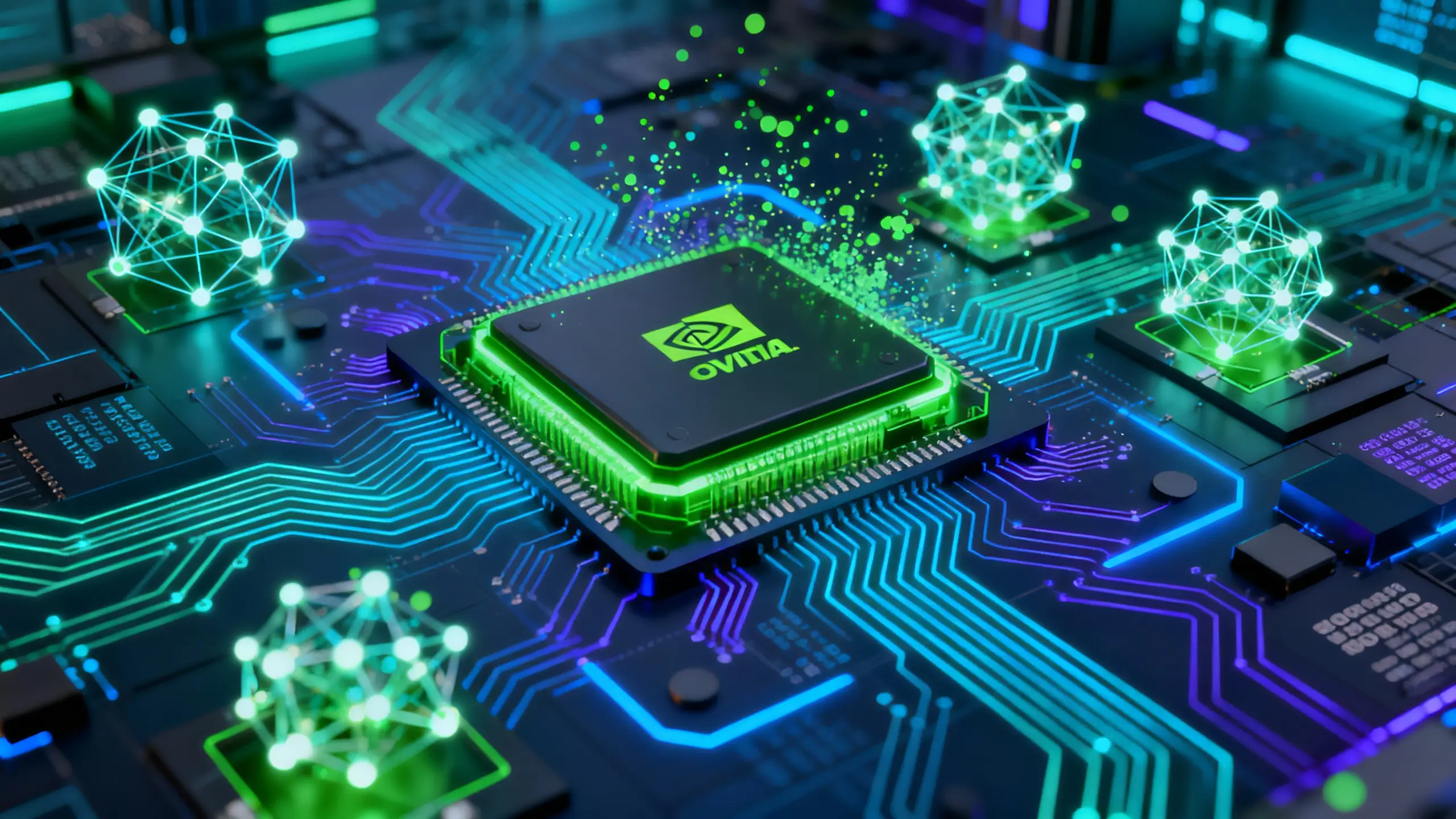
On January 5, 2026, at CES in Las Vegas, NVIDIA CEO Jensen Huang unveiled what may be the most significant advancement in AI computing infrastructure since the company revolutionized the field with its first data center GPUs. The Rubin platform, named after astronomer Vera Rubin who discovered dark matter, represents a complete reimagining of AI computing architecture—not as individual components, but as an extreme-codesigned system of six integrated chips working in perfect harmony.
The numbers are staggering. Rubin delivers up to 50 petaflops of NVFP4 inference performance—five times faster than the previous Blackwell generation. It achieves a 10x reduction in inference token costs, meaning AI companies can process ten times as many tokens using the same time and power. Training mixture-of-experts models requires four times fewer GPUs than before. And all of this comes with a 5x performance uplift compared to Blackwell while using only 1.6x more transistors—a testament to the platform's extreme codesign philosophy.
"The Rubin platform harnesses extreme codesign to deliver unprecedented performance and efficiency," NVIDIA stated in its official announcement. "This isn't just a new GPU—it's a complete computing system designed from the ground up for the agentic AI era."
The platform is already entering full production, with major cloud providers including Microsoft Azure, AWS, Google Cloud, and CoreWeave deploying Rubin systems starting in the second half of 2026. This rapid transition from announcement to production deployment reflects both the platform's readiness and the urgent demand for more efficient AI infrastructure as companies race to deploy increasingly sophisticated AI applications.
The Six-Chip Architecture: Extreme Codesign in Action
What makes Rubin revolutionary isn't just the performance numbers—it's the architectural philosophy. Rather than optimizing individual components in isolation, NVIDIA designed all six chips together as a unified system, enabling optimizations that would be impossible with a traditional approach.
The Rubin GPU serves as the computational heart, featuring 336 billion transistors and delivering up to 50 petaflops of NVFP4 inference compute and 35 petaflops of training performance. The GPU incorporates HBM4 memory with up to 22 TB/s bandwidth per chip—a 2.8x increase over Blackwell that addresses one of the most critical bottlenecks in AI workloads. This massive memory bandwidth enables the GPU to feed data to its processing cores at unprecedented speeds, eliminating the memory starvation that has limited previous generations.
The Vera CPU represents NVIDIA's most advanced processor yet, featuring 88 Olympus cores and 176 threads with 227 billion transistors. According to WCCFtech's detailed analysis, the Vera CPU provides 1.5 TB of system memory with 1.2 TB/s memory bandwidth using LPDDR5X, representing a 3x increase over the previous Grace generation. The CPU connects to GPUs through NVLink-C2C coherent memory interconnect at 1.8 TB/s, creating a unified memory architecture that allows CPUs and GPUs to share data seamlessly.
The NVLink 6 Switch represents the sixth generation of NVIDIA's high-speed interconnect technology, delivering 3.6 TB/s bidirectional bandwidth per GPU—double the previous generation and over 14x faster than PCIe Gen6. In the full Vera Rubin NVL72 rack-scale configuration with 72 GPUs, the system achieves 260 TB/s of total bandwidth in an all-to-all topology, enabling every GPU to communicate with every other GPU at maximum speed simultaneously.
The ConnectX-9 SuperNIC provides advanced networking capabilities optimized for AI workloads, while the BlueField-4 DPU offloads infrastructure tasks from the main processors, enabling more efficient resource utilization. The Spectrum-6 Ethernet Switch completes the platform with 5x improved power efficiency for networking infrastructure, addressing one of the most significant operational costs in large-scale AI deployments.
This extreme codesign approach enables optimizations that cascade across the entire system. When the GPU needs data, the CPU can provide it instantly through the coherent memory interconnect. When multiple GPUs need to share intermediate results during training, the NVLink 6 Switch enables near-instantaneous communication. When the system needs to move data to and from storage, the SuperNIC and DPU handle it efficiently without burdening the main processors. Every component is optimized not just for its individual function, but for how it contributes to the overall system's performance.
Performance Breakthrough: 5x Uplift with Minimal Transistor Increase
Perhaps the most impressive aspect of Rubin's design is its efficiency. The platform delivers a 5x performance uplift compared to Blackwell while using only 1.6x more transistors—a remarkable achievement that demonstrates the power of extreme codesign. Traditional chip design approaches typically require roughly proportional increases in transistor count to achieve performance gains, but Rubin's integrated design enables much more efficient utilization of every transistor.
This efficiency improvement has profound implications for AI infrastructure economics. Training a 10-trillion parameter model that previously required massive GPU clusters can now be accomplished with one-quarter of the hardware, as reported by TechCrunch. This reduction doesn't just lower capital costs—it dramatically reduces power consumption, cooling requirements, and data center footprint, making large-scale AI training more accessible and sustainable.
The performance gains are particularly dramatic for inference workloads, where Rubin achieves the 10x reduction in token costs that has captured industry attention. This improvement means that AI companies running inference at scale can process ten times as many user queries with the same infrastructure investment, fundamentally changing the economics of deploying AI applications to millions of users.
For mixture-of-experts models, which have become increasingly important for efficient large language model deployment, Rubin requires 4x fewer GPUs for training compared to Blackwell. This reduction addresses one of the key challenges in deploying MoE models: the massive computational resources required for training. With Rubin, companies can train sophisticated MoE architectures that would have been economically impractical with previous generations.
The platform's memory architecture plays a crucial role in these performance gains. The 22 TB/s HBM4 bandwidth per chip ensures that the GPU's processing cores are never starved for data, while the 1.8 TB/s NVLink-C2C interconnect between CPUs and GPUs enables seamless data sharing that eliminates traditional bottlenecks. The system's 260 TB/s total bandwidth in the NVL72 configuration ensures that even the most communication-intensive workloads can run efficiently.
The Inference Revolution: 10x Cost Reduction
Rubin's most immediately impactful improvement may be its 10x reduction in inference token costs compared to Blackwell. This achievement addresses one of the most significant barriers to deploying AI applications at scale: the cost of serving millions of users with real-time AI responses.
The cost reduction comes from processing ten times as many tokens using the same time and power, as explained in NVIDIA's technical documentation. This efficiency improvement means that an AI service that previously required 1,000 GPUs to serve a million users could potentially serve ten million users with the same infrastructure, or serve the same million users with 100 GPUs—dramatically reducing both capital and operational costs.
The implications extend far beyond cost savings. Lower inference costs enable new categories of AI applications that were previously economically unviable. Real-time AI assistants that respond to every user interaction, AI-powered search that processes complex queries instantly, and agentic AI systems that make autonomous decisions—all of these become more feasible when inference costs drop by an order of magnitude.
NVIDIA also introduced the Inference Context Memory Storage Platform specifically to address agentic AI's memory bottleneck. This innovation moves key-value cache data from GPUs to shared AI-native storage, delivering five times higher tokens per second with five times better power efficiency. This capability is particularly important for agentic AI applications that maintain context across long conversations or complex multi-step tasks, where traditional GPU memory limitations have been a significant constraint.
The inference improvements also benefit from Rubin's extreme codesign. The platform's unified memory architecture means that context data can be stored efficiently and accessed quickly, while the NVLink 6 Switch enables rapid communication between GPUs when distributing inference workloads across multiple processors. The Vera CPU's massive memory capacity provides additional context storage that complements the GPU's high-speed processing.
Rack-Scale Supercomputers: The NVL72 and NVL8 Systems
Rubin isn't just a collection of chips—it's designed as complete rack-scale supercomputers that integrate all six components into optimized systems. The Vera Rubin NVL72 represents the flagship configuration, combining 72 Rubin GPUs with 36 Vera CPUs in a single rack that delivers 260 TB/s of total bandwidth.
According to NVIDIA's detailed specifications, each NVL72 rack contains 220 trillion transistors across all components, representing one of the most complex computing systems ever created. The system uses 45°C liquid cooling, eliminating the need for expensive water chillers that have been a significant operational cost in previous-generation data centers. This cooling efficiency, combined with the platform's power efficiency improvements, dramatically reduces the total cost of ownership for AI infrastructure.
The system's all-to-all NVLink 6 topology means that every GPU can communicate directly with every other GPU at maximum bandwidth, enabling efficient parallel processing for the largest AI models. This architecture is particularly important for training workloads where different parts of a model may be distributed across different GPUs, requiring constant communication to synchronize gradients and parameters.
The HGX Rubin NVL8 provides a smaller-scale configuration for workloads that don't require the full NVL72's capacity, offering the same extreme codesign benefits in a more compact form factor. This flexibility allows cloud providers and enterprises to match infrastructure to their specific needs while still benefiting from Rubin's architectural advantages.
Microsoft's strategic datacenter planning demonstrates how major cloud providers are preparing for Rubin deployment. According to Microsoft's Azure blog, the company's Fairwater AI superfactories in Wisconsin and Atlanta were engineered in advance to accommodate Rubin's power, thermal, memory, and networking requirements. This forward-looking infrastructure planning reflects the scale of investment required and the confidence that major cloud providers have in Rubin's capabilities.
Cloud Provider Deployment: The Race to Production
The rapid deployment timeline for Rubin reflects both the platform's readiness and the urgent demand from AI companies for more efficient infrastructure. Microsoft Azure, AWS, Google Cloud, and CoreWeave are all deploying Rubin systems starting in the second half of 2026, with some providers expected to be among the first to offer Rubin-based instances.
CoreWeave's announcement provides insight into how specialized AI cloud providers are positioning Rubin. According to CoreWeave's press release, the company will operate Rubin through its CoreWeave Mission Control platform to provide flexibility and performance optimization. The deployment will specifically support customers building agentic AI, reasoning, and large-scale inference workloads—use cases that benefit most from Rubin's inference cost reductions and memory architecture improvements.
Microsoft's preparation for large-scale Rubin deployments demonstrates the strategic importance that major cloud providers place on AI infrastructure. The company's Fairwater AI superfactories represent billions of dollars in infrastructure investment specifically designed to support next-generation AI workloads. The fact that Microsoft engineered these facilities in advance to accommodate Rubin's requirements reflects both confidence in the platform and recognition that AI infrastructure is becoming a critical competitive differentiator.
The deployment timeline also reflects the maturity of Rubin's design. Unlike previous generations that required significant time between announcement and production availability, Rubin is entering full production immediately, with partner availability scheduled for the second half of 2026. This rapid transition suggests that NVIDIA has been developing and validating the platform for some time, ensuring that it's ready for production workloads when cloud providers begin deployment.
Technical Specifications: The Numbers Behind the Performance
The Rubin GPU's specifications reflect the platform's focus on both raw performance and efficiency. With 336 billion transistors, the GPU represents one of the most complex chips ever created, yet it delivers performance improvements that far exceed the proportional increase in transistor count. The 50 petaflops of NVFP4 inference compute represents a new benchmark for AI inference performance, while the 35 petaflops of training performance ensures that the platform excels at both training and inference workloads.
The HBM4 memory with 22 TB/s bandwidth per chip addresses one of the most persistent bottlenecks in AI computing. Previous generations have been limited by memory bandwidth, with GPUs often waiting for data to arrive from memory while their processing cores sit idle. Rubin's massive memory bandwidth ensures that data flows to processing cores at speeds that match their computational capabilities, eliminating this bottleneck and enabling more efficient utilization of the GPU's processing power.
The Vera CPU's 88 Olympus cores and 176 threads provide substantial compute capability for CPU-intensive tasks, while the 1.5 TB of system memory with 1.2 TB/s bandwidth offers massive capacity for storing context, models, and intermediate results. The NVLink-C2C coherent interconnect at 1.8 TB/s creates a unified memory space where CPUs and GPUs can share data seamlessly, enabling optimizations that weren't possible with previous architectures.
The NVLink 6 Switch's 3.6 TB/s bidirectional bandwidth per GPU enables the all-to-all communication topology that makes the NVL72 system possible. In a system with 72 GPUs, this means that every GPU can communicate with every other GPU simultaneously at maximum speed, enabling efficient parallel processing for the largest AI models. The 260 TB/s total bandwidth in the NVL72 configuration represents an unprecedented level of interconnect performance that enables new categories of distributed AI workloads.
The Competitive Landscape: NVIDIA's AI Infrastructure Dominance
Rubin's announcement comes at a time when competition in AI infrastructure is intensifying. Companies including AMD, Intel, and specialized AI chip startups are all developing alternatives to NVIDIA's GPUs, while cloud providers are exploring custom silicon solutions. However, Rubin's extreme codesign approach and comprehensive platform strategy create advantages that are difficult for competitors to match.
The platform's 10x inference cost reduction addresses one of the most significant pain points for AI companies, potentially making NVIDIA's infrastructure the clear economic choice for large-scale AI deployment. The 4x reduction in GPUs needed for MoE training similarly addresses training costs, which have been a major barrier to deploying sophisticated AI models.
NVIDIA's approach of designing complete systems rather than individual components also creates switching costs that make it difficult for customers to adopt alternative solutions. A company that has optimized its AI infrastructure around Rubin's six-chip architecture, unified memory system, and NVLink 6 interconnect would face significant challenges migrating to a different platform, even if individual components from competitors offered competitive performance.
The rapid deployment timeline also gives NVIDIA a time-to-market advantage. With Rubin entering production immediately and cloud providers deploying systems in the second half of 2026, NVIDIA will have months or potentially years of real-world deployment experience before competitors can offer comparable solutions. This experience will enable NVIDIA to refine the platform based on actual usage patterns, creating a feedback loop that further strengthens its competitive position.
However, the competitive landscape is also evolving. Cloud providers are investing heavily in custom AI chips, with companies like Google developing TPUs and Amazon developing Trainium and Inferentia processors. These custom solutions can be optimized for specific workloads and may offer advantages for particular use cases. NVIDIA's challenge is to maintain its platform's general-purpose advantages while also ensuring that it excels at the specific workloads that matter most to customers.
Use Cases: Where Rubin Makes the Difference
Rubin's performance and efficiency improvements enable new categories of AI applications and make existing applications more economically viable. The platform's capabilities are particularly valuable for several key use cases that are driving AI adoption.
Agentic AI represents one of the most important applications for Rubin's capabilities. These systems, which can autonomously complete complex multi-step tasks, require maintaining context across long sequences of actions and making decisions in real-time. Rubin's Inference Context Memory Storage Platform and massive memory bandwidth are specifically designed to address the memory bottlenecks that have limited agentic AI deployment. The platform's inference cost reductions also make agentic AI more economically viable, as these systems typically require extensive inference compute to maintain context and make decisions.
Large-scale inference for consumer applications benefits dramatically from Rubin's 10x cost reduction. AI-powered search, real-time translation, image generation, and conversational assistants all become more economically viable when inference costs drop by an order of magnitude. This cost reduction enables companies to offer these services to millions of users without the infrastructure costs that would have made them unprofitable with previous generations.
Training mixture-of-experts models represents another key use case where Rubin's 4x reduction in required GPUs has significant impact. MoE models have become increasingly important for efficient large language model deployment, as they enable models to activate only a subset of parameters for each input, reducing computational requirements while maintaining model quality. However, training MoE models has been computationally expensive, limiting their adoption. Rubin's efficiency improvements make MoE training more accessible, potentially accelerating the adoption of these more efficient model architectures.
Scientific computing and research applications also benefit from Rubin's capabilities. Drug discovery, genomic research, climate simulation, and fusion energy modeling all require massive computational resources, and Rubin's performance improvements make these applications more feasible. The platform's unified memory architecture and high-speed interconnects are particularly valuable for these workloads, which often involve complex data structures and require extensive communication between processing units.
The Future of AI Infrastructure: What Rubin Enables
Rubin's capabilities suggest a future where AI infrastructure is not just faster and more efficient, but fundamentally different in how it's architected and used. The platform's extreme codesign philosophy points toward a trend where AI computing systems are designed as integrated platforms rather than collections of individual components.
The 10x inference cost reduction suggests that we're approaching a point where AI inference becomes so inexpensive that it can be integrated into applications that previously couldn't justify the cost. Real-time AI features in consumer applications, AI-powered automation in enterprise software, and agentic AI systems that handle routine tasks autonomously—all of these become more feasible when inference costs are low enough to be essentially negligible.
The platform's memory architecture innovations, particularly the Inference Context Memory Storage Platform, point toward AI systems that can maintain much longer context windows and handle more complex multi-step tasks. This capability is essential for the agentic AI applications that many companies are developing, where AI systems need to maintain awareness of context across extended interactions and complex workflows.
Rubin's efficiency improvements also have implications for AI's environmental impact. The 5x performance uplift with only 1.6x transistor increase means that the same computational work can be accomplished with significantly less power consumption. Combined with the platform's liquid cooling efficiency and power-optimized networking, Rubin represents a step toward more sustainable AI infrastructure that can scale to serve billions of users without proportional increases in energy consumption.
The platform's rapid deployment timeline also suggests that AI infrastructure is becoming more of a commodity, with new generations becoming available more quickly and cloud providers competing to offer the latest capabilities. This acceleration could lead to a future where AI infrastructure improvements are available to companies of all sizes, not just the largest tech companies with the resources to build custom infrastructure.
Conclusion: The Next Generation of AI Computing
NVIDIA's Rubin platform represents more than an incremental improvement—it's a fundamental reimagining of how AI computing systems are designed and deployed. The extreme codesign philosophy that integrates six chips into a unified platform, the 10x inference cost reduction, the 5x performance uplift with minimal transistor increase, and the comprehensive rack-scale systems all point toward a future where AI infrastructure is more powerful, more efficient, and more accessible.
For AI companies, Rubin's capabilities mean that deploying sophisticated AI applications at scale becomes more economically viable. The 10x cost reduction for inference enables new categories of applications, while the 4x reduction in training hardware makes developing advanced models more accessible. The platform's memory architecture innovations address bottlenecks that have limited agentic AI deployment, while the unified system design enables optimizations that weren't possible with previous architectures.
For cloud providers, Rubin represents an opportunity to offer more competitive AI infrastructure while also improving their own operational efficiency. The platform's power efficiency improvements reduce operational costs, while the performance gains enable providers to serve more customers with the same infrastructure investment. The rapid deployment timeline also means that providers can begin offering Rubin-based services relatively quickly, gaining a competitive advantage in the race to provide the best AI infrastructure.
For the broader technology industry, Rubin's capabilities suggest that we're entering an era where AI becomes so inexpensive and capable that it can be integrated into virtually every application and service. The 10x inference cost reduction is particularly significant in this regard, as it moves AI from a premium feature that requires careful cost management to a capability that can be included in applications without significant economic constraints.
As Rubin enters production and cloud providers begin deployment in the second half of 2026, we'll see how these capabilities translate into real-world applications. The platform's extreme codesign philosophy, comprehensive system architecture, and dramatic performance improvements position it as a foundational technology for the next generation of AI applications. The question isn't whether Rubin will transform AI infrastructure—the platform's capabilities make that transformation inevitable. The question is how quickly that transformation will occur and what new applications and capabilities it will enable.
One thing is certain: with Rubin, NVIDIA has created not just a new generation of AI chips, but a complete computing platform that represents the state of the art in AI infrastructure. As 2026 unfolds and the platform enters production deployment, its impact on the AI industry will be profound, enabling new applications, reducing costs, and accelerating the adoption of artificial intelligence across every industry.