

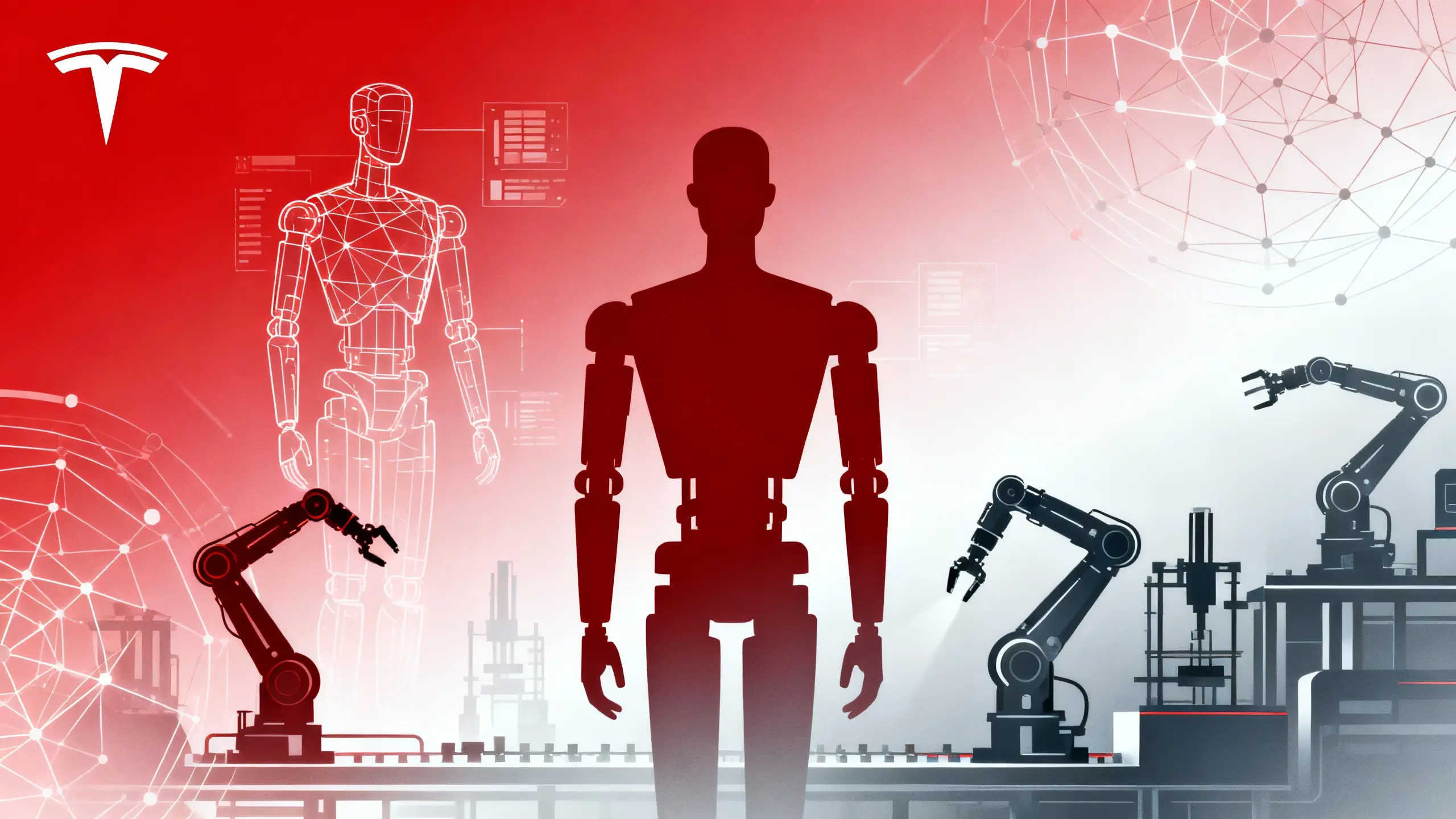
Tesla's Optimus Gen 3, entering production in 2026, represents a historic shift from research prototypes to commercial humanoid robots deployed in manufacturing. As of January 2026, over 1,000 Optimus units are operating across Tesla's global manufacturing facilities, primarily at Gigafactory Texas and Fremont, handling autonomous parts processing, kitting tasks, and intricate assembly work on 4680 battery cell lines.
According to markets.financialcontent.com's coverage, the Gen 3 features revolutionary 22-degree-of-freedom hands with actuators relocated to the forearms using a tendon-driven system, approaching human hand dexterity with integrated tactile sensors. The robot runs on FSD-v15 neural architecture, treating the robot as "a vehicle with legs and hands" and enabling vision-based autonomy in unscripted factory environments.
Tesla is targeting 1 million units annually at Fremont by late 2026, with a dedicated 10-million-unit facility under construction at Gigafactory Texas expected to come online in 2027. According to Humanoids Daily's coverage, the V3 prototype, described by Elon Musk as so advanced "it won't even seem like a robot" and will appear "like a person in a robot suit," is scheduled for unveiling in Q1 2026.
Tesla is pursuing aggressive vertical integration to achieve a $20,000 manufacturing cost at scale, though the complexity of 10,000 components per robot presents significant supply chain challenges. According to Digitimes' analysis, Tesla plans to leverage its vehicle drivetrain experience to standardize actuators and reduce electronics expenses, targeting a $30,000 external price point.
22-Degree-of-Freedom Hands: Approaching Human Dexterity
Tesla's Optimus Gen 3 features revolutionary hands with 22 degrees of freedom, plus 3 additional degrees in the wrist and forearm, approaching human hand capability (which has approximately 27 DoF). According to Kingy.ai's analysis, the design uses a tendon-driven architecture with all actuators relocated to the forearm, reducing weight while increasing agility and enabling precise manipulation of both fragile and heavy components.
This hand design is significant because it enables human-level dexterity. According to OpenTools.ai's coverage, the hands include integrated tactile sensors and a soft protective layer, enabling precise tasks like catching tennis balls and handling fragile objects without damage. This capability is crucial for manufacturing tasks that require delicate manipulation.
The tendon-driven system also enables efficient power transmission. According to Robottoday.com's analysis, the design employs custom planetary gearboxes and ball-screw linear actuators in the forearm, converting motor rotation into tendon pull—mimicking biological muscle-tendon systems. A non-backdrivable clutch mechanism allows fingers to lock in place without continuous power consumption, improving efficiency.
However, the hand design also represents significant engineering challenges. According to Humanoids Daily's coverage, the hands and forearms are identified as the single greatest electromechanical challenge for humanoid robots. This complexity is crucial for achieving human-level dexterity but adds manufacturing complexity.
The hand design also highlights the importance of tactile sensing. According to markets.financialcontent.com's coverage, integrated tactile sensors allow precise pressure control for handling both fragile and heavy components, which is crucial for manufacturing applications that require fine motor control.
FSD-v15 Neural Architecture: Physical AI for Humanoid Robots
Tesla's Optimus Gen 3 runs on FSD-v15 neural architecture, a direct evolution of Tesla's autonomous vehicle software that treats the robot as "a vehicle with legs and hands." According to markets.financialcontent.com's coverage, this "Physical AI" stack utilizes end-to-end neural networks to process sensory data and control movement, enabling vision-based autonomy in unscripted factory environments.
This neural architecture is significant because it enables autonomous operation. According to Capitaly.vc's analysis, the system uses a single unified neural network processing data from 8 high-resolution cameras, IMU sensors, and force sensors simultaneously, enabling the robot to navigate and operate in complex, unscripted environments. This capability is crucial for manufacturing applications that require adaptability.
The FSD-v15 architecture also enables continuous learning. According to Business Insider's coverage, Tesla is collecting data at Gigafactory Texas to train Optimus for factory operations, with data collectors recording themselves organizing vehicle parts and working on conveyor belts to teach the robots to mimic movements. This continuous learning is crucial for improving performance over time.
However, the neural architecture also requires significant computational resources. According to Capitaly.vc's analysis, the unified neural network must process multiple sensor streams simultaneously, requiring powerful onboard computing. This computational requirement is crucial for real-time operation but adds complexity and cost.
The neural architecture also highlights the importance of sensor fusion. According to markets.financialcontent.com's coverage, the system combines visual, inertial, and force sensor data to enable robust operation in complex environments. This sensor fusion is crucial for reliable autonomous operation.
Factory Deployment: From Prototypes to Production
As of January 2026, Tesla has deployed over 1,000 Optimus units across its global manufacturing facilities, primarily at Gigafactory Texas and Fremont, marking the transition from research and development to commercial deployment. According to markets.financialcontent.com's coverage, the robots are performing autonomous parts processing on 4680 battery cell lines, kitting tasks, and identifying misplaced components in unscripted factory environments.
This deployment is significant because it demonstrates real-world capabilities. According to Business Insider's coverage, Elon Musk stated the robots are currently doing "simple tasks" but will progress to "more complex tasks" by year-end 2026. This progression is crucial for demonstrating the value of humanoid robots in manufacturing.
The factory deployment also enables data collection for training. According to Business Insider's coverage, Tesla began collecting data at Gigafactory Texas in February 2026 to train Optimus for factory operations, with data collectors recording themselves performing tasks to teach the robots. This data collection is crucial for improving robot capabilities.
However, factory deployment also requires careful integration. According to markets.financialcontent.com's coverage, the robots must operate safely alongside human workers and integrate with existing manufacturing processes. This integration is crucial for successful deployment but requires careful planning and validation.
The factory deployment also highlights the importance of reliability. According to markets.financialcontent.com's coverage, the robots operate with true vision-based autonomy, independently identifying, picking, and placing delicate components with failure rates lower than human trainees. This reliability is crucial for manufacturing applications.
Production Strategy: 1 Million at Fremont, 10 Million at Texas
Tesla has outlined an ambitious two-phase production strategy, targeting 1 million units annually at Fremont by late 2026 and 10 million units annually at a dedicated facility at Gigafactory Texas expected to come online in 2027. According to Humanoids Daily's coverage, pilot production of Optimus V3 units is already underway at Fremont, with the company targeting a ramp to 1 million units per year by late 2026.
This production strategy is significant because it demonstrates Tesla's commitment to scale. According to Tesla North's coverage, Tesla has begun construction on a dedicated stand-alone Optimus factory at Gigafactory Texas, which will have an annual production capacity of 10 million robots. This facility is expected to come online in 2027 and will take all of 2026 to complete.
The production strategy also enables cost reduction through scale. According to Humanoids Daily's coverage, Tesla targets a manufacturing cost of around $20,000 per unit once production scales, with a $30,000 external price point. This cost target is crucial for making humanoid robots economically viable for widespread adoption.
However, the production strategy also faces significant challenges. According to Digitimes' analysis, each Optimus contains roughly 10,000 components, many custom-designed, creating complex logistics dependencies. Suppliers warn that sourcing 10,000 components per robot complicates 1 million production capacity timelines.
The production strategy also highlights the importance of vertical integration. According to Digitimes' analysis, Tesla plans to leverage its vehicle drivetrain experience to standardize actuators and reduce electronics expenses, enabling cost reduction through vertical integration. This strategy is crucial for achieving the $20,000 cost target.
Vertical Integration: Building the Supply Chain from Scratch
Tesla is pursuing aggressive vertical integration to achieve its production goals, building a humanoid robot supply chain from scratch. According to Humanoids Daily's coverage, Elon Musk stated that "with a humanoid robot, there is no supply chain," forcing Tesla to manufacture deep into the supply chain and vertically integrate components internally.
This vertical integration is significant because it enables cost control. According to Digitimes' analysis, Tesla plans to leverage its vehicle drivetrain experience to standardize actuators and reduce electronics expenses, enabling cost reduction through vertical integration. This strategy is crucial for achieving the $20,000 manufacturing cost target.
The vertical integration also enables quality control. According to Digitimes' analysis, by manufacturing components internally, Tesla can ensure quality and consistency, which is crucial for reliable robot operation. This quality control is essential for manufacturing applications.
However, vertical integration also requires significant investment. According to Digitimes' analysis, building a supply chain from scratch requires substantial capital investment in manufacturing facilities and equipment. This investment is crucial for long-term success but presents near-term financial challenges.
The vertical integration also highlights the complexity of humanoid robots. According to Digitimes' analysis, each Optimus contains roughly 10,000 components, many custom-designed, creating complex logistics dependencies. This complexity is crucial for achieving human-level capabilities but adds manufacturing complexity.
V3 Prototype: "Like a Person in a Robot Suit"
Tesla's V3 prototype, scheduled for unveiling in Q1 2026, represents a significant capability leap. According to Humanoids Daily's coverage, Elon Musk described the V3 as so advanced that "it won't even seem like a robot" and will appear "like a person in a robot suit." This description suggests significant improvements in appearance, movement, and behavior.
This V3 prototype is significant because it represents production-intent design. According to Humanoids Daily's coverage, the V3 is a production-intent prototype, meaning it's designed for manufacturing rather than research. This transition is crucial for moving from prototypes to commercial products.
The V3 prototype also demonstrates continuous iteration. According to Humanoids Daily's coverage, unlike traditional manufacturing, Tesla plans to continuously iterate hardware design even after production begins. This iterative approach is crucial for improving capabilities over time.
However, the V3 prototype also faces high expectations. According to Humanoids Daily's coverage, Musk's description of the V3 as appearing "like a person in a robot suit" sets very high expectations for appearance and behavior. Meeting these expectations is crucial for market acceptance but presents significant technical challenges.
The V3 prototype also highlights the importance of production readiness. According to Humanoids Daily's coverage, the V3 is designed for production, meaning it must be manufacturable at scale. This production readiness is crucial for achieving Tesla's ambitious production targets.
Manufacturing Challenges: 10,000 Components Per Robot
Tesla faces significant manufacturing challenges in scaling Optimus production, with each robot containing roughly 10,000 components, many custom-designed. According to Digitimes' analysis, suppliers warn that sourcing 10,000 components per robot complicates 1 million production capacity timelines, with Tesla acknowledging that production ramp "will be limited by the slowest part."
This component complexity is significant because it creates supply chain dependencies. According to Digitimes' analysis, the complexity of 10,000 components per robot creates complex logistics dependencies, requiring careful coordination across multiple suppliers. This coordination is crucial for achieving production targets but presents significant challenges.
The component complexity also highlights the importance of vertical integration. According to Digitimes' analysis, Tesla's vertical integration strategy aims to reduce supply chain dependencies by manufacturing components internally. This strategy is crucial for achieving production targets but requires significant investment.
However, component complexity also requires careful design. According to Digitimes' analysis, many components are custom-designed, requiring specialized manufacturing capabilities. This customization is crucial for achieving human-level capabilities but adds manufacturing complexity.
The component complexity also highlights the importance of standardization. According to Digitimes' analysis, Tesla plans to leverage its vehicle drivetrain experience to standardize actuators and reduce electronics expenses. This standardization is crucial for achieving cost targets but requires careful design.
The Future of Manufacturing: Humanoid Robots at Scale
Tesla's Optimus Gen 3 represents a significant step toward humanoid robots at scale in manufacturing. The combination of human-level dexterity, autonomous operation, and ambitious production targets positions Tesla as a leader in humanoid robotics. However, the success of this vision will depend on several factors.
The future of manufacturing also depends on cost reduction. According to Humanoids Daily's coverage, Tesla targets a $20,000 manufacturing cost at scale, which is crucial for making humanoid robots economically viable. Achieving this cost target requires successful vertical integration and production scaling.
The manufacturing market is also evolving rapidly. According to Digitimes' analysis, Tesla executives argue that few rivals possess the combined AI, hardware, and manufacturing capabilities to execute this strategy. This competitive advantage is crucial for market leadership but requires continued innovation.
The future of manufacturing also depends on reliability and safety. According to markets.financialcontent.com's coverage, the robots operate with true vision-based autonomy, independently identifying, picking, and placing delicate components with failure rates lower than human trainees. This reliability is crucial for manufacturing applications.
Conclusion: Transforming Manufacturing with Humanoid Robots
Tesla's Optimus Gen 3 represents a historic shift from research prototypes to commercial humanoid robots deployed in manufacturing. The combination of 22-degree-of-freedom hands, FSD-v15 neural architecture, and ambitious production targets positions Tesla as a leader in humanoid robotics.
The robot's ability to operate autonomously in unscripted factory environments, handle delicate components with human-level dexterity, and scale to millions of units demonstrates the practical value of humanoid robots for manufacturing. The aggressive vertical integration strategy and ambitious production targets show Tesla's commitment to making humanoid robots economically viable.
However, the success of Optimus Gen 3 will depend on achieving production targets, meeting cost goals, and demonstrating reliability in manufacturing applications. The complexity of 10,000 components per robot and the challenges of building a supply chain from scratch present significant hurdles. The future of manufacturing looks promising, with Optimus Gen 3 leading the way.
As humanoid robots continue to evolve, we can expect even better capabilities, lower costs, and broader adoption. Tesla's commitment to continuous iteration, vertical integration, and production scaling positions it well for the future of manufacturing. Optimus Gen 3 is just the beginning of what's possible with humanoid robots in manufacturing.
The transformation of manufacturing through humanoid robots is underway, and Tesla's Optimus Gen 3 is at the forefront of this revolution. Whether this leadership continues will depend on achieving production targets, meeting cost goals, and demonstrating value in manufacturing applications. One thing is certain: humanoid robots are becoming more capable, affordable, and integral to manufacturing, and Tesla is leading the charge.