

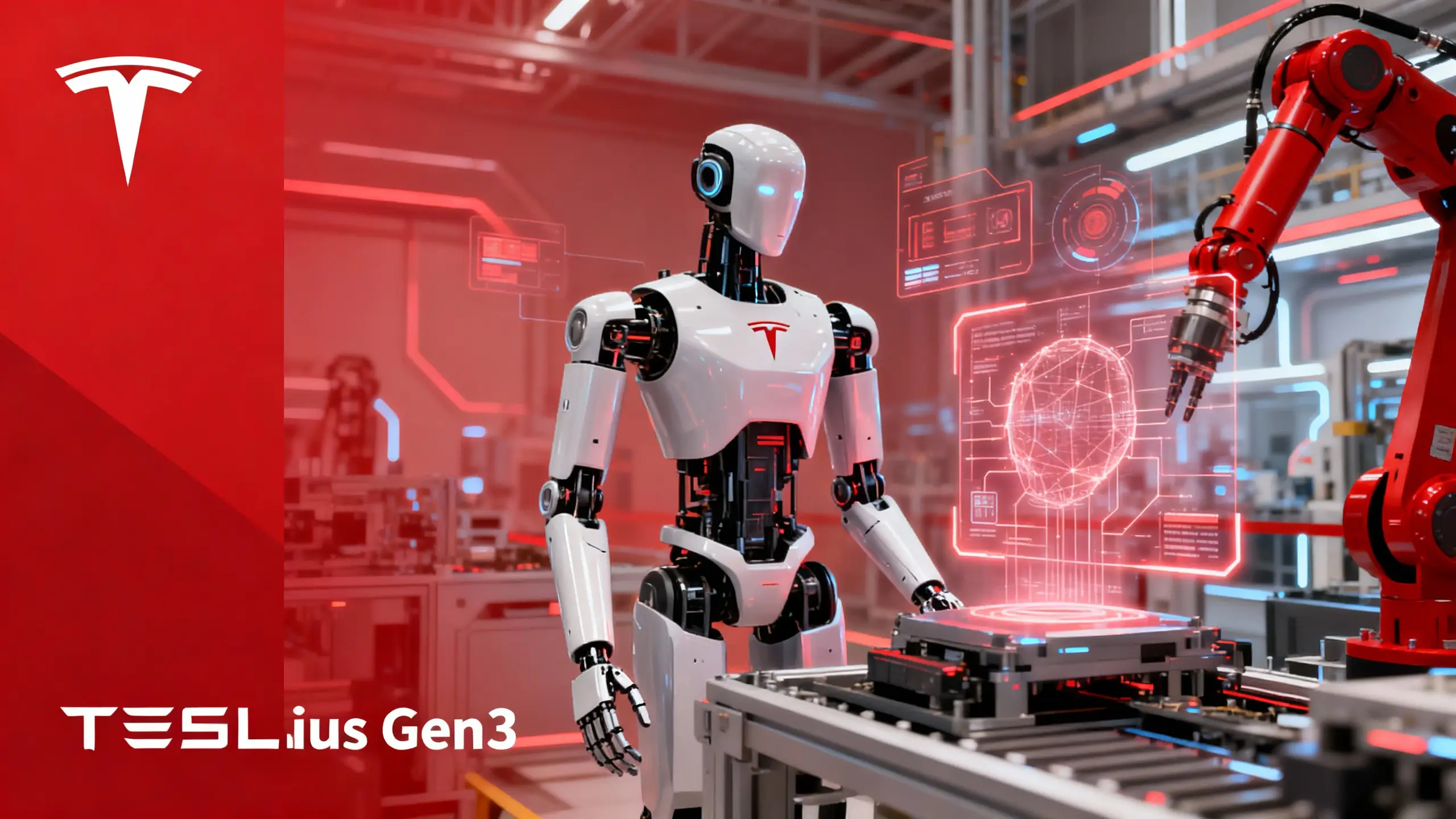
In January 2026, a milestone that many in the robotics industry considered years away has become reality: Tesla has deployed over 1,000 Optimus Gen 3 humanoid robots across its global manufacturing facilities, primarily at Gigafactory Texas and the Fremont facility. These robots are no longer prototypes or demonstrations—they're actively working on factory floors, handling autonomous parts processing, kitting tasks, and other manufacturing operations that previously required manual labor.
The deployment represents far more than a technical achievement. It marks the arrival of production-ready humanoid robotics at scale, with Tesla leading a transformation that could fundamentally reshape manufacturing, logistics, and eventually even domestic work. The Optimus Gen 3 (V3) robots, powered by the same FSD-v15 neural architecture that drives Tesla's autonomous vehicles, feature 22-degree-of-freedom hands with integrated tactile sensors, enabling them to handle both fragile components and heavy objects with human-like dexterity.
"We're treating factory work as Physical AI," Tesla's engineering team explained in recent demonstrations. "The same neural networks that understand roads and traffic can understand factory floors and manufacturing tasks."
The scale of Tesla's ambition is staggering. The company is targeting production of 1 million Optimus units annually by late 2026, with a dedicated factory under construction at Giga Texas expected to reach 10 million units per year by 2027. At scale, Tesla aims to achieve a manufacturing cost of approximately $20,000 per unit—a price point that would make humanoid robots economically viable for widespread factory deployment. This represents a dramatic cost reduction from the $50,000-$250,000 per unit that characterized the humanoid robotics industry just two years ago.
From Prototype to Production: The Gen 3 Breakthrough
The Optimus Gen 3 represents a fundamental evolution from previous generations, incorporating lessons learned from years of development and real-world testing. The robot stands 1.73 meters (5'8") tall and weighs 57 kilograms (125 pounds), with a carrying capacity of 20 kilograms (45 pounds). Its lightweight titanium body provides durability while maintaining the agility necessary for complex manufacturing tasks.
The most significant advancement is in the hands. The Gen 3 features 22 degrees of freedom across both hands—11 per hand—using tendon-driven mechanisms that provide human-like dexterity. Integrated tactile sensors enable the robots to sense pressure and texture, allowing them to handle delicate components like battery cells without damage while also gripping heavy objects securely. This dexterity is crucial for manufacturing applications where precision and adaptability are essential.
The robot's 50 total actuators—28 for the main body and 22 for the hands—provide the range of motion necessary for complex tasks. The system achieves 30% faster walking speed than previous generations, improving efficiency in factory environments where robots must move between workstations. Advanced balance control via foot sensors enables stable operation even when carrying loads or working on uneven surfaces.
Power and computing capabilities have also been significantly enhanced. The Gen 3 features a 2.3 kWh lithium-sulfur battery pack providing up to 24 hours of operation, with power consumption of 100W at idle and 500W during intensive activities. The robot's 16-core Tesla AI chip processor and AI5 brain deliver 50x the throughput of previous generations, enabling real-time processing of complex visual and sensor data necessary for autonomous operation.
Perhaps most importantly, the Gen 3 incorporates integrated Grok AI for natural language processing, enabling the robots to understand verbal instructions and communicate with human workers. This capability transforms humanoid robots from autonomous systems that operate independently to collaborative partners that can work alongside human teams, understanding context and adapting to changing requirements.
The FSD Connection: Neural Networks for Physical AI
What makes Optimus particularly revolutionary is its use of Tesla's Full Self-Driving neural architecture. The robots run FSD-v15, the same software foundation that powers Tesla's autonomous vehicles, adapted for physical manipulation rather than vehicle control. This approach represents a fundamental shift from traditional robotics programming to end-to-end neural network control.
According to Tesla's AI team, the company has developed a unified training architecture where the same neural networks can be trained for both autonomous driving and humanoid robotics. Tesla's VP of AI Software, Ashok Elluswamy, confirmed that the company's autonomy technology "seamlessly transfers" between vehicle and robotics applications, using the same training pipeline and data collection infrastructure.
This unified approach provides significant advantages. Tesla can leverage the massive data collection infrastructure built for autonomous vehicles—the company's fleet of over 4 million vehicles continuously collecting real-world driving data—and apply similar techniques to robotics. The company has built a "neural world simulator" trained on massive amounts of video data that generates high-fidelity synthetic video of AI actions, enabling closed-loop simulations for both vehicles and robots.
For Optimus specifically, Tesla is collecting training data by recording video of human workers performing tasks in its factories. According to Business Insider, the company has been collecting this data at its Fremont factory for over a year, using it to teach robots specific movements and tasks. The company is expanding this data collection to its Austin Gigafactory, with a targeted February 2026 start date.
This video-based training approach enables Optimus to learn tasks by observation rather than requiring explicit programming for each new task. When a robot needs to learn a new manufacturing operation, it can watch human workers perform the task and learn the necessary movements, adapting to variations and edge cases through neural network training rather than rule-based programming.
Factory Deployment: Real Work in Real Facilities
The deployment of over 1,000 Optimus units represents the largest-scale humanoid robot deployment in manufacturing history. These robots are actively working in Tesla's facilities, handling tasks that previously required human workers. The primary applications currently include autonomous parts processing, where robots sort and organize components for assembly, and kitting tasks, where robots prepare sets of parts needed for specific manufacturing operations.
According to reports from Tesla's facilities, the robots are demonstrating capabilities including sorting battery cells autonomously using cameras, hand tactile sensors, and force sensors. This task requires both visual recognition to identify different cell types and precise manipulation to handle delicate components without damage—capabilities that demonstrate the Gen 3's advanced sensor fusion and control systems.
The robots are also being tested for more complex tasks. Tesla has demonstrated Optimus units folding laundry and sorting objects, tasks that require understanding of fabric manipulation and object recognition—capabilities that translate directly to manufacturing applications like handling flexible materials or organizing components by type.
The deployment strategy is methodical. Tesla is starting with tasks that are well-defined and repetitive, allowing the robots to demonstrate reliability before expanding to more complex operations. As the neural networks improve through training data collection and the robots prove their capabilities, Tesla plans to expand their responsibilities to more sophisticated manufacturing tasks.
The company's goal is to have thousands of Optimus robots working in Tesla factories by the end of 2026, with the robots performing increasingly complex tasks as the technology matures. Elon Musk has stated that by the end of 2026, robots should be performing "more complex tasks" in industrial environments, with public sales expected by the end of 2027.
Production Scaling: From Hundreds to Millions
Tesla's production scaling plans are unprecedented in the robotics industry. The company is currently in pilot production at its Fremont facility, where hundreds of Gen 3 units have been built. However, the scaling trajectory is aggressive: Tesla aims to ramp up Optimus V3 production at Fremont to 1 million units per year by late 2026.
This scaling is supported by a dedicated Optimus factory under construction at Gigafactory Texas. According to Tesla North, the facility is expected to enter production in 2027 with a planned capacity of 10 million units annually. This scale of production would make Tesla the largest manufacturer of humanoid robots in the world, potentially by orders of magnitude.
The production timeline reflects Tesla's experience scaling automotive manufacturing. The company has demonstrated the ability to rapidly scale production of complex electromechanical systems, from the Model 3's production ramp to the Cybertruck's manufacturing challenges. Applying these capabilities to humanoid robotics could enable the rapid cost reductions necessary to make the technology economically viable at scale.
The target manufacturing cost of $20,000 per unit at scale represents a dramatic reduction from current humanoid robot prices. According to industry analysis, manufacturing costs across the humanoid robotics sector dropped 40% from 2023 to 2024, falling from $50,000-$250,000 to $30,000-$150,000 per unit. Tesla's $20,000 target would represent another significant step down, making humanoid robots cost-competitive with human labor in many applications.
However, initial commercial units will be priced significantly higher. Early enterprise units are expected to cost $100,000-$150,000, reflecting the higher costs of low-volume production and the value proposition for early adopters who can justify premium pricing for advanced capabilities. As production scales and costs decrease, pricing is expected to approach the $20,000 target, with pre-orders for Gen 3 expected in Q1 2026 at prices under $30,000.
The Competitive Landscape: Tesla vs. the World
Tesla's deployment of over 1,000 production robots places it ahead of most competitors in the race to commercialize humanoid robotics. However, the competitive landscape is intensifying, with multiple companies pursuing similar goals through different approaches.
Chinese competitors represent a significant challenge. According to Reuters reporting, nearly 30 Chinese companies are developing factory robots, with government-set targets for mass production by 2025. Companies like Shanghai Kepler Exploration Robotics are targeting sale prices under $30,000, compared to estimated material costs of approximately $150,000 each—suggesting significant government subsidies to accelerate adoption.
The Chinese approach emphasizes rapid deployment and cost competitiveness, with government support enabling companies to price aggressively to gain market share. This strategy could challenge Tesla's market position, particularly in manufacturing applications where cost is a primary consideration.
Other U.S. competitors include Figure AI, which has demonstrated impressive capabilities in humanoid robotics, Boston Dynamics (now a Hyundai Motor subsidiary) with its Atlas robot, Agility Robotics with its Digit robot designed for logistics, and Apptronik with its Apollo robot. However, none of these competitors have yet demonstrated the scale of deployment that Tesla has achieved with over 1,000 units in production use.
Tesla's advantages include its manufacturing expertise, neural network training infrastructure, and the ability to use its own factories as testing and deployment environments. The company can iterate rapidly, collecting real-world data from actual manufacturing applications and using that data to improve the robots' capabilities. This feedback loop—deploy robots, collect data, improve performance, deploy improved robots—could create a significant competitive advantage as the technology matures.
The company's unified FSD and Optimus training architecture also provides advantages. Rather than building separate AI systems for vehicles and robots, Tesla can leverage advances in one domain to benefit the other. Improvements in visual recognition, path planning, or decision-making for autonomous vehicles can be applied to humanoid robotics, accelerating development in both areas.
Economic Implications: The $20,000 Robot
The economic implications of humanoid robots at a $20,000 price point are profound. At this cost, robots become economically viable for a wide range of applications where they weren't previously feasible. The calculation is straightforward: if a robot can perform work equivalent to a human worker and costs $20,000 with a useful life of several years, it becomes cost-competitive with human labor in many manufacturing and logistics applications.
However, the economics are more complex than simple cost comparison. Humanoid robots offer advantages beyond labor cost savings: they can work 24 hours a day without breaks, don't require benefits or insurance, can perform dangerous tasks without safety concerns, and provide consistent quality without fatigue-related errors. These advantages can justify premium pricing even when robots aren't strictly cheaper than human workers on an hourly basis.
The $20,000 target also represents a threshold where robots become accessible to smaller manufacturers. Previous generations of humanoid robots, priced at $100,000 or more, were only viable for large enterprises with significant capital budgets. At $20,000, smaller manufacturers could justify purchasing robots for specific applications, potentially expanding the addressable market significantly.
Tesla's own use case demonstrates the value proposition. By deploying robots in its own factories, the company can validate the technology, improve performance through real-world use, and demonstrate ROI to potential customers. If Optimus robots can improve manufacturing efficiency, reduce costs, or enable new capabilities in Tesla's facilities, that success provides a compelling case for external customers.
The scaling economics also favor Tesla. As production increases from hundreds to millions of units, manufacturing costs should decrease through economies of scale, learning curve effects, and supply chain optimization. The company's experience scaling automotive production provides a roadmap for achieving these cost reductions in robotics manufacturing.
Technical Challenges: From Demonstration to Production
The transition from prototype to production has required solving numerous technical challenges that don't appear in controlled demonstrations. Real factory environments present variability, edge cases, and failure modes that must be handled robustly for production deployment.
Reliability is paramount. A robot that works perfectly in 99% of cases but fails unpredictably in 1% of cases isn't suitable for production manufacturing, where failures can disrupt entire production lines. Tesla has addressed this through extensive testing, redundant systems, and the ability to fall back to human workers when robots encounter situations they can't handle.
Safety is another critical consideration. Humanoid robots working alongside human workers must be designed to avoid causing injury. The Gen 3's tactile sensors and force control enable the robots to detect when they're making contact with humans or objects and adjust their force accordingly. However, ensuring safety in all scenarios requires extensive testing and validation.
Maintenance and serviceability are also important for production deployment. Robots that require specialized technicians for every repair aren't practical at scale. Tesla's experience with automotive service networks could provide advantages here, as the company understands how to design products for serviceability and build support infrastructure.
The neural network approach also presents challenges. While end-to-end learning provides flexibility and adaptability, it can be difficult to debug when robots make unexpected decisions. Understanding why a robot chose a particular action requires analyzing neural network activations, which is more complex than reviewing rule-based code. Tesla is addressing this through extensive logging and simulation capabilities that enable understanding robot decision-making.
Battery life and power management are practical concerns for production deployment. The Gen 3's 24-hour battery life is impressive, but in high-utilization scenarios, robots may need charging infrastructure or battery swap capabilities. Tesla's experience with electric vehicle charging infrastructure could inform solutions for robot power management.
Use Cases: Where Humanoid Robots Excel
The current deployment focuses on manufacturing applications, but the technology's potential extends far beyond factory floors. Humanoid robots' ability to work in environments designed for humans, use human tools, and navigate human spaces makes them suitable for a wide range of applications.
Manufacturing represents the immediate use case, where robots can handle repetitive tasks, work in hazardous environments, and operate during off-hours when human workers aren't present. The ability to handle both delicate and heavy components, work with existing factory infrastructure, and adapt to new tasks through learning makes humanoid robots particularly valuable for manufacturing applications.
Logistics and warehousing represent another major opportunity. Humanoid robots can work in existing warehouses designed for human workers, use standard equipment, and handle the variability inherent in logistics operations. The ability to pick and place items, navigate warehouse environments, and work alongside human workers could transform logistics operations.
Construction and maintenance offer opportunities where humanoid robots could work in hazardous environments or perform tasks that are difficult for human workers. The ability to work at height, handle heavy materials, and operate in confined spaces could make robots valuable for construction applications.
Eventually, domestic applications could represent an even larger market. Humanoid robots that can perform household tasks, assist with caregiving, or handle routine maintenance could transform daily life. However, these applications require even more advanced capabilities and are likely further in the future than manufacturing and logistics applications.
Tesla's current focus on manufacturing makes sense as a starting point. Factory environments are more controlled than domestic settings, tasks are more well-defined, and the economic case is clearer. Success in manufacturing provides the foundation for expanding to other applications as the technology matures.
The Path Forward: Scaling to Millions
Tesla's path to producing millions of Optimus robots annually represents one of the most ambitious scaling efforts in robotics history. The company's timeline—from hundreds of units in 2025 to 1 million annually by late 2026 to 10 million annually by 2027—requires solving challenges across manufacturing, supply chain, software, and deployment.
Manufacturing scaling requires building production lines capable of assembling complex electromechanical systems at unprecedented volumes. The Optimus factory under construction at Giga Texas will need to produce robots at rates that rival automotive production, requiring sophisticated automation, quality control, and supply chain management.
Supply chain scaling presents challenges as demand for components increases. Actuators, sensors, batteries, and computing components must be available in quantities sufficient to support millions of units annually. Tesla's experience managing automotive supply chains provides advantages, but robotics components may have different requirements or suppliers.
Software scaling requires ensuring that neural networks perform reliably across millions of robots in diverse environments. The unified training architecture helps, as improvements can be deployed across all robots, but validation and testing become more complex as deployment scales.
Deployment scaling requires building service and support infrastructure. Robots will need maintenance, software updates, and occasional repairs. Tesla's automotive service network could provide a foundation, but robotics may require different capabilities or training for service technicians.
The company's aggressive timeline reflects confidence in its capabilities and the urgency of establishing market leadership. However, the challenges of scaling from hundreds to millions of units shouldn't be underestimated. Tesla has demonstrated the ability to scale complex manufacturing before, but humanoid robotics presents unique challenges that will test the company's capabilities.
Conclusion: The Humanoid Robotics Revolution Begins
Tesla's deployment of over 1,000 Optimus Gen 3 robots in January 2026 marks a turning point in the history of robotics. For decades, humanoid robots have been the subject of research, demonstrations, and science fiction. Now, they're working in real factories, performing real tasks, and demonstrating that the technology is ready for production deployment.
The implications extend far beyond Tesla's factories. The company's success validates the humanoid robotics approach, demonstrating that robots can work effectively in human-designed environments using human tools. This validation will accelerate investment and development across the industry, as competitors work to match or exceed Tesla's capabilities.
The economic implications are equally significant. At a target cost of $20,000 per unit, humanoid robots become economically viable for widespread deployment. This price point could transform manufacturing, logistics, and eventually domestic work, as robots become cost-competitive with human labor in an increasing range of applications.
The technology's foundation in neural networks rather than traditional programming also represents a fundamental shift. Rather than explicitly programming robots for each task, Tesla's approach enables robots to learn from observation and adapt to new situations. This flexibility makes humanoid robots more versatile and valuable than previous generations of industrial automation.
As 2026 unfolds and Tesla scales production toward millions of units annually, we'll see how quickly humanoid robotics transforms from a promising technology to a mainstream manufacturing tool. The company's aggressive timeline and proven ability to scale complex manufacturing suggest that this transformation could occur faster than many observers expect.
The question isn't whether humanoid robots will transform manufacturing—Tesla's deployment demonstrates they already are. The question is how quickly this transformation will occur, how broadly it will expand beyond manufacturing, and what new capabilities will emerge as the technology matures. With over 1,000 robots already working in Tesla's factories and production scaling toward millions of units, the humanoid robotics revolution has clearly begun.