


Advanced materials science has achieved transformative breakthroughs in 2026, with graphene, metamaterials, and other next-generation materials entering commercial production and enabling revolutionary applications across multiple industries. Graphene production has reached industrial scale, with companies producing thousands of tons annually at costs that make it viable for commercial applications. Metamaterials with programmable properties are being deployed in electronics, optics, and aerospace applications, while self-healing materials are extending product lifetimes and reducing maintenance costs. According to analysis from the Materials Research Society, the global advanced materials market has reached over $500 billion, with graphene and metamaterials representing the fastest-growing segments.
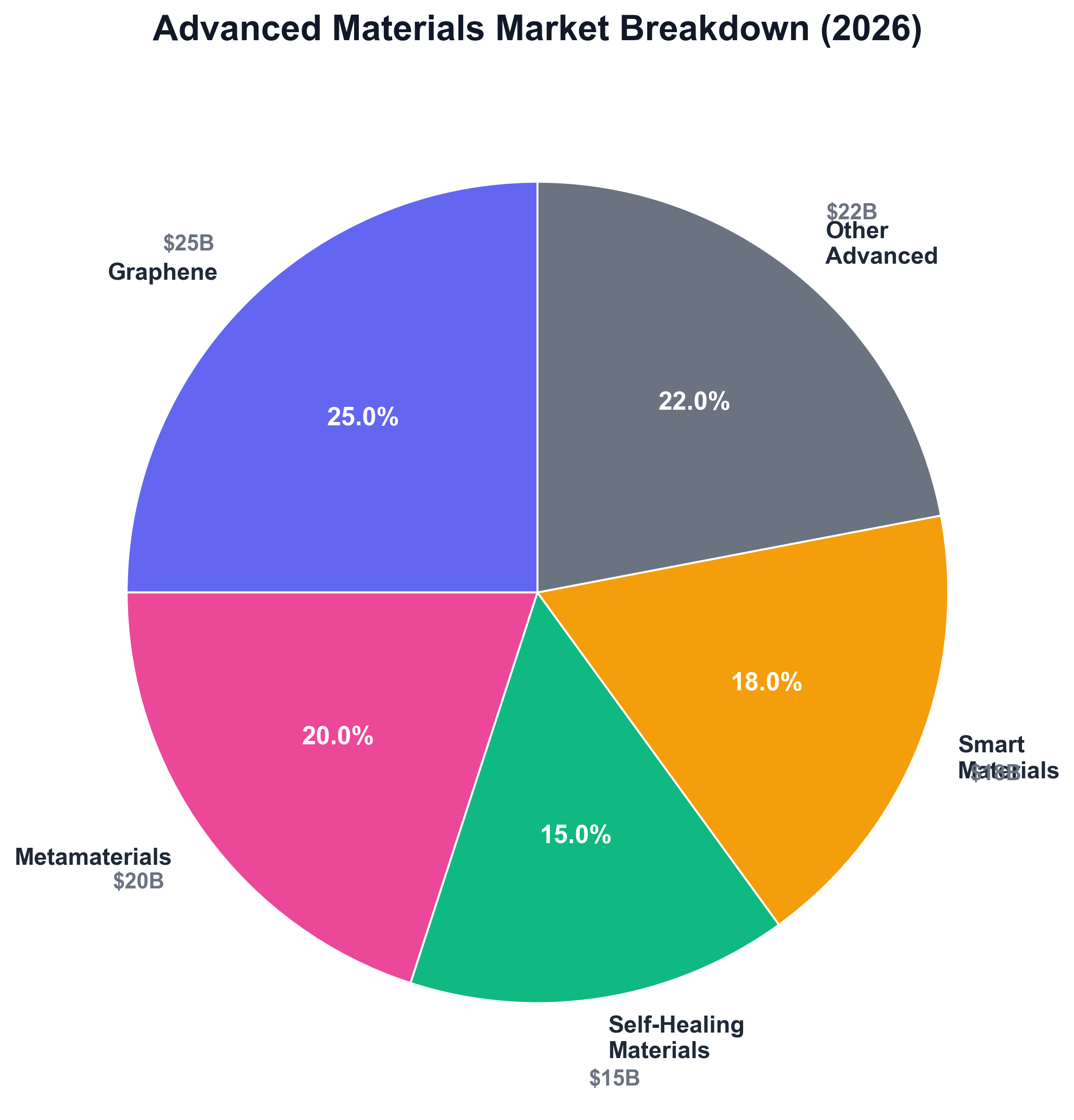
The market breakdown shows that graphene represents 25% of the advanced materials market, followed by metamaterials at 20% and smart materials at 18%, demonstrating the significant commercial deployment of these next-generation materials across multiple industries.
The commercialization of graphene represents a significant milestone, as graphene's exceptional properties including 200 times the strength of steel, excellent electrical conductivity, and optical transparency enable applications that weren't possible with conventional materials. According to graphene industry analysis, graphene is being used in applications including flexible electronics, energy storage, composites, and sensors, with the market expected to reach over $2 billion by 2030. The achievement of cost-effective graphene production at scale has enabled commercial deployment across multiple industries.
Metamaterials with programmable properties are enabling revolutionary applications in optics, acoustics, and electromagnetics, as these materials can be designed to exhibit properties that don't exist in nature. According to metamaterials research, programmable metamaterials can change their properties in response to external stimuli, enabling applications including adaptive optics, cloaking devices, and advanced antennas. The development of manufacturing processes for metamaterials has enabled commercial deployment in applications including 5G and 6G communications, radar systems, and medical imaging.
Self-healing materials represent another major advance, as these materials can automatically repair damage, extending product lifetimes and reducing maintenance requirements. According to self-healing materials research, self-healing polymers, metals, and composites are being deployed in applications including automotive, aerospace, and construction, where the ability to repair damage automatically provides significant economic and safety benefits. The development of self-healing materials is enabling products with longer lifetimes and reduced environmental impact.
Graphene: Production at Scale and Commercial Applications
Graphene production has achieved industrial scale, with companies producing thousands of tons annually using methods including chemical vapor deposition, liquid-phase exfoliation, and electrochemical exfoliation. According to graphene production analysis, the cost of graphene has decreased by over 90% in the past five years, making it viable for commercial applications.

The cost reduction chart illustrates the dramatic decrease in graphene prices from $500/kg in 2020 to $10/kg in 2026, representing a 98% cost reduction that has made graphene viable for commercial applications across multiple industries. Companies including Graphenea, Applied Graphene Materials, and Haydale have achieved production scales of hundreds of tons annually, enabling commercial deployment across multiple industries.
The exceptional properties of graphene enable applications in electronics, where graphene's high electrical conductivity and flexibility make it ideal for flexible displays, sensors, and transistors. According to graphene electronics research, graphene-based flexible electronics are being deployed in applications including wearable devices, foldable smartphones, and flexible displays. Graphene's transparency and conductivity also make it ideal for transparent electrodes in displays and solar cells, enabling more efficient and flexible devices.
Energy storage represents another major application area for graphene, as graphene's high surface area and electrical conductivity enable high-performance batteries and supercapacitors. According to graphene energy storage, graphene-enhanced batteries can achieve 30-50% higher energy density compared to conventional batteries, while graphene supercapacitors can charge and discharge much faster than batteries. The deployment of graphene in energy storage is enabling electric vehicles with longer ranges and faster charging, as well as grid-scale energy storage systems.
Composites represent another significant application area, as graphene can enhance the strength, conductivity, and other properties of composite materials. According to graphene composites research, graphene-enhanced composites are being used in applications including aerospace, automotive, and sports equipment, where the combination of strength and lightweight properties provides significant advantages. The deployment of graphene composites is enabling lighter, stronger products with improved performance.
Metamaterials: Programmable Properties and Revolutionary Applications
Metamaterials with programmable properties are enabling revolutionary applications by allowing materials to change their properties in response to external stimuli. According to programmable metamaterials research, these materials can change their optical, acoustic, or electromagnetic properties in real-time, enabling applications including adaptive optics, tunable antennas, and smart surfaces. The development of manufacturing processes for programmable metamaterials has enabled commercial deployment in applications including 5G and 6G communications, radar systems, and medical imaging.
Optical metamaterials are enabling applications including invisibility cloaking, super-resolution imaging, and advanced optical devices. According to optical metamaterials research, metamaterials can manipulate light in ways that aren't possible with conventional materials, enabling devices including perfect lenses, optical cloaks, and advanced sensors. The deployment of optical metamaterials is enabling new capabilities in imaging, sensing, and communication systems.
Acoustic metamaterials are enabling applications including noise cancellation, acoustic cloaking, and advanced audio devices. According to acoustic metamaterials research, these materials can manipulate sound waves in ways that aren't possible with conventional materials, enabling devices that can block, redirect, or amplify sound. The deployment of acoustic metamaterials is enabling quieter environments, improved audio devices, and new capabilities in acoustic sensing and communication.
Electromagnetic metamaterials are enabling applications including advanced antennas, radar systems, and wireless communication devices. According to electromagnetic metamaterials research, these materials can manipulate electromagnetic waves to enable smaller, more efficient antennas and improved wireless communication performance. The deployment of electromagnetic metamaterials is enabling 5G and 6G communication systems with improved performance and efficiency.
Self-Healing Materials: Extended Lifetimes and Reduced Maintenance
Self-healing materials can automatically repair damage, extending product lifetimes and reducing maintenance requirements. According to self-healing materials research, self-healing polymers can repair cracks and damage through mechanisms including microcapsules that release healing agents, vascular networks that supply healing materials, and intrinsic self-healing through reversible chemical bonds. The deployment of self-healing materials is enabling products with longer lifetimes and reduced environmental impact.
Self-healing polymers are being deployed in applications including automotive coatings, aerospace composites, and construction materials. According to self-healing polymers applications, these materials can repair scratches, cracks, and other damage automatically, maintaining product appearance and performance over extended periods. The deployment of self-healing polymers is reducing maintenance costs and extending product lifetimes in multiple industries.
Self-healing metals represent another major advance, as these materials can repair cracks and damage in metal structures. According to self-healing metals research, self-healing mechanisms in metals include shape memory alloys that can recover from deformation, and materials with embedded healing agents that can repair cracks. The deployment of self-healing metals is enabling safer and more durable structures in applications including aerospace, automotive, and infrastructure.
Self-healing composites combine self-healing capabilities with the advantages of composite materials, enabling products that can repair damage while maintaining the strength and lightweight properties of composites. According to self-healing composites research, these materials are being deployed in applications including aerospace, automotive, and sports equipment, where the combination of self-healing capabilities and composite properties provides significant advantages. The deployment of self-healing composites is enabling products with longer lifetimes and improved reliability.
Smart Materials: Responsive to Environmental Conditions
Smart materials that respond to environmental conditions are enabling applications including shape-changing structures, adaptive surfaces, and responsive devices. According to smart materials research, these materials can change their properties including shape, color, conductivity, or stiffness in response to stimuli including temperature, light, electric fields, or magnetic fields. The deployment of smart materials is enabling adaptive devices and structures that can respond to changing conditions.
Shape-memory materials can change shape in response to temperature or other stimuli, enabling applications including actuators, medical devices, and adaptive structures. According to shape-memory materials research, shape-memory alloys and polymers can remember their original shape and return to it when heated or exposed to other stimuli. The deployment of shape-memory materials is enabling devices that can change shape automatically, providing new capabilities in robotics, medical devices, and adaptive structures.
Electrochromic and photochromic materials can change color in response to electrical signals or light, enabling applications including smart windows, displays, and sensors. According to chromic materials research, these materials can change their optical properties to control light transmission, reflection, or absorption. The deployment of chromic materials is enabling smart windows that can adjust their transparency, displays that can change appearance, and sensors that can indicate environmental conditions.
Piezoelectric and magnetostrictive materials can generate electrical signals or change shape in response to mechanical stress or magnetic fields, enabling applications including sensors, actuators, and energy harvesting devices. According to responsive materials research, these materials can convert mechanical energy to electrical energy or vice versa, enabling devices that can sense, actuate, or harvest energy. The deployment of responsive materials is enabling new capabilities in sensing, actuation, and energy harvesting.
Manufacturing and Production Advances
The manufacturing and production of advanced materials has achieved significant advances, enabling cost-effective production at scale. According to advanced materials manufacturing, manufacturing processes including chemical vapor deposition, 3D printing, and roll-to-roll processing have enabled production of advanced materials at scales and costs that make commercial deployment viable. The development of manufacturing processes for advanced materials is critical for enabling widespread adoption.
3D printing of advanced materials is enabling production of complex structures with advanced material properties. According to 3D printing advanced materials, 3D printing processes can produce structures with graphene, metamaterials, and other advanced materials, enabling products with properties that weren't possible with conventional manufacturing. The deployment of 3D printing for advanced materials is enabling rapid prototyping and production of complex structures with advanced properties.
Roll-to-roll processing is enabling continuous production of advanced materials including graphene and flexible electronics. According to roll-to-roll processing, this manufacturing approach enables high-volume, cost-effective production of advanced materials in continuous processes. The deployment of roll-to-roll processing is enabling commercial-scale production of advanced materials for applications including electronics, energy storage, and composites.
Quality control and characterization of advanced materials are critical for ensuring consistent properties and performance. According to materials characterization, advanced characterization techniques including electron microscopy, spectroscopy, and mechanical testing enable detailed analysis of material properties. The development of characterization techniques for advanced materials is essential for ensuring quality and enabling commercial deployment.
Applications Across Industries
Advanced materials are enabling applications across multiple industries, transforming products and processes in ways that weren't possible with conventional materials. Electronics represents a major application area, as advanced materials enable flexible, transparent, and high-performance electronic devices.
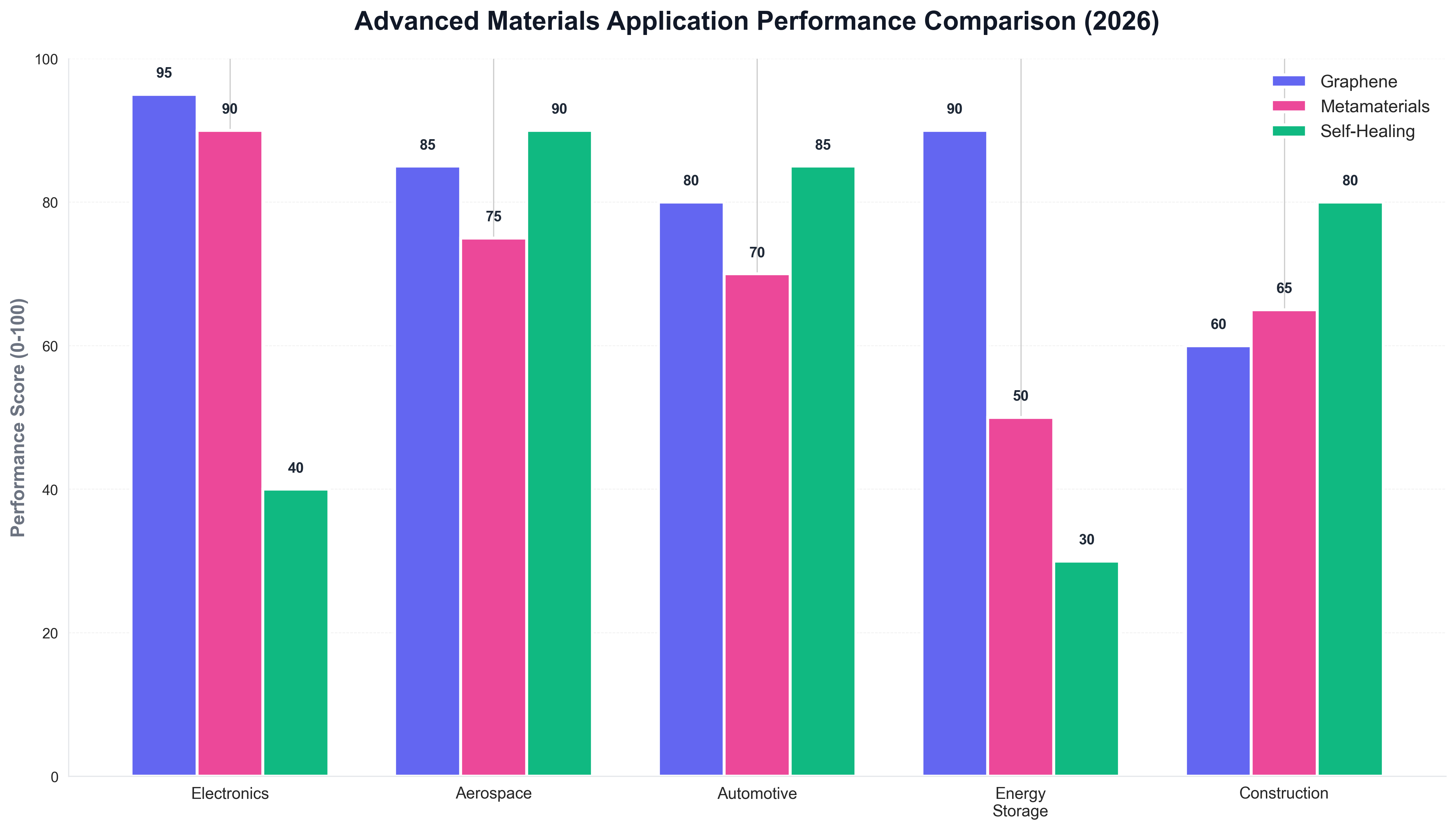
The application comparison shows how different advanced materials excel in different applications, with graphene performing best in electronics and energy storage, metamaterials excelling in electronics and aerospace, and self-healing materials showing strong performance in aerospace, automotive, and construction applications. According to electronics materials applications, advanced materials including graphene, metamaterials, and smart materials are enabling flexible displays, transparent electronics, and high-performance sensors. The deployment of advanced materials in electronics is enabling new device capabilities and form factors.
Aerospace represents another major application area, as advanced materials enable lighter, stronger, and more durable aircraft and spacecraft. According to aerospace materials applications, advanced materials including graphene composites, self-healing materials, and metamaterials are enabling aircraft with improved performance, reduced weight, and extended lifetimes. The deployment of advanced materials in aerospace is enabling more efficient and capable aircraft and spacecraft.
Automotive applications of advanced materials include lightweight composites, self-healing coatings, and smart materials for adaptive systems. According to automotive materials applications, advanced materials are enabling vehicles with improved fuel efficiency, extended lifetimes, and new capabilities including adaptive surfaces and self-repairing components. The deployment of advanced materials in automotive applications is enabling more efficient and capable vehicles.
Energy applications of advanced materials include improved batteries, solar cells, and energy storage systems. According to energy materials applications, advanced materials including graphene, metamaterials, and smart materials are enabling energy storage and generation systems with improved performance and efficiency. The deployment of advanced materials in energy applications is enabling more efficient and capable energy systems.
Economic Impact and Market Growth
The economic impact of advanced materials is substantial, as these materials enable products and processes that weren't possible with conventional materials. According to advanced materials market analysis, the global advanced materials market has reached over $500 billion, with graphene and metamaterials representing the fastest-growing segments. The deployment of advanced materials is enabling new products, improving existing products, and creating economic opportunities across multiple industries.
The cost reduction of advanced materials is enabling broader adoption, as materials including graphene have become cost-competitive with conventional materials for many applications. According to materials cost analysis, the cost of graphene has decreased by over 90% in the past five years, making it viable for commercial applications. The continued cost reduction of advanced materials will enable broader adoption and maximize their economic impact.
The deployment of advanced materials is creating new business opportunities in materials production, product development, and applications. According to advanced materials business opportunities, companies developing and deploying advanced materials are creating new markets and business models. The growth of the advanced materials industry is creating economic opportunities while also enabling products and processes that weren't possible with conventional materials.
The economic benefits of advanced materials extend beyond direct market value to include improved product performance, extended lifetimes, and reduced environmental impact. According to advanced materials economic benefits, the deployment of advanced materials is improving product performance, reducing maintenance costs, and enabling more sustainable products. The economic benefits of advanced materials justify continued investment and development.
Future Directions: Next-Generation Materials
The future of advanced materials promises even more significant capabilities as new materials are developed and existing materials are improved. According to future materials research, next-generation materials including 2D materials beyond graphene, quantum materials, and bio-inspired materials could enable even more revolutionary applications. The development of new materials and the improvement of existing materials will continue to enable new capabilities and applications.
2D materials beyond graphene including molybdenum disulfide, boron nitride, and phosphorene are being developed for applications including electronics, optoelectronics, and energy storage. According 2D materials research, these materials offer properties complementary to graphene, enabling applications that require different material characteristics. The development of 2D materials beyond graphene is expanding the capabilities of advanced materials.
Quantum materials that exhibit quantum mechanical properties are being developed for applications including quantum computing, sensing, and communication. According to quantum materials research, these materials can exhibit properties including superconductivity, topological states, and quantum entanglement, enabling applications that weren't possible with conventional materials. The development of quantum materials is enabling new capabilities in quantum technologies.
Bio-inspired materials that mimic biological structures and processes are being developed for applications including self-healing, adaptive properties, and sustainable materials. According to bio-inspired materials research, these materials can exhibit properties including self-healing, self-assembly, and adaptive responses that mimic biological systems. The development of bio-inspired materials is enabling materials with capabilities that weren't possible with conventional synthetic materials.
Conclusion: Advanced Materials as an Industrial Transformation
Advanced materials science has reached a transformative moment in 2026, with graphene, metamaterials, and other next-generation materials entering commercial production and enabling revolutionary applications. The technology's ability to provide properties that don't exist in conventional materials is transforming multiple industries and enabling products and processes that weren't possible before. As advanced materials continue to improve and become more cost-effective, they will play an increasingly important role in enabling new technologies and improving existing products.
The commercialization of advanced materials including graphene and metamaterials represents a significant milestone, as these materials are now available at scales and costs that enable commercial deployment. The achievement of cost-effective production at scale has enabled applications across multiple industries, from electronics and aerospace to automotive and energy. The continued improvement of manufacturing processes and cost reduction will enable even broader adoption of advanced materials.
The diversity of advanced materials being developed—including graphene, metamaterials, self-healing materials, and smart materials—increases the likelihood that appropriate materials will be available for different applications. The development of materials with programmable properties, self-healing capabilities, and responsive behaviors enables products and processes that weren't possible with conventional materials. The continued development of advanced materials will enable even more revolutionary applications.
As we look toward the future, advanced materials will continue to evolve, becoming more capable, cost-effective, and widely deployed. The technology's potential to transform industries, enable new products, and improve existing products makes it one of the most important technological developments of our time. Advanced materials are not just new substances—they represent a fundamental shift toward materials with properties and capabilities that weren't possible before, enabling technologies and applications that will transform how we live and work.