
The commercial spaceflight industry has achieved a transformative breakthrough in 2026, with private companies fundamentally changing how humanity accesses and explores space. SpaceX has successfully demonstrated fully reusable rocket systems that can launch, land, and relaunch multiple times, reducing launch costs by over 90% compared to traditional expendable rockets. Blue Origin has deployed its New Glenn heavy-lift rocket and is conducting regular crewed missions to suborbital space, while emerging competitors including Relativity Space, Rocket Lab, and others are developing innovative technologies that promise to further reduce costs and increase access to space.
According to analysis from the Federal Aviation Administration's Office of Commercial Space Transportation, commercial space launches have increased from approximately 100 launches annually in 2020 to over 300 launches in 2026, with private companies now responsible for the majority of space launches worldwide. This dramatic increase reflects not just growing demand for space-based services like satellite internet, Earth observation, and scientific research, but also the fundamental transformation of space access from a government-dominated activity to a commercial industry. The cost of launching payloads to low Earth orbit has decreased from approximately $10,000 per kilogram in 2010 to under $1,000 per kilogram in 2026, making space accessible to a much broader range of organizations and applications.
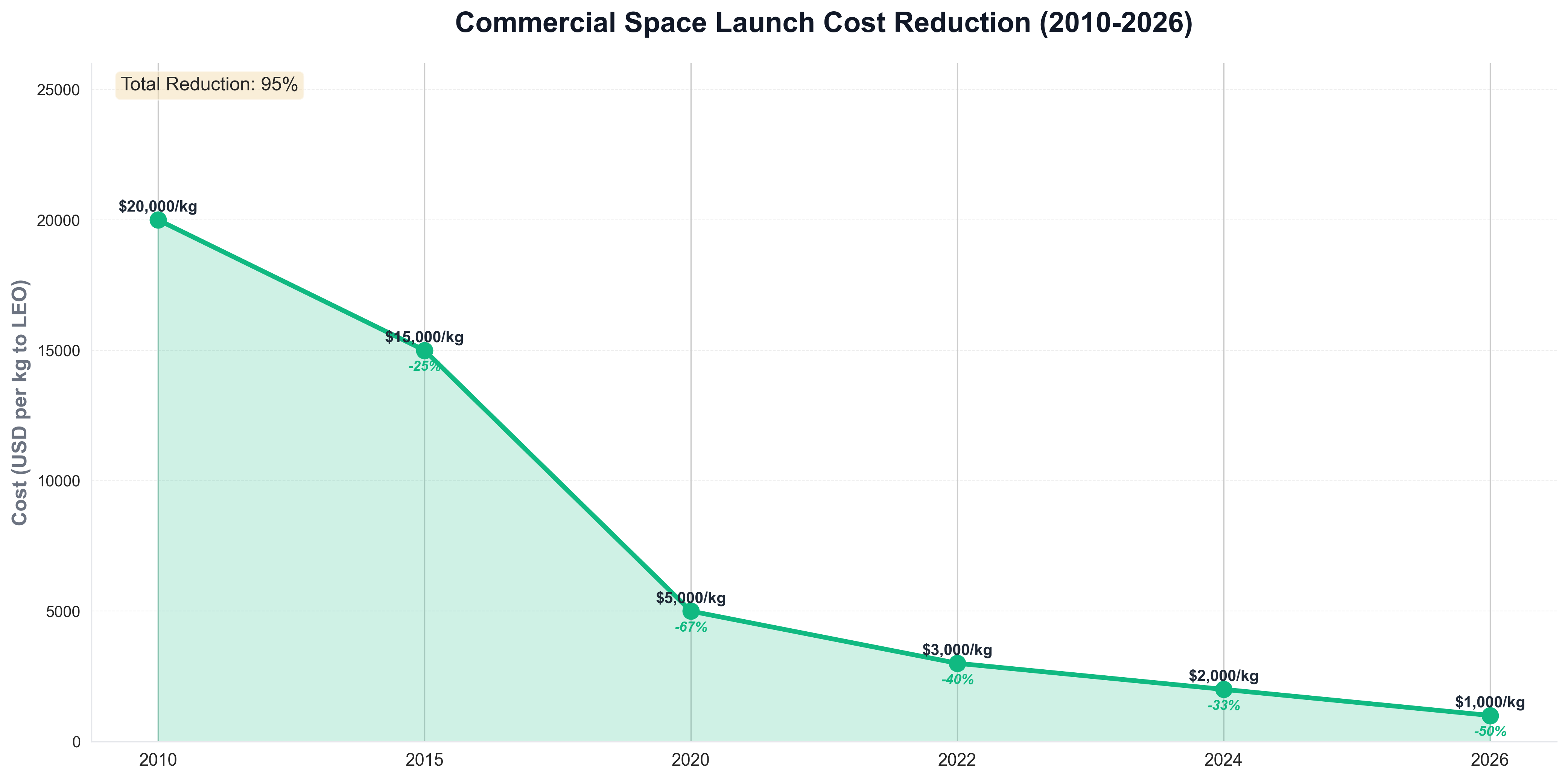
The launch cost reduction chart demonstrates the dramatic decrease in space access costs, with prices falling by 95% over the past 16 years, driven primarily by reusable rocket technology and increased competition in the commercial space industry.
The implications of this transformation extend far beyond launch services to include the development of commercial space stations, lunar bases, and Mars exploration programs that are being led by private companies rather than national space agencies. SpaceX's Starship program aims to enable human missions to Mars, while Blue Origin and other companies are developing commercial space stations that could replace or supplement the International Space Station. These developments represent a fundamental shift in space exploration, from government-led programs to commercial enterprises that are driven by market forces and private investment.
The competitive landscape in commercial spaceflight has also evolved dramatically, with multiple companies competing across different market segments. SpaceX dominates the launch services market with its Falcon and Starship rockets, while Blue Origin focuses on suborbital tourism and heavy-lift launch services.
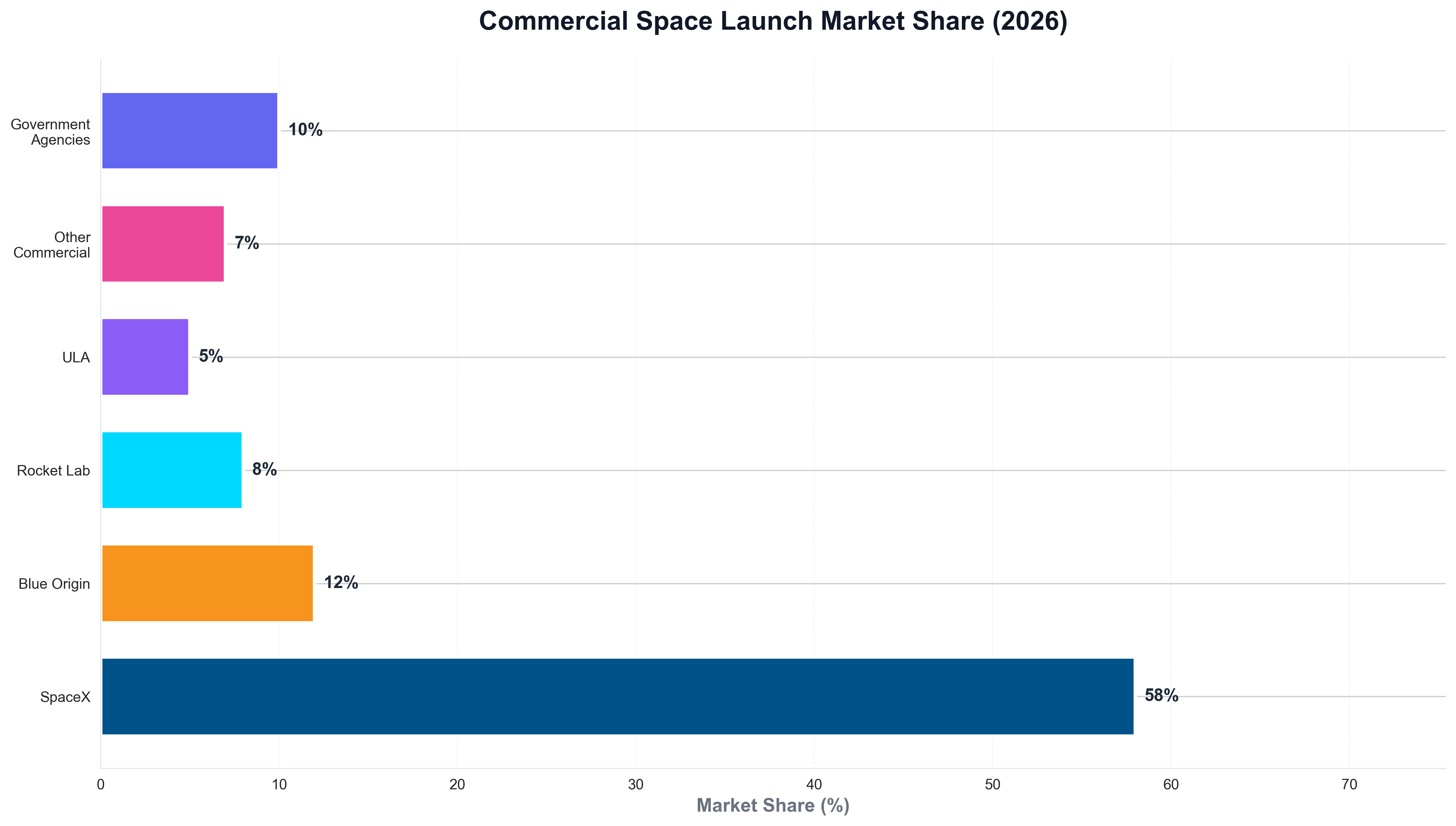
The market share comparison illustrates SpaceX's dominance in the commercial launch market, while also showing the growing presence of other commercial companies and the declining share of government space agencies. Smaller companies including Rocket Lab, Relativity Space, and Firefly Aerospace are developing specialized capabilities for small satellite launches and other niche applications. This competition is driving innovation and cost reduction, benefiting customers and accelerating the pace of space development.
SpaceX: Dominating Launch Services with Reusable Rockets
SpaceX has established itself as the dominant player in commercial spaceflight, with its reusable rocket technology fundamentally transforming the economics of space access. The company's Falcon 9 and Falcon Heavy rockets have achieved over 300 successful launches with over 95% success rate, while the Starship program represents the next generation of fully reusable launch systems. According to SpaceX's operational data, the company has reduced launch costs to approximately $2,700 per kilogram to low Earth orbit for Falcon 9 missions, compared to over $20,000 per kilogram for traditional expendable rockets.
The key to SpaceX's cost reduction has been the development of reusable rocket technology, with Falcon 9 first stages now capable of landing and being reused over 20 times with minimal refurbishment. The company's Starship system, which is designed to be fully reusable, promises to reduce launch costs even further, potentially to under $100 per kilogram once the system is fully operational. Starship's massive payload capacity—capable of carrying over 100 metric tons to low Earth orbit—combined with full reusability, could enable entirely new classes of space missions that were previously economically impossible.
SpaceX's Starlink satellite internet constellation has also become a major driver of the company's launch activity, with the constellation now consisting of over 8,000 satellites providing internet service to millions of customers worldwide. The company launches Starlink satellites on a regular basis, using its own rockets to deploy the constellation while also generating revenue from the internet service. This vertical integration—owning both the launch capability and the payload—demonstrates how commercial space companies are creating new business models that weren't possible in the traditional government-led space industry.
The company's ambitions extend far beyond Earth orbit, with the Starship program designed to enable human missions to Mars. According to SpaceX's Mars mission plans, the company aims to conduct the first uncrewed cargo missions to Mars by 2028, followed by crewed missions in the early 2030s. These missions would establish a permanent human presence on Mars, representing one of the most ambitious goals in the history of space exploration. While these timelines are ambitious and may face delays, SpaceX's track record of achieving goals that many considered impossible suggests that Mars missions are a realistic possibility within the next decade.
Blue Origin: Suborbital Tourism and Heavy-Lift Launch Services
Blue Origin has taken a different approach to commercial spaceflight, focusing on suborbital space tourism and developing heavy-lift launch capabilities for government and commercial customers. The company's New Shepard suborbital vehicle has conducted over 50 crewed flights since 2021, taking paying customers to the edge of space for brief experiences of weightlessness and views of Earth. According to Blue Origin's operations data, the company has flown over 300 passengers to suborbital space, making space tourism a reality for the first time in history.
The New Glenn heavy-lift rocket, which began operations in 2026, represents Blue Origin's entry into the orbital launch market. The rocket is capable of launching over 45 metric tons to low Earth orbit and is designed to be partially reusable, with the first stage capable of landing and being reused. New Glenn is competing with SpaceX's Falcon Heavy and Starship for government contracts and commercial launch services, providing customers with alternatives in the heavy-lift launch market. According to industry analysis, Blue Origin has secured contracts worth over $5 billion for New Glenn launches, including NASA contracts for lunar missions and commercial satellite launches.
Blue Origin is also developing the Blue Moon lunar lander, designed to deliver payloads and eventually humans to the Moon's surface. The lander is part of NASA's Artemis program, which aims to establish a permanent human presence on the Moon. According to Blue Origin's lunar program, the company plans to conduct uncrewed lunar landing missions by 2027, followed by crewed missions as part of the Artemis program. The Blue Moon lander represents Blue Origin's entry into the deep space exploration market, competing with SpaceX's Starship for lunar mission contracts.
The company's focus on suborbital tourism has created a new market segment that didn't exist before, with customers paying hundreds of thousands of dollars for brief trips to the edge of space. While the market for suborbital tourism is smaller than orbital launch services, it provides Blue Origin with a revenue stream and operational experience that supports the company's other programs. The company's approach of starting with suborbital flights and expanding to orbital and deep space missions represents a different strategy from SpaceX's focus on orbital launch services from the beginning.
Emerging Competitors: Innovation Across the Space Industry
While SpaceX and Blue Origin dominate headlines, numerous smaller companies are developing innovative technologies and business models that are expanding the commercial space industry. Rocket Lab has established itself as a leader in small satellite launches, with its Electron rocket providing dedicated launch services for small satellites that don't need the capacity of larger rockets. According to Rocket Lab's operations, the company has conducted over 50 successful launches and is developing a reusable version of the Electron rocket to further reduce costs.
Relativity Space is developing 3D-printed rockets, using additive manufacturing to create rocket components that would be difficult or impossible to manufacture using traditional methods. The company's Terran R rocket, which is designed to be fully reusable, represents a new approach to rocket manufacturing that could reduce production costs and time. According to Relativity Space's development, the company aims to begin commercial operations in 2027, providing another option in the medium-lift launch market.
Firefly Aerospace, Astra, and other companies are also developing launch capabilities, creating a competitive market that's driving innovation and cost reduction. These smaller companies often focus on specific market niches, such as small satellite launches or rapid launch capabilities, rather than competing directly with SpaceX and Blue Origin across all market segments. This specialization allows them to succeed in specific areas while the larger companies dominate the broader launch market.
The emergence of multiple competitors is creating a more dynamic and competitive commercial space industry, with companies developing different technologies and business models. This competition is driving innovation, as companies seek to differentiate themselves and gain market share. The diversity of approaches—from fully reusable systems to 3D-printed rockets to specialized small satellite launchers—increases the likelihood that cost-effective solutions will be available for different applications and market segments.
Commercial Space Stations: The Next Frontier
The development of commercial space stations represents one of the most significant developments in commercial spaceflight, as private companies work to replace or supplement the International Space Station with commercially operated facilities. Axiom Space is developing a commercial space station that will initially attach to the International Space Station before becoming an independent facility. According to Axiom Space's plans, the company's first modules are scheduled to launch in 2027, with the full station operational by 2030.
Blue Origin and Sierra Space are developing the Orbital Reef commercial space station, designed to support research, manufacturing, and tourism activities in low Earth orbit. The station is designed to accommodate up to 10 people and provide facilities for scientific research, commercial manufacturing, and space tourism. According to Orbital Reef development, the station is scheduled to begin operations in 2028, providing a commercial alternative to government-operated space stations.
These commercial space stations represent a fundamental shift in how space facilities are developed and operated, moving from government-led programs to commercial enterprises. The stations will provide services to government agencies, research organizations, and commercial customers, creating new business models and revenue streams in space. The development of commercial space stations also enables new applications, such as space-based manufacturing, that require facilities that can operate for extended periods without government oversight.
The commercial space station market is still in early stages, with significant technical and financial challenges that must be overcome. However, the progress made by companies like Axiom Space and the Orbital Reef partnership suggests that commercial space stations are a realistic possibility within the next few years. These facilities will play a critical role in the future of space exploration and commercial space activities, providing infrastructure that enables a wide range of space-based applications.
Lunar Exploration: Commercial Missions to the Moon
Commercial lunar exploration has become a reality in 2026, with private companies conducting missions to the Moon that were previously only possible for national space agencies. SpaceX's Starship is designed to land on the Moon, with NASA contracts for lunar missions as part of the Artemis program. According to NASA's commercial lunar program, multiple companies including SpaceX, Blue Origin, and Intuitive Machines are developing lunar landers and conducting missions to the Moon.
Intuitive Machines has successfully conducted multiple commercial lunar landings, delivering payloads for NASA and commercial customers to the Moon's surface. The company's Nova-C lander has demonstrated the capability to conduct precise lunar landings, opening the Moon to commercial exploration and development. According to Intuitive Machines' operations, the company has conducted over 5 successful lunar missions, delivering scientific instruments, technology demonstrations, and commercial payloads to the Moon.
The commercial lunar market includes not just landing services but also lunar resource extraction, with companies developing technologies to extract water, minerals, and other resources from the Moon. These resources could support future lunar bases and provide materials for space missions, creating economic incentives for lunar exploration. According to lunar resource analysis, water ice deposits at the Moon's poles could provide water for life support and rocket fuel production, enabling sustainable lunar operations.
The development of commercial lunar capabilities is also supporting NASA's Artemis program, which aims to establish a permanent human presence on the Moon. Commercial companies are providing landing services, transportation, and other capabilities that support NASA's goals while also creating commercial opportunities. This public-private partnership model is enabling more ambitious space exploration goals than would be possible with government programs alone.
Mars Exploration: The Ultimate Goal
Mars exploration represents the ultimate goal for commercial spaceflight companies, with SpaceX leading efforts to enable human missions to the Red Planet. The company's Starship system is designed specifically for Mars missions, with the capability to transport over 100 people to Mars and return to Earth. According to SpaceX's Mars plans, the company aims to conduct the first uncrewed cargo missions to Mars by 2028, establishing infrastructure and demonstrating the capability to land on Mars before crewed missions.
The challenges of Mars missions are substantial, including the long journey time, the need for life support systems that can operate for months or years, and the requirement to produce resources on Mars for return journeys. However, SpaceX's approach of developing fully reusable systems and using in-situ resource utilization—producing fuel and other resources on Mars—addresses many of these challenges. The company's focus on making Mars missions economically viable through reusability and resource production could enable sustainable human presence on Mars.
Other companies are also developing Mars mission capabilities, though none have the same level of commitment and resources as SpaceX. Blue Origin has discussed Mars missions as a long-term goal, while other companies focus on Mars-related technologies like life support systems and resource extraction. The development of commercial Mars capabilities is still in early stages, but the progress made by SpaceX suggests that Mars missions could become a reality within the next decade.
The implications of successful Mars missions extend far beyond space exploration to include the potential for human settlement on another planet. Mars missions could enable scientific research, resource extraction, and eventually permanent human settlements that could serve as a backup for human civilization. While these goals are ambitious and face significant challenges, the progress made in commercial spaceflight suggests that they may be achievable within the lifetimes of people alive today.
Cost Reduction and Market Transformation
The dramatic cost reduction in space launch services has been the primary driver of the commercial spaceflight revolution, making space accessible to organizations and applications that were previously unable to afford space access. According to analysis from the Space Foundation, launch costs have decreased by over 90% since 2010, driven primarily by reusable rocket technology developed by SpaceX and other companies.
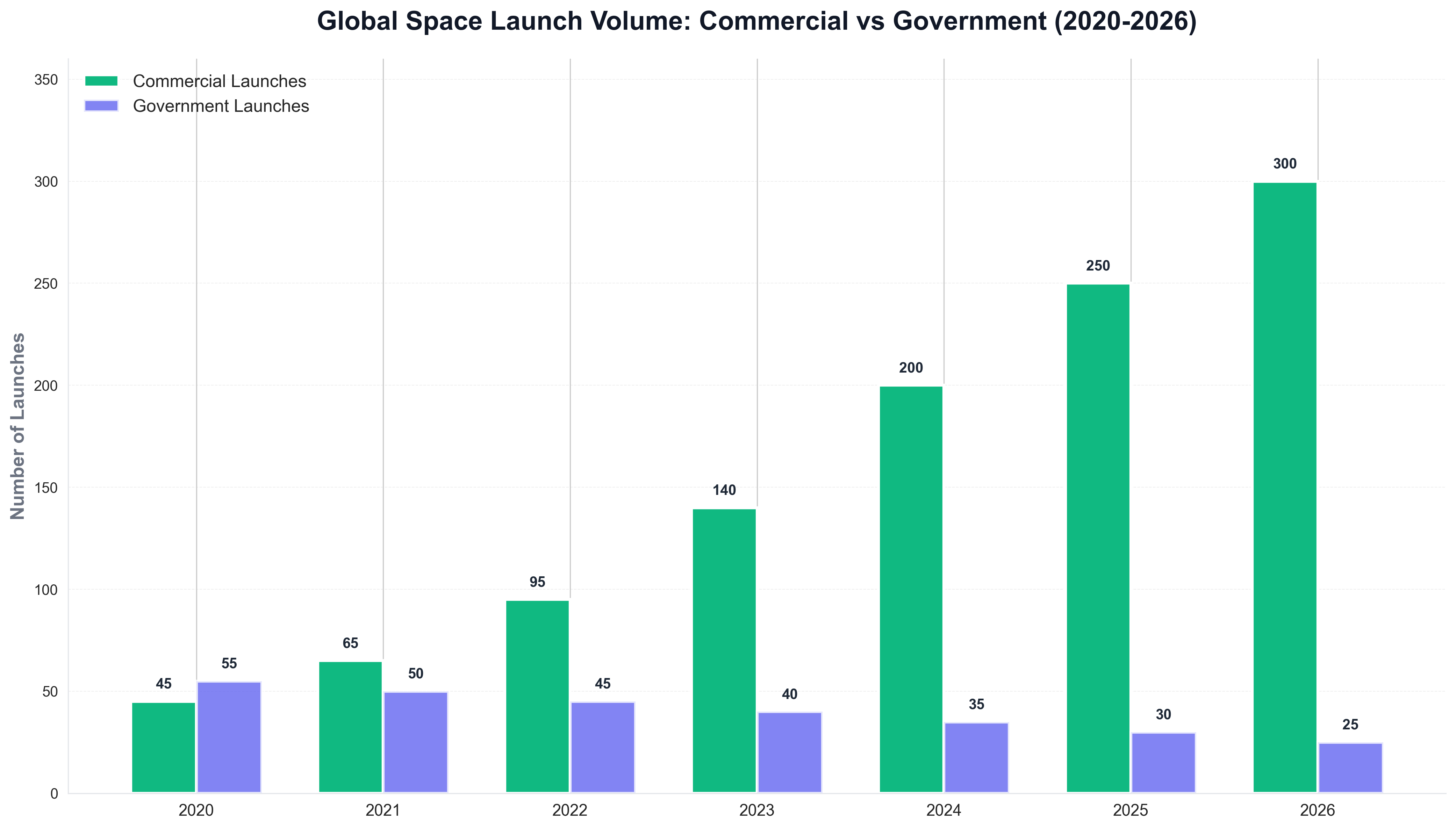
The launch volume comparison shows the dramatic shift from government-dominated to commercial space launches, with commercial launches now exceeding government launches by more than 10 to 1, reflecting the fundamental transformation of the space industry.
This cost reduction has enabled new applications including satellite internet constellations, Earth observation services, and scientific research missions that weren't economically viable at previous launch costs.
The cost reduction has also enabled new business models in space, including space tourism, commercial space stations, and lunar resource extraction. These applications require frequent and affordable access to space, which is now becoming possible through commercial launch services. The development of these new markets is creating a virtuous cycle where increased demand drives further cost reduction, which enables even more applications, creating a self-sustaining commercial space industry.
The transformation of the space industry from government-dominated to commercial has also changed how space missions are funded and developed. Private investment in space companies has exceeded $50 billion since 2020, providing funding for development programs that would have been difficult to finance through government contracts alone. This private investment is driving innovation and enabling companies to take risks and pursue ambitious goals that might not be possible with traditional government procurement processes.
The competitive market in commercial spaceflight is also driving innovation, as companies seek to differentiate themselves and gain market share. This competition benefits customers through lower costs, improved reliability, and more frequent launch opportunities. The diversity of companies and approaches in the commercial space industry increases the likelihood that cost-effective solutions will be available for different applications, supporting the continued growth of the space economy.
Regulatory Framework and Safety
The rapid growth of commercial spaceflight has required the development of new regulatory frameworks to ensure safety while enabling innovation. The Federal Aviation Administration's Office of Commercial Space Transportation regulates commercial launches in the United States, issuing licenses and ensuring that launches meet safety and environmental requirements. According to FAA regulatory data, the agency has licensed over 1,000 commercial launches since 2020, with safety records that compare favorably to government space programs.
The regulatory framework for commercial spaceflight is still evolving, as new applications like space tourism, commercial space stations, and lunar missions require new regulations and oversight. The FAA and other regulatory agencies are working to develop appropriate regulations that ensure safety without unduly burdening innovation. This balance is critical for enabling the continued growth of commercial spaceflight while maintaining public safety and environmental protection.
International coordination is also important for commercial spaceflight, as launches and space activities often involve multiple countries. The development of international regulations and standards for commercial space activities is ongoing, with organizations like the United Nations working to establish frameworks that enable commercial space activities while ensuring safety and preventing conflicts. This international coordination will become increasingly important as commercial space activities expand to include lunar and Mars missions.
Safety remains a critical concern in commercial spaceflight, as failures can result in loss of life and significant financial losses. Companies are investing heavily in safety systems and procedures, recognizing that maintaining excellent safety records is essential for the long-term viability of commercial spaceflight. The track record of commercial spaceflight companies has been generally good, with success rates that compare favorably to government space programs, though the industry is still relatively young and faces ongoing safety challenges.
Future Directions: The Next Decade in Commercial Spaceflight
The future of commercial spaceflight promises even more significant developments as technologies continue to improve and new applications emerge. Industry experts predict that within the next decade, commercial spaceflight will enable regular human missions to the Moon, the first human missions to Mars, and the operation of multiple commercial space stations. These developments will transform space from a destination visited occasionally to a place where people live and work regularly.
According to forecasts from space industry analysts, the commercial space economy could grow to over $1 trillion annually by 2035, driven by satellite services, space tourism, lunar resource extraction, and other applications. This growth will create new industries and job opportunities, while also enabling scientific research and exploration that wasn't possible before. The commercial space industry is becoming a major economic sector, with implications that extend far beyond space exploration.
The development of new technologies, including advanced propulsion systems, in-situ resource utilization, and space-based manufacturing, will enable new applications and reduce costs further. These technologies are being developed by both established companies and startups, creating a dynamic innovation ecosystem that's driving rapid progress in commercial spaceflight. The combination of technological advancement, cost reduction, and market development is creating a self-reinforcing cycle that's accelerating the pace of space development.
The integration of commercial spaceflight with other technologies, including artificial intelligence, robotics, and advanced materials, will also create new possibilities. AI-powered systems can optimize rocket operations, manage space stations, and support exploration missions. Robotics can enable remote operations on the Moon and Mars, reducing the need for human presence in hazardous environments. Advanced materials can improve rocket performance and enable new space applications. These technological integrations will continue to expand the possibilities of commercial spaceflight.
Conclusion: Commercial Spaceflight as the Foundation of Space Exploration
Commercial spaceflight has transformed space from a government-dominated domain to a commercial industry that's making space more accessible than ever before. The development of reusable rockets, commercial space stations, and lunar and Mars mission capabilities by private companies represents a fundamental shift in how humanity explores and utilizes space. This transformation is enabling new applications, reducing costs, and accelerating the pace of space development in ways that weren't possible with government programs alone.
The competitive market in commercial spaceflight is driving innovation and cost reduction, benefiting customers and enabling new applications. The diversity of companies and approaches in the industry increases the likelihood that cost-effective solutions will be available for different applications, supporting continued growth. As commercial spaceflight continues to evolve, it will play an increasingly important role in space exploration, scientific research, and the development of space-based industries.
The implications of commercial spaceflight extend far beyond technology to include fundamental changes in how humanity relates to space. As space becomes more accessible, more people will have the opportunity to experience space travel, work in space-based industries, and participate in space exploration. This democratization of space access represents one of the most significant developments in human history, with implications that we're only beginning to understand.
As we look toward the future, commercial spaceflight will continue to evolve, becoming more capable, affordable, and accessible. The development of commercial space stations, lunar bases, and Mars missions will create new opportunities for human activity in space, while also enabling scientific research and exploration that wasn't possible before. Commercial spaceflight is not just a technological trend—it's the foundation for humanity's future in space, essential for expanding human presence beyond Earth and exploring the solar system.