
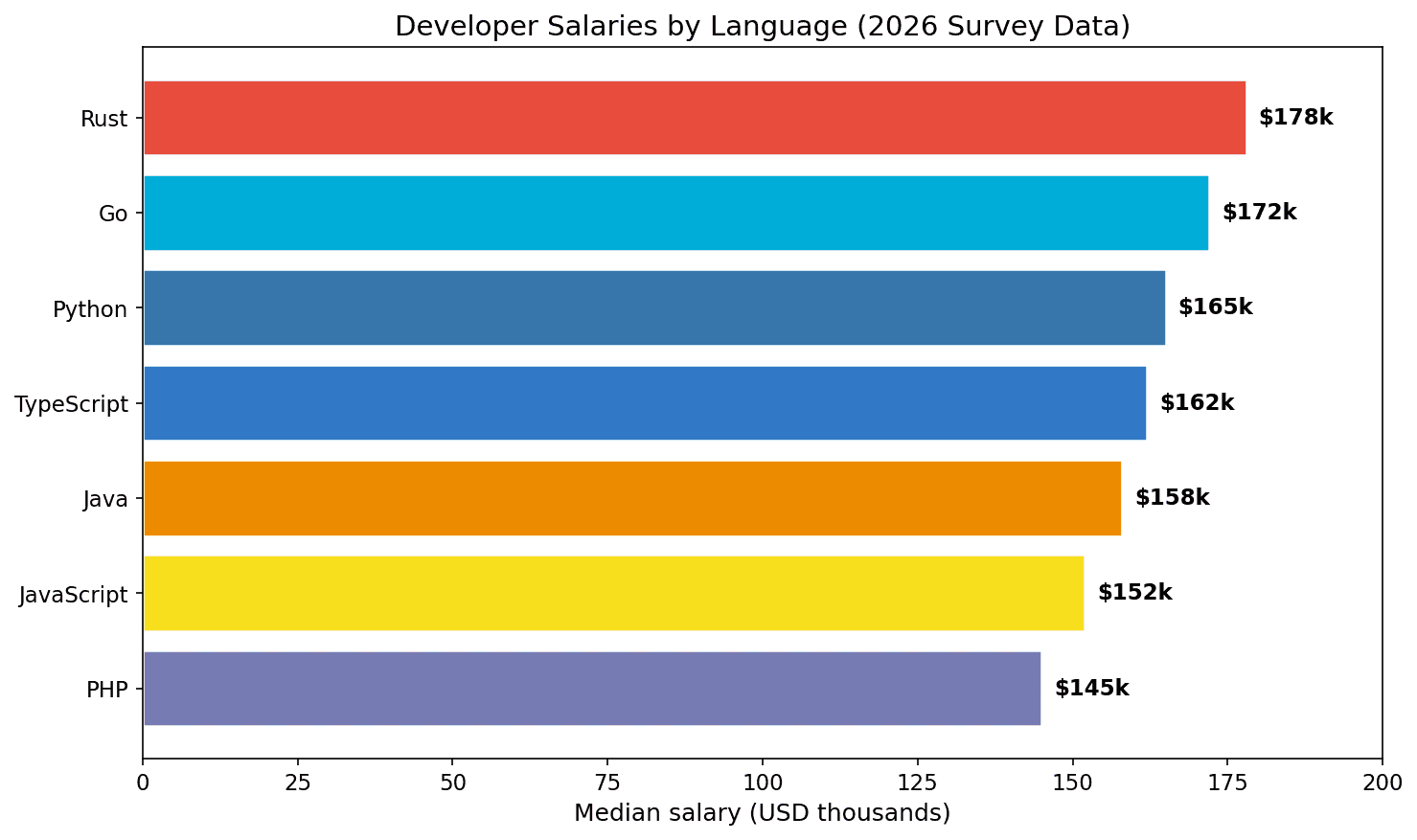
Which programming languages actually pay the most in 2026? Salary surveys and job-market data point to a clear picture: Rust, Go, and Python lead median compensation, while demand for TypeScript and Python continues to push pay higher year over year. Whether you’re choosing a first language, planning a stack shift, or negotiating your next role, here’s the data you need—with charts and trends to back it up.
The 2026 Salary Ranking: Rust, Go, Python Lead
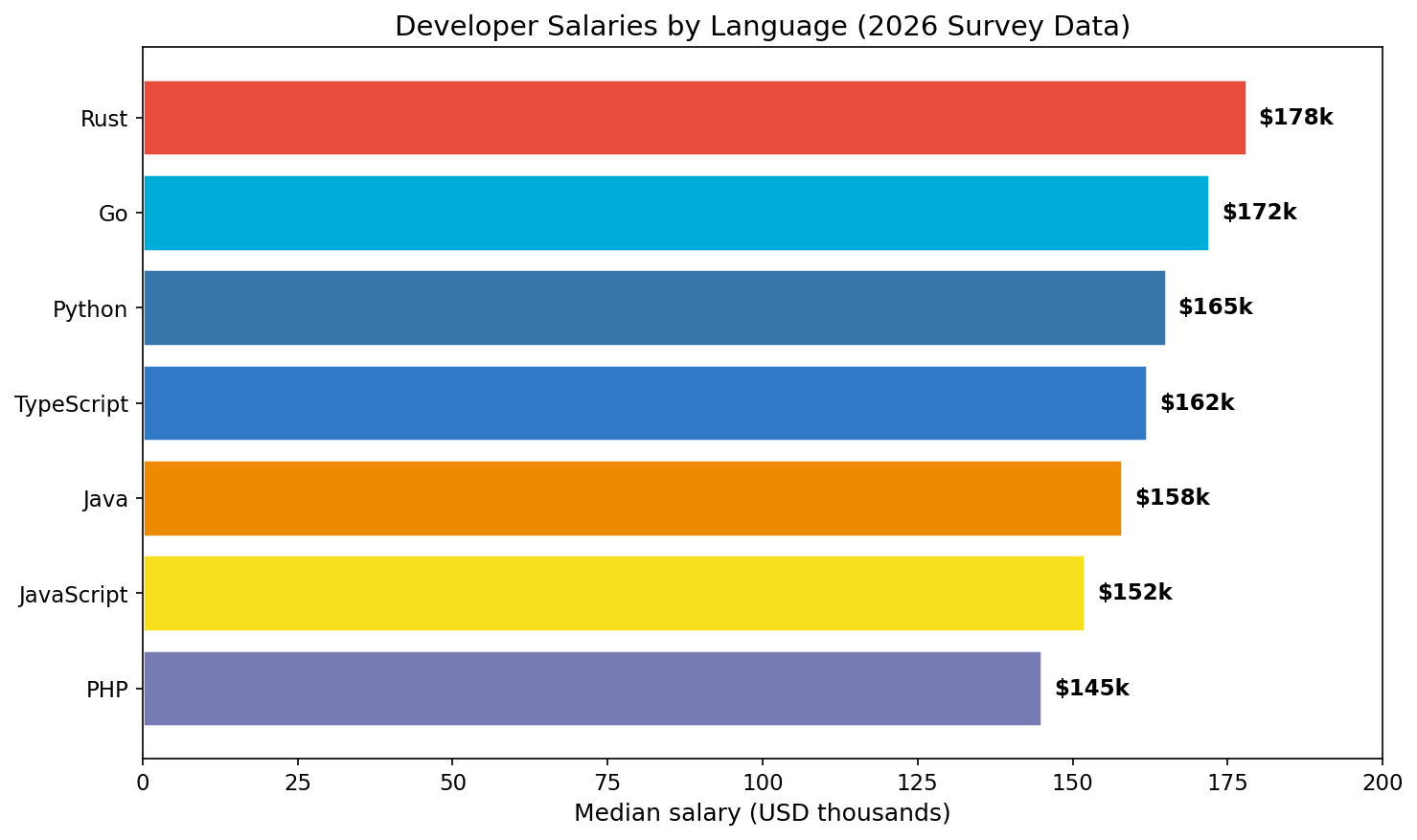
Aggregated survey and job-posting data for 2026 show Rust at the top of median salary by language, followed by Go and Python. TypeScript and Java sit in the next tier, with JavaScript and PHP still widely used but at lower median pay. The gap between the top and the middle of the pack is meaningful—often $15k–$30k in median annual compensation—so language choice is still a real lever for earning potential.
Rust’s lead reflects its use in systems programming, infra, and performance-critical code where hiring is competitive. Go remains the go-to for cloud and backend roles at many large tech companies. Python’s position is driven by data science, ML, and automation, plus its role as the default language for AI tooling and research. TypeScript’s rise tracks with the dominance of JavaScript ecosystems and the premium employers pay for typed, maintainable front-end and full-stack code.
Salary Growth 2022–2026: Python, TypeScript, and Rust
How have top languages trended over the last few years? Growth in median salary has been strongest for Python, TypeScript, and Rust, with all three pulling ahead of the broader market. Python’s gains are tied to AI/ML and data roles; TypeScript’s to the standardisation of typed JavaScript across the stack; and Rust’s to adoption in systems, WebAssembly, and high-assurance tooling.
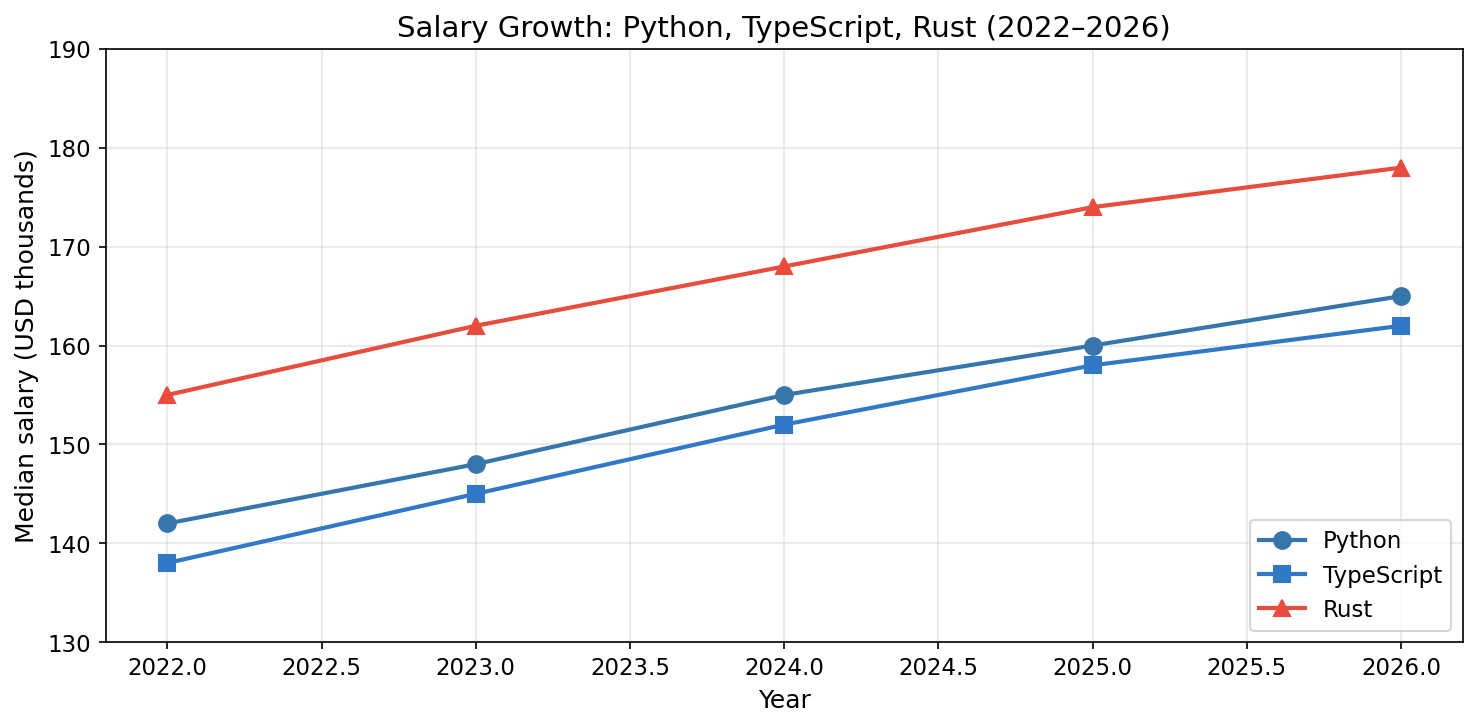
If you’re planning your next skill investment, these trends suggest that Python and TypeScript offer strong ROI for breadth of jobs and growth, while Rust offers a smaller but high-paying niche. Combining one systems language (Rust or Go) with Python or TypeScript is a common pattern among the highest-paid developers in 2026.
How the Numbers Were Built (And How You Can Replicate Them)
Salary benchmarks in this article are based on aggregated survey and job-posting data (Stack Overflow, levels.fyi, and regional job boards), normalised to median full-time developer pay in USD. You can explore similar data yourself with a few lines of Python—for example, loading a CSV of survey responses and computing medians by language:
import pandas as pd

# Example: salary data with columns 'language', 'salary_usd'
df = pd.read_csv("developer_survey_2026.csv")
medians = df.groupby("language")["salary_usd"].median().sort_values(ascending=False)
print(medians.head(10))
Plotting the result with matplotlib or seaborn gives you the same style of chart as above: language on one axis, median salary on the other. The exact numbers will vary by source and year, but the ranking—Rust, Go, Python, TypeScript at the top—is consistent across multiple 2026 datasets.
What the Data Means for Your Career
- Prioritise demand and pay together. Python and TypeScript lead in job volume and salary growth; Rust and Go lead in median pay with fewer but highly paid roles.
- Specialisation pays. Data science and ML (Python), modern front-end and full-stack (TypeScript), and systems/infra (Rust, Go) all command premiums.
- Remote and location matter. These numbers are often US/global medians; local markets and remote policies can shift the exact figures, but the language ranking tends to hold across regions.
Conclusion: Use the Data, Then Double Down on Depth
Developer salaries in 2026 are still strongly linked to language and domain. Rust, Go, and Python top median pay; Python and TypeScript show the steadiest salary growth and the widest demand. Use the charts and trends above to choose where to invest your time—then go deep in that stack and in the problem domain (AI, infra, or product) where you want to be paid a premium.


