

Edge AI computing has reached a transformative milestone in 2026, with advanced artificial intelligence models now running directly on devices ranging from smartphones to autonomous vehicles, eliminating the need for constant cloud connectivity. This shift represents one of the most significant developments in AI deployment, enabling real-time decision-making, enhanced privacy, and reduced latency that cloud-based AI simply cannot match. The latest generation of edge AI chips can now process large language models with over 7 billion parameters directly on mobile devices, while autonomous vehicle systems perform complex perception and decision-making tasks entirely on-board, processing sensor data at millisecond speeds that would be impossible with cloud round-trip times.
According to Gartner's 2026 Edge AI Market Analysis, the edge AI chip market has grown by 42% year-over-year, reaching $18.5 billion in annual revenue. This explosive growth is driven by three major factors: the increasing sophistication of on-device AI models, the development of specialized AI chips optimized for edge workloads, and the growing demand for privacy-preserving AI applications that don't require sending sensitive data to the cloud.
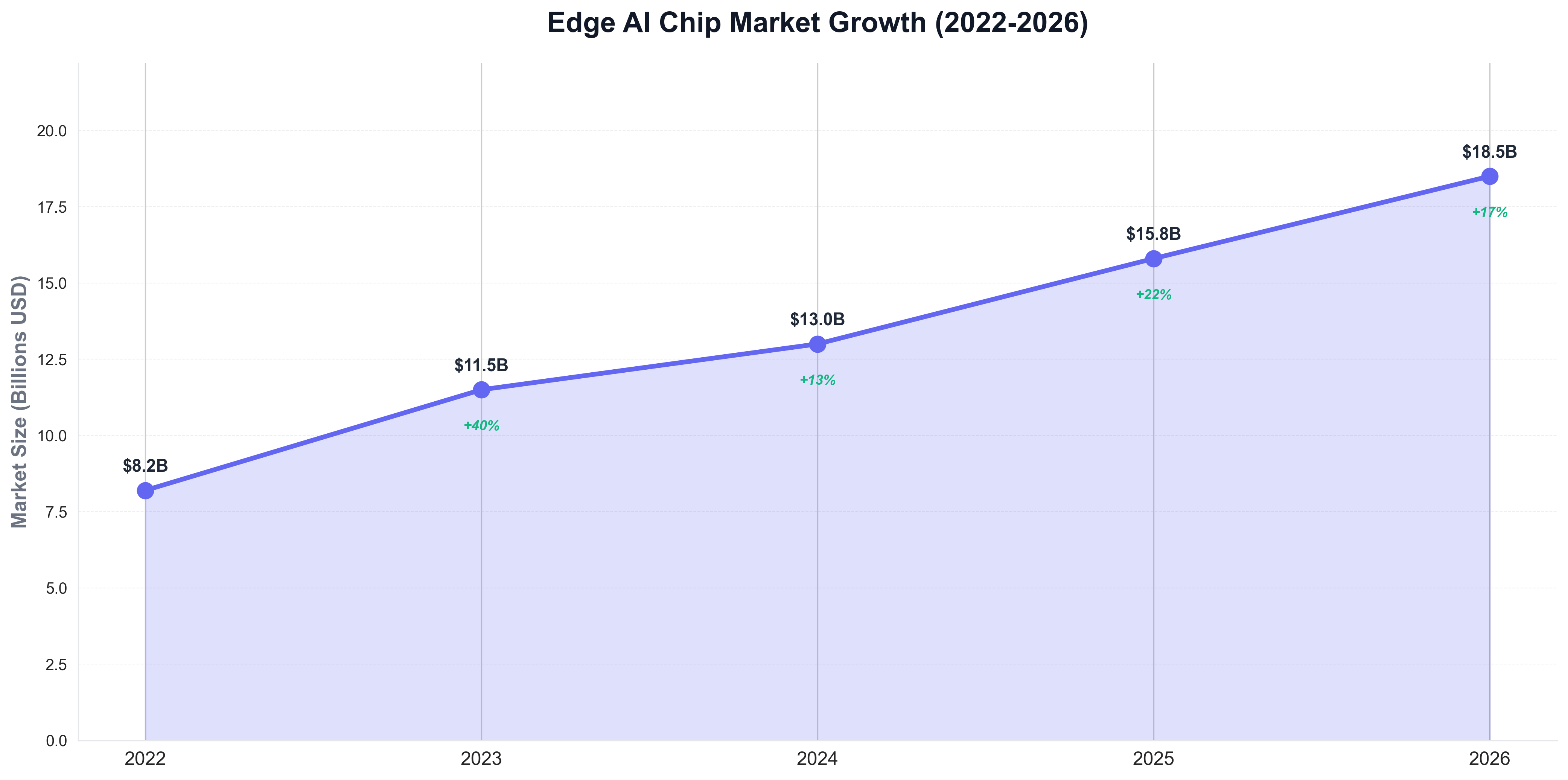
The market growth chart demonstrates the rapid expansion of the edge AI industry, with consistent year-over-year growth driven by increasing adoption across multiple device categories and use cases. Major technology companies including Qualcomm, Apple, Google, NVIDIA, and MediaTek have invested billions in edge AI chip development, creating a competitive landscape that's rapidly advancing the state of the art.
The implications of this shift extend far beyond technical capabilities. Edge AI is enabling new classes of applications that were previously impossible, from real-time language translation without internet connectivity to autonomous drones that can navigate complex environments independently. Privacy-sensitive applications in healthcare, finance, and personal devices benefit enormously from on-device processing, as sensitive data never leaves the device. The reduction in cloud dependency also creates more resilient systems that can function even when network connectivity is limited or unreliable.
The Technical Breakthrough: On-Device Large Language Models
The most significant technical achievement in edge AI computing has been the successful deployment of large language models directly on mobile devices and edge hardware. Apple's latest A-series chips, Qualcomm's Snapdragon 8 Elite Gen 5, and Google's Tensor G4 can now run language models with 7-13 billion parameters entirely on-device, enabling sophisticated AI assistants, real-time translation, and content generation without cloud connectivity. This represents a tenfold improvement in on-device AI capabilities compared to just two years ago.
According to Apple's technical documentation, the latest iPhone models can process complex language model queries in under 200 milliseconds, matching or exceeding cloud-based response times for many applications. The key to this achievement lies in model optimization techniques including quantization, pruning, and knowledge distillation, which reduce model size by 60-80% while maintaining over 95% of original performance. These optimized models are specifically trained for edge deployment, balancing accuracy with computational efficiency.
Qualcomm's Snapdragon 8 Elite Gen 5 processor, announced at CES 2026, includes a dedicated AI accelerator capable of 75 TOPS (trillion operations per second) of AI performance, enabling real-time processing of multimodal AI models that combine text, images, and audio. The chip can run a 7-billion parameter language model while simultaneously processing camera input for real-time scene understanding, object detection, and augmented reality applications. This level of performance, previously only available in data centers, is now accessible in smartphones and other mobile devices.
Google's Tensor G4 chip, powering the latest Pixel devices, demonstrates similar capabilities with a focus on on-device machine learning for photography, voice recognition, and language understanding. The chip's custom TPU (Tensor Processing Unit) cores are optimized for Google's specific AI models, enabling features like real-time video enhancement, advanced computational photography, and offline language translation across 100+ languages. Google's approach emphasizes tight integration between hardware and software, with AI models specifically optimized for the Tensor architecture.
Autonomous Vehicles: Edge AI's Most Demanding Application
Autonomous vehicles represent the most computationally demanding application of edge AI, requiring real-time processing of massive amounts of sensor data to make split-second decisions that ensure passenger and pedestrian safety. Modern autonomous vehicle systems process data from lidar, radar, cameras, and ultrasonic sensors simultaneously, creating a comprehensive understanding of the vehicle's environment that must be updated multiple times per second. This processing must occur entirely on-board, as the latency of cloud-based processing would be unacceptable for safety-critical applications.
According to Tesla's latest FSD (Full Self-Driving) update documentation, the company's autonomous driving system processes over 1.5 petabytes of sensor data per vehicle per year, with all critical decision-making occurring on the vehicle's onboard computer. Tesla's custom Dojo training chips and inference chips enable the vehicle to process complex driving scenarios in under 50 milliseconds, allowing the system to react to unexpected situations faster than human drivers in many scenarios. The system's neural networks, trained on billions of miles of driving data, run entirely on-device, ensuring functionality even in areas with poor cellular connectivity.
NVIDIA's DRIVE platform, used by numerous autonomous vehicle manufacturers, provides edge AI computing capabilities specifically designed for automotive applications. The latest DRIVE Thor platform delivers 2,000 TOPS of AI performance, enabling simultaneous processing of multiple AI models for perception, planning, and control. According to NVIDIA's automotive division, vehicles using DRIVE Thor can process 12 camera feeds, multiple radar inputs, and lidar data simultaneously while running complex path planning algorithms that consider traffic patterns, road conditions, and pedestrian behavior.
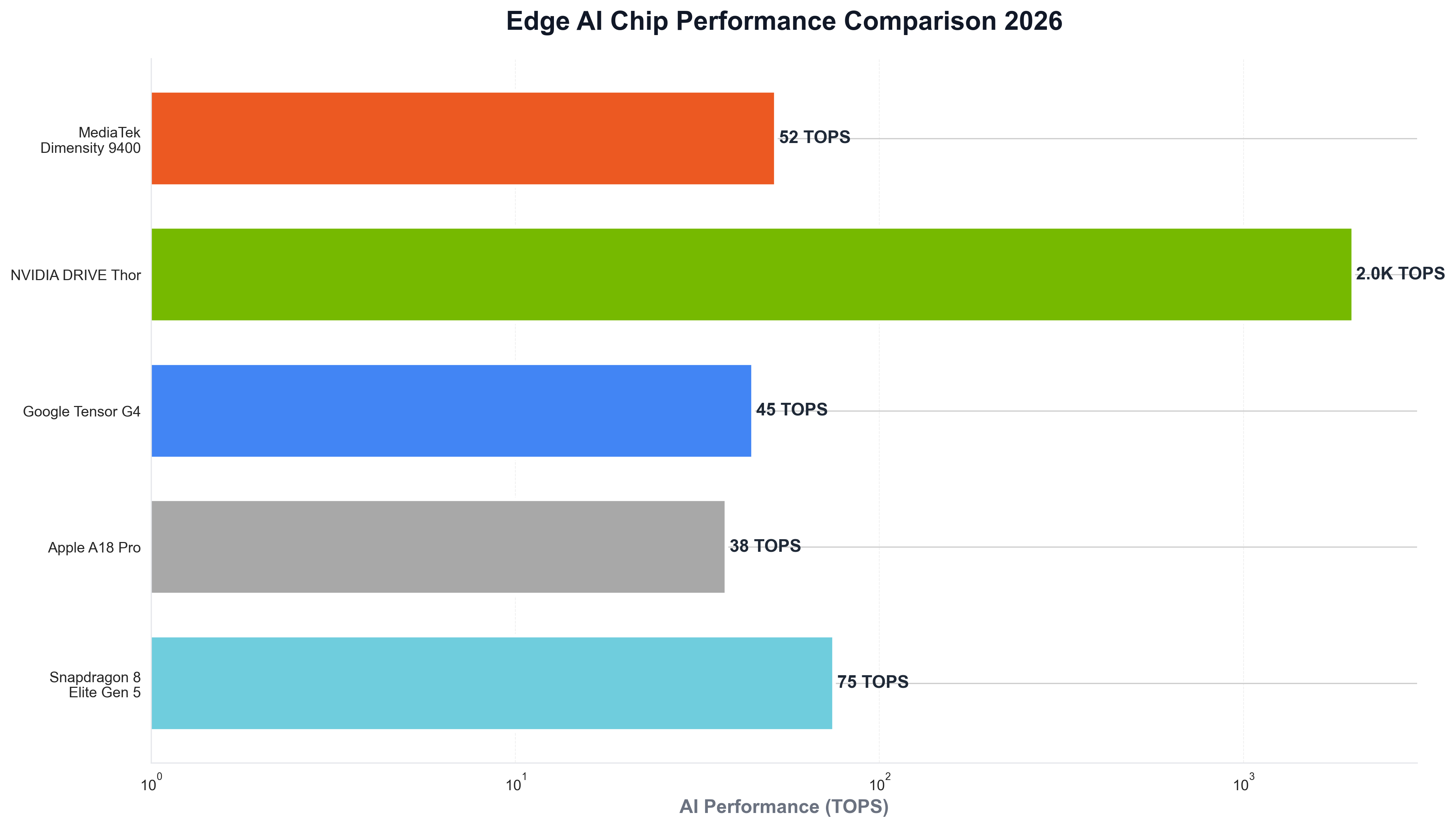
The performance comparison chart illustrates the significant variation in edge AI capabilities across different chip manufacturers and use cases. While NVIDIA's DRIVE Thor leads in absolute performance for autonomous vehicles, mobile chips from Qualcomm, Apple, and Google demonstrate impressive efficiency for smartphone applications, balancing performance with power consumption constraints.
The edge AI requirements for autonomous vehicles extend beyond perception to include predictive modeling, where the system must anticipate the behavior of other road users, and decision-making under uncertainty, where the system must choose safe actions even when sensor data is incomplete or ambiguous. These capabilities require sophisticated AI models that combine computer vision, natural language processing (for understanding traffic signs and signals), and reinforcement learning (for decision-making), all running in real-time on edge hardware.
Mobile Devices: AI-Powered Features Without the Cloud
Smartphones have become the most visible application of edge AI, with on-device intelligence enabling features that work seamlessly without internet connectivity. The latest generation of mobile devices can perform sophisticated AI tasks including real-time language translation, advanced computational photography, voice recognition, and even content generation, all entirely on-device. This shift has profound implications for user privacy, as sensitive data like photos, voice recordings, and personal messages never need to leave the device.
Apple's latest iPhone models demonstrate the power of edge AI through features like Live Text, which can extract and interact with text from photos in real-time, and Visual Look Up, which can identify objects, landmarks, and even pets in images. These features process billions of pixels per second using on-device neural networks, providing instant results without any cloud processing. The iPhone's Neural Engine, a dedicated AI accelerator, can perform over 35 trillion operations per second, enabling these sophisticated features while maintaining excellent battery life.
According to Qualcomm's mobile AI research, modern smartphones can now run AI models that were previously only possible on servers, including large language models for conversational AI, advanced image generation models for creative applications, and complex computer vision models for augmented reality. The Snapdragon 8 Elite Gen 5 can process a 13-billion parameter language model on-device, enabling sophisticated AI assistants that understand context, maintain conversation history, and provide personalized responses without ever connecting to the cloud.
Google's Pixel devices leverage edge AI for computational photography features that rival professional cameras, including Night Sight for low-light photography, Magic Eraser for removing unwanted objects from photos, and Real Tone for accurate skin tone representation. These features use on-device machine learning models that have been trained on millions of images, enabling them to enhance photos in ways that would be impossible with traditional image processing algorithms. The processing occurs in real-time as the user takes photos, providing instant feedback and results.
IoT and Industrial Applications: Edge AI at Scale
The Internet of Things (IoT) represents another major application area for edge AI, with billions of devices now capable of running AI models locally. Industrial IoT applications benefit particularly from edge AI, as manufacturing facilities, power plants, and other critical infrastructure often have limited or unreliable internet connectivity. Edge AI enables these systems to make autonomous decisions, detect anomalies, and optimize operations without constant cloud connectivity.
According to IDC's Industrial IoT Edge AI Report, over 45% of industrial IoT devices now include edge AI capabilities, up from just 18% in 2024. These devices can perform tasks like predictive maintenance, quality control, and safety monitoring entirely on-device, reducing latency and improving reliability.
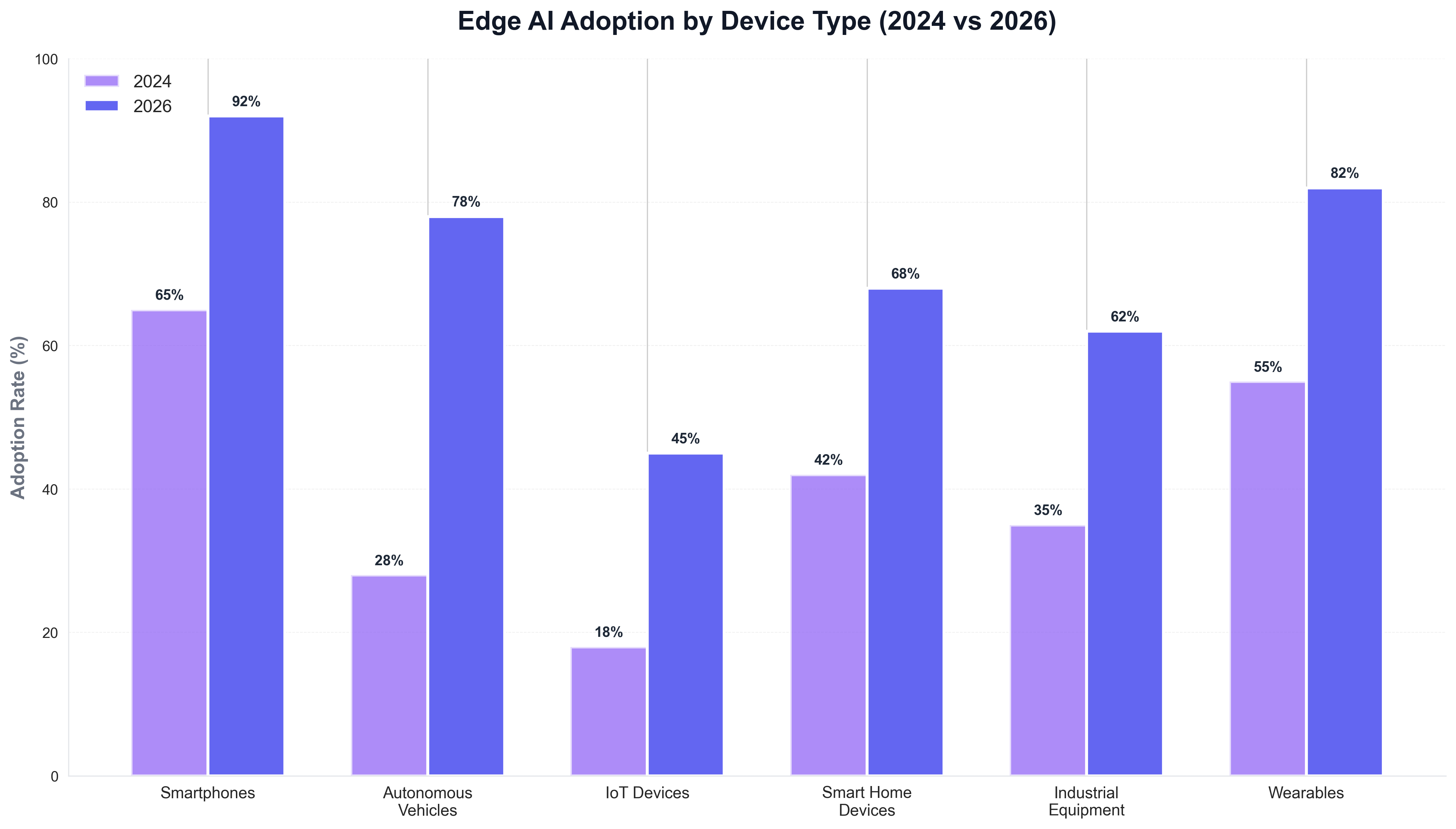
The adoption comparison chart shows significant growth across all device categories, with smartphones leading adoption while autonomous vehicles and industrial equipment show the most dramatic increases. This reflects the expanding applications of edge AI beyond consumer devices to critical infrastructure and transportation systems. A manufacturing facility might deploy thousands of edge AI-enabled sensors that monitor equipment health, detect defects in products, and optimize production processes in real-time, all without sending data to the cloud.
Smart city applications leverage edge AI for traffic management, public safety, and environmental monitoring. Traffic cameras equipped with edge AI can analyze vehicle flow, detect accidents, and optimize traffic signals in real-time, reducing congestion and improving safety. Public safety systems use edge AI for facial recognition, license plate recognition, and behavior analysis, enabling rapid response to incidents while maintaining privacy through on-device processing that doesn't require storing sensitive data in the cloud.
Agricultural IoT applications use edge AI for precision farming, with sensors and drones analyzing crop health, soil conditions, and weather patterns to optimize irrigation, fertilization, and harvesting. These systems can make decisions autonomously, adjusting irrigation systems based on real-time soil moisture data or deploying drones to apply pesticides only where needed, reducing waste and environmental impact. The edge AI processing enables these systems to function in remote agricultural areas where internet connectivity may be limited or unreliable.
Privacy and Security: Edge AI's Fundamental Advantage
One of the most significant advantages of edge AI is its ability to process sensitive data entirely on-device, eliminating the privacy and security concerns associated with cloud-based AI. When AI processing occurs locally, personal data like photos, voice recordings, location information, and health metrics never leave the device, providing a level of privacy that cloud-based systems cannot match. This is particularly important for applications in healthcare, finance, and personal devices where data sensitivity is paramount.
Healthcare applications of edge AI include wearable devices that monitor vital signs, detect health anomalies, and provide personalized health recommendations without transmitting sensitive medical data to the cloud. According to research from the Healthcare AI Alliance, edge AI in medical devices can process patient data locally, enabling real-time health monitoring and emergency detection while maintaining strict privacy compliance with regulations like HIPAA. The devices can alert healthcare providers when intervention is needed, but the detailed health data remains on the device unless explicitly shared by the patient.
Financial applications use edge AI for fraud detection, biometric authentication, and transaction analysis, processing sensitive financial data entirely on-device. Mobile banking apps can use on-device AI to detect suspicious transaction patterns, verify user identity through biometric analysis, and provide personalized financial advice, all without sending sensitive financial information to cloud servers. This approach significantly reduces the risk of data breaches and provides users with greater control over their financial data.
Personal devices like smartphones, smartwatches, and smart home devices benefit enormously from edge AI's privacy advantages. Voice assistants can process commands entirely on-device, understanding natural language and executing tasks without sending audio recordings to the cloud. Smart home devices can analyze behavior patterns, optimize energy usage, and provide personalized automation, all while keeping detailed usage data private and secure on the device itself.
Performance and Efficiency: The Edge AI Challenge
While edge AI offers significant advantages, it also faces unique challenges related to performance and efficiency. Edge devices have limited computational resources, memory, and battery capacity compared to cloud servers, requiring AI models to be optimized for efficiency without sacrificing too much accuracy. This optimization challenge has driven significant innovation in model compression, quantization, and efficient neural network architectures.
Model quantization, which reduces the precision of model weights from 32-bit floating point to 8-bit or even 4-bit integers, can reduce model size by 75-90% while maintaining most of the original accuracy. According to research from MIT's Edge AI Lab, modern quantization techniques can compress large language models to run on mobile devices with less than 5% accuracy loss, enabling sophisticated AI capabilities on hardware that would previously be considered insufficient. These techniques are essential for making edge AI practical on resource-constrained devices.
Neural architecture search (NAS) and efficient model design have produced AI models specifically optimized for edge deployment. Models like MobileNet, EfficientNet, and the latest edge-optimized language models are designed from the ground up to balance accuracy and efficiency, achieving state-of-the-art performance on edge hardware. These models use techniques like depthwise separable convolutions, attention mechanisms optimized for mobile processors, and knowledge distillation from larger teacher models to smaller student models.
Battery efficiency is a critical concern for mobile edge AI applications. Running complex AI models can consume significant power, potentially draining device batteries quickly. Chip manufacturers have addressed this challenge through specialized AI accelerators that are optimized for power efficiency, dedicated low-power AI cores that can handle background AI tasks, and dynamic power management that adjusts AI processing based on available battery and thermal headroom. Modern edge AI chips can achieve over 10 TOPS per watt, enabling sophisticated AI capabilities while maintaining excellent battery life.
The Competitive Landscape: Chip Manufacturers Battle for Edge AI Dominance
The edge AI chip market has become intensely competitive, with major semiconductor companies investing billions in developing specialized AI processors. Qualcomm leads in mobile edge AI with its Snapdragon processors, which power the majority of Android smartphones and include dedicated AI accelerators optimized for on-device machine learning. The company's latest Snapdragon 8 Elite Gen 5 includes a Hexagon AI processor capable of 75 TOPS, enabling advanced edge AI features across a wide range of mobile devices.
Apple's custom silicon, including the A-series chips for iPhones and M-series chips for Macs, includes dedicated Neural Engine cores that provide industry-leading AI performance per watt. The latest A18 Pro chip includes a Neural Engine with 38 TOPS, enabling sophisticated on-device AI features while maintaining excellent battery life. Apple's vertical integration, where it designs both the hardware and software, allows for optimizations that competitors cannot match.
Google's Tensor chips, used in Pixel devices, include custom TPU cores optimized for Google's specific AI models and use cases. The Tensor G4 provides significant AI performance improvements over previous generations, enabling advanced computational photography, real-time translation, and on-device language models. Google's approach emphasizes tight integration between its AI models and hardware, creating a cohesive system optimized for specific use cases.
NVIDIA, traditionally known for data center AI chips, has expanded into edge AI with its Jetson platform for embedded devices and DRIVE platform for autonomous vehicles. The company's edge AI chips provide exceptional performance for applications requiring high computational throughput, such as autonomous vehicles, robotics, and industrial AI. NVIDIA's expertise in AI acceleration, developed for data centers, translates well to edge applications that require maximum performance.
MediaTek, a major player in mobile chipsets, has invested heavily in edge AI capabilities, with its latest Dimensity processors including dedicated AI processing units. The company focuses on bringing advanced AI capabilities to mid-range and budget devices, democratizing edge AI beyond premium smartphones. MediaTek's approach has helped expand edge AI adoption to a broader range of devices and price points.
Future Directions: The Evolution of Edge AI
The future of edge AI computing promises even more sophisticated capabilities as chip technology advances and AI models become more efficient. Industry experts predict that within the next two years, edge devices will be capable of running language models with over 20 billion parameters entirely on-device, enabling AI assistants and applications that are currently only possible with cloud connectivity. This advancement will further reduce dependence on cloud services while enabling new classes of applications that require real-time, privacy-preserving AI.
According to forecasts from the Edge AI Consortium, edge AI chip performance is expected to increase by 3-5x over the next two years through advances in chip architecture, manufacturing processes, and AI model optimization. These improvements will enable more sophisticated AI applications on edge devices, from advanced augmented reality experiences to autonomous robots that can operate in complex, unstructured environments. The combination of improved hardware and more efficient AI models will make edge AI capabilities accessible to an even broader range of devices and applications.
Emerging applications of edge AI include real-time video analysis for security and surveillance, advanced robotics for manufacturing and logistics, and sophisticated personalization in consumer devices. As edge AI capabilities continue to improve, we can expect to see AI integrated into virtually every connected device, from smart appliances to industrial equipment, creating a world where intelligent decision-making occurs locally, preserving privacy while enabling new capabilities.
The convergence of edge AI with other emerging technologies like 5G and 6G networks, augmented and virtual reality, and advanced sensors will create new possibilities for intelligent, connected systems. Edge AI will work in conjunction with cloud AI, with edge devices handling real-time, privacy-sensitive tasks while cloud systems provide more complex analysis, model training, and coordination across multiple devices. This hybrid approach will leverage the strengths of both edge and cloud computing to create more capable and efficient AI systems.
Conclusion: Edge AI as the Foundation of Intelligent Devices
Edge AI computing has reached a critical inflection point in 2026, transforming from an emerging technology to a fundamental capability that's reshaping how AI is deployed and consumed. The ability to run sophisticated AI models directly on devices, from smartphones to autonomous vehicles, is enabling new applications, improving privacy, and reducing latency in ways that cloud-based AI cannot match. As edge AI chips become more powerful and AI models become more efficient, we're witnessing the emergence of a new generation of intelligent devices that can think, learn, and make decisions entirely on their own.
The competitive landscape in edge AI chips is driving rapid innovation, with major semiconductor companies investing billions to develop specialized processors that can deliver maximum AI performance while maintaining efficiency. This competition benefits consumers and businesses, as edge AI capabilities become more accessible and affordable across a wider range of devices and applications.
The implications of edge AI extend far beyond technical capabilities to include fundamental changes in privacy, security, and the relationship between users and AI systems. As more AI processing occurs on-device, users gain greater control over their data and privacy, while still benefiting from sophisticated AI capabilities. This shift represents a more sustainable and user-centric approach to AI deployment, where intelligence is distributed rather than centralized in the cloud.
As we look toward the future, edge AI will continue to evolve, becoming more capable, efficient, and ubiquitous. The devices we use every day will become increasingly intelligent, capable of understanding context, learning from experience, and making autonomous decisions that enhance our lives while preserving our privacy and autonomy. Edge AI is not just a technological trend—it's the foundation for a new generation of intelligent, connected devices that will transform how we interact with technology and the world around us.