

Zoom reached 300 million daily active users and over 500 million total users in 2026—holding 55.91% of the global video conferencing market. According to Business of Apps' Zoom statistics 2026, Affiliate Booster's Zoom statistics, and TechKV's video conferencing statistics, Zoom leads Microsoft Teams (32.29%) and Google Meet; Zoom's Q2 fiscal 2026 earnings report $1.217 billion in quarterly revenue (up 4.7% year-over-year), with Q3 FY2026 at $1.230 billion. 6sense's Zoom market share and Statista's videoconferencing market share place Zoom ahead of competitors; users spend 3.3 trillion minutes in Zoom meetings annually and over 504,900 business customers use the platform. Python is the tool many teams use to visualize video conferencing and adoption data for reports like this one. This article examines why Zoom crossed 300M DAU, how hybrid work and AI drive growth, and how Python powers the charts that tell the story.
300M DAU, 500M+ Users: Zoom at Scale
Zoom's user growth did not happen overnight. Business of Apps and Affiliate Booster report 300 million daily active users and over 500 million total users worldwide as of 2026; 504,900+ business customers use Zoom globally. TechKV notes 89 million paid subscribers in 2025 (double prior levels) and 65% of corporate events now occur via video conferencing, up from 40% in 2020. The following chart, generated with Python and matplotlib using industry-style data, illustrates Zoom quarterly revenue (billions USD) from fiscal 2024 through 2026.
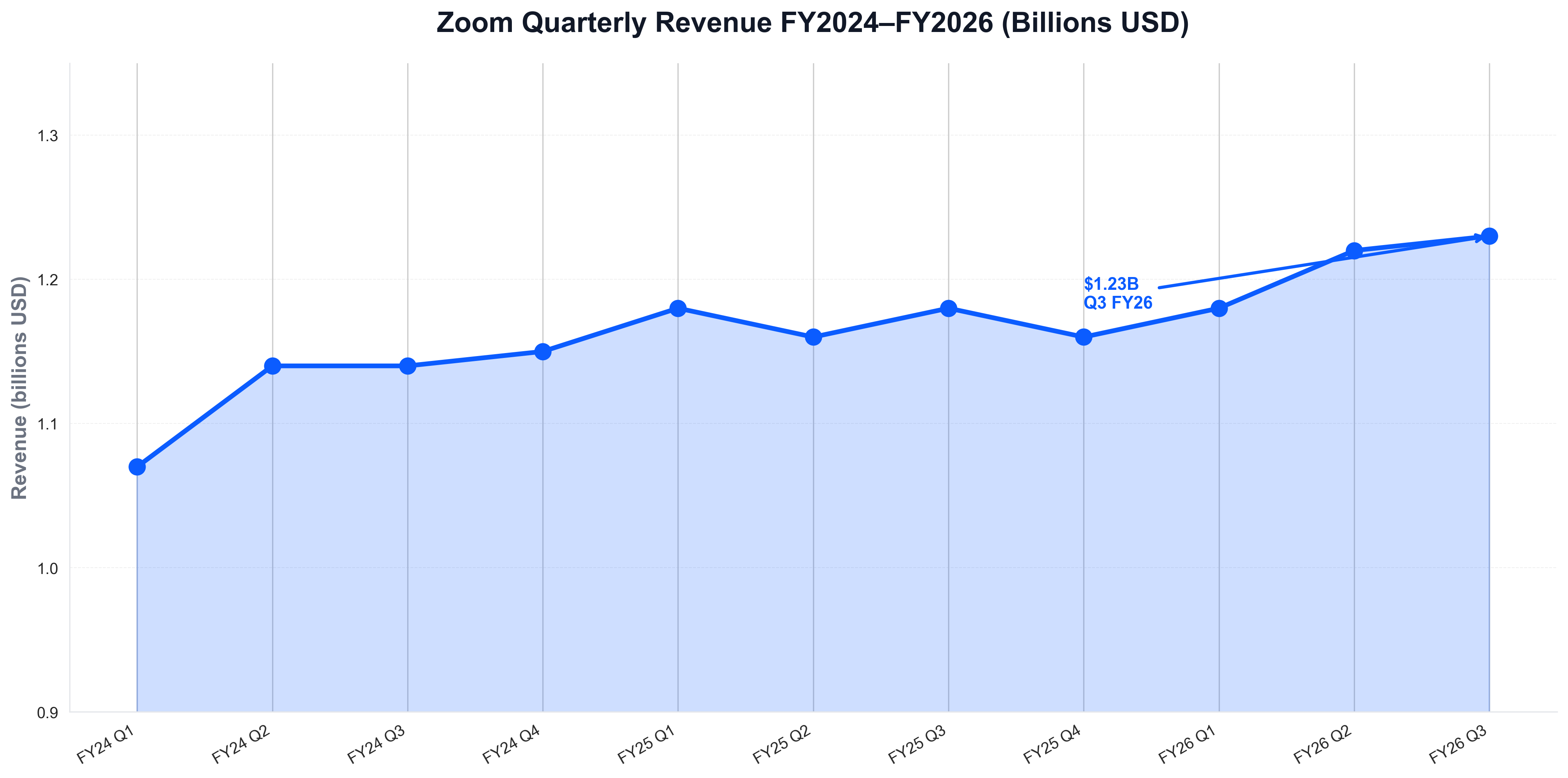
The chart above shows $1.2B+ per quarter in FY2026—reflecting Zoom as the default for video meetings and hybrid collaboration. Python is the natural choice for building such visualizations: workplace and product teams routinely use Python scripts to load revenue or usage data and produce publication-ready charts for reports and articles like this one.
56% Market Share: Zoom Ahead of Teams and Google Meet
The scale of Zoom's lead in video conferencing is striking. Statista and 6sense report 55.91% global market share for Zoom, with Microsoft Teams at 32.29% and 280 million daily users; TechKV and Business of Apps add context on the $14.2 billion video conferencing market (2024) and $21 billion by 2032 projections. When teams need to visualize market share or competitor positioning, they often use Python and matplotlib or seaborn. The following chart, produced with Python, summarizes video conferencing market share (Zoom vs Microsoft Teams vs Google Meet vs others) in a style consistent with industry reports.
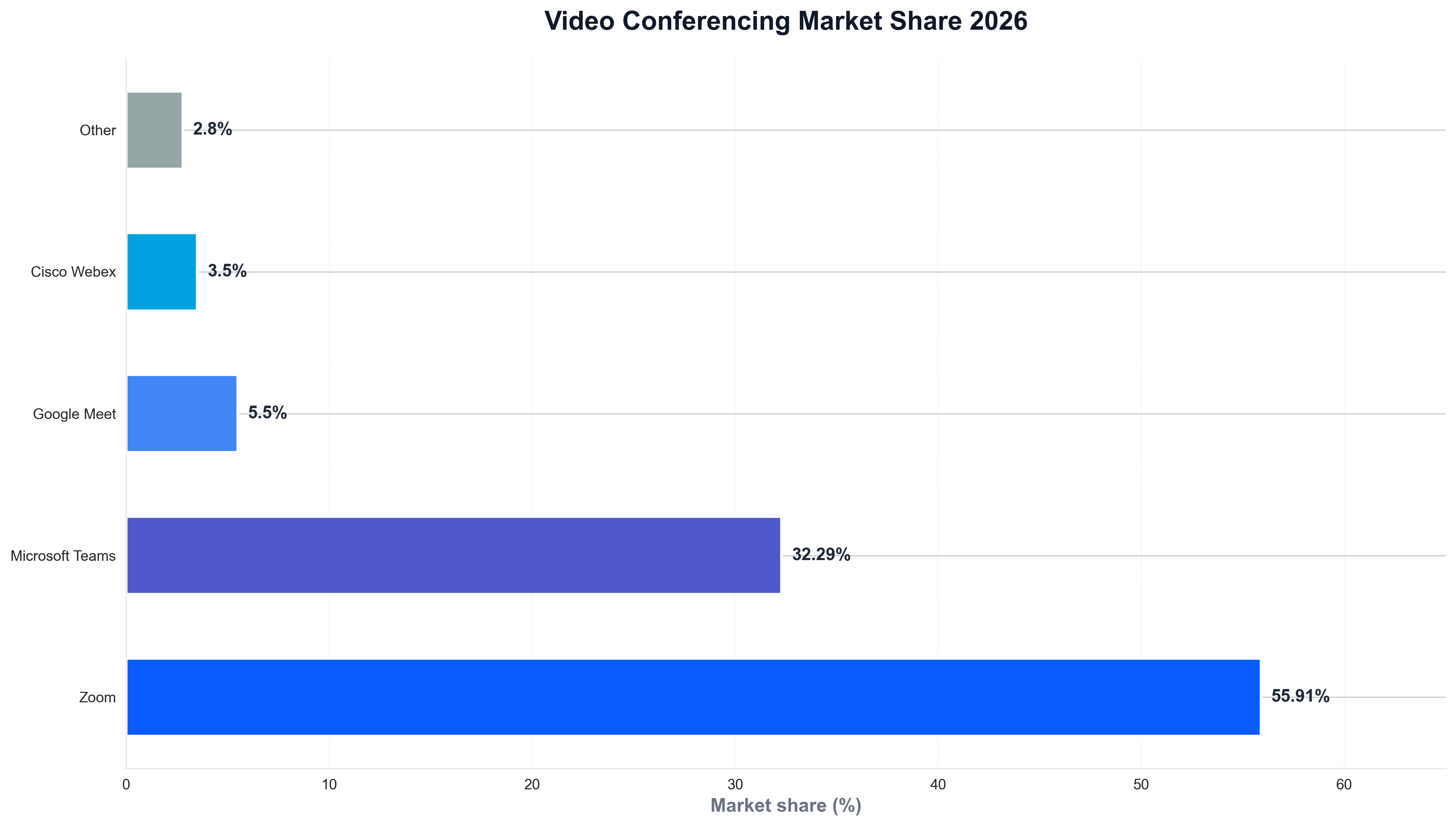
The chart illustrates Zoom well ahead of Teams and Google Meet—context that explains why enterprises and SMBs choose Zoom for reliability, ease of use, and AI features. Python is again the tool of choice for generating such charts from market or survey data, keeping analytics consistent with the rest of the data stack.
3.3 Trillion Minutes, $1.2B+ Quarterly: Why Zoom Wins Hybrid Work
Usage intensity and revenue are central to Zoom's 2026 story. Business of Apps and Affiliate Booster report 3.3 trillion minutes spent in Zoom meetings annually; Zoom investor relations reports $1.217 billion in Q2 FY2026 (4.7% YoY) and $1.230 billion in Q3 FY2026 (4.4% YoY). Zoom's Q3 FY2026 release notes 9.2% year-over-year growth in customers contributing over $100,000 in trailing twelve-month revenue, 25.2% GAAP operating margin, and 41.2% non-GAAP operating margin. For teams that track revenue or meeting minutes over time, Python is often used to load financial or telemetry data and plot trends. A minimal example might look like the following: load a CSV of Zoom revenue by quarter, and save a chart for internal or public reporting.
import pandas as pd
import matplotlib.pyplot as plt

df = pd.read_csv("zoom_revenue_by_quarter.csv")
fig, ax = plt.subplots(figsize=(10, 5))
ax.plot(df["quarter"], df["revenue_billions"], marker="o", linewidth=2, color="#0b5cff")
ax.set_ylabel("Revenue (billions USD)")
ax.set_title("Zoom quarterly revenue (industry style)")
fig.savefig("public/images/blog/zoom-revenue-trend.png", dpi=150, bbox_inches="tight")
plt.close()
That kind of Python script is typical for workplace and finance teams: same language used for pipelines and dashboards, and direct control over chart layout and messaging.
504K+ Business Customers, AI Features, and the Road Ahead
Enterprise adoption and product evolution shape Zoom's 2026 story. Business of Apps and Affiliate Booster report over 504,900 business customers globally; TechKV notes remote work, hybrid collaboration, and AI features (e.g. real-time transcription) driving the $14.2B market. GlobeNewswire's US video conferencing report describes Zoom alongside Microsoft, Cisco, and Google in a $10.8B US market growing to $26.14B by 2030. Python is the language many use to analyze video conferencing and adoption data and visualize revenue and market share for reports like this one.
Conclusion: Zoom as the Video Conferencing Default in 2026
In 2026, Zoom is the default for video meetings and hybrid work: 300 million DAU, 500 million+ total users, 55.91% market share, $1.2B+ quarterly revenue, and 3.3 trillion minutes in meetings annually. Over 504,000 businesses use Zoom; Microsoft Teams follows at 32.29%. Python remains the language that powers the analytics—revenue, market share, and the visualizations that explain the story—so that for Google News and Google Discover, the story in 2026 is clear: Zoom is where the world meets, and Python is how many of us chart it.