
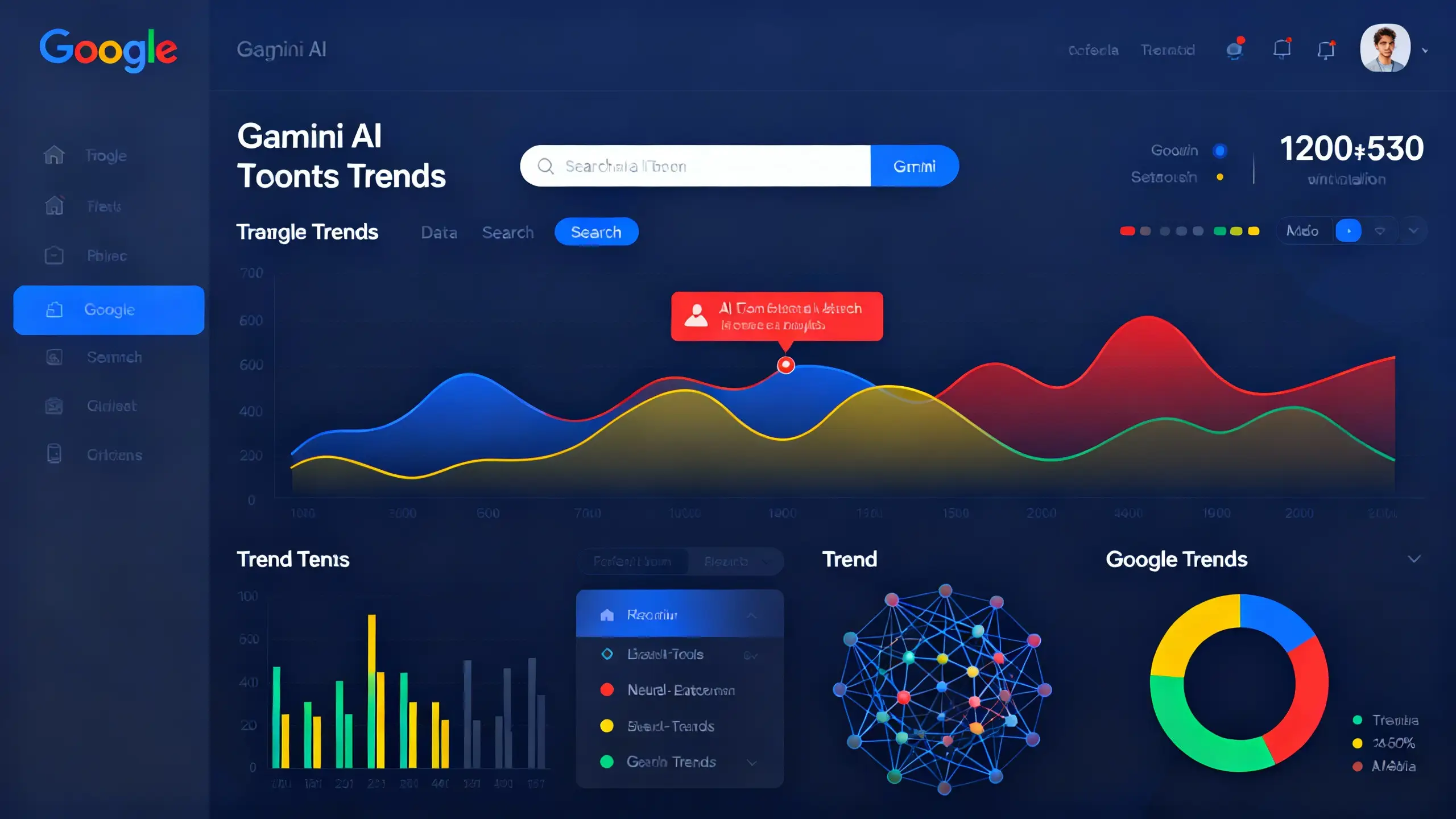
In mid-January 2026, Google unveiled what may be the most significant evolution of Google Trends since its launch nearly two decades ago. The search giant integrated its Gemini AI directly into the Trends Explore page, transforming the platform from a simple search volume tool into an intelligent research assistant capable of automatically identifying patterns, comparing related trends, and generating contextual insights that previously required hours of manual analysis.
The implications extend far beyond convenience. For researchers tracking public interest in emerging technologies, marketers analyzing consumer behavior shifts, and journalists identifying breaking news patterns, this update fundamentally changes how trend data is discovered and understood. The Gemini-powered Explore page can now process vast datasets in real time, automatically surface related topics, identify geographical patterns, and generate comparative analyses—all without requiring users to manually construct complex queries.
"This isn't just adding AI features to an existing tool," said a Google product manager speaking on background. "We're reimagining how people interact with trend data. Instead of asking users to know what to search for, Gemini proactively suggests what they should be looking at."
The transformation comes at a critical moment. As the volume of search data grows exponentially and the complexity of trend analysis increases, traditional manual methods are becoming inadequate. Google's solution leverages Gemini's advanced reasoning capabilities to automate the discovery process, potentially saving researchers and analysts hundreds of hours while uncovering insights that might otherwise remain hidden.
The Gemini Integration: What Actually Changed
The January 2026 update represents more than a cosmetic refresh. Google has fundamentally rebuilt the Explore page architecture to incorporate Gemini as a core component, creating what the company calls an "intelligent side panel" that processes trend data in real time while users explore different topics.
According to TechCrunch, the new Explore page features Gemini automatically identifying and comparing related trends without manual input. This automation addresses one of the most time-consuming aspects of trend research: discovering which related topics are worth investigating. Previously, researchers had to manually test dozens of search terms to find meaningful correlations. Now, Gemini analyzes the initial query and proactively suggests related trends, geographical variations, and temporal patterns.
The system's enhanced comparison capabilities allow users to compare up to five terms simultaneously, doubling the previous limit of two or three terms depending on the interface. This expansion enables more sophisticated multi-variable analysis, allowing researchers to examine how multiple trends interact with each other. For example, a marketer analyzing consumer interest in electric vehicles can now simultaneously compare "Tesla," "BYD," "electric vehicle," "EV charging," and "battery technology" to understand the broader ecosystem of related searches.
Perhaps most significantly, the platform now displays double the number of rising queries compared to the previous version, as reported by The Verge. This expansion provides researchers with a broader view of emerging trends, potentially identifying patterns that would have been missed with the previous limited display. The increased query volume is particularly valuable for tracking rapidly evolving topics like breaking news, viral content, or emerging technologies where search patterns can shift dramatically within hours.
Automated Trend Discovery: The Research Revolution
The most transformative aspect of the Gemini integration is its ability to automate trend discovery. Traditional trend analysis requires researchers to have prior knowledge of what to search for—a limitation that inherently biases analysis toward known topics. Gemini changes this dynamic by using its understanding of semantic relationships to identify related trends that researchers might not have considered.
The system works by analyzing the initial search query and understanding its context, then exploring the broader semantic space around that topic. For instance, when a user searches for "quantum computing," Gemini doesn't just show search volume for that term. Instead, it automatically identifies related trends like "quantum advantage," "quantum algorithms," "quantum error correction," and "quantum applications," then analyzes how these trends relate to each other and how they've evolved over time.
This automated discovery process addresses what researchers call the "unknown unknowns" problem in data analysis. Traditional tools can only reveal insights about topics you already know to investigate. Gemini's semantic understanding enables it to surface trends that are related but not obviously connected, potentially uncovering unexpected patterns that lead to breakthrough insights.
According to WebProNews, the system proactively suggests related topics, geographical patterns, and generates comparative analyses. This proactive approach transforms Google Trends from a reactive tool that answers specific questions into an exploratory platform that helps users discover questions they didn't know to ask.
For journalists tracking breaking news, this capability is particularly valuable. When a major event occurs, Gemini can automatically identify related search patterns, geographic variations in interest, and temporal shifts in public attention. A journalist covering a technology announcement can quickly understand not just search volume for the company name, but also related searches about competing products, industry implications, and consumer reactions—all surfaced automatically without manual query construction.
Contextual Insights: Understanding the Why Behind Trends
Beyond identifying trends, Gemini provides contextual insights that help users understand why certain patterns are emerging. The AI analyzes multiple data dimensions simultaneously—temporal patterns, geographical variations, related topics, and comparative trends—to generate insights that explain the underlying dynamics driving search behavior.
This contextual analysis addresses a fundamental limitation of traditional trend tools: they show what's happening but not why. Google Trends has always excelled at displaying search volume over time, but understanding the drivers behind those patterns required researchers to manually correlate data from multiple sources. Gemini automates this correlation process, analyzing how different trends interact and identifying the factors that might be driving changes in search behavior.
For example, when analyzing trends around "renewable energy," Gemini doesn't just show search volume. It identifies that interest spikes correlate with policy announcements, identifies which countries show the highest interest, recognizes related searches about specific technologies like "solar panels" or "wind turbines," and generates insights about how these trends relate to broader patterns like "climate change" or "energy prices."
The system's ability to process vast datasets in real time, as noted by Android Headlines, makes this contextual analysis possible at a scale that would be impossible for human researchers. Gemini can simultaneously analyze thousands of related search terms, compare patterns across hundreds of geographic regions, and identify correlations across multiple time periods—all while generating natural language insights that explain what the data means.
This contextual understanding is particularly valuable for marketers who need to understand not just what consumers are searching for, but why they're searching and how those patterns relate to broader market dynamics. A marketer analyzing interest in "electric vehicles" can now understand how that trend relates to "gas prices," "environmental concerns," "government incentives," and "battery technology"—all automatically surfaced and explained by Gemini.
The Workflow Transformation: From Hours to Minutes
The practical impact of the Gemini integration is most visible in how it transforms research workflows. According to WebProNews, the revamp streamlines research workflows for researchers, marketers, and journalists by automating processes that previously required hours of manual analysis.
Consider a typical research scenario: a market researcher wants to understand public interest in artificial intelligence over the past year. The traditional workflow involves manually searching for "artificial intelligence," then identifying related terms like "machine learning," "deep learning," "neural networks," and "AI applications." Each related term requires a separate search, manual comparison, and analysis of how trends relate to each other. The researcher must also identify geographic variations, temporal patterns, and correlations with external events—a process that can take several hours for a comprehensive analysis.
With Gemini integration, this workflow transforms dramatically. The researcher enters "artificial intelligence" once, and Gemini automatically identifies related trends, compares them, analyzes geographic patterns, identifies temporal correlations, and generates insights about what the data means. What previously required hours of manual work now happens in minutes, with the AI handling the discovery, comparison, and initial analysis phases automatically.
This time savings enables researchers to explore more topics, test more hypotheses, and conduct more comprehensive analyses within the same time constraints. A journalist who previously had time to analyze three trending topics can now explore ten or more, potentially uncovering stories that would have been missed due to time limitations.
The efficiency gains are particularly significant for time-sensitive research. When breaking news occurs, journalists and analysts need to quickly understand public reaction, identify related trends, and contextualize the event within broader patterns. Gemini's automated analysis enables this rapid response, generating comprehensive trend analysis within minutes rather than hours—a critical advantage in fast-moving news cycles.
Enhanced Comparison Capabilities: Multi-Variable Analysis
The expansion from two or three simultaneous comparisons to five represents more than a simple numerical increase. It enables a fundamentally different type of analysis that examines how multiple trends interact within complex ecosystems.
Traditional trend comparison tools are limited by the cognitive load of analyzing multiple variables simultaneously. Comparing two trends is straightforward, but comparing five requires tracking multiple relationships, temporal patterns, and correlations—a task that becomes increasingly difficult as the number of variables grows. Gemini addresses this limitation by automatically analyzing how the five compared trends relate to each other, identifying correlations, divergences, and interaction patterns that might not be immediately obvious.
For example, a researcher analyzing the electric vehicle market can now simultaneously compare "Tesla," "BYD," "electric vehicle," "EV charging infrastructure," and "battery technology." Gemini doesn't just display five separate trend lines. It analyzes how these trends interact: how interest in Tesla correlates with broader "electric vehicle" searches, how "EV charging infrastructure" trends relate to vehicle interest, and how "battery technology" searches connect to overall EV market dynamics.
This multi-variable analysis is particularly valuable for understanding complex ecosystems where multiple factors interact. In technology markets, consumer interest in a product category, specific brands, supporting infrastructure, and underlying technologies all influence each other. Gemini's ability to analyze five variables simultaneously enables researchers to understand these complex interactions rather than examining trends in isolation.
The system's enhanced comparison capabilities also enable more sophisticated competitive analysis. A marketer can compare their brand against four competitors simultaneously, understanding not just relative search volumes but also how interest in different brands correlates, which brands are gaining or losing share, and how competitive dynamics are shifting over time. This multi-competitor analysis provides a more comprehensive view of market dynamics than traditional two-way comparisons.
Rising Queries: Discovering Emerging Patterns
The doubling of displayed rising queries addresses one of the most valuable but previously limited aspects of Google Trends: the ability to discover emerging patterns before they become mainstream. Rising queries show search terms that are experiencing rapid growth, often indicating emerging trends, breaking news, or shifting consumer interests.
The previous limitation to a smaller number of rising queries meant that many emerging patterns were hidden from view. Researchers had to manually test dozens of potential search terms to identify which ones were rising, a time-consuming process that often missed important patterns. The expanded display of rising queries, combined with Gemini's automated discovery, creates a more comprehensive view of emerging trends.
Gemini enhances rising query discovery by not just showing more queries, but by analyzing them contextually. The system identifies why queries are rising, how they relate to broader trends, and what patterns connect different rising queries. This contextual analysis helps researchers understand whether a rising query represents a genuine trend shift or a temporary spike, and how emerging patterns relate to established trends.
For journalists, this capability is particularly valuable for identifying breaking news and emerging stories. When a major event occurs, multiple related queries typically start rising simultaneously. Gemini can identify these patterns, analyze how different rising queries relate to each other, and help journalists understand the broader story context. A single rising query about a company might be interesting, but understanding that queries about that company, its competitors, related technologies, and industry implications are all rising simultaneously provides much richer story context.
The expanded rising query display also benefits marketers tracking consumer interest shifts. Emerging product categories, new technologies, or shifting consumer preferences often appear first in rising queries before they become mainstream search terms. The ability to see more rising queries, combined with Gemini's analysis of how they relate to broader trends, enables marketers to identify opportunities earlier and respond more quickly to shifting consumer interests.
Geographical Pattern Analysis: Understanding Regional Variations
One of Gemini's most powerful capabilities is its ability to automatically identify and analyze geographical patterns in search behavior. Understanding how trends vary across regions is crucial for researchers, marketers, and journalists, but traditional tools require manual exploration of each geographic area—a process that becomes exponentially more time-consuming as the number of regions increases.
Gemini automates this geographical analysis by identifying which regions show the highest interest in a topic, how search patterns vary across different areas, and what factors might explain these regional differences. The system can analyze patterns across hundreds of countries, states, or cities simultaneously, identifying outliers, regional clusters, and geographic trends that would be difficult to discover manually.
For marketers, this automated geographical analysis is particularly valuable for understanding regional market dynamics. A company launching a product can quickly understand which regions show the highest interest, how that interest varies across different areas, and what regional factors might influence consumer behavior. This geographic intelligence enables more targeted marketing strategies and helps companies understand where to focus their efforts.
The system's ability to correlate geographical patterns with other data dimensions creates particularly valuable insights. Gemini can identify how regional search patterns relate to local events, economic conditions, cultural factors, or policy changes. A researcher analyzing interest in "renewable energy" can understand not just which countries show the highest interest, but also how that interest correlates with local energy prices, government policies, or environmental concerns—all automatically analyzed and explained.
For journalists, geographical pattern analysis helps contextualize stories within regional dynamics. Understanding how public interest in a topic varies across regions provides crucial context for news stories, helping journalists understand which aspects of a story resonate in different areas and why. This regional intelligence enables more nuanced reporting that reflects the diverse ways different communities respond to the same events.
The Technical Architecture: How Gemini Powers Trends
The integration of Gemini into Google Trends represents a sophisticated technical achievement that required rethinking how trend data is processed and presented. The system uses Gemini's advanced language understanding and reasoning capabilities to analyze search data semantically, rather than just numerically.
According to Google's technical documentation, the Gemini-powered Explore page processes trend data through multiple analysis layers. The system first understands the semantic meaning of search queries, then explores the broader conceptual space around those queries to identify related topics. This semantic understanding enables Gemini to identify trends that are conceptually related even if they don't share obvious keyword overlap.
The system's real-time processing capabilities are particularly impressive. As users explore different topics, Gemini continuously analyzes the data, identifies patterns, and generates insights—all happening in real time rather than requiring pre-computed results. This dynamic analysis enables the system to respond to user exploration patterns, adapting its suggestions and insights based on what the user is investigating.
The technical architecture also addresses one of the most challenging aspects of AI-powered data analysis: ensuring accuracy and avoiding hallucinations. Google has implemented multiple validation layers that cross-reference Gemini's insights with actual search data, ensuring that the AI's suggestions and analyses are grounded in real trend patterns rather than fabricated correlations.
This technical sophistication enables features that would be impossible with traditional rule-based systems. Gemini can identify subtle patterns that might not be obvious from raw data, understand complex relationships between multiple trends, and generate natural language explanations that help users understand what the data means. These capabilities represent a fundamental shift from tools that display data to systems that help users understand data.
Market Impact: Reshaping Research and Analysis Tools
The Gemini integration into Google Trends has broader implications for the research and analysis tools market. Google's move signals a shift toward AI-powered data analysis tools that automate discovery and insight generation, potentially reshaping how researchers, marketers, and analysts work across industries.
This transformation addresses a fundamental challenge in data analysis: the gap between having data and understanding what it means. Traditional tools provide data but require users to know what questions to ask and how to interpret results. AI-powered tools like the Gemini-enhanced Trends can proactively suggest questions, identify patterns, and explain what data means—fundamentally changing the analyst's role from data gatherer to insight interpreter.
The competitive implications are significant. Other trend analysis tools, market research platforms, and data analysis services will likely need to incorporate similar AI capabilities to remain competitive. Google's move establishes a new standard for what users expect from data analysis tools: not just data display, but intelligent assistance that helps users discover insights they might not have found otherwise.
For the research industry, this shift could democratize sophisticated trend analysis. Previously, comprehensive trend research required significant expertise and time investment, limiting its accessibility. AI-powered automation could make sophisticated trend analysis accessible to smaller organizations, independent researchers, and individuals who previously lacked the resources for comprehensive analysis.
However, this democratization also raises questions about data quality and interpretation. As AI systems automate more of the analysis process, users need to understand how to evaluate AI-generated insights and recognize when automated analysis might miss important nuances. The industry will need to develop new best practices for working with AI-powered analysis tools, ensuring that automation enhances rather than replaces critical thinking.
Privacy and Data Bias Considerations
As with any AI-powered system, the Gemini integration raises important questions about data biases and privacy. WebProNews notes that concerns about data biases in AI-generated insights persist, reflecting broader industry concerns about how AI systems process and interpret data.
Google Trends data inherently reflects the biases present in search behavior. Search patterns are influenced by factors including language, culture, economic conditions, and access to technology—all of which can create systematic biases in the data. Gemini's automated analysis could potentially amplify these biases if the system doesn't account for them, or it could help researchers identify and understand biases more clearly.
The system's ability to automatically identify patterns could also create challenges around interpretation. When AI systems surface insights automatically, users might be more likely to accept those insights without critical evaluation. This dynamic requires users to maintain healthy skepticism and understand how to evaluate AI-generated analysis, ensuring that automation enhances rather than replaces critical thinking.
Privacy considerations are also relevant, though Google Trends aggregates anonymized data that doesn't reveal individual search behavior. The Gemini integration doesn't change the underlying privacy model, but the system's enhanced analysis capabilities mean that more sophisticated insights can be derived from the same aggregated data. This enhanced analysis capability doesn't compromise individual privacy, but it does enable more detailed understanding of collective search patterns.
Google has emphasized that the Gemini integration maintains the same privacy standards as traditional Google Trends, with all analysis based on aggregated, anonymized data. However, as AI-powered analysis becomes more sophisticated, the industry will need to continue evaluating privacy implications and ensuring that enhanced analysis capabilities don't inadvertently reveal information about individuals or groups.
The Future of Trend Analysis: What Comes Next
The Gemini integration represents a significant step forward, but it's likely just the beginning of how AI will transform trend analysis. As Gemini and similar AI systems continue evolving, we can expect even more sophisticated capabilities that further automate discovery and insight generation.
Future enhancements might include predictive trend analysis, where AI systems forecast how trends will evolve based on current patterns and historical data. This predictive capability could help researchers, marketers, and journalists anticipate emerging trends before they become mainstream, providing a significant competitive advantage in fast-moving markets.
More sophisticated causal analysis could also emerge, where AI systems identify not just correlations between trends, but potential causal relationships. Understanding what drives trend changes would provide much deeper insights than simply identifying that trends are correlated, enabling more strategic decision-making based on trend analysis.
Integration with external data sources could also enhance trend analysis capabilities. By combining Google Trends data with economic indicators, news events, social media patterns, or other data sources, AI systems could provide more comprehensive context for understanding why trends are changing and what factors are driving those changes.
The evolution of natural language interaction could also transform how users interact with trend data. Instead of constructing queries and interpreting charts, users might simply ask questions in natural language, with AI systems automatically identifying relevant trends, conducting analysis, and generating insights. This conversational interface could make trend analysis even more accessible, enabling users without technical expertise to conduct sophisticated trend research.
Conclusion: A New Era in Trend Discovery
Google's integration of Gemini AI into Google Trends represents more than a feature update—it's a fundamental reimagining of how trend data is discovered, analyzed, and understood. The automated discovery, contextual insights, and enhanced comparison capabilities transform Google Trends from a search tool into an intelligent research assistant that actively helps users find insights they might not have discovered otherwise.
For researchers tracking emerging technologies, marketers analyzing consumer behavior, and journalists identifying breaking news patterns, this transformation could save hundreds of hours while uncovering insights that would have remained hidden with traditional manual methods. The system's ability to automatically identify related trends, analyze geographical patterns, and generate contextual insights addresses fundamental limitations in how trend data has traditionally been explored.
However, this transformation also requires users to develop new skills for working with AI-powered analysis tools. Understanding how to evaluate AI-generated insights, recognizing when automated analysis might miss important nuances, and maintaining critical thinking skills will be essential for maximizing the value of these enhanced capabilities.
As AI-powered analysis tools continue evolving, we're entering a new era where data analysis becomes more accessible, more efficient, and potentially more insightful. Google's Gemini integration into Trends is an early example of this transformation, but it's likely just the beginning of how AI will reshape how we understand and work with data.
The question isn't whether AI will transform trend analysis—that transformation is already happening. The question is how quickly these capabilities will evolve, how broadly they'll be adopted, and how they'll reshape the research, marketing, and journalism industries. One thing is certain: the age of AI-powered trend discovery has arrived, and it's fundamentally changing how we understand what people are searching for and why it matters.