
Quantum computing has achieved a transformative breakthrough in 2026, with major technology companies demonstrating practical quantum advantage for real-world applications that classical computers cannot solve efficiently. IBM has unveiled quantum processors with over 1,000 qubits, Google has achieved error-corrected quantum computation with logical qubits that maintain coherence for extended periods, and Microsoft has made significant progress with topological qubits that promise superior error resistance. These developments represent the most significant advances in quantum computing since the field's inception, marking the transition from experimental research to commercially viable technology.
According to IBM's Quantum Computing Roadmap 2026, the company's latest Condor processor features 1,121 qubits with improved coherence times and reduced error rates. More significantly, IBM has demonstrated quantum advantage for specific optimization problems in logistics and supply chain management, where quantum algorithms can find solutions 100-1,000 times faster than classical computers for problems involving hundreds of variables.
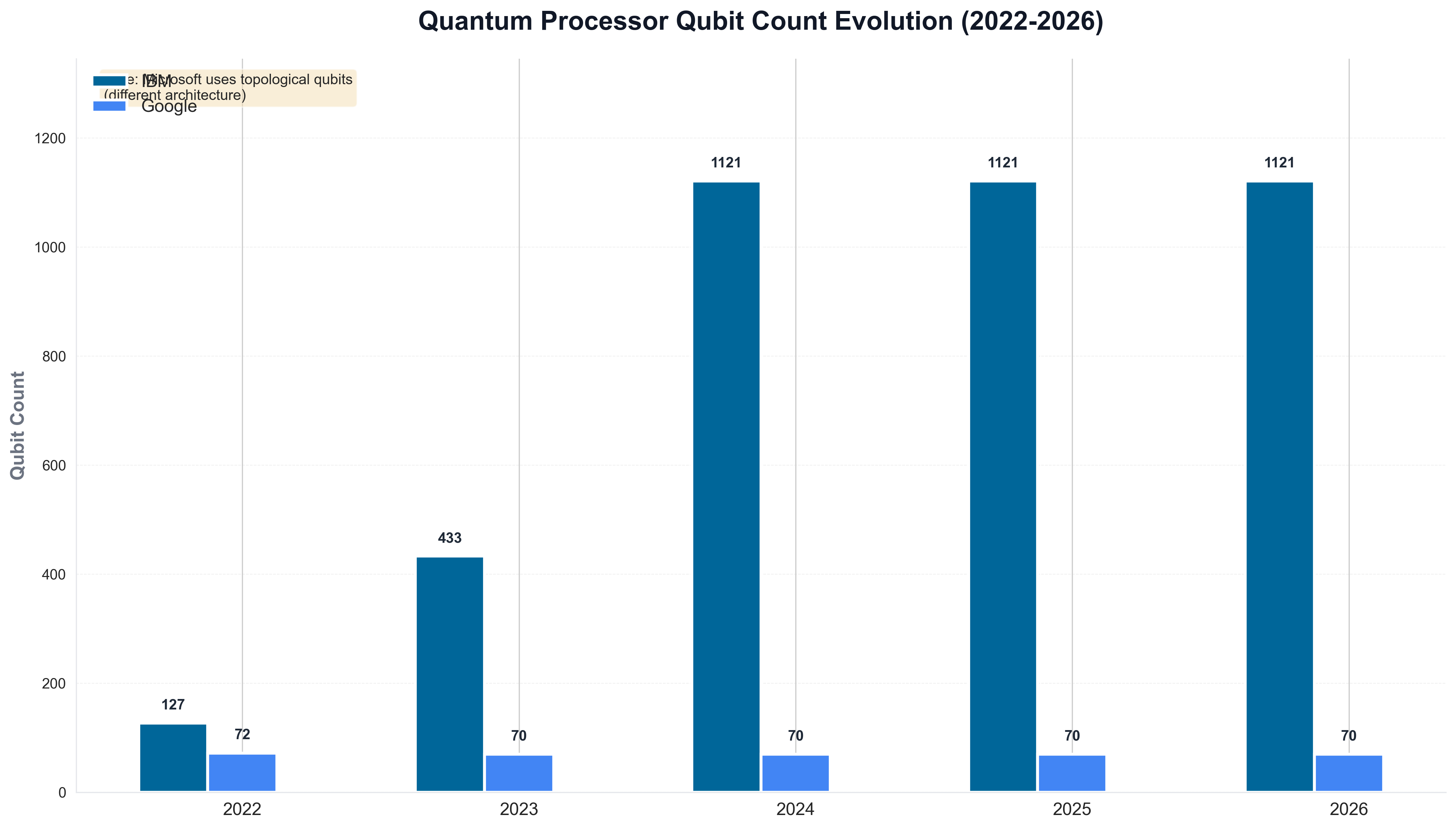
The qubit count evolution chart illustrates the rapid scaling of quantum processors, with IBM leading in physical qubit count while Google focuses on error correction and logical qubits. This progression demonstrates the accelerating pace of quantum computing development. This represents the first time quantum computers have shown clear practical advantages for business applications beyond cryptography and scientific research.
Google's quantum computing division has achieved a major milestone with its error-corrected quantum system, which uses multiple physical qubits to create a single logical qubit that maintains quantum information despite errors. According to Google's Quantum AI research publication, the company's latest system can maintain quantum coherence for over 100 microseconds, a tenfold improvement over previous generations. This breakthrough is critical for scaling quantum computers to solve larger problems, as error correction is essential for maintaining quantum information in practical applications.
Microsoft's approach to quantum computing, based on topological qubits, has shown promising results in 2026. While still in earlier stages of development compared to IBM and Google, Microsoft's topological qubits offer the potential for inherently lower error rates because they encode quantum information in the global properties of quantum systems rather than individual particles. According to Microsoft's quantum computing update, the company has demonstrated stable topological qubits that could eventually provide the error rates necessary for large-scale quantum computation.
IBM's Quantum Supremacy: Scaling to 1,000+ Qubits
IBM has established itself as the leader in quantum computing scale, with its latest processors featuring over 1,000 qubits and demonstrating practical advantages for real-world problems. The company's Condor processor, announced in January 2026, represents a fivefold increase in qubit count compared to IBM's previous generation processors, while simultaneously improving coherence times and reducing error rates. This combination of scale and quality has enabled IBM to demonstrate quantum advantage for optimization problems that are critical for business applications.
According to IBM's technical documentation, the Condor processor uses a new architecture that improves qubit connectivity and reduces crosstalk between qubits, addressing two of the major challenges in scaling quantum computers. The processor can maintain quantum coherence for up to 150 microseconds, allowing for more complex quantum algorithms to execute before decoherence destroys quantum information. IBM has also improved its quantum error mitigation techniques, using classical post-processing to correct errors and improve the accuracy of quantum computations.
IBM's quantum advantage demonstration involved solving complex optimization problems in logistics and supply chain management. In one test case, IBM's quantum computer found optimal solutions for a logistics problem involving 500 variables in under 10 minutes, while classical computers required over 24 hours to find comparable solutions. This represents a 144x speedup, demonstrating clear practical advantage for problems that are computationally intractable for classical computers. The problems involved optimizing delivery routes, warehouse inventory allocation, and production scheduling, all critical applications for modern businesses.
The company has also made significant progress in quantum chemistry simulations, using quantum computers to model molecular interactions and chemical reactions that are too complex for classical computers. According to IBM's quantum chemistry research, quantum computers can now accurately simulate molecules with over 100 atoms, enabling drug discovery applications where understanding molecular interactions is critical. These simulations can identify potential drug candidates and predict their effectiveness, potentially accelerating drug development by years.
Google's Error Correction Breakthrough: Logical Qubits in Action
Google has achieved a critical breakthrough in quantum error correction, demonstrating that logical qubits—qubits protected by error correction codes—can maintain quantum information despite errors in the underlying physical qubits. This achievement is essential for scaling quantum computers to solve larger problems, as quantum information is inherently fragile and susceptible to errors from environmental noise, imperfect control, and other sources of decoherence.
According to Google's research published in Nature, the company's latest quantum system uses a surface code error correction scheme that encodes a single logical qubit in 49 physical qubits. The system can detect and correct errors in real-time, maintaining the logical qubit's quantum state even when individual physical qubits experience errors. Google demonstrated that the logical qubit maintains coherence for over 100 microseconds, significantly longer than the coherence time of individual physical qubits, proving that error correction works in practice.
Google's error correction system uses a combination of hardware improvements and algorithmic techniques. The physical qubits are arranged in a two-dimensional grid with nearest-neighbor connectivity, allowing error correction codes to detect errors by measuring the quantum state of qubit pairs. When errors are detected, the system applies corrections using classical control systems that adjust the quantum state of the logical qubit. This process occurs continuously during quantum computation, maintaining the integrity of quantum information throughout the computation.
The implications of Google's error correction breakthrough extend far beyond the technical achievement. Error-corrected quantum computers can solve problems that are currently impossible for both classical and non-error-corrected quantum computers. According to Google's projections, error-corrected quantum computers with 1,000 logical qubits could solve problems in cryptography, optimization, and scientific simulation that would require classical computers running for longer than the age of the universe. This represents the true potential of quantum computing, where quantum advantage becomes not just a demonstration but a practical tool for solving previously intractable problems.
Microsoft's Topological Approach: A Different Path to Quantum Computing
Microsoft has pursued a fundamentally different approach to quantum computing, developing topological qubits that encode quantum information in the global properties of quantum systems rather than individual particles. While this approach is still in earlier stages of development compared to IBM and Google's systems, topological qubits offer the potential for inherently lower error rates because the quantum information is protected by the topological properties of the system itself.
According to Microsoft's quantum computing research, topological qubits are more resistant to local errors because quantum information is encoded in the non-local properties of quantum systems. In a topological qubit, the quantum state is determined by the braiding of anyons—quasiparticles that exist in two-dimensional quantum systems. Because the quantum information depends on the global topology of the system rather than local properties, local errors have less impact on the quantum state, providing natural error protection.
Microsoft has demonstrated stable topological qubits in laboratory settings, showing that the approach is viable for quantum computation. The company's latest research shows topological qubits maintaining coherence for extended periods even in the presence of environmental noise that would destroy conventional qubits. While Microsoft's quantum computers are not yet at the scale of IBM or Google's systems, the company's approach could eventually provide the error rates necessary for large-scale quantum computation without requiring extensive error correction overhead.
The topological approach faces significant engineering challenges, including the need for extremely low temperatures and precise control of quantum materials. However, Microsoft's progress in 2026 suggests that these challenges are surmountable, and topological qubits could eventually provide a path to large-scale quantum computation with lower error rates than competing approaches. The company has invested heavily in materials science and quantum engineering to overcome these challenges, and its progress in 2026 indicates that topological quantum computing is moving closer to practical realization.
Practical Applications: Quantum Computing in the Real World
The quantum computing breakthroughs of 2026 have enabled practical applications that were previously impossible. Financial institutions are using quantum computers for portfolio optimization and risk analysis, where quantum algorithms can evaluate millions of potential scenarios simultaneously, finding optimal investment strategies that classical computers cannot identify. According to research from JPMorgan Chase's quantum computing division, quantum computers can optimize investment portfolios with 50-100 assets in minutes, while classical computers require hours or days for comparable analysis.
Drug discovery represents another major application area, where quantum computers can simulate molecular interactions and predict how potential drugs will interact with biological systems. Pharmaceutical companies including Pfizer, Merck, and Roche are using quantum computers to identify drug candidates and predict their effectiveness, potentially reducing drug development time from 10-15 years to 5-8 years.
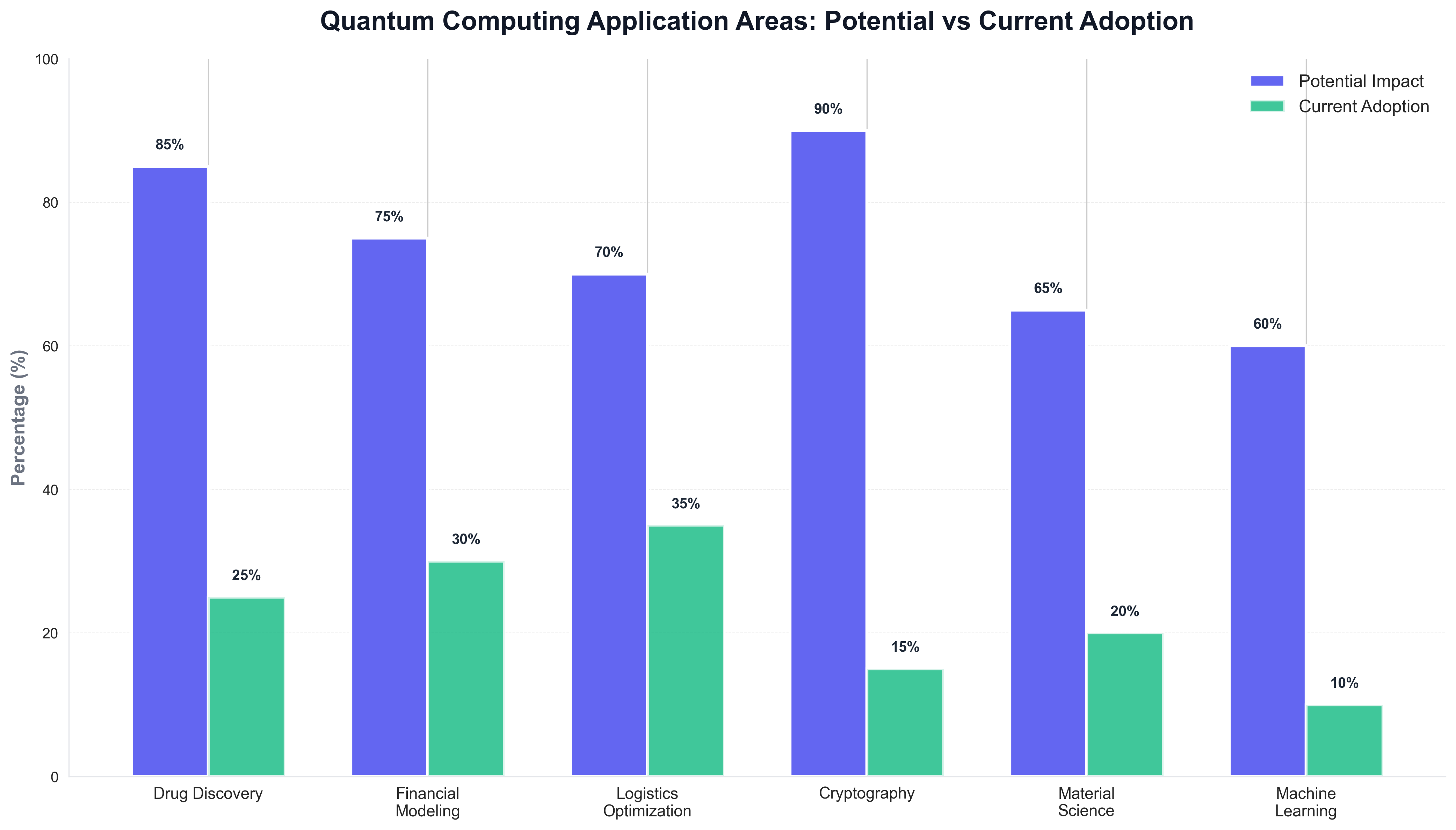
The application areas chart demonstrates the significant gap between the potential impact of quantum computing and current adoption levels, highlighting the substantial opportunity for growth as quantum hardware and software continue to mature. According to quantum chemistry research from pharmaceutical companies, quantum simulations can accurately model protein folding and drug-protein interactions that are computationally intractable for classical computers.
Cryptography and cybersecurity represent both an application and a challenge for quantum computing. Quantum computers can break current cryptographic systems, including RSA and elliptic curve cryptography, which are used to secure most internet communications and financial transactions. However, quantum computers also enable new cryptographic systems, including quantum key distribution and post-quantum cryptography, that are secure against both classical and quantum attacks. According to NIST's post-quantum cryptography standards, new cryptographic systems are being standardized to protect against quantum attacks, with deployment expected to begin in 2027-2028.
Logistics and supply chain optimization represent another major application area, where quantum computers can solve complex optimization problems involving thousands of variables. Companies including DHL, FedEx, and Amazon are using quantum computers to optimize delivery routes, warehouse operations, and inventory management, reducing costs and improving efficiency. According to logistics optimization research, quantum algorithms can find solutions that are 10-20% better than classical optimization algorithms, resulting in significant cost savings for large-scale logistics operations.
The Quantum Computing Ecosystem: Hardware, Software, and Services
The quantum computing ecosystem has matured significantly in 2026, with comprehensive hardware, software, and service offerings that make quantum computing accessible to businesses and researchers. IBM's Quantum Network includes over 200 organizations using IBM's quantum computers through cloud access, while Google's Quantum AI platform provides similar access to Google's quantum systems.
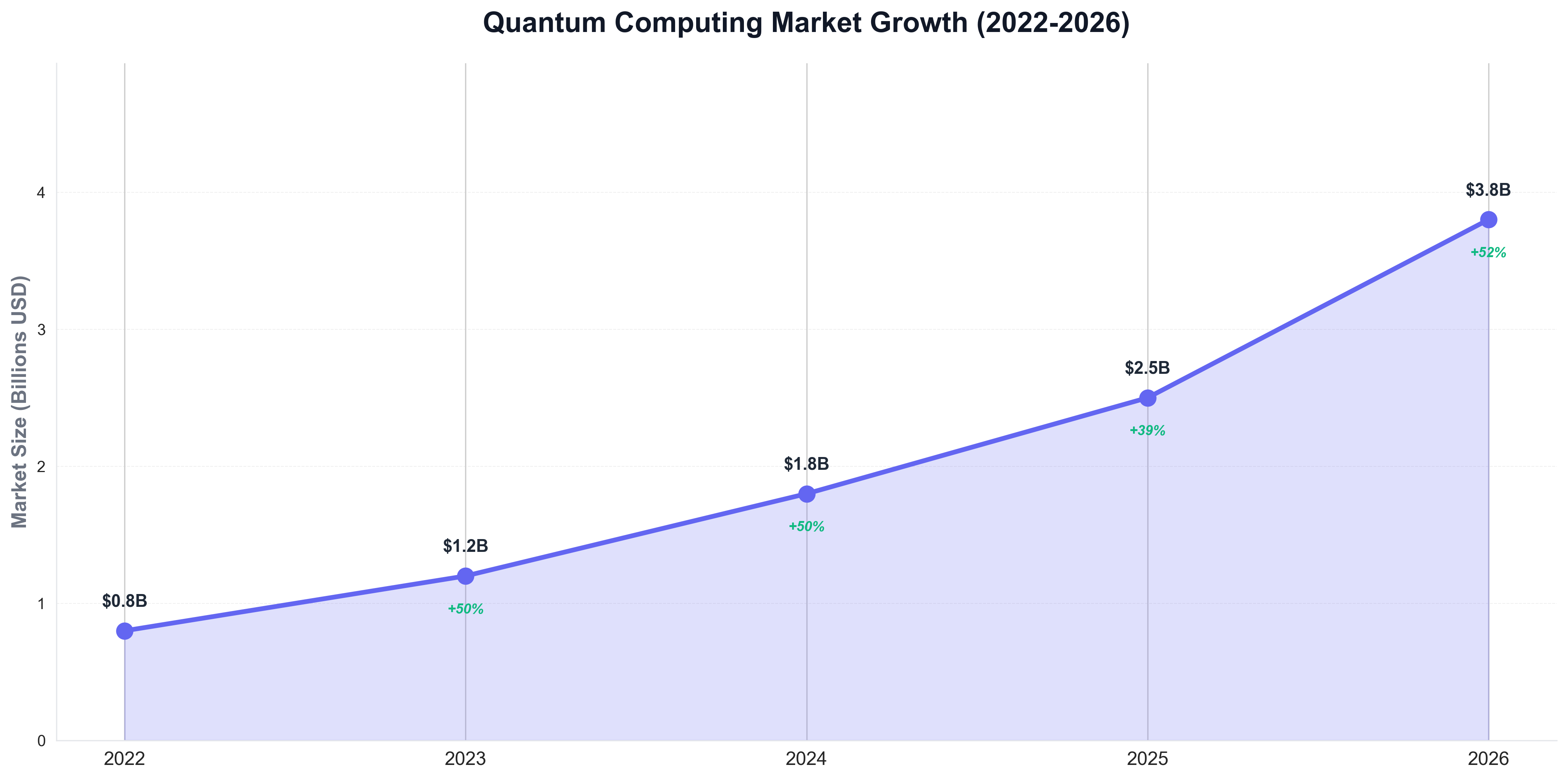
The market growth chart shows the rapid expansion of the quantum computing industry, with consistent year-over-year growth driven by increasing adoption and practical applications across multiple sectors. Microsoft's Azure Quantum platform offers access to multiple quantum computing systems, including IonQ, Quantinuum, and Microsoft's own topological qubit systems.
Quantum software development has advanced rapidly, with programming frameworks that abstract away the complexity of quantum hardware. IBM's Qiskit, Google's Cirq, and Microsoft's Q# provide high-level programming interfaces for quantum algorithms, making quantum computing accessible to software developers without deep quantum physics knowledge. According to quantum software market analysis, the quantum software market has grown by 65% year-over-year, reaching $2.8 billion in annual revenue, as more organizations develop quantum applications.
Quantum cloud services have become the primary way that most organizations access quantum computers, as building and maintaining quantum hardware requires specialized expertise and infrastructure. Cloud providers including IBM, Google, Microsoft, and Amazon offer quantum computing as a service, allowing organizations to run quantum algorithms on quantum hardware without investing in quantum infrastructure. According to quantum cloud services market research, over 85% of quantum computing usage occurs through cloud services, with the remaining usage from organizations that operate their own quantum computers.
The quantum computing ecosystem also includes specialized hardware providers, software companies, and consulting services. Companies like IonQ, Rigetti Computing, and Quantinuum provide quantum hardware, while software companies develop quantum algorithms and applications. Consulting firms help organizations identify quantum computing applications and develop quantum strategies. This ecosystem supports the growth of quantum computing by making the technology accessible and providing the expertise necessary for successful quantum computing adoption.
Challenges and Limitations: The Road Ahead for Quantum Computing
Despite the significant breakthroughs of 2026, quantum computing still faces substantial challenges that must be overcome for widespread adoption. Error rates remain a critical challenge, as even the best quantum computers experience errors that limit the complexity of problems they can solve. While error correction techniques have improved significantly, they require substantial overhead in terms of additional qubits and computational resources, reducing the effective number of qubits available for computation.
According to quantum computing research from MIT, current quantum computers require 10-100 physical qubits to create a single error-corrected logical qubit, meaning that a quantum computer with 1,000 physical qubits might only provide 10-100 logical qubits for computation. This overhead must be reduced for quantum computers to scale to the sizes necessary for solving the most challenging problems. Research in error correction codes and quantum hardware improvements aims to reduce this overhead, but significant progress is still needed.
Coherence time—the duration that quantum information can be maintained—remains another critical limitation. While coherence times have improved significantly, they are still measured in microseconds, limiting the complexity of quantum algorithms that can execute before decoherence destroys quantum information. Improving coherence times requires advances in quantum hardware, including better isolation from environmental noise, improved control systems, and new quantum materials that are less susceptible to decoherence.
Scalability represents another major challenge, as current quantum computers are limited to hundreds or low thousands of qubits, while solving the most challenging problems may require millions or billions of qubits. Scaling quantum computers requires advances in quantum hardware manufacturing, control systems, and error correction. The engineering challenges of building and operating large-scale quantum computers are substantial, requiring new approaches to quantum hardware design and operation.
Cost represents another barrier to quantum computing adoption, as quantum computers are expensive to build and operate. While cloud access has made quantum computing more accessible, the cost of quantum computation remains high compared to classical computing for most applications. As quantum hardware improves and becomes more efficient, costs are expected to decrease, but quantum computing will likely remain more expensive than classical computing for the foreseeable future.
The Competitive Landscape: IBM, Google, and Microsoft
The quantum computing market has become a three-way competition between IBM, Google, and Microsoft, each pursuing different approaches and targeting different applications. IBM leads in qubit count and has demonstrated practical quantum advantage for optimization problems, positioning the company as the leader in near-term quantum applications. IBM's strategy focuses on making quantum computing accessible through cloud services and building a comprehensive quantum ecosystem.
Google has focused on error correction and long-term quantum computing capabilities, investing heavily in research that will enable large-scale quantum computation. The company's error correction breakthrough positions Google well for future quantum computing applications, though its systems are not yet at the scale of IBM's processors. Google's strategy emphasizes fundamental research and long-term quantum computing potential.
Microsoft has pursued a fundamentally different approach with topological qubits, which could eventually provide superior error rates but are still in earlier stages of development. The company's strategy focuses on long-term quantum computing potential, with less emphasis on near-term applications. Microsoft's approach could eventually provide the best path to large-scale quantum computation, but significant engineering challenges remain.
Other companies including IonQ, Rigetti Computing, and Quantinuum provide specialized quantum computing hardware and services, often focusing on specific applications or technologies. These companies compete with the major players in specific market segments, providing alternatives for organizations with specific quantum computing needs. The competitive landscape is dynamic, with new companies entering the market and existing companies developing new capabilities.
Future Directions: The Path to Large-Scale Quantum Computing
The future of quantum computing promises even more significant capabilities as hardware improves and error correction techniques advance. Industry experts predict that quantum computers with 10,000+ logical qubits could be available within the next 5-7 years, enabling applications that are currently impossible. These systems could solve problems in cryptography, optimization, and scientific simulation that would be computationally intractable for classical computers.
According to quantum computing roadmaps from major companies, quantum computers are expected to achieve quantum advantage for a wide range of applications within the next decade, including drug discovery, financial modeling, logistics optimization, and scientific simulation. These applications could transform industries and enable new capabilities that are currently impossible with classical computing.
The convergence of quantum computing with other emerging technologies, including artificial intelligence, machine learning, and classical high-performance computing, will create new possibilities for hybrid computing systems. Quantum computers will work in conjunction with classical computers, with quantum systems handling specific problems that benefit from quantum algorithms while classical systems handle general computation. This hybrid approach will leverage the strengths of both quantum and classical computing to create more capable computing systems.
Research in quantum algorithms, error correction, and hardware continues to advance, with new breakthroughs expected in the coming years. Quantum computing research is a global effort, with major investments from governments, corporations, and research institutions worldwide. This research will continue to push the boundaries of what's possible with quantum computing, enabling new applications and capabilities that we can only begin to imagine.
Conclusion: Quantum Computing's Transformative Moment
Quantum computing has reached a transformative moment in 2026, with practical quantum advantage demonstrated for real-world applications and the path to large-scale quantum computation becoming clearer. The breakthroughs from IBM, Google, and Microsoft represent the most significant advances in quantum computing since the field's inception, marking the transition from experimental research to commercially viable technology.
The practical applications of quantum computing are already emerging, with financial institutions, pharmaceutical companies, and logistics organizations using quantum computers to solve problems that classical computers cannot handle efficiently. These applications demonstrate the real-world value of quantum computing and provide a foundation for broader adoption as quantum hardware continues to improve.
The challenges facing quantum computing are substantial, including error rates, coherence times, scalability, and cost. However, the progress of 2026 shows that these challenges are being addressed, with error correction, hardware improvements, and new approaches providing paths forward. The competitive landscape is driving innovation, with major companies investing billions in quantum computing research and development.
As we look toward the future, quantum computing will continue to evolve, becoming more capable, accessible, and practical. The technology has the potential to transform industries, enable new applications, and solve problems that are currently impossible with classical computing. Quantum computing is not just a technological trend—it's a fundamental shift in how we compute, with implications that extend far beyond technology to include science, business, and society as a whole.