
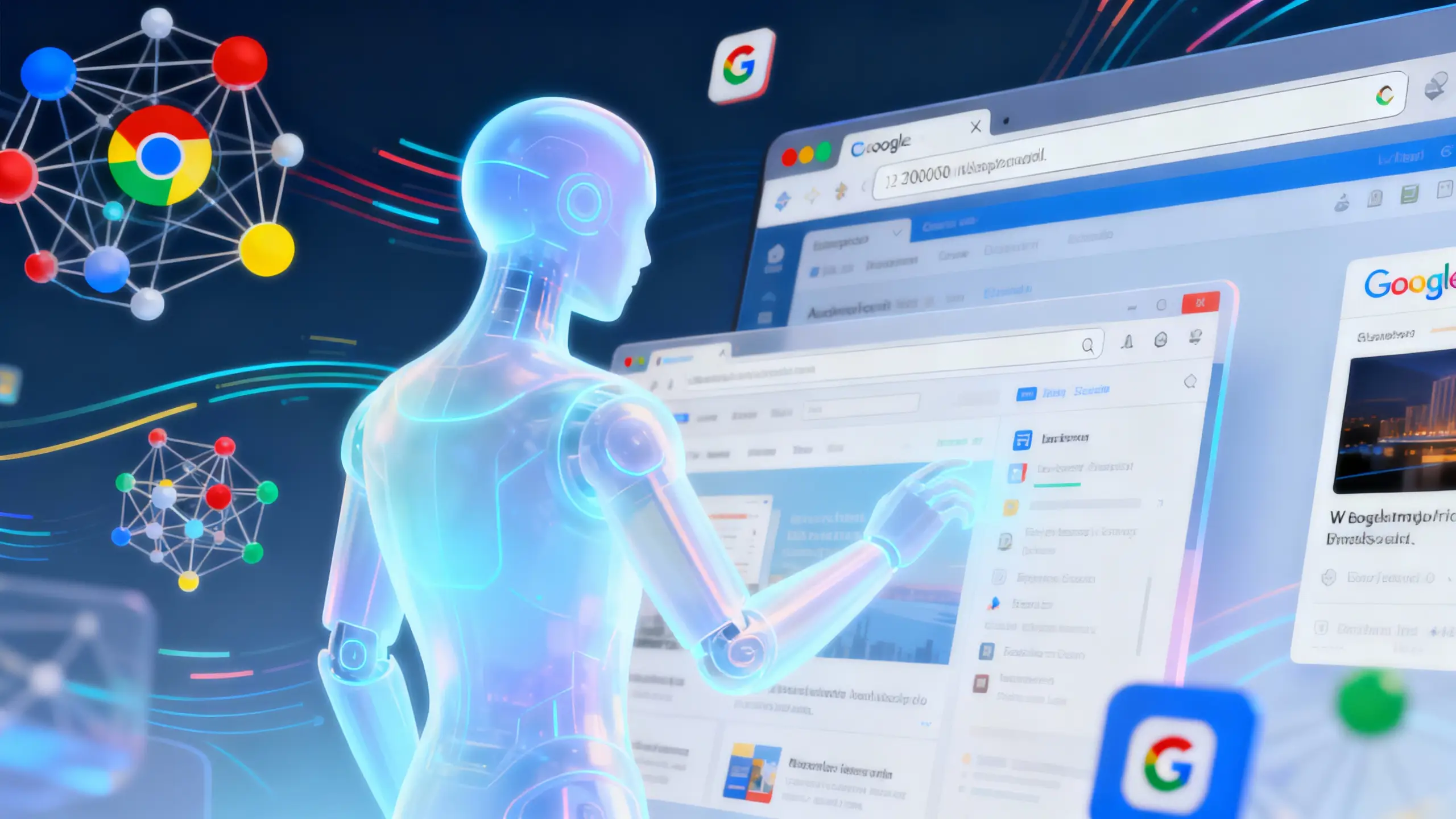
In December 2024, Google DeepMind unveiled what may be the most significant evolution in web browsing since the browser itself was invented. Project Mariner, an AI agent that can autonomously navigate websites, complete complex tasks, and interact with web pages exactly like a human would, represents a fundamental shift from browsers as tools we use to browsers as agents that work for us.
When Google expanded Project Mariner's availability at Google I/O 2025 in May, the implications became clear: we're entering the agentic browsing era, where artificial intelligence doesn't just help us find information—it actively completes tasks across the web on our behalf. Powered by Gemini 2.0 and achieving an 83.5% success rate on the WebVoyager benchmark for real-world web tasks, Project Mariner can simultaneously handle up to 10 different tasks, learn workflows through its "Teach & Repeat" functionality, and navigate any website regardless of its underlying structure.
"We're exploring the future of human-agent interaction, starting with browsers," Google DeepMind stated in its official announcement. "Mariner represents a new paradigm where AI agents understand web content visually, reason about complex goals, and take actions autonomously—all while keeping users informed and in control."
The technology is already transforming how early adopters interact with the web. Users can ask Mariner to find personalized job listings, book travel arrangements, research products, hire services, or order groceries—and the AI agent handles the entire multi-step process across multiple websites without requiring constant supervision. This capability addresses one of the most persistent frustrations of modern web use: the countless clicks, form fills, and navigation steps required to complete even simple tasks.
The Technical Breakthrough: From Pixels to Actions
What makes Project Mariner revolutionary isn't just what it can do, but how it does it. Unlike traditional automation tools that rely on fragile scripts tied to specific website structures, Mariner uses what Google calls "pixels-to-action" mapping—the AI literally sees web pages the way humans do, interpreting visual elements, text, images, forms, and interactive components to understand context and take appropriate actions.
This approach represents a fundamental shift in how AI interacts with digital interfaces. Traditional automation breaks when websites change their code structure, update their design, or modify their interface. Mariner's visual understanding means it can adapt to any website, regardless of how it's built, because it's interpreting the visual presentation rather than parsing underlying code.
According to Google DeepMind's technical documentation, Mariner operates through an "Observe-Plan-Act" loop that mirrors human problem-solving. The system first observes web elements including text, code, images, and forms, then plans actionable steps by interpreting complex goals and reasoning through the sequence of actions needed, and finally acts by navigating websites, clicking buttons, filling forms, and completing tasks while keeping users informed of its progress.
This multimodal reasoning capability is powered by Gemini 2.0, which Google specifically designed to be "agentic native" with context windows up to 2 million tokens. This massive context capacity enables Mariner to maintain awareness of complex, multi-step tasks that span multiple websites and require understanding relationships between different pieces of information.
The system's "Transparent Reasoning" engine displays step-by-step plans in a sidebar as it works, allowing users to see exactly what Mariner is thinking and why it's taking specific actions. This transparency addresses one of the key concerns about autonomous AI agents: the "black box" problem where users don't understand how decisions are being made. Mariner's approach makes the AI's reasoning process visible and understandable, building trust while enabling users to intervene when necessary.
Performance Metrics: The WebVoyager Benchmark
Project Mariner's 83.5% success rate on the WebVoyager benchmark provides concrete evidence of its capabilities. The WebVoyager benchmark is a standardized evaluation suite designed to measure autonomous agents' real-world browsing capabilities on live websites like Amazon, Apple, and Google Flights, testing navigation, form filling, and information extraction without human assistance.
This performance level places Mariner among the leading autonomous web agents, though the competitive landscape is rapidly evolving. According to Skyvern's analysis, several agents have achieved higher scores, with Browserable reaching 90.4% and Magnitude achieving 94% on the WebVoyager benchmark. However, Mariner's performance is particularly significant because it represents Google's entry into a market where the company has unique advantages: integration with Chrome's 65% browser market share, access to DeepMind's research capabilities, and infrastructure advantages including TPUs for model training and cheaper inference capabilities.
The benchmark results demonstrate that Mariner can handle real-world web tasks with high reliability, but more importantly, they validate the pixels-to-action approach. The fact that an AI agent can achieve 83.5% success on diverse, real-world websites without relying on website-specific code suggests that visual understanding is a viable path forward for autonomous web agents.
Parallel Task Execution: The Power of Simultaneous Operations
One of Project Mariner's most impressive capabilities is its ability to handle up to 10 tasks simultaneously across virtual machines. This parallel execution capability transforms Mariner from a single-task assistant into a multi-threaded productivity tool that can work on multiple objectives at once.
The technical implementation involves running multiple browser instances in virtual machines, with Mariner coordinating actions across all of them simultaneously. This architecture enables use cases that would be impossible with sequential task execution. A user could, for example, ask Mariner to research vacation destinations while simultaneously comparing flight prices, checking hotel availability, and finding restaurant recommendations—all happening in parallel rather than one after another.
This parallel capability is particularly valuable for complex workflows that involve multiple independent steps. Traditional automation requires completing tasks sequentially, which means users wait for each step to finish before the next begins. Mariner's parallel execution means that independent tasks can proceed simultaneously, dramatically reducing the total time required for complex multi-step objectives.
The system's ability to manage multiple tasks simultaneously also demonstrates sophisticated resource management and coordination capabilities. Mariner must track the state of each task, manage resources across virtual machines, and ensure that parallel operations don't conflict with each other—all while maintaining the transparency that allows users to monitor and intervene in any task at any time.
Teach & Repeat: Learning Workflows for Future Efficiency
Perhaps the most forward-looking feature of Project Mariner is its "Teach & Repeat" functionality, which allows the agent to learn workflows and replicate them with minimal future input. This capability transforms Mariner from a tool that executes commands into a system that builds institutional knowledge about how specific tasks should be completed.
The learning mechanism works by observing how users complete tasks and identifying patterns in workflows. Once Mariner has learned a workflow, it can replicate the same sequence of actions in the future with significantly reduced input requirements. This means that tasks that initially require detailed instructions can eventually be triggered with simple commands, as Mariner remembers the specific steps, websites, and actions involved.
This learning capability has profound implications for productivity. Repetitive tasks that currently require manual execution every time could become one-command operations once Mariner has learned the workflow. A user who regularly books similar travel arrangements, orders recurring grocery items, or completes routine data entry tasks could train Mariner once and then simply trigger the learned workflow whenever needed.
The Teach & Repeat feature also addresses one of the key limitations of current AI assistants: their inability to remember and apply learned patterns across sessions. While most AI systems treat each interaction as independent, Mariner's learning capability creates continuity that makes the agent more useful over time. The more a user works with Mariner, the more efficient their interactions become as the agent builds a library of learned workflows.
However, this learning capability also raises important questions about how workflows should be validated and updated. As websites change, learned workflows may become outdated or incorrect. Google will need to implement mechanisms for detecting when learned workflows no longer work correctly and either updating them automatically or alerting users that retraining is needed.
Integration Architecture: From Standalone Prototype to Ecosystem Feature
Project Mariner's evolution from a standalone research prototype to an integrated ecosystem feature demonstrates Google's strategic vision for agentic browsing. The initial December 2024 announcement positioned Mariner as an experimental Chrome extension, but by Google I/O 2025, the company had revealed a comprehensive integration strategy that extends Mariner's capabilities across multiple Google products.
The most significant integration is "Agent Mode" in the Gemini app, which brings Mariner's browser automation capabilities to Google's primary AI interface. According to 9to5Google, Agent Mode allows users to state objectives and have Gemini orchestrate the steps to complete them, with the interface displaying the chat on the left and a live web preview on the right showing actions being taken. This integration makes Mariner's capabilities accessible through the familiar Gemini interface, potentially expanding adoption beyond users who specifically seek out the standalone Chrome extension.
The integration also extends to Google Search's AI Mode, where Mariner capabilities will enable more sophisticated search experiences that go beyond providing information to actually completing tasks. A user searching for "book a flight to Paris" could trigger Mariner to actually complete the booking process rather than just showing search results.
Google's plan to bring Mariner capabilities to the Gemini API represents another strategic move, enabling developers to build applications that leverage autonomous browsing capabilities. This API access could enable a new category of applications that combine AI reasoning with web automation, creating possibilities for everything from automated research tools to intelligent shopping assistants to autonomous data collection systems.
The integration strategy reflects Google's broader approach to AI: rather than keeping advanced capabilities locked in research labs, the company is rapidly moving them into production products where they can reach billions of users. This approach accelerates adoption while also generating the usage data needed to improve the technology.
Availability and Access: The Google AI Ultra Requirement
Project Mariner's current availability is limited to Google AI Ultra subscribers in the United States who are 18 or older, with access provided through labs.google.com/mariner. The Google AI Ultra subscription costs $249.99 per month in the U.S., with a special introductory offer of 50% off for the first three months, as reported by Google's official blog.
This pricing and availability structure positions Project Mariner as a premium, early-access feature rather than a mass-market product. The $249.99 monthly price point is significantly higher than most consumer AI subscriptions, reflecting both the experimental nature of the technology and the computational resources required to run multiple browser instances in virtual machines.
The geographic limitation to the United States suggests that Google is taking a cautious approach to rollout, likely due to regulatory considerations, infrastructure requirements, or the need to gather usage data in a controlled environment before expanding internationally. The age restriction to 18+ reflects concerns about autonomous agents making purchases or taking actions that could have legal or financial consequences.
The requirement for a Google AI Ultra subscription means that Mariner is bundled with other premium AI features, including highest usage limits for Gemini with Deep Research, video generation capabilities with Veo 2 and early access to Veo 3, the Flow filmmaking tool with 1080p video generation, and enhanced access to NotebookLM and other Google AI tools. This bundling strategy makes Mariner part of a comprehensive premium AI offering rather than a standalone product.
The limited availability also serves as a natural constraint on usage, allowing Google to manage the computational load and gather data about how users interact with autonomous browsing agents before scaling to broader availability. As the technology matures and infrastructure scales, we can expect broader availability, potentially including access for lower-tier subscriptions or even free users with usage limits.
The Competitive Landscape: Mariner vs. ChatGPT Browser Mode
Project Mariner enters a competitive landscape where multiple companies are pursuing similar visions of agentic browsing. OpenAI's ChatGPT has browser mode capabilities, and the company is developing a dedicated ChatGPT web browser launching in mid-2025, as reported by The Verge. Microsoft is integrating Copilot Vision capabilities into browsers, creating a three-way competition for the future of AI-powered web interaction.
Google's strategic advantages in this competition are significant. Chrome's 65% browser market share provides a massive distribution advantage that competitors cannot match. While ChatGPT and Microsoft Copilot must work across different browsers or build their own, Google can integrate Mariner directly into Chrome, creating a seamless experience that doesn't require users to install extensions or switch browsers.
Google also benefits from infrastructure advantages that enable cost-effective deployment at scale. The company's TPU infrastructure for model training, cheaper inference capabilities, and DeepMind's research capabilities provide technical advantages that could translate into better performance, lower costs, or faster innovation cycles compared to competitors.
However, Google faces challenges that competitors don't. The company is under significant antitrust pressure that limits its ability to aggressively defend Chrome's dominance or bundle AI features in ways that might be seen as anti-competitive. This regulatory environment creates an opportunity window for competitors like OpenAI and Microsoft to gain market share while Google must be more cautious about how it integrates and promotes new features.
The competitive dynamics also reflect different strategic approaches. OpenAI's development of a dedicated ChatGPT browser represents an effort to reduce dependence on Google infrastructure and collect search data independently, as noted by Azoma AI. Microsoft's integration of Copilot into existing browsers represents a different approach focused on enhancing current browsing experiences rather than creating autonomous agents.
The outcome of this competition will likely depend on which approach users find most valuable: Google's deep browser integration, OpenAI's standalone browser experience, or Microsoft's enhancement of existing browsers. Each approach has different trade-offs in terms of convenience, capabilities, and user control.
Real-World Applications: Transforming Daily Web Interactions
Project Mariner's capabilities enable use cases that fundamentally change how people interact with the web. The system can handle complex, multi-step tasks that previously required significant time and attention, automating workflows that span multiple websites and involve numerous interactions.
Travel planning represents one of the most compelling use cases. A user can ask Mariner to plan a vacation, and the agent will research destinations, compare flight prices across multiple airlines, check hotel availability, find restaurant recommendations, and even book reservations—all autonomously while the user monitors progress. This capability transforms travel planning from a hours-long research project into a simple command that produces a complete itinerary.
Shopping automation is another transformative application. Mariner can research products, compare prices across multiple retailers, read reviews, check availability, and add items to shopping carts—all based on natural language descriptions of what the user wants. The system can even handle complex requirements like finding products that meet specific criteria, comparing options, and making recommendations based on user preferences.
Job searching becomes dramatically more efficient with Mariner's capabilities. The agent can search multiple job boards simultaneously, filter results based on criteria, extract relevant information, and even apply for positions that match user qualifications. This automation addresses one of the most time-consuming aspects of job searching: the repetitive process of searching, filtering, and applying across multiple platforms.
Research and data collection represent another powerful application. Mariner can visit multiple websites, extract specific information, synthesize findings, and present comprehensive summaries—all while the user provides high-level guidance rather than manually visiting each site. This capability is particularly valuable for tasks like competitive analysis, market research, or academic research that requires gathering information from numerous sources.
The system's ability to handle form filling and data entry addresses another persistent web interaction challenge. Mariner can extract information from documents or previous interactions and automatically fill forms across multiple websites, reducing the repetitive data entry that currently consumes significant time for tasks like applying for services, registering for events, or completing administrative processes.
Safety and Control: Maintaining User Agency
One of the most critical aspects of autonomous browsing agents is ensuring that users maintain control and can intervene when necessary. Project Mariner addresses this through multiple mechanisms designed to keep users informed and in control while the agent works autonomously.
The "Transparent Reasoning" feature displays Mariner's step-by-step plans in a sidebar, allowing users to see exactly what the agent is thinking and why it's taking specific actions. This transparency enables users to understand the agent's decision-making process and identify potential issues before they become problems.
Users can pause, resume, take over, or cancel tasks at any time, ensuring that Mariner never operates in a way that removes user agency. This control mechanism is particularly important for tasks involving purchases, bookings, or other actions with financial or legal consequences. The system requires user confirmation for actions like making purchases, providing an additional safety layer for high-stakes operations.
The live monitoring capability allows users to watch Mariner work in real-time, seeing exactly what actions the agent is taking on which websites. This visibility builds trust by making the agent's behavior transparent and understandable, addressing concerns about "black box" AI systems that operate without explanation.
However, safety considerations extend beyond user control mechanisms. Autonomous agents that can make purchases, book services, or take actions with real-world consequences raise questions about liability, error handling, and security. Google will need to implement robust error detection, secure handling of payment information, and clear policies about what happens when agents make mistakes or take incorrect actions.
The system's ability to learn workflows through Teach & Repeat also raises safety considerations. If a learned workflow contains errors or becomes outdated, the agent could repeatedly make the same mistakes. Google will need mechanisms for validating learned workflows, detecting when they no longer work correctly, and either updating them automatically or alerting users to the need for retraining.
The Future of Agentic Browsing: Implications and Possibilities
Project Mariner represents an early stage in what could become a fundamental transformation of how humans interact with digital information and services. The technology's current capabilities, while impressive, likely represent just the beginning of what's possible as AI agents become more sophisticated and integrated into web experiences.
The integration of Mariner capabilities into the Gemini API suggests that autonomous browsing could become a foundational capability that developers build into applications across industries. Research tools could automatically gather information from multiple sources, shopping applications could handle entire purchase workflows autonomously, and productivity tools could automate routine web-based tasks that currently require manual execution.
The technology's ability to learn workflows through Teach & Repeat could eventually enable highly personalized agents that understand individual user preferences, work styles, and common tasks. Over time, these agents could become increasingly efficient as they build libraries of learned workflows tailored to specific users' needs and patterns.
The parallel task execution capability could enable new categories of applications that coordinate multiple simultaneous objectives. A user planning a complex event could have Mariner simultaneously handle venue research, catering options, guest management, and logistics—all happening in parallel rather than sequentially.
However, the widespread adoption of autonomous browsing agents also raises important questions about the future of web design, security, and user experience. Websites may need to adapt to accommodate AI agents, potentially through structured data, API access, or agent-specific interfaces. Security systems will need to distinguish between legitimate AI agents and malicious bots, creating new challenges for authentication and access control.
The economic implications are also significant. If AI agents can autonomously complete tasks that currently require human attention, the value proposition of many web services could change. Companies that currently rely on user engagement metrics may need to adapt to a world where agents complete tasks efficiently without extended browsing sessions.
Technical Challenges and Limitations
Despite its impressive capabilities, Project Mariner faces technical challenges that will need to be addressed as the technology matures. The 83.5% success rate on the WebVoyager benchmark, while strong, means that approximately one in six tasks still fail—a failure rate that could be problematic for critical applications.
The pixels-to-action approach, while more robust than code-based automation, still faces challenges with dynamic content, complex interactions, and edge cases that don't match training data. Websites with unusual layouts, non-standard interactions, or rapidly changing content could pose challenges that the current system struggles to handle.
The computational requirements for running multiple browser instances in virtual machines are significant, which is likely one reason for the premium pricing and limited availability. Scaling to broader availability will require either reducing computational costs, optimizing the system's efficiency, or implementing usage limits that manage resource consumption.
The system's ability to learn workflows through Teach & Repeat, while powerful, also creates challenges around workflow validation, error handling, and adaptation to website changes. Learned workflows that work today may break tomorrow if websites update their interfaces, and the system will need robust mechanisms for detecting and handling these situations.
Privacy and security considerations are also critical. Autonomous agents that can make purchases, access accounts, and take actions with real-world consequences require secure handling of authentication information, payment details, and personal data. The system will need to balance convenience with security, ensuring that agents can complete tasks efficiently while protecting user information.
Conclusion: The Arrival of Agentic Browsing
Project Mariner represents more than a new feature or product—it signals the arrival of the agentic browsing era, where AI agents don't just help us use the web but actively work on our behalf to complete tasks autonomously. The technology's combination of visual understanding, multimodal reasoning, parallel execution, and learning capabilities creates possibilities that fundamentally change how we interact with digital information and services.
For early adopters with access to Google AI Ultra, Mariner is already transforming daily web interactions, automating complex multi-step tasks that previously required hours of manual work. As the technology integrates into the Gemini app, Google Search, and the Gemini API, these capabilities will become accessible to broader audiences, potentially reshaping how millions of people interact with the web.
However, the widespread adoption of autonomous browsing agents also raises important questions about safety, security, privacy, and the future of web design. As AI agents become more capable and widely used, the web ecosystem will need to adapt to accommodate these new interaction patterns while maintaining user agency, security, and positive user experiences.
The competitive landscape is also evolving rapidly, with Google, OpenAI, and Microsoft pursuing different approaches to agentic browsing. The outcome of this competition will likely determine not just which company succeeds, but what form autonomous web agents take and how they integrate into our daily digital lives.
One thing is certain: Project Mariner represents a significant step toward a future where AI agents handle routine web tasks autonomously, freeing humans to focus on higher-level decision-making and creative work. The question isn't whether agentic browsing will become mainstream—the technology is already demonstrating its value. The question is how quickly it will evolve, how broadly it will be adopted, and how it will reshape our relationship with the digital world.
As 2026 unfolds, Project Mariner is moving from experimental prototype to integrated ecosystem feature, bringing autonomous browsing capabilities to Google's products and potentially transforming how billions of people interact with the web. The age of agentic browsing has arrived, and its impact on productivity, convenience, and digital interaction will be profound.