

AI agents have crossed from pilot to production in 2026. According to Zapier's AI agents survey of over 500 U.S. enterprise leaders, 84% of enterprises plan to increase AI agent investments over the next 12 months, and 72% are already using or testing AI agents—with 40% deploying multiple agents in production. LangChain's State of Agent Engineering survey of 1,300+ professionals reports that 57% of respondents now have AI agents running in production, up from 51% the previous year, and 67% of organizations with 10,000+ employees have agents in production versus 50% for companies under 100 employees. At the same time, SearchYour.ai's 2026 State of AI Agents report notes that 80% of organizations already report measurable ROI from AI agent investments, with data analysis and report generation (60%), internal process automation (48%), and customer support (49%) among the top use cases. The story in 2026 is that AI agents are the default for enterprise automation and intelligence—and Python is the language most teams use to build and visualize agent adoption and ROI. This article examines why 84% plan to boost investment, how LangChain and Python fit the stack, and how Python powers the charts that tell the story.
84% of Enterprises Plan to Boost AI Agent Investment
The commitment to AI agents is no longer experimental. Zapier's AI agents survey and Business Insider's coverage report that 84% of enterprises plan to increase AI agent investments over the next 12 months—a clear signal that AI agents are a strategic priority. Zapier's 34 enterprise AI statistics for 2026 and LangChain's State of Agent Engineering add that 72% of enterprises are actively using or testing AI agents, 57% have agents in production (up from 51%), and 40% deploy multiple agents in production. The following chart, generated with Python and matplotlib using Zapier and LangChain–style survey data, illustrates AI agent adoption and production in 2025–2026.
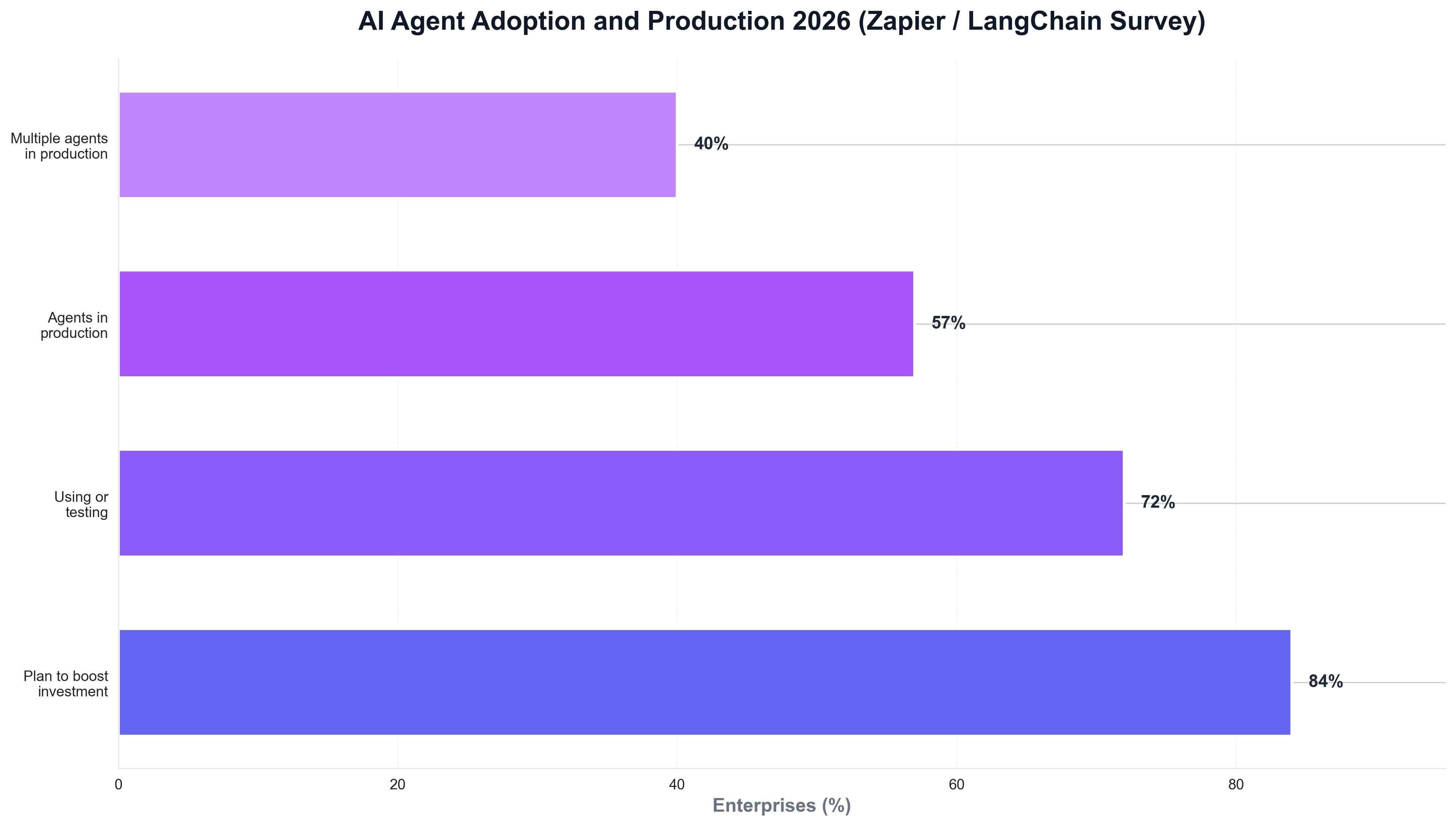
The chart above shows 84% planning to boost investment, 72% using or testing, and 57% in production—reflecting the shift from pilot to production. Python is the natural choice for building such visualizations: data and product teams routinely use Python scripts to load survey or internal usage data and produce publication-ready charts for reports and articles like this one.
57% Have Agents in Production: LangChain and the State of Agent Engineering
Production adoption has accelerated. LangChain's State of Agent Engineering and LangChain's State of AI Agents explain that 57% of respondents now have AI agents in production, up from 51% the previous year, with 30.4% actively developing agents with concrete plans to deploy. 67% of organizations with 10,000+ employees have agents in production versus 50% for companies under 100 employees—so large enterprises are leading. Quality is the top production barrier (cited by 32%), while observability is table stakes—89% have implemented it for their agents. When teams need to visualize adoption by use case or department—customer service, research, data analysis, operations—they often use Python and matplotlib or seaborn. The following chart, produced with Python, summarizes the leading use cases for AI agents as reported in LangChain and Zapier surveys.
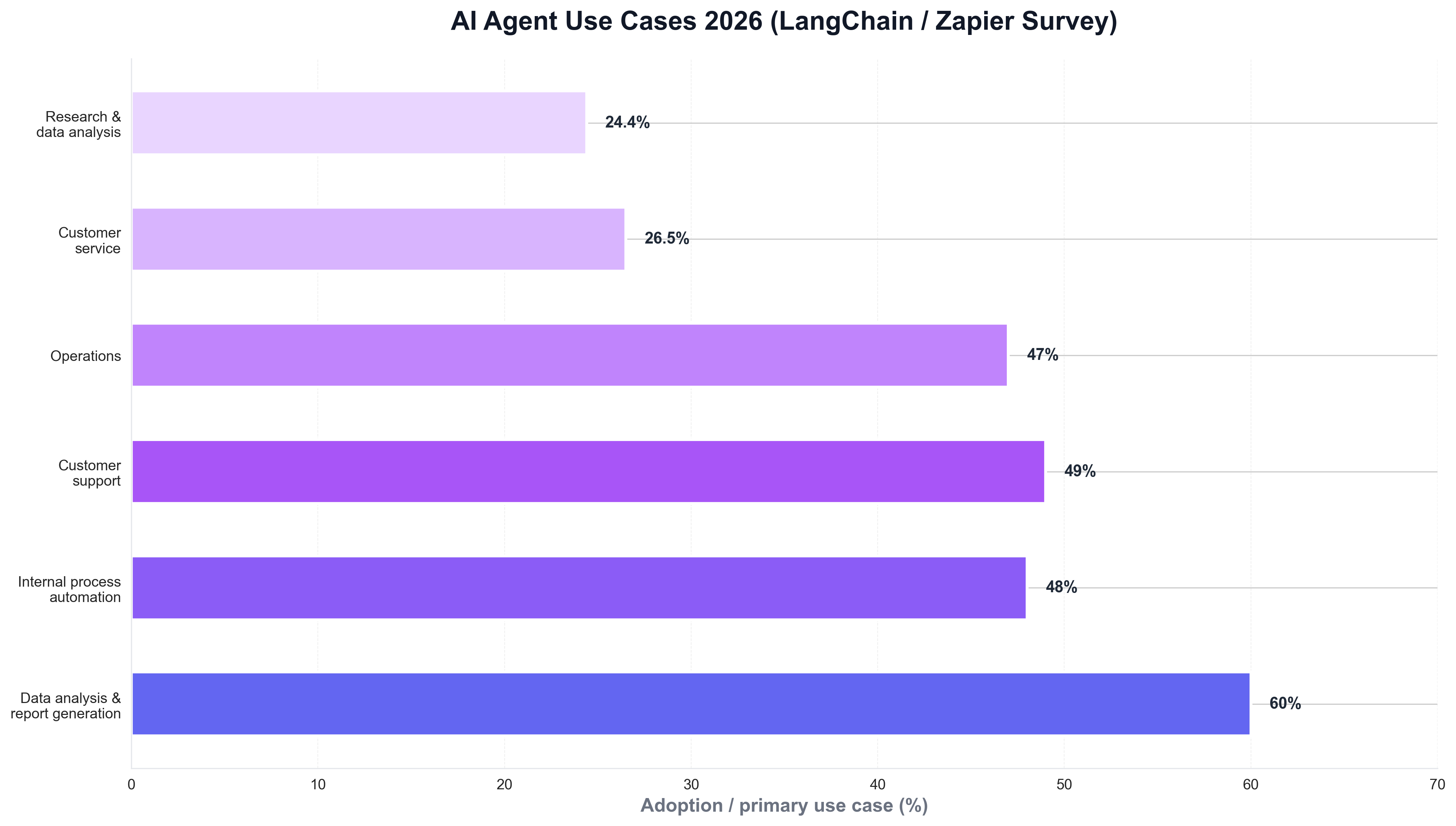
The chart illustrates customer service (26.5%), research and data analysis (24.4%), data analysis and report generation (60%), and internal process automation (48%)—context that explains why 84% plan to boost investment. Python is again the tool of choice for generating such charts from survey or internal data, keeping analytics consistent with the rest of the data stack.
80% Report Measurable ROI: Why Investment Is Paying Off
The business case for AI agents is measurable ROI. SearchYour.ai's 2026 State of AI Agents report and Zapier's survey state that 80% of organizations already report measurable ROI from AI agent investments—so the shift from "experiment" to "strategic" is data-driven. Leading use cases include data analysis and report generation (60%), internal process automation (48%), customer support (49%), and operations (47%). LangChain's State of Agent Engineering adds that customer service (26.5%) and research and data analysis (24.4%) are the top primary deployments—so automation and intelligence are the twin drivers. For teams that track ROI or use case adoption over time, Python is often used to load survey or telemetry data and plot trends. A minimal example might look like the following: load a CSV of use case adoption by department, and save a chart for internal or public reporting.
import pandas as pd
import matplotlib.pyplot as plt

df = pd.read_csv("ai_agents_use_cases_survey.csv")
fig, ax = plt.subplots(figsize=(10, 6))
ax.barh(df["use_case"], df["adoption_pct"], color="#6366f1", edgecolor="white", height=0.6)
ax.set_xlabel("Adoption (%)")
ax.set_title("AI Agent Use Cases 2026 (survey-style)")
fig.savefig("public/images/blog/ai-agents-use-cases-trend.png", dpi=150, bbox_inches="tight")
plt.close()
That kind of Python script is typical for product and strategy teams: same language as much of their agent tooling (LangChain, LlamaIndex), and direct control over chart layout and messaging.
Human-in-the-Loop and Security: How Enterprises Deploy Safely
Investment does not mean full autonomy. Zapier's survey and IT Brief's coverage note that the human-in-the-loop approach is the most popular strategy—humans maintain oversight at key decision points rather than allowing fully autonomous operation. Security and data privacy remain the biggest barriers to wider AI agent adoption, so enterprises are boosting spend while retaining human checks. LangChain's State of Agent Engineering adds that quality is the top production barrier (32%), while system integration (46%), data quality and access (42%), and change management (39%) are key challenges in the SearchYour.ai report. Python fits into this story as the language of agent frameworks (LangChain, LlamaIndex, CrewAI) and evaluation—many teams use Python scripts to run evals, log agent behavior, and plot quality and safety metrics over time.
LangChain, Python, and the Agent Stack
Python is the default language for building and operating AI agents. LangChain and LangChain's State of AI Agents are Python-first frameworks for chains, agents, and tools; LlamaIndex, CrewAI, and AutoGen are also Python-native. When teams visualize agent adoption, ROI, or use case mix, they typically use Python and pandas, matplotlib, or seaborn—the same stack they use for data pipelines and model evaluation. So the story is not just "AI agents are hot"; it is Python as the language of agent engineering and analytics, from building agents to measuring their impact.
What the 84% Figure Means for Teams and Strategy
The 84% investment figure has practical implications. Zapier's survey surveyed over 500 U.S. enterprise leaders; LangChain's State of Agent Engineering surveyed 1,300+ professionals. For product and engineering, the takeaway is that AI agents are a strategic priority—new projects and roadmaps should assume agent-enabled workflows where they add value. For data and strategy, the takeaway is that 80% report ROI—so the case for investment is evidence-based. For hiring and training, agent engineering and Python (LangChain, LlamaIndex) are core skills for AI and automation roles. For reporting, Python remains the language of choice for pulling survey data and visualizing adoption and ROI—so the same Python scripts that power internal dashboards can power articles and public reports.
Conclusion: AI Agents as the New Normal for Enterprise Automation
In 2026, AI agents have crossed from pilot to production: 84% of enterprises plan to boost AI agent investments over the next 12 months, 72% are using or testing agents, 57% have agents in production (up from 51%), and 80% report measurable ROI. Customer service, research and data analysis, data analysis and report generation, and internal process automation lead use cases; human-in-the-loop and security remain central to deployment. Python is central to this story: the language of LangChain, LlamaIndex, and agent frameworks, and the language of visualization for adoption and ROI. Teams that treat AI agents as a strategic priority—and use Python to build and measure them—are well positioned for 2026 and beyond: AI agents are where enterprise automation lives; Python is where the story gets told.