
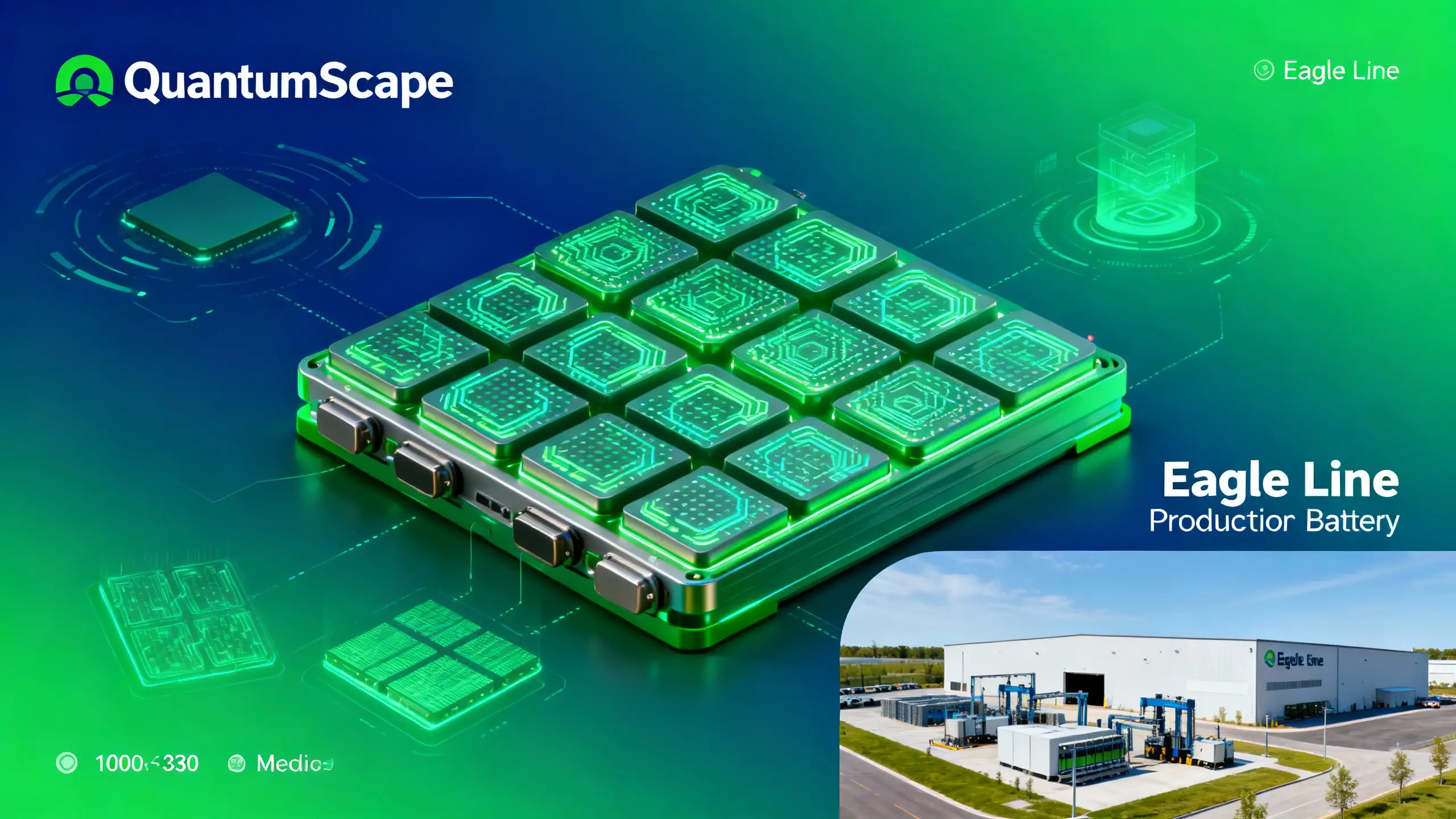
QuantumScape's solid-state battery technology is reaching a critical milestone in 2026 with the inauguration of its Eagle Line pilot production facility in February, representing a major step toward gigawatt-hour-scale manufacturing. The Eagle Line incorporates QuantumScape's breakthrough Cobra separator process, which offers approximately 25x faster heat treatment speed compared to the previous-generation Raptor process while occupying a fraction of the physical space—critical advantages for scalable production.
According to QuantumScape's announcement, the Cobra process entered baseline production in June 2025, enabling QuantumScape to begin shipping QSE-5 B1 sample cells in Q3 2025, with these cells demonstrating 844 Wh/L volumetric energy density, 12-minute charging from 10% to 80%, and 10C continuous discharge capability. The QSE-5 cells powered the world's first live vehicle demonstration in a Ducati V21L race motorcycle at IAA Mobility in Munich in September 2025, marking the first time anode-free solid-state batteries moved from laboratory to real-world application.
QuantumScape has established strategic partnerships with PowerCo (Volkswagen Group) for up to 80 GWh/year production capacity, Corning for ceramic separator development, and Murata Manufacturing for high-volume ceramic film manufacturing. According to QuantumScape's PowerCo announcement, the licensing agreement enables PowerCo to manufacture up to 40 GWh per year initially, with an option to expand to 80 GWh annually—enough to equip approximately one million vehicles per year.
The Eagle Line serves as the foundation for future gigawatt-hour-scale production by licensing partners, with the February 2026 inauguration event featuring customer representatives, technology partners, and government officials. According to Energy Storage Tech's coverage, the Eagle Line is a highly automated battery cell production line designed to produce QSE-5 solid-state lithium-metal cells at higher volumes, serving as the foundation for future gigawatt-hour-scale production.
Cobra Separator Process: 25x Faster Heat Treatment
QuantumScape's Cobra separator process represents a breakthrough in solid-state battery manufacturing, offering approximately 25x faster heat treatment speed compared to the previous-generation Raptor process while occupying a fraction of the physical space. According to QuantumScape's Cobra announcement, the process was successfully integrated into baseline cell production in June 2025, enabling faster, more energy-efficient production compared to Raptor while maintaining separator quality and process stability.
This speed improvement is significant because it enables scalable production. According to QuantumScape's Cobra announcement, the 25x improvement in heat treatment speed makes Cobra significantly more efficient for scalable gigafactory production, addressing one of the main challenges in solid-state battery manufacturing. This efficiency is crucial for achieving cost targets and production scale.
The space efficiency is also notable. According to QuantumScape's Cobra announcement, Cobra occupies a fraction of the physical space per film start compared to Raptor, enabling higher production density in manufacturing facilities. This space efficiency is crucial for maximizing production capacity within existing facilities.
However, the Cobra process also required careful development. According to QuantumScape's Cobra announcement, Cobra equipment was delivered, installed, and released for initial separator processing in December 2024, with integration into baseline production taking until June 2025. This timeline demonstrates the complexity of manufacturing process development.
The Cobra process also highlights the importance of continuous improvement. According to QuantumScape's Cobra announcement, the process represents a 200-fold improvement over 2023 production methods, demonstrating rapid advancement in manufacturing capabilities. This continuous improvement is crucial for maintaining competitiveness.
QSE-5 Battery Performance: 844 Wh/L and 12-Minute Charging
QuantumScape's QSE-5 solid-state lithium-metal batteries demonstrate impressive performance characteristics, with 844 Wh/L volumetric energy density, 12-minute charging from 10% to 80% state of charge, and 10C continuous discharge capability. According to eMobility Engineering's coverage, these cells use QuantumScape's proprietary Cobra separator manufacturing process and represent the most advanced cells to date.
This energy density is significant because it exceeds conventional lithium-ion batteries. According to eMobility Engineering's coverage, the 844 Wh/L volumetric energy density is substantially higher than current lithium-ion batteries, enabling longer range or smaller battery packs for electric vehicles. This capability is crucial for electric vehicle adoption.
The charging speed is also remarkable. According to eMobility Engineering's coverage, the 12-minute charging from 10% to 80% state of charge addresses one of the main concerns with electric vehicles—charging time. This capability is crucial for making electric vehicles more convenient and practical.
However, the performance also requires validation. According to eMobility Engineering's coverage, extensive durability testing is still needed before broader commercialization, with the Ducati motorcycle program serving as a rigorous proving ground. This validation is crucial for ensuring reliability in real-world applications.
The performance also highlights the importance of anode-free design. According to QuantumScape's Ducati announcement, the QSE-5 cells are anode-free solid-state batteries, eliminating the need for a separate anode and enabling higher energy density. This design is crucial for achieving the performance characteristics.
Eagle Line Pilot Production: Foundation for Gigawatt-Scale Manufacturing
QuantumScape's Eagle Line pilot production facility, scheduled for inauguration in February 2026, represents a critical milestone in scaling solid-state battery production. According to QuantumScape's announcement, the Eagle Line is a highly automated battery cell production line designed to produce QSE-5 solid-state lithium-metal cells at higher volumes, serving as the foundation for future gigawatt-hour-scale production by licensing partners.
This pilot facility is significant because it demonstrates production capability. According to Electrive's coverage, the Eagle Line enables QuantumScape to produce cells at higher volumes for customer testing and validation, which is crucial for moving toward commercial production. This capability is essential for demonstrating manufacturing readiness.
The Eagle Line also enables process optimization. According to QuantumScape's announcement, the facility incorporates the Cobra separator process, enabling continuous improvement and optimization of manufacturing processes. This optimization is crucial for achieving cost targets and production efficiency.
However, the Eagle Line is just the beginning. According to QuantumScape's announcement, the facility serves as the foundation for future gigawatt-hour-scale production by licensing partners, meaning that much larger facilities will be needed for commercial scale. This scaling is crucial for meeting market demand but requires significant investment.
The Eagle Line also highlights the importance of automation. According to QuantumScape's announcement, the facility is highly automated, enabling consistent quality and efficient production. This automation is crucial for achieving production targets and cost goals.
PowerCo Partnership: Up to 80 GWh/Year Production Capacity
QuantumScape's partnership with PowerCo, Volkswagen Group's battery company, represents a major step toward commercial production, with PowerCo licensed to manufacture up to 80 GWh/year of QuantumScape's QSE-5 solid-state batteries. According to QuantumScape's PowerCo announcement, the initial agreement enables PowerCo to manufacture up to 40 GWh per year, with an option to expand to 80 GWh annually—enough to equip approximately one million vehicles per year.
This partnership is significant because it enables capital-light scaling. According to QuantumScape's PowerCo announcement, the licensing approach leverages PowerCo's existing global manufacturing capabilities and industrialization expertise rather than requiring QuantumScape to build production facilities independently. This strategy is crucial for rapid scaling without massive capital investment.
The partnership also includes milestone payments. According to QuantumScape's expanded collaboration announcement, an expanded collaboration announced in July 2025 includes up to $131 million in new payments over two years upon achieving certain milestones, with the first payments expected to begin in 2025. This structure aligns incentives and provides funding for development.
However, the partnership also requires technical milestones. According to QuantumScape's PowerCo announcement, PowerCo will work toward gigawatt-hour-scale production following achievement of technical milestones, meaning that production scaling depends on continued technical progress. This dependency is crucial for managing risk but requires ongoing validation.
The partnership also highlights the importance of automotive industry relationships. According to Reuters' coverage, the agreement positions QuantumScape as a key supplier for Volkswagen Group's electric vehicle strategy, which is crucial for market adoption. This relationship is essential for demonstrating commercial viability.
Corning and Murata Partnerships: Ceramic Separator Manufacturing
QuantumScape has established strategic partnerships with Corning and Murata Manufacturing to develop and scale production of ceramic separators for its solid-state batteries. According to QuantumScape's Corning announcement, the partnership combines both companies' strengths in materials science and manufacturing to support QuantumScape's industrialization goals, working toward high-volume production for commercial applications.
The Corning partnership is significant because it brings materials expertise. According to QuantumScape's Corning announcement, Corning's expertise in materials science and manufacturing complements QuantumScape's battery technology, enabling faster development and scaling of ceramic separator production. This expertise is crucial for achieving production targets.
The Murata partnership also brings manufacturing capabilities. According to Murata's announcement, the joint development agreement focuses on scaling ceramic separator production and exploring commercialization models, with Murata's expertise in ceramics material formulation, sheet forming, and firing applied to QuantumScape's ceramic separator production. This capability is crucial for high-volume manufacturing.
However, these partnerships also require coordination. According to QuantumScape's Murata framework announcement, the partnerships are part of QuantumScape's broader ecosystem strategy to build a network of industry-leading partners, requiring careful coordination across multiple companies. This coordination is crucial for success but adds complexity.
The partnerships also highlight the importance of supply chain development. According to Electrive's coverage, QuantumScape is building a network of partners including equipment vendors, materials suppliers, and contract manufacturers to accelerate commercialization. This supply chain development is essential for scaling production.
Ducati V21L Demonstration: First Real-World Application
QuantumScape's QSE-5 solid-state batteries powered the world's first live vehicle demonstration in a Ducati V21L race motorcycle at IAA Mobility in Munich in September 2025, marking the first time anode-free solid-state batteries moved from laboratory to real-world application. According to QuantumScape's Ducati announcement, the demonstration showcased the batteries' performance under demanding race conditions, with Audi specialists designing the battery system architecture specifically for the QSE-5 cells.
This demonstration is significant because it validates real-world performance. According to QuantumScape's Ducati announcement, the Ducati motorcycle can be equipped with up to 980 QSE-5 cells, providing a rigorous proving ground for high-performance electric vehicles under demanding conditions. This validation is crucial for demonstrating commercial viability.
The demonstration also showcases performance capabilities. According to eMobility Engineering's coverage, the batteries demonstrated 844 Wh/L energy density, 12-minute charging, and 10C continuous discharge capability in a real vehicle application. This demonstration is crucial for showing practical value to automotive manufacturers.
However, the demonstration also highlights the need for further testing. According to eMobility Engineering's coverage, extensive durability testing is still needed before broader commercialization, with the Ducati program serving as an initial validation. This testing is crucial for ensuring reliability in production vehicles.
The demonstration also highlights the importance of automotive partnerships. According to QuantumScape's Ducati announcement, the program involved collaboration with Volkswagen Group companies including Ducati, Audi, and PowerCo, demonstrating the value of close partnerships with automotive manufacturers. This collaboration is essential for successful commercialization.
B1 Sample Shipments: Moving Toward Commercial Production
QuantumScape began shipping QSE-5 B1 sample cells in Q3 2025, representing the most advanced cells to date and a major step toward high-volume commercial production. According to QuantumScape's B1 samples announcement, these cells use the new Cobra separator production method and are expected to be used in initial vehicle programs, particularly with partner Volkswagen.
This sample shipment is significant because it enables customer validation. According to QuantumScape's B1 samples announcement, the B1 samples allow automotive manufacturers to test and validate the batteries in their own systems, which is crucial for moving toward commercial adoption. This validation is essential for securing production contracts.
The sample shipment also demonstrates production capability. According to QuantumScape's B1 samples announcement, the ability to produce and ship B1 samples demonstrates that QuantumScape can manufacture cells at sufficient quality and volume for customer testing. This capability is crucial for demonstrating manufacturing readiness.
However, sample production is just the beginning. According to QuantumScape's B1 samples announcement, the samples are for initial vehicle programs, meaning that much larger production volumes will be needed for commercial launch. This scaling is crucial for meeting market demand but requires significant expansion.
The sample shipment also highlights the importance of quality. According to QuantumScape's B1 samples announcement, the B1 samples represent the most advanced cells to date, demonstrating continuous improvement in performance and quality. This improvement is crucial for maintaining competitiveness.
The Future of Solid-State Batteries: Scaling to Gigawatt-Hour Production
QuantumScape's progress toward gigawatt-hour-scale production represents a significant step forward in solid-state battery technology. The combination of the Cobra separator process, Eagle Line pilot production, strategic partnerships, and real-world demonstrations positions QuantumScape as a leader in solid-state battery commercialization.
However, the success of solid-state batteries will depend on several factors. According to Nasdaq's analysis, achieving mass production requires successful scaling of manufacturing processes, meeting cost targets, and demonstrating reliability in real-world applications. These factors are crucial for widespread adoption.
The future of solid-state batteries also depends on continued innovation. According to QuantumScape's announcements, the Eagle Line serves as a foundation for future production, meaning that continued process improvement and optimization will be needed. This innovation is crucial for maintaining competitiveness.
The battery market is also evolving rapidly. According to QuantumScape's PowerCo announcement, the licensing approach enables rapid scaling through partnerships, but competition from other solid-state battery technologies and improvements in conventional lithium-ion batteries will continue. This competition is crucial for driving innovation and lower costs.
The future of solid-state batteries also depends on automotive adoption. According to QuantumScape's Ducati announcement, real-world demonstrations and customer validation are crucial for securing production contracts. This adoption is essential for achieving production scale.
Conclusion: Transforming Electric Vehicle Batteries
QuantumScape's solid-state battery technology represents a significant advancement in energy storage, with the Eagle Line pilot production facility and Cobra separator process enabling scalable manufacturing. The QSE-5 cells' impressive performance characteristics—844 Wh/L energy density, 12-minute charging, and 10C discharge capability—demonstrate the practical value of solid-state batteries for electric vehicles.
The strategic partnerships with PowerCo, Corning, and Murata Manufacturing, combined with the real-world Ducati demonstration and B1 sample shipments, position QuantumScape well for commercial production. The Eagle Line inauguration in February 2026 represents a critical milestone in scaling toward gigawatt-hour production capacity.
However, the success of solid-state batteries will depend on achieving production scale, meeting cost targets, and demonstrating reliability in real-world applications. The battery market is evolving rapidly, with competition from other technologies and improvements in conventional batteries. The future of solid-state batteries looks promising, with QuantumScape leading the way.
As solid-state battery technology continues to evolve, we can expect even better performance, lower costs, and broader adoption. QuantumScape's commitment to manufacturing innovation, strategic partnerships, and real-world validation positions it well for the future of electric vehicle batteries. The Eagle Line is just the beginning of what's possible with solid-state batteries.
The transformation of electric vehicle batteries through solid-state technology is underway, and QuantumScape is at the forefront of this revolution. Whether this leadership continues will depend on achieving production scale, meeting cost targets, and demonstrating value in real-world applications. One thing is certain: solid-state batteries are becoming more capable, affordable, and integral to electric vehicles, and QuantumScape is leading the charge.