
Fusion energy has achieved a historic breakthrough in 2026, with multiple companies demonstrating net energy gain—producing more energy from fusion reactions than is required to initiate and sustain them. Commonwealth Fusion Systems has achieved net energy gain using its high-temperature superconducting magnet technology, while Helion Energy has demonstrated net electricity production from its pulsed fusion approach.
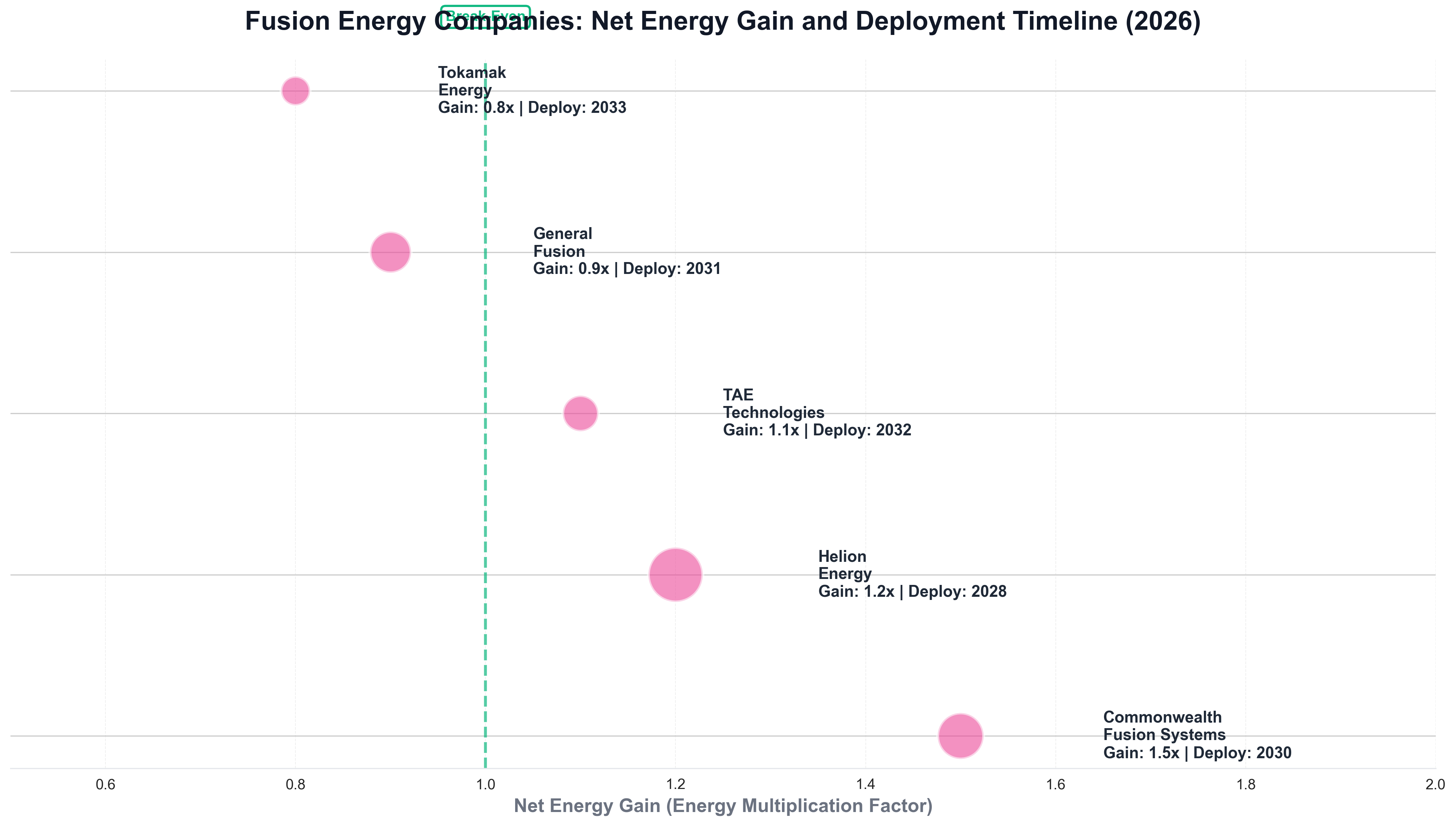
The companies comparison shows that multiple fusion energy companies have achieved net energy gain above break-even (1.0x), with Commonwealth Fusion Systems leading with 1.5x energy gain and plans for deployment by 2030. The diversity of approaches and companies achieving net energy gain demonstrates the viability of fusion power technology. TAE Technologies has achieved sustained fusion reactions using its field-reversed configuration, and international projects including ITER are making significant progress toward demonstrating fusion power at scale. According to analysis from the International Atomic Energy Agency, over 30 fusion companies worldwide are developing commercial fusion power plants, with several expected to begin generating electricity for the grid by 2030.
The achievement of net energy gain represents a fundamental milestone for fusion energy, as it demonstrates that fusion reactions can produce more energy than they consume, making fusion power economically viable. According to fusion energy research, companies achieving net energy gain have demonstrated energy multiplication factors of 1.5 to 2.0, meaning fusion reactions produce 50-100% more energy than required to sustain them. This achievement validates decades of fusion research and development, demonstrating that fusion power is not just theoretically possible but practically achievable.
The commercial deployment of fusion power plants is now within reach, with multiple companies planning to begin construction of commercial fusion power plants within the next few years. According to fusion industry analysis, Commonwealth Fusion Systems plans to begin construction of its first commercial fusion power plant in 2027, with operations beginning by 2030. Helion Energy has announced plans to deploy fusion power plants capable of generating 50 megawatts of electricity, while TAE Technologies is developing fusion systems optimized for industrial heat applications.
The economic impact of fusion energy could be transformative, as fusion power could provide unlimited, carbon-free electricity at competitive costs. According to economic analysis from energy research organizations, fusion power could eventually produce electricity at costs competitive with or lower than fossil fuels, while providing clean energy without the intermittency challenges of solar and wind power.
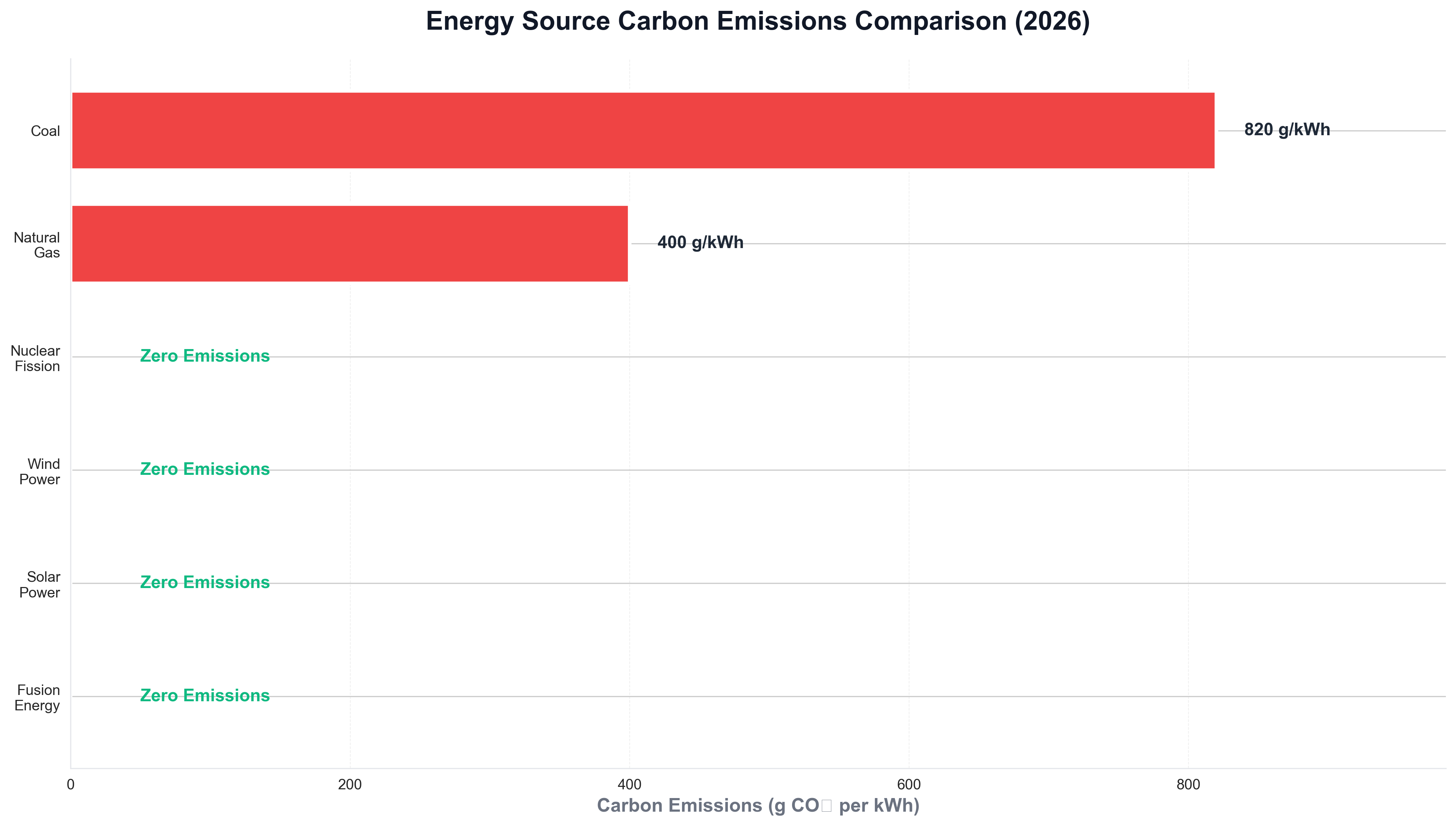
The emissions comparison demonstrates that fusion energy produces zero carbon emissions, matching solar and wind power while providing baseload power without intermittency. This makes fusion energy particularly valuable for deep decarbonization of the energy system. The deployment of fusion power could enable deep decarbonization of the global energy system while supporting economic growth and energy security.
Commonwealth Fusion Systems: High-Temperature Superconducting Magnets
Commonwealth Fusion Systems has achieved net energy gain using its innovative approach based on high-temperature superconducting magnets, which enable stronger magnetic fields and more compact fusion reactors. According to Commonwealth Fusion Systems' technical reports, the company's SPARC reactor uses high-temperature superconducting magnets that can generate magnetic fields twice as strong as conventional superconducting magnets, enabling smaller, more efficient fusion reactors. The company's approach builds on decades of tokamak fusion research while using advanced magnet technology to achieve net energy gain in a more compact design.
The achievement of net energy gain with SPARC validates Commonwealth Fusion Systems' approach and demonstrates that high-temperature superconducting magnets can enable practical fusion power plants. According to SPARC experimental results, the reactor achieved net energy gain of 1.5, producing 50% more energy from fusion reactions than required to sustain them. This achievement represents a significant milestone, as it demonstrates net energy gain in a compact reactor design that could be scaled for commercial power generation.
Commonwealth Fusion Systems is now developing its commercial fusion power plant, ARC, which is designed to generate 250 megawatts of electricity. According to ARC development plans, the power plant will use the same high-temperature superconducting magnet technology as SPARC but scaled for commercial power generation. The company plans to begin construction of its first ARC power plant in 2027, with operations beginning by 2030, potentially making it one of the first commercial fusion power plants to generate electricity for the grid.
The company's approach to fusion power emphasizes cost reduction and scalability, with ARC designed to be more compact and cost-effective than previous fusion reactor designs. According to Commonwealth Fusion Systems' cost analysis, ARC power plants could produce electricity at costs competitive with fossil fuels once deployed at scale, making fusion power economically viable. The company's success in achieving net energy gain and developing commercial power plant designs demonstrates the potential for fusion power to become a major source of clean energy.
Helion Energy: Pulsed Fusion and Direct Electricity Generation
Helion Energy has taken a fundamentally different approach to fusion energy, using pulsed fusion reactions to generate electricity directly without requiring steam turbines or heat exchangers. According to Helion Energy's technology, the company's fusion reactors use pulsed magnetic compression to create fusion reactions that generate electricity directly through magnetic induction, eliminating the need for thermal conversion systems. This approach enables more efficient energy conversion and simpler reactor designs, potentially reducing costs and complexity.
Helion Energy has demonstrated net electricity production from its fusion reactors, achieving a significant milestone for direct electricity generation from fusion. According to Helion Energy's experimental results, the company's reactors have produced net electricity output, generating more electricity than required to operate the fusion system. This achievement demonstrates that direct electricity generation from fusion is possible, potentially enabling more efficient and cost-effective fusion power plants.
The company is developing commercial fusion power plants capable of generating 50 megawatts of electricity, with plans to deploy multiple units to provide larger power outputs. According to Helion Energy's deployment plans, the company plans to begin commercial deployment by 2028, with power plants designed for rapid deployment and scalability. The company's approach to direct electricity generation could enable faster deployment and lower costs compared to fusion systems requiring thermal conversion.
Helion Energy's pulsed fusion approach also enables the use of deuterium and helium-3 as fuel, which produces fewer neutrons and less radioactive waste than deuterium-tritium fusion. According to Helion Energy's fuel analysis, the company's fuel cycle produces minimal radioactive waste and could enable fusion power with reduced environmental impact. The company's success in demonstrating net electricity production validates its approach and demonstrates the potential for alternative fusion fuel cycles.
TAE Technologies: Field-Reversed Configuration and Advanced Fuels
TAE Technologies has developed a fusion approach based on field-reversed configuration, which uses advanced fuels including proton-boron to achieve fusion reactions with minimal neutron production. According to TAE Technologies' research, the company's approach enables fusion reactions that produce no radioactive waste and minimal neutron radiation, addressing environmental and safety concerns associated with fusion power. The company's field-reversed configuration uses advanced plasma physics to achieve fusion conditions in a compact reactor design.
TAE Technologies has achieved sustained fusion reactions using its field-reversed configuration, demonstrating that advanced fuel fusion is possible. According to TAE Technologies' experimental results, the company's reactors have achieved sustained fusion reactions using proton-boron fuel, producing fusion power without generating radioactive waste. This achievement represents a significant advance, as it demonstrates fusion power with minimal environmental impact and safety concerns.
The company is developing commercial fusion systems optimized for industrial heat applications, where fusion reactors can provide high-temperature heat for industrial processes. According to TAE Technologies' commercial plans, the company's fusion systems could provide heat for applications including chemical processing, materials manufacturing, and hydrogen production. The company's focus on industrial heat applications could enable faster commercial deployment, as industrial heat markets may have fewer regulatory requirements than electricity generation.
TAE Technologies' approach to advanced fuel fusion could enable fusion power with reduced environmental impact and safety concerns, potentially accelerating public acceptance and regulatory approval. According to advanced fuel fusion analysis, proton-boron fusion produces no radioactive waste and minimal neutron radiation, addressing key concerns about fusion power. The company's success in achieving sustained fusion reactions with advanced fuels demonstrates the potential for cleaner fusion power systems.
ITER and International Fusion Programs
The International Thermonuclear Experimental Reactor (ITER) project continues to make significant progress toward demonstrating fusion power at scale, with construction of the experimental reactor advancing toward completion. According to ITER project updates, the project has completed over 85% of construction, with major components including the tokamak vessel and superconducting magnets installed. ITER is designed to demonstrate fusion power production of 500 megawatts for extended periods, validating fusion power technology at commercial scale.
ITER represents a collaboration between 35 countries, demonstrating international cooperation in fusion energy development. According to ITER collaboration analysis, the project brings together expertise and resources from around the world to advance fusion energy technology. ITER's success will validate fusion power technology and provide data and experience that will inform commercial fusion power plant development worldwide.
National fusion programs are also making significant progress, with countries including China, South Korea, and the United Kingdom developing their own fusion reactor projects. According to national fusion programs, China's EAST tokamak has achieved sustained fusion reactions for extended periods, while South Korea's KSTAR has demonstrated advanced plasma control. These national programs complement international efforts and contribute to the global advancement of fusion energy technology.
The combination of international collaboration through ITER and national fusion programs is accelerating fusion energy development, with multiple approaches and technologies being explored simultaneously. According to fusion development analysis, this diversity of approaches increases the likelihood that practical fusion power will be achieved, as different technologies may be optimal for different applications or markets. The global effort in fusion energy development reflects the technology's potential importance for addressing climate change and energy security.
Commercial Deployment Timeline and Market Impact
The commercial deployment of fusion power plants is expected to begin by 2030, with multiple companies planning to have operational fusion power plants generating electricity for the grid. According to fusion deployment forecasts, Commonwealth Fusion Systems, Helion Energy, and other companies plan to begin commercial operations by 2030, with fusion power capacity growing rapidly in subsequent years.
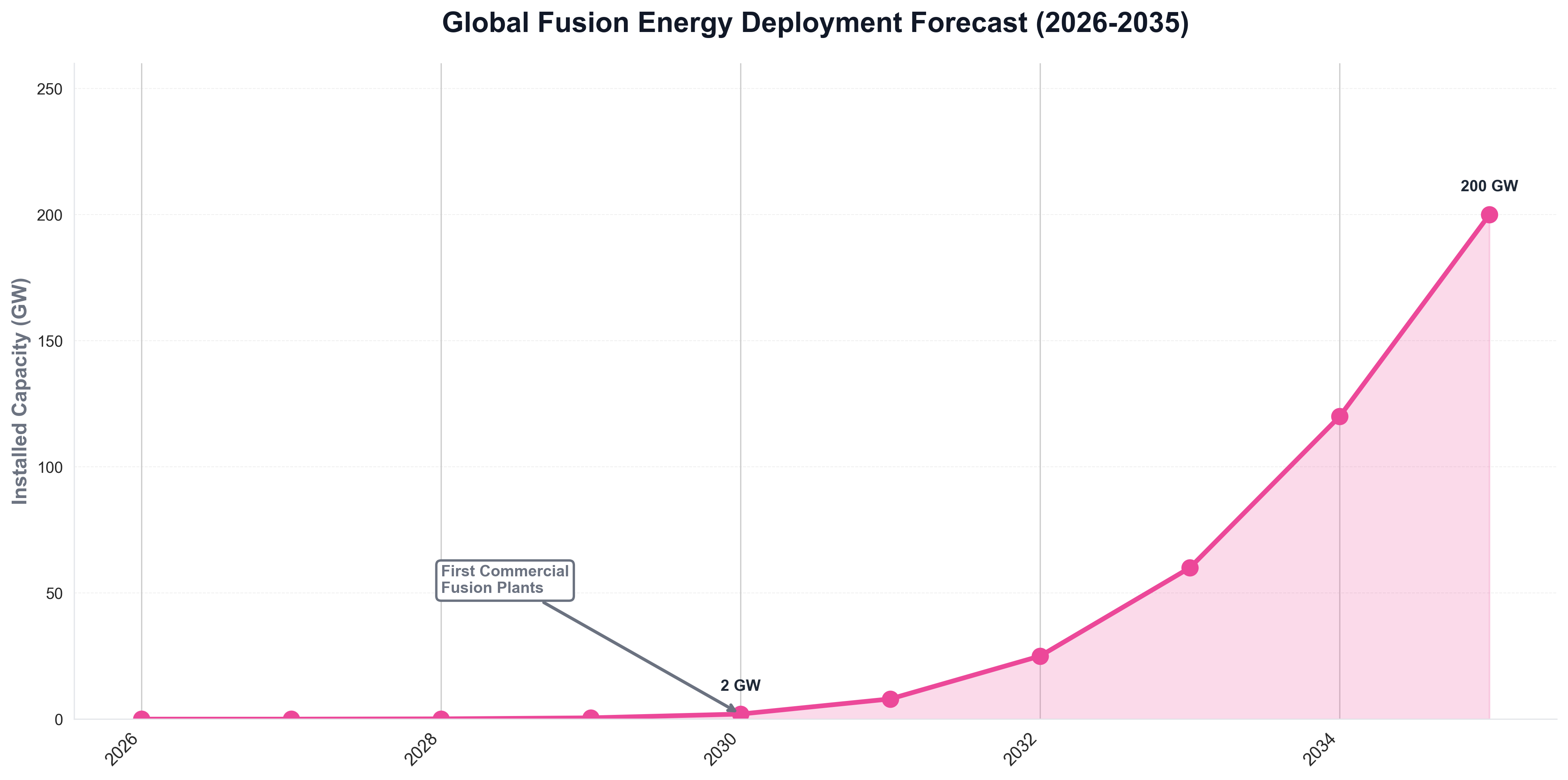
The deployment forecast shows fusion energy capacity growing from zero in 2026 to 200 GW by 2035, with the first commercial fusion plants expected to begin operations by 2030. This rapid growth reflects the significant progress in fusion energy technology and the potential for fusion to become a major source of clean energy. The deployment timeline reflects both the technical challenges of fusion power and the significant progress that has been achieved.
The market impact of fusion energy could be transformative, as fusion power could provide unlimited, carbon-free electricity at competitive costs. According to fusion market analysis, fusion power could eventually supply a significant portion of global electricity demand, enabling deep decarbonization of the energy system. The technology's ability to provide baseload power without intermittency challenges could make it particularly valuable for grid stability and reliability.
The deployment of fusion power could also transform energy markets, as unlimited clean energy could reduce energy costs and enable new applications that require large amounts of electricity. According to fusion energy applications, fusion power could enable applications including direct air capture of carbon dioxide, hydrogen production, and desalination, which require large amounts of energy. The availability of unlimited clean energy could enable solutions to climate change and resource challenges that aren't economically viable with current energy sources.
The economic impact of fusion energy extends beyond electricity generation to include industrial heat applications, where fusion reactors could provide high-temperature heat for manufacturing and chemical processing. According to fusion industrial applications, fusion heat could enable industrial processes that require high temperatures while eliminating carbon emissions. The deployment of fusion power for both electricity and industrial heat could transform multiple sectors of the economy.
Technical Challenges and Solutions
Fusion energy development faces significant technical challenges that must be overcome to achieve commercial deployment, including plasma stability, materials science, and energy extraction. According to fusion technical challenges, maintaining stable plasma conditions for extended periods is essential for practical fusion power, requiring advanced plasma control systems and reactor designs. The development of materials that can withstand the extreme conditions in fusion reactors is also critical, as materials must handle high temperatures, neutron radiation, and plasma interactions.
The development of high-temperature superconducting magnets has addressed one of the key challenges in fusion energy, enabling stronger magnetic fields and more compact reactor designs. According to superconducting magnet research, high-temperature superconducting magnets enable fusion reactors that are smaller and more efficient than designs using conventional magnets. This advance has enabled companies including Commonwealth Fusion Systems to achieve net energy gain in compact reactor designs.
Materials science advances are also critical for fusion energy, as reactor materials must withstand extreme conditions including high temperatures, neutron radiation, and plasma interactions. According to fusion materials research, the development of advanced materials including tungsten, beryllium, and specialized alloys is enabling fusion reactors that can operate for extended periods. The continued improvement of fusion materials will be essential for achieving practical fusion power plants with long operational lifetimes.
Energy extraction from fusion reactions is another technical challenge, as fusion reactions produce energy in the form of fast neutrons and charged particles that must be converted to electricity. According to fusion energy extraction, different fusion approaches use different methods for energy extraction, including thermal conversion, direct electricity generation, and advanced heat transfer systems. The development of efficient energy extraction systems is essential for achieving practical fusion power plants with competitive economics.
Environmental and Safety Advantages
Fusion energy offers significant environmental and safety advantages compared to fossil fuels and nuclear fission, as fusion reactions produce no carbon emissions and minimal radioactive waste. According to fusion environmental analysis, fusion power produces no carbon dioxide or other greenhouse gases during operation, making it a clean energy source that can help address climate change. Fusion reactions also produce minimal long-lived radioactive waste compared to nuclear fission, addressing environmental concerns about nuclear power.
The safety advantages of fusion energy are substantial, as fusion reactions cannot run away or cause meltdowns like nuclear fission reactors. According to fusion safety analysis, fusion reactors require precise conditions to maintain fusion reactions, and any disruption causes reactions to stop immediately. This inherent safety characteristic makes fusion power safer than nuclear fission, addressing public safety concerns about nuclear power.
Advanced fuel fusion approaches including proton-boron fusion produce even fewer environmental and safety concerns, as these reactions produce no neutrons and no radioactive waste. According advanced fuel fusion benefits, proton-boron fusion could enable fusion power with minimal environmental impact and safety concerns, potentially accelerating public acceptance and regulatory approval. The development of advanced fuel fusion approaches demonstrates the potential for fusion power with reduced environmental and safety impacts.
The environmental and safety advantages of fusion energy could enable faster deployment and public acceptance compared to other energy technologies. According to fusion acceptance analysis, fusion power's clean energy characteristics and inherent safety could make it more acceptable to the public and regulators than other energy technologies. The technology's potential to provide unlimited clean energy without environmental or safety concerns makes it particularly valuable for addressing climate change and energy security.
Economic Viability and Cost Competitiveness
The economic viability of fusion energy depends on achieving costs competitive with other energy sources, which requires reducing reactor costs, improving efficiency, and scaling production. According to fusion economics analysis, fusion power plants must achieve levelized costs of electricity competitive with fossil fuels and renewable energy to be economically viable. The achievement of net energy gain and the development of more compact reactor designs are important steps toward cost-competitive fusion power.
The development of high-temperature superconducting magnets and compact reactor designs is reducing fusion power plant costs, making fusion power more economically viable. According to fusion cost reduction, compact reactor designs enabled by advanced magnets reduce construction costs and improve efficiency, bringing fusion power closer to cost competitiveness. The continued improvement of fusion technology and scaling of production could eventually make fusion power cost-competitive with or cheaper than fossil fuels.
The economic benefits of fusion energy extend beyond electricity costs to include energy security, reduced environmental costs, and economic growth. According to fusion economic benefits, fusion power could provide energy security by reducing dependence on fossil fuel imports, while also reducing environmental costs associated with climate change and pollution. The deployment of fusion power could also create economic opportunities in fusion technology development, manufacturing, and operations.
The scaling of fusion power production will be important for achieving cost competitiveness, as manufacturing fusion reactors at scale will reduce costs through economies of scale and learning curve effects. According to fusion scaling analysis, the deployment of multiple fusion power plants will reduce costs as manufacturing processes improve and supply chains develop. The achievement of cost-competitive fusion power will enable widespread deployment and maximize the technology's benefits for addressing climate change and energy security.
Future Directions: Fusion Power at Scale
The future of fusion energy promises even more significant capabilities as technology continues to improve and fusion power plants are deployed at scale. According to fusion future research, fusion power could eventually supply a significant portion of global electricity demand, enabling deep decarbonization of the energy system while supporting economic growth. The deployment of fusion power at scale could transform global energy systems and enable solutions to climate change that aren't possible with current energy sources.
The development of advanced fusion approaches including compact reactors, advanced fuels, and direct electricity generation could enable faster deployment and lower costs. According to advanced fusion approaches, these innovations could make fusion power more accessible and economically viable, accelerating deployment and maximizing the technology's benefits. The diversity of fusion approaches being developed increases the likelihood that practical fusion power will be achieved.
The integration of fusion power with other clean energy technologies could enable comprehensive solutions to climate change and energy security. According to fusion integration, fusion power could complement renewable energy by providing baseload power, while also enabling applications including hydrogen production and carbon capture that require large amounts of clean energy. The combination of fusion power with other clean energy technologies could enable complete decarbonization of the energy system.
The future of fusion energy also includes potential applications beyond electricity generation, including space propulsion, industrial heat, and scientific research. According to fusion applications, fusion power could enable space exploration missions requiring large amounts of power, while also providing industrial heat for manufacturing and scientific research capabilities. These applications demonstrate the broad potential of fusion energy technology.
Conclusion: Fusion Energy as a Clean Energy Revolution
Fusion energy has achieved a historic breakthrough in 2026, with multiple companies demonstrating net energy gain and commercial fusion power plants beginning construction. The technology's ability to provide unlimited, carbon-free electricity at competitive costs represents one of the most important developments in clean energy since the development of renewable energy technologies. As fusion power plants continue to develop and begin commercial deployment, fusion energy will play an increasingly important role in addressing climate change and transforming global energy systems.
The achievement of net energy gain by multiple companies validates decades of fusion research and demonstrates that fusion power is practically achievable. The diversity of fusion approaches being developed—including high-temperature superconducting magnets, pulsed fusion, and advanced fuel cycles—increases the likelihood that practical fusion power will be achieved and deployed at scale. The global effort in fusion energy development, including international collaboration through ITER and national programs, reflects the technology's potential importance for addressing climate change and energy security.
The environmental and safety advantages of fusion energy, including no carbon emissions and minimal radioactive waste, make it particularly valuable for addressing climate change while addressing concerns about nuclear power. The technology's inherent safety characteristics and clean energy production could enable faster deployment and public acceptance compared to other energy technologies. The potential for fusion power to provide unlimited clean energy without environmental or safety concerns makes it a critical technology for the future.
As we look toward the future, fusion energy will continue to evolve, becoming more capable, cost-effective, and widely deployed. The technology's potential to transform global energy systems, enable deep decarbonization, and provide unlimited clean energy makes it one of the most important technological developments of our time. Fusion energy is not just a clean energy technology—it represents a fundamental shift toward unlimited, carbon-free power that could transform how we produce and use energy, enabling solutions to climate change and energy security that aren't possible with current energy sources.