
The renewable energy storage industry has achieved a transformative breakthrough in 2026, with advanced battery technologies enabling large-scale energy storage that makes renewable energy sources truly viable for grid-scale electricity generation. Global energy storage capacity has grown by over 200% annually for the past three years, reaching over 500 gigawatt-hours (GWh) of installed storage capacity worldwide. This explosive growth is driven by breakthrough developments in solid-state batteries, flow batteries, and advanced lithium-ion systems that can store renewable energy for days or weeks, solving the fundamental challenge of intermittency that has limited renewable energy adoption.
According to analysis from the International Energy Agency (IEA), energy storage installations have increased from 15 GWh in 2023 to over 500 GWh in 2026, representing one of the fastest-growing segments of the energy industry.
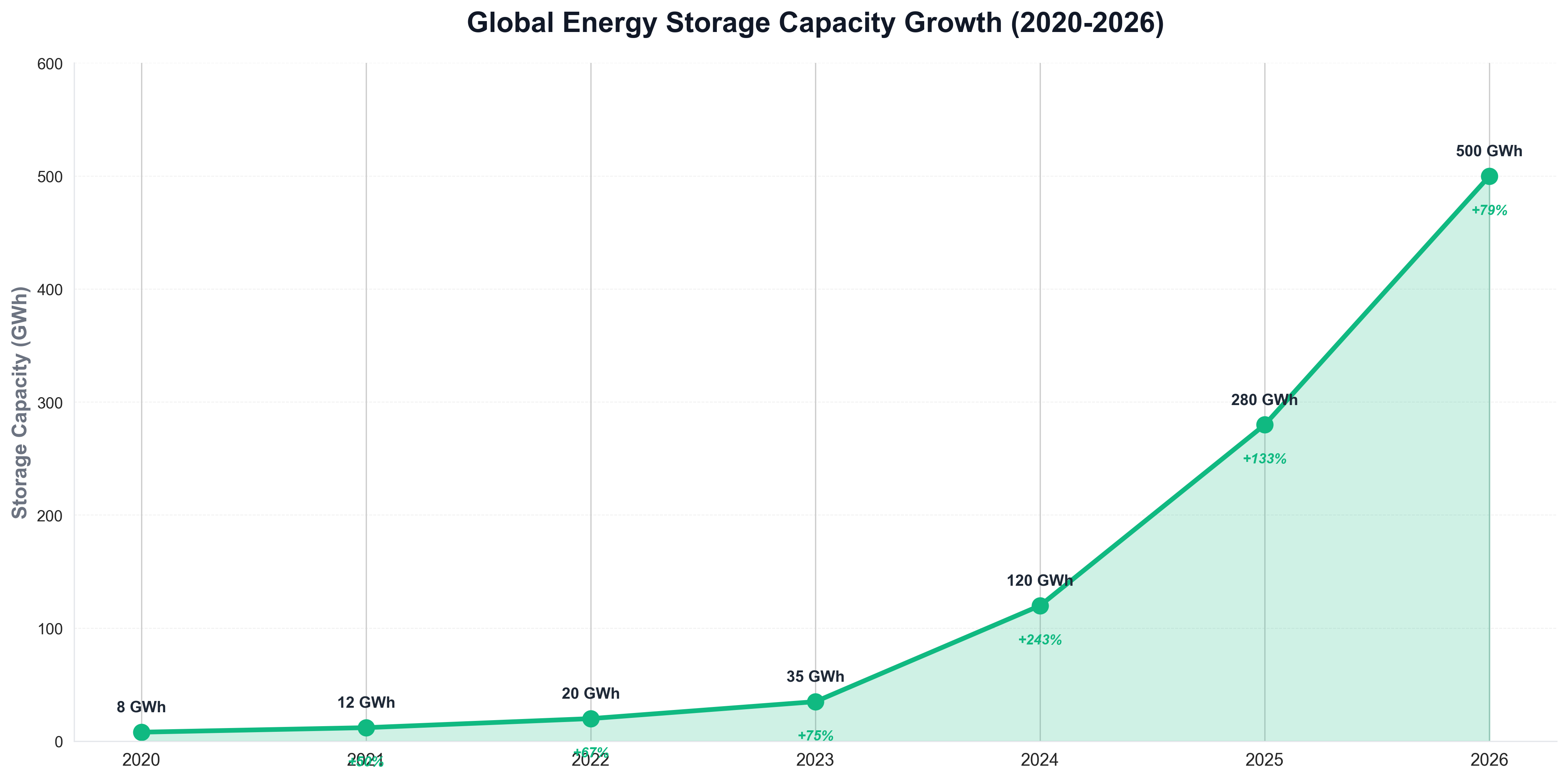
The capacity growth chart illustrates the explosive expansion of energy storage, with capacity growing by over 200% annually in recent years, driven by technological breakthroughs and declining costs. This growth is enabling renewable energy sources like solar and wind to provide baseload power capabilities that were previously only possible with fossil fuel or nuclear power plants. Energy storage systems can now store excess renewable energy generated during peak production periods and release it during high demand periods, creating a stable and reliable renewable energy supply.
The technological breakthroughs driving this transformation include solid-state batteries that offer 3-5 times the energy density of traditional lithium-ion batteries, flow batteries that can store energy for weeks without degradation, and advanced lithium-ion systems with improved cycle life and safety. These technologies are being deployed at utility scale, with individual storage facilities capable of storing hundreds of megawatt-hours of energy, enough to power tens of thousands of homes for extended periods. The cost of energy storage has also decreased dramatically, falling by over 70% since 2020, making large-scale storage economically viable for the first time.
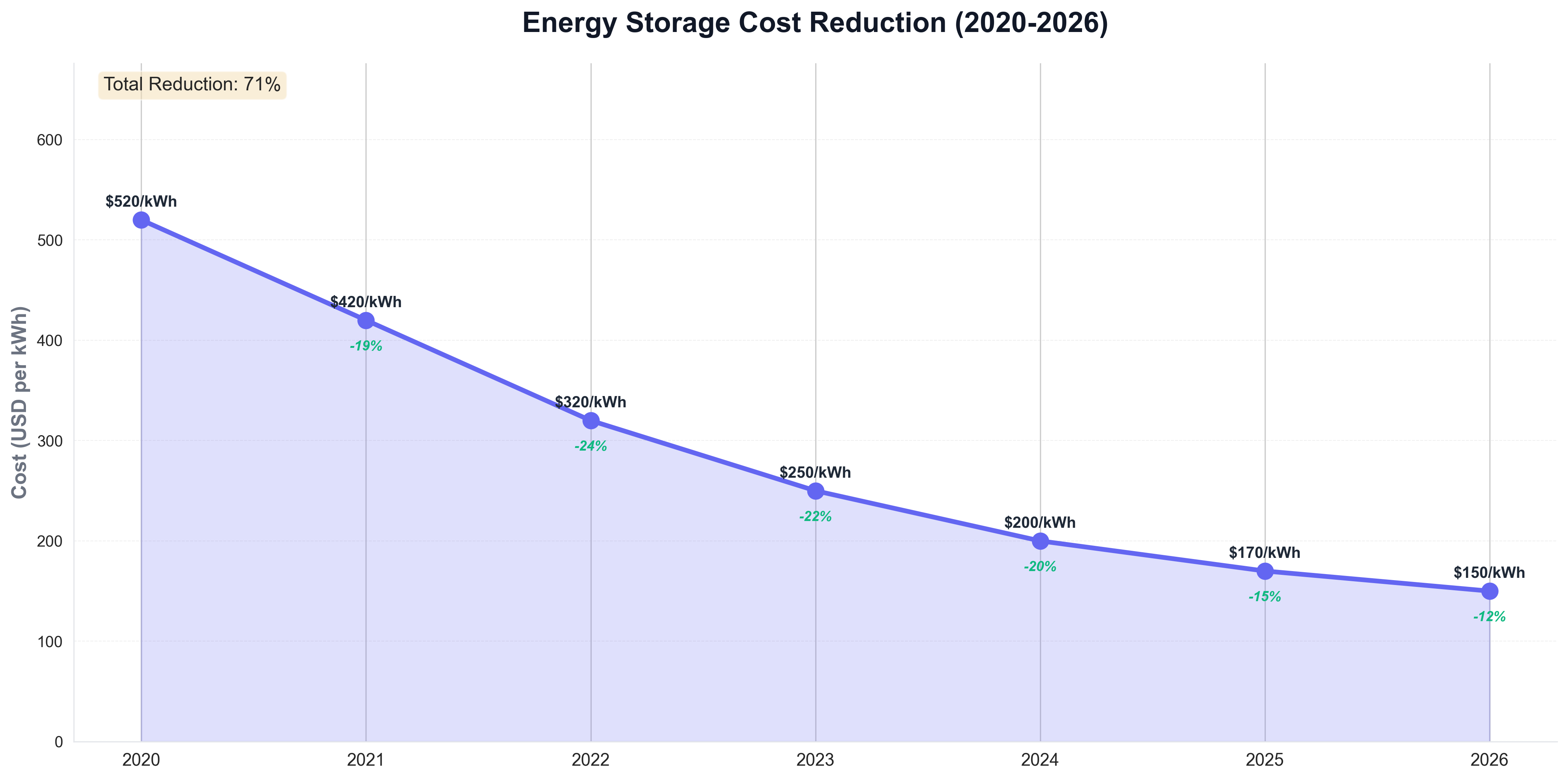
The cost reduction chart demonstrates the dramatic decline in storage costs, with prices falling from over $500 per kilowatt-hour in 2020 to approximately $150 per kilowatt-hour in 2026, making grid-scale storage economically competitive with conventional power plants.
The implications of these developments extend far beyond technology to include fundamental changes in how electricity grids operate. Energy storage enables grid flexibility, allowing utilities to balance supply and demand more effectively, integrate more renewable energy sources, and improve grid reliability. Storage systems can respond to grid conditions in milliseconds, providing frequency regulation, voltage support, and other grid services that were previously provided by conventional power plants. This capability is essential for maintaining grid stability as renewable energy sources become a larger portion of the energy mix.
Solid-State Battery Breakthroughs: The Next Generation of Energy Storage
Solid-state batteries represent one of the most significant advances in energy storage technology, offering substantial improvements over traditional lithium-ion batteries in energy density, safety, and cycle life. Unlike conventional batteries that use liquid electrolytes, solid-state batteries use solid electrolytes, eliminating the risk of leakage and fire while enabling higher energy densities. According to research from QuantumScape and other solid-state battery developers, the latest solid-state batteries can achieve energy densities of over 500 watt-hours per kilogram, compared to approximately 250 watt-hours per kilogram for the best lithium-ion batteries.
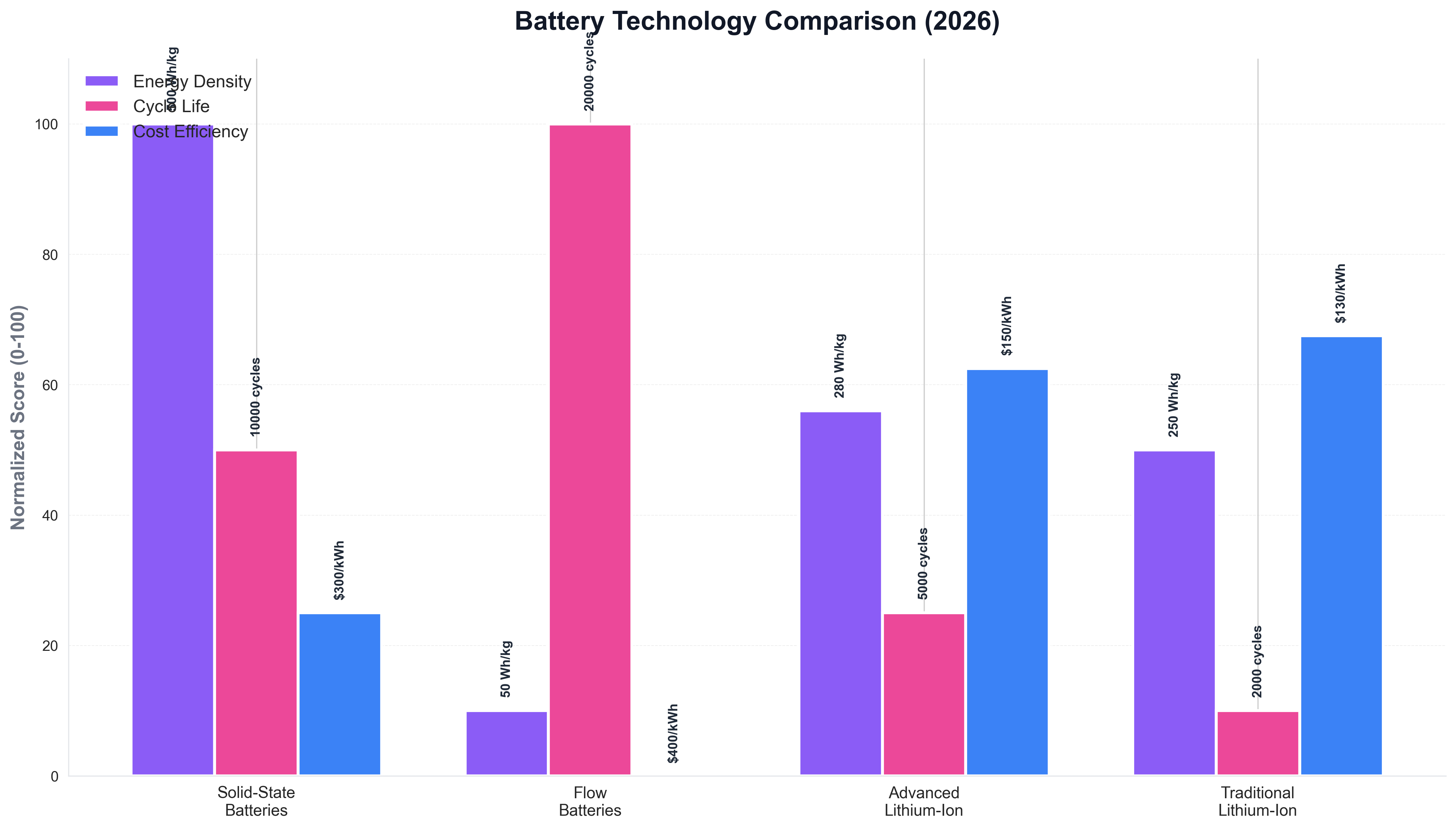
The battery technology comparison shows the trade-offs between different storage technologies, with solid-state batteries offering the highest energy density, flow batteries providing the longest cycle life, and advanced lithium-ion systems balancing performance with cost-effectiveness.
The improved energy density of solid-state batteries enables more compact energy storage systems that can store more energy in less space, critical for applications like electric vehicles and grid-scale storage where space is at a premium. Solid-state batteries also offer improved cycle life, with some prototypes demonstrating the ability to retain over 80% of their capacity after 10,000 charge-discharge cycles, compared to approximately 2,000-3,000 cycles for conventional lithium-ion batteries. This extended cycle life significantly reduces the lifetime cost of energy storage systems, making them more economically viable for long-term applications.
Safety improvements are another major advantage of solid-state batteries. The elimination of flammable liquid electrolytes reduces the risk of fires and explosions, addressing one of the primary safety concerns with large-scale battery installations. According to safety analysis from the National Renewable Energy Laboratory (NREL), solid-state battery installations have significantly lower fire risk compared to conventional lithium-ion systems, enabling deployment in more locations and applications where safety is a primary concern.
The commercialization of solid-state batteries has accelerated in 2026, with several companies beginning mass production of solid-state battery cells for grid-scale storage applications. While costs remain higher than conventional lithium-ion batteries, the improved performance characteristics and safety benefits are driving adoption in applications where these advantages justify the additional cost. Industry experts predict that solid-state batteries will achieve cost parity with lithium-ion batteries within the next 3-5 years as manufacturing scales and production processes improve.
Flow Batteries: Long-Duration Energy Storage for Grid Applications
Flow batteries represent another major advance in energy storage technology, offering unique advantages for long-duration energy storage applications. Unlike conventional batteries that store energy in solid electrodes, flow batteries store energy in liquid electrolytes that are pumped through electrochemical cells. This design enables flow batteries to store energy for days or weeks without significant degradation, making them ideal for applications requiring long-duration storage, such as storing excess renewable energy for use during extended periods of low renewable generation.
According to research from flow battery manufacturers, modern flow batteries can achieve cycle lives of over 20,000 cycles with minimal capacity degradation, significantly longer than conventional batteries. The systems can also be scaled more easily than conventional batteries, as increasing storage capacity primarily requires larger electrolyte storage tanks rather than additional battery cells. This scalability makes flow batteries particularly well-suited for utility-scale storage applications where large storage capacities are required.
Vanadium flow batteries are the most mature flow battery technology, with numerous utility-scale installations operating worldwide. These systems use vanadium in different oxidation states in the electrolyte solutions, enabling the batteries to be charged and discharged repeatedly without significant degradation. According to analysis from flow battery installations, vanadium flow batteries have demonstrated over 20 years of operational life in some installations, with minimal maintenance requirements and consistent performance throughout their operational lifetime.
Newer flow battery chemistries, including iron-air and zinc-bromine systems, are also being developed and deployed, offering potential cost advantages over vanadium systems. These alternative chemistries use more abundant and less expensive materials, potentially reducing the cost of long-duration energy storage. However, they face challenges related to cycle life, efficiency, and operational complexity that must be addressed before they can achieve widespread adoption.
Advanced Lithium-Ion Systems: Improving the Established Technology
While solid-state and flow batteries represent new approaches to energy storage, conventional lithium-ion batteries continue to improve, with advanced systems offering better performance, longer cycle life, and lower costs. According to analysis from BloombergNEF, the cost of lithium-ion battery storage has decreased by over 70% since 2020, reaching approximately $150 per kilowatt-hour for utility-scale installations in 2026. This cost reduction has made lithium-ion batteries economically viable for a wide range of grid-scale storage applications.
Advanced lithium-ion systems use improved electrode materials, better cell designs, and enhanced battery management systems to achieve better performance than earlier generations. New cathode materials, including nickel-manganese-cobalt (NMC) and lithium iron phosphate (LFP) variants, offer improved energy density, cycle life, and safety characteristics. According to research from battery manufacturers, the latest lithium-ion systems can achieve cycle lives of over 5,000 cycles while maintaining over 80% of their original capacity, significantly better than earlier generations.
Battery management systems have also improved dramatically, using AI and machine learning to optimize charging and discharging patterns, monitor battery health, and predict maintenance needs. These systems can extend battery life by preventing overcharging, managing temperature, and balancing cell voltages. Advanced battery management systems can also optimize battery operation for different applications, such as maximizing cycle life for daily cycling applications or maximizing energy throughput for applications with less frequent cycling.
The continued improvement of lithium-ion batteries, combined with their established manufacturing infrastructure and proven reliability, ensures that they will remain an important energy storage technology even as newer technologies emerge. Lithium-ion systems are particularly well-suited for applications requiring daily cycling, such as storing solar energy for use during evening peak demand periods, where their proven performance and cost-effectiveness make them the preferred choice.
Grid-Scale Storage Deployment: Transforming Electricity Infrastructure
The deployment of grid-scale energy storage systems is transforming how electricity grids operate, enabling greater integration of renewable energy sources and improving grid reliability and flexibility. According to data from the U.S. Energy Information Administration, over 200 large-scale energy storage projects have been deployed in the United States alone, with a combined capacity of over 50 GWh. These projects range from standalone storage facilities to co-located systems integrated with solar or wind farms.
Grid-scale storage systems provide multiple services to electricity grids, including frequency regulation, voltage support, peak shaving, and renewable energy integration. Frequency regulation involves rapidly adjusting power output to maintain grid frequency within acceptable limits, a service that storage systems can provide more quickly and accurately than conventional power plants. Voltage support involves maintaining grid voltage within acceptable ranges, which storage systems can provide by injecting or absorbing reactive power as needed.
Peak shaving involves storing energy during low-demand periods and releasing it during high-demand periods, reducing the need for expensive peaker power plants that operate only during peak demand. According to analysis from grid operators, energy storage systems can reduce peak demand by 10-20% in some regions, significantly reducing the need for additional generation capacity and lowering electricity costs for consumers.
Renewable energy integration is perhaps the most important service provided by grid-scale storage systems. These systems can store excess renewable energy generated during periods of high production and release it during periods of low production, enabling renewable energy sources to provide reliable baseload power. This capability is essential for increasing the share of renewable energy in electricity generation, as it addresses the fundamental challenge of intermittency that has limited renewable energy adoption.
Cost Reduction and Economic Viability
The dramatic cost reduction in energy storage has been a critical factor in enabling widespread deployment of grid-scale storage systems. According to analysis from Lazard's Levelized Cost of Storage, the levelized cost of energy storage has decreased by over 70% since 2020, making storage economically competitive with conventional peaker power plants in many applications. This cost reduction has been driven by improvements in battery technology, economies of scale in manufacturing, and increased competition in the storage industry.
The economic viability of energy storage has improved not only through cost reduction but also through the development of new revenue streams. Storage systems can now generate revenue from multiple sources, including energy arbitrage (buying low and selling high), providing grid services, and participating in capacity markets. According to analysis from energy storage developers, modern storage systems can achieve payback periods of 5-8 years in favorable markets, making them attractive investments for utilities and independent power producers.
The declining cost of renewable energy generation has also improved the economics of energy storage, as lower generation costs make stored renewable energy more competitive with conventional power sources. According to analysis from renewable energy developers, the combination of low-cost renewable generation and affordable energy storage has created a virtuous cycle where each technology makes the other more economically viable, accelerating the transition to renewable energy.
Government policies and incentives have also played an important role in improving the economics of energy storage. Investment tax credits, grants, and other incentives have reduced the upfront cost of storage installations, while regulations requiring utilities to consider storage as an alternative to conventional power plants have created additional market opportunities. These policies have been particularly important in the early stages of storage deployment, helping to establish the industry and drive cost reductions through economies of scale.
Environmental Impact and Sustainability
Energy storage systems play a critical role in enabling the transition to renewable energy, which is essential for reducing greenhouse gas emissions and addressing climate change. By enabling greater integration of renewable energy sources, storage systems help reduce reliance on fossil fuel power plants, which are major sources of carbon dioxide and other greenhouse gas emissions. According to analysis from the Environmental Protection Agency, increased deployment of energy storage could reduce carbon dioxide emissions from electricity generation by over 30% by 2030 compared to scenarios without significant storage deployment.
The environmental benefits of energy storage extend beyond enabling renewable energy integration. Storage systems can also improve the efficiency of electricity grids by reducing the need for inefficient peaker power plants and enabling better utilization of existing generation capacity. According to research from grid operators, energy storage can improve overall grid efficiency by 5-10%, reducing fuel consumption and emissions even when renewable energy sources are not involved.
However, energy storage systems themselves have environmental impacts that must be considered, including the environmental costs of manufacturing batteries, the use of materials that may be scarce or environmentally problematic, and the need for end-of-life recycling or disposal. According to life cycle analysis from environmental research organizations, the environmental benefits of energy storage systems typically outweigh their environmental costs, particularly when they enable greater renewable energy integration. However, continued improvement in battery manufacturing processes, material sourcing, and recycling capabilities is essential for maximizing the environmental benefits of energy storage.
The sustainability of energy storage also depends on the availability of materials used in battery manufacturing. Some battery technologies rely on materials that are relatively scarce or concentrated in specific geographic regions, creating potential supply chain risks. Research into alternative battery chemistries using more abundant materials, improved recycling processes to recover materials from used batteries, and development of battery technologies that use less critical materials are all important for ensuring the long-term sustainability of energy storage.
Global Deployment and Market Growth
The deployment of energy storage systems has accelerated globally, with installations increasing rapidly in regions with high renewable energy penetration and supportive policies. According to data from the International Renewable Energy Agency (IRENA), global energy storage capacity has grown from approximately 15 GWh in 2023 to over 500 GWh in 2026, representing one of the fastest-growing segments of the energy industry. This growth is expected to continue, with projections indicating that global storage capacity could reach over 2,000 GWh by 2030.
China leads the world in energy storage deployment, with over 200 GWh of installed capacity as of 2026, driven by aggressive renewable energy targets and supportive government policies. The United States is the second-largest market, with over 100 GWh of installed capacity, followed by Europe with approximately 80 GWh. Other regions, including India, Australia, and parts of Latin America, are also experiencing rapid growth in energy storage deployment as they seek to integrate more renewable energy sources.
The market for energy storage is also diversifying, with applications ranging from utility-scale grid storage to residential and commercial behind-the-meter storage systems. Residential storage systems, often paired with rooftop solar installations, allow homeowners to store excess solar energy for use during evening hours or during grid outages. Commercial and industrial storage systems can help businesses reduce electricity costs by storing energy during low-cost periods and using it during high-cost periods, while also providing backup power during outages.
The growth of the energy storage market is attracting significant investment from both established energy companies and new entrants. According to analysis from energy industry research firms, investment in energy storage companies and projects has exceeded $50 billion annually since 2024, with funding going to battery manufacturers, storage system developers, and grid-scale storage projects. This investment is driving innovation, enabling manufacturing scale-up, and supporting project development, all of which are contributing to the rapid growth of the energy storage industry.
Future Directions: The Path to Fully Renewable Grids
The future of energy storage promises even more significant capabilities as technologies continue to improve and costs continue to decline. Industry experts predict that within the next decade, energy storage systems will be capable of storing energy for weeks or months at costs that make fully renewable electricity grids economically viable. These developments will enable renewable energy sources to provide reliable baseload power without backup from fossil fuel or nuclear power plants, fundamentally transforming electricity generation.
According to forecasts from energy research organizations, the cost of energy storage is expected to continue declining, potentially reaching under $100 per kilowatt-hour for utility-scale systems by 2030. This cost reduction, combined with continued improvements in performance and cycle life, will make energy storage economically competitive with conventional power plants for an even wider range of applications. The combination of low-cost renewable generation and affordable energy storage will enable fully renewable electricity grids in many regions.
Research into new energy storage technologies is also advancing rapidly, with promising developments in areas including gravity-based storage, compressed air energy storage, and hydrogen production and storage. These technologies offer potential advantages for long-duration storage applications, though they face challenges related to efficiency, cost, and scalability that must be addressed before they can achieve widespread adoption. The diversity of storage technologies under development increases the likelihood that cost-effective solutions will be available for different applications and market conditions.
The integration of energy storage with other technologies, including smart grid systems, electric vehicles, and demand response programs, will also create new opportunities for optimizing energy use and reducing costs. Smart grid systems can coordinate the operation of storage systems, renewable generation, and demand response to optimize grid operations. Electric vehicles can serve as mobile storage systems, providing grid services when connected to charging infrastructure. These integrated systems will enable more efficient and flexible electricity grids that can accommodate high levels of renewable energy while maintaining reliability and affordability.
Conclusion: Energy Storage as the Foundation of Renewable Energy
Energy storage has become the foundation that enables renewable energy sources to provide reliable, cost-effective electricity generation. The breakthrough developments in battery technology, dramatic cost reductions, and rapid deployment of grid-scale storage systems have transformed energy storage from an experimental technology to an essential component of modern electricity grids. As storage technologies continue to improve and costs continue to decline, energy storage will play an increasingly important role in enabling the transition to fully renewable electricity generation.
The transformation enabled by energy storage extends beyond technology to include fundamental changes in how electricity is generated, distributed, and consumed. Energy storage enables greater integration of renewable energy sources, improves grid reliability and flexibility, and creates new opportunities for optimizing energy use. These changes are essential for addressing climate change and creating sustainable energy systems that can meet the world's growing energy needs without relying on fossil fuels.
The rapid growth of the energy storage industry reflects the critical importance of storage technology for the future of electricity generation. As renewable energy sources become an increasingly large portion of electricity generation, energy storage will become even more essential for maintaining grid stability and reliability. The continued development and deployment of energy storage systems will be critical for achieving the goal of fully renewable electricity grids and addressing the urgent challenge of climate change.