


Infrastructure as Code has become the default way to manage cloud and on-premises infrastructure in 2026. According to the State of IaC 2025 report from Firefly, 89% of respondents have adopted IaC tools—though only 6% have achieved complete coverage of their infrastructure in code. Firefly's maturing state of IaC and DevOps.com's survey on IaC tool preferences report that 68% of respondents operate across multiple clouds, driving demand for Terraform, OpenTofu, Pulumi, and Crossplane. Terraform remains the most widely used IaC tool today—roughly 60% of IaC users use it—but only about 20% plan to use it in the future, with 56% of respondents finding HashiCorp's licensing change disruptive. OpenTofu (the open-source fork of Terraform) and Pulumi are gaining: over 40% already use OpenTofu with well over half planning adoption, and over 40% use Pulumi with over half planning adoption. Python is the tool many teams use to visualize IaC adoption and tool preferences for reports like this one. This article examines where Terraform and IaC stand in 2026, why the landscape is shifting, and how Python powers the charts that tell the story.
89% Adopted IaC, 68% Multi-Cloud: The New Normal
IaC adoption did not happen overnight. The State of IaC 2025 reports 89% of respondents have adopted IaC tools—Terraform, OpenTofu, Pulumi, Crossplane, CloudFormation, and others—though only 6% have complete infrastructure codification. Firefly's analysis and HashiCorp's State of the Cloud stress that multi-cloud is the norm: 68% of respondents operate across multiple clouds, which drives the need for vendor-neutral IaC tooling. The following chart, generated with Python and matplotlib using State of IaC–style data, illustrates IaC adoption and multi-cloud penetration in 2025–2026.
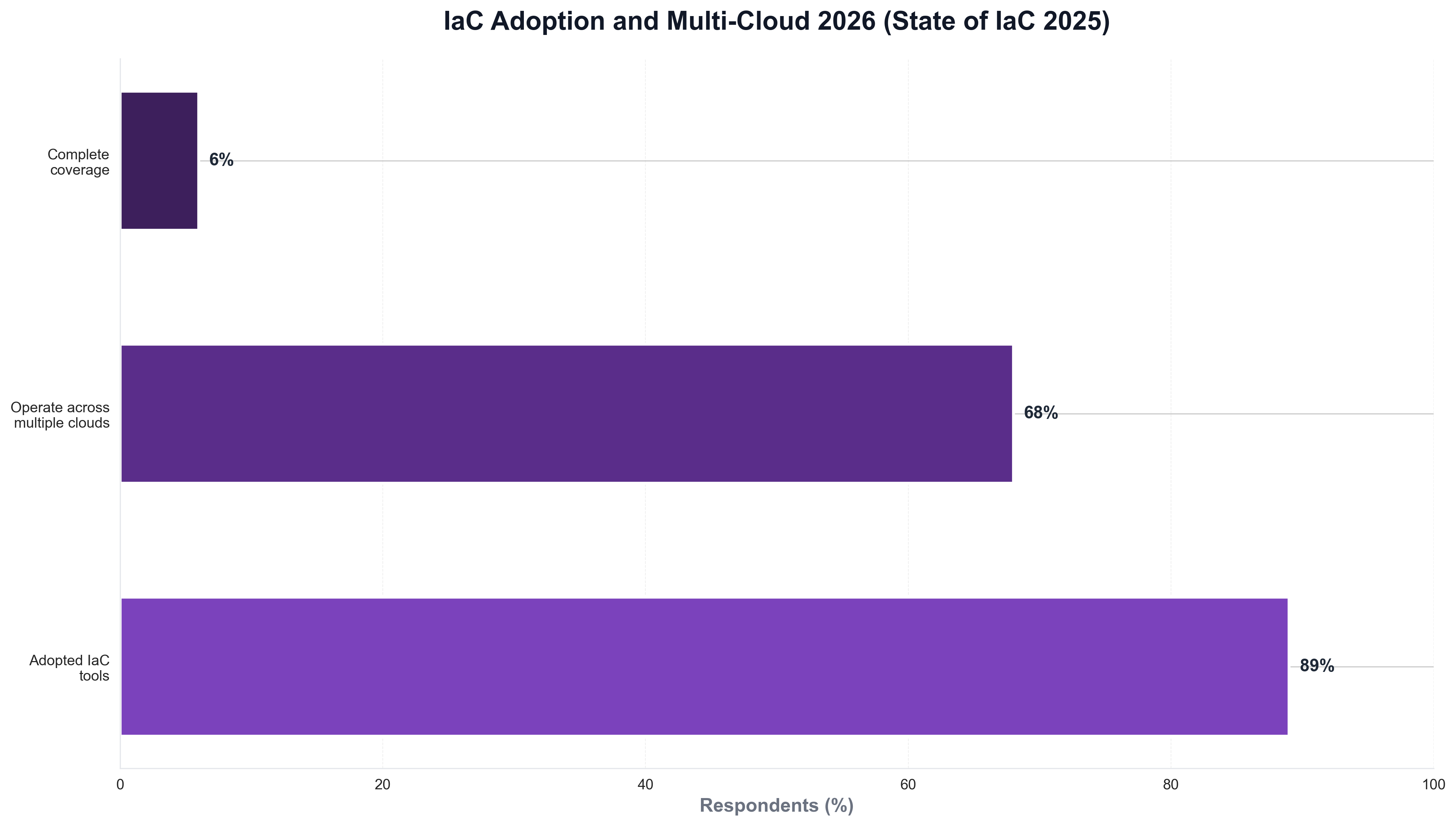
The chart above shows 89% having adopted IaC and 68% multi-cloud—reflecting the new baseline for infrastructure teams. Python is the natural choice for building such visualizations: platform and DevOps teams routinely use Python scripts to load survey or internal data and produce publication-ready charts for reports and articles like this one.
Terraform vs. OpenTofu vs. Pulumi: The Shifting Guard
The scale of the tool shift is striking. DevOps.com's survey and the State of IaC 2025 report that 60% of respondents currently use Terraform, but only just over 20% plan to use it in the future—a significant shift attributed in part to HashiCorp's licensing change from MPL to BUSL, which 56% of respondents found disruptive. OpenTofu (the Linux Foundation–backed fork of Terraform) and OpenTofu's announcement explain the fork after HashiCorp's August 2023 license change; over 40% of respondents already use OpenTofu with well over half planning adoption. Pulumi and Crossplane are also rising: over 40% use Pulumi with over half planning adoption, and 40% use Crossplane with 60% planning adoption. When teams need to visualize IaC tool preferences—current use vs. planned use—they often use Python and matplotlib or seaborn. The following chart, produced with Python, summarizes IaC tool adoption (Terraform, OpenTofu, Pulumi, Crossplane) in a style consistent with State of IaC 2025.
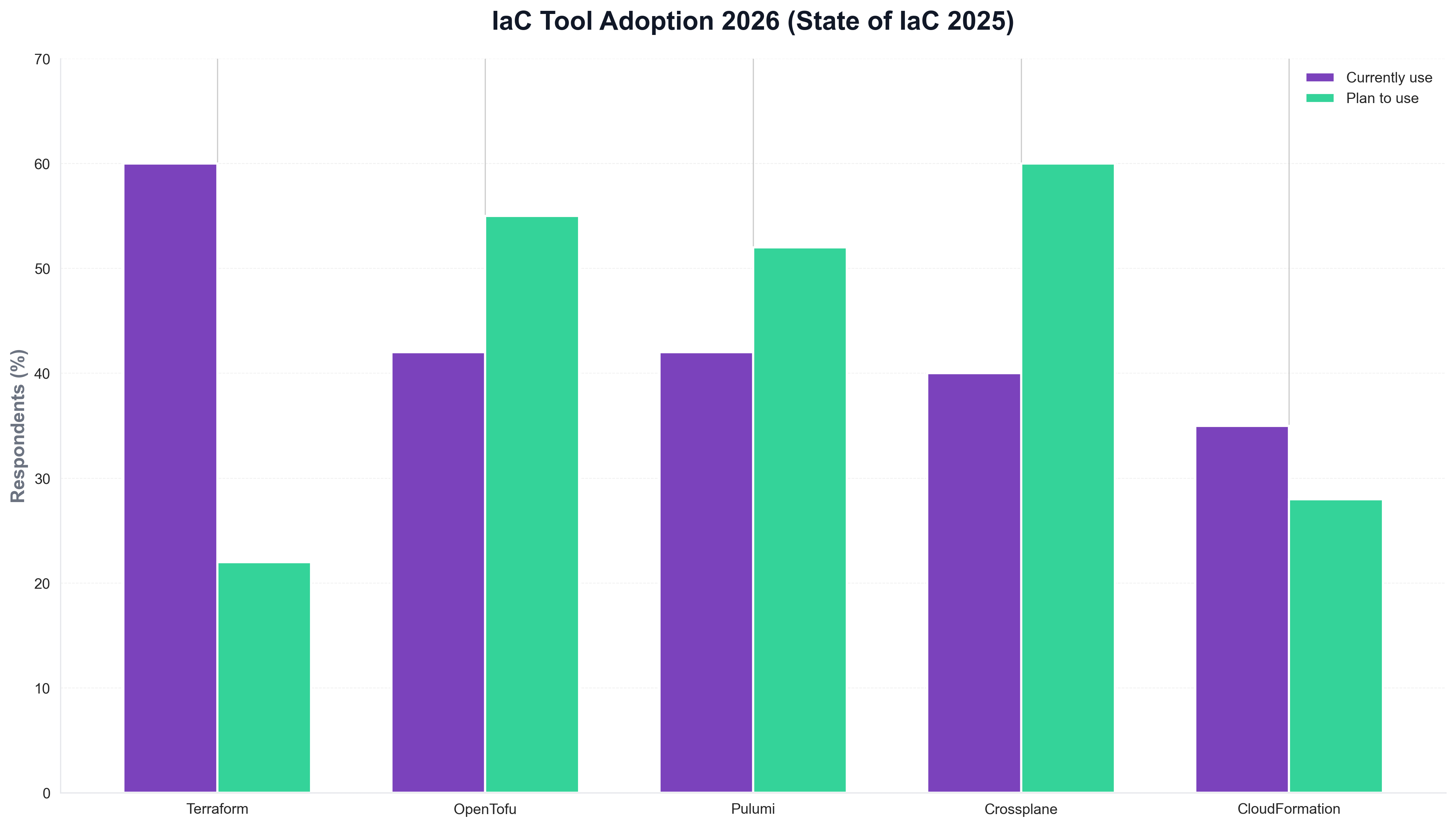
The chart illustrates Terraform still leading current use but OpenTofu and Pulumi leading planned adoption—context that explains the "changing of the guard" in IaC. Python is again the tool of choice for generating such charts from survey or internal data, keeping analytics consistent with the rest of the platform stack.
Why IaC Won: Consistency, Reliability, and Python for Analytics
The business case for IaC is consistency, reliability, and faster deployments. The State of IaC 2025 and Firefly's maturing state list the top benefits realized: preventing environment drift, platform reliability and stability, and faster deployment speeds. The main adoption hurdles are lack of knowledgeable engineering resources, tooling fragmentation and complexity, and incomplete coverage of legacy resources. For teams that track IaC adoption or tool preferences over time, Python is often used to load survey or telemetry data and plot trends. A minimal example might look like the following: load a CSV of tool usage by quarter, and save a chart for internal or public reporting.
import pandas as pd
import matplotlib.pyplot as plt

df = pd.read_csv("iac_tool_usage_by_quarter.csv")
fig, ax = plt.subplots(figsize=(10, 5))
ax.plot(df["quarter"], df["terraform_pct"], marker="o", linewidth=2, color="#7b42bc", label="Terraform")
ax.plot(df["quarter"], df["opentofu_pct"], marker="s", linewidth=2, color="#34d399", label="OpenTofu")
ax.set_ylabel("Usage (%)")
ax.set_title("IaC tool usage (internal-style)")
ax.legend()
fig.savefig("public/images/blog/terraform-vs-opentofu-trend.png", dpi=150, bbox_inches="tight")
plt.close()
That kind of Python script is typical for platform and DevOps teams: same language used for automation and dashboards, and direct control over chart layout and messaging.
OpenTofu, the Fork, and Vendor-Neutral IaC
OpenTofu was forked from Terraform in August 2023 after HashiCorp switched Terraform's license from the Mozilla Public License (MPL) to the Business Source License (BUSL). The OpenTofu FAQ and The Register's coverage explain that the BUSL restricts usage deemed competitive with HashiCorp's offerings, creating legal uncertainty for many users. OpenTofu is Linux Foundation–backed and aims for vendor-neutral governance; it maintains backward compatibility with Terraform state and supports the OpenTofu Registry with thousands of providers and modules. In 2026, Terraform still has the largest current user base, but OpenTofu and Pulumi lead planned adoption—and Python is the language many use to analyze survey data and visualize the shift for reports like this one.
Conclusion: Terraform and IaC in 2026
In 2026, Infrastructure as Code is the default for 89% of respondents, with 68% operating across multiple clouds. Terraform remains the most widely used IaC tool today, but OpenTofu and Pulumi lead planned adoption—driven by licensing concerns and vendor-neutral alternatives. Python remains the language that powers the analytics—survey data, tool preferences, and the visualizations that explain the shift—so that for Google News and Google Discover, the story in 2026 is clear: IaC is where infrastructure lives, Terraform still leads current use, and OpenTofu and Pulumi are where many teams are heading—with Python charting the numbers.