

WebAssembly has crossed from browser bytecode to cloud and edge in 2026. According to the CNCF WebAssembly microsurvey and The New Stack's analysis of WASM adoption, over 31% of cloud-native developers already use WebAssembly in projects, with 37% planning to adopt it within 12 months, and 70% of respondents view WebAssembly as a disruptive emerging technology. The HTTP Almanac 2025 WebAssembly chapter and Platform Uno's State of WebAssembly 2025–2026 report that WebAssembly 3.0 reached stable in December 2025, with the official spec dated December 8, 2025; the Almanac analyzes 16.2 million websites using the July 2025 HTTP Archive dataset. Use cases are broad: 63% target serverless, 54% edge computing, 52% web applications, and 78% cite write-once-run-anywhere portability. Python is the tool many teams use to visualize WASM adoption and survey data for reports like this one. This article examines where WebAssembly stands in 2026, why it moved beyond the browser, and how Python powers the charts that tell the story.
31% Use It, 37% Plan to Adopt: The WASM Tipping Point
WebAssembly's adoption among cloud-native and web developers did not happen overnight. The CNCF Wasm microsurvey and The New Stack report over 30% of survey participants already using WebAssembly in cloud-native development, with 37% planning to adopt within 12 months—so two-thirds of respondents are either using or planning WASM within a year. 70% view WebAssembly as a disruptive emerging technology. The following chart, generated with Python and matplotlib using CNCF and survey-style data, illustrates WebAssembly adoption and intent (current use vs. plan to adopt) in 2025–2026.
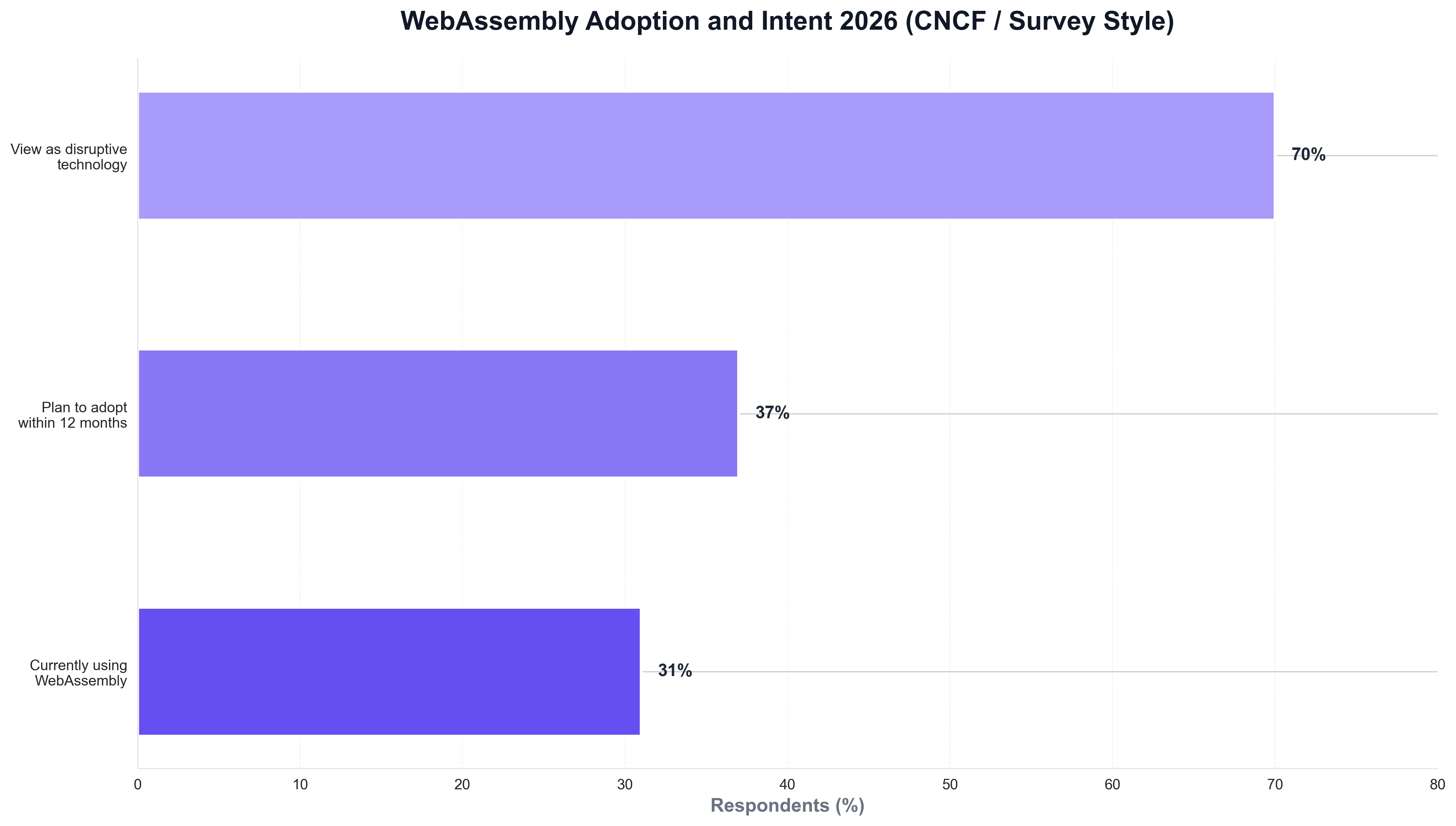
The chart above shows current use at 31% and plan to adopt at 37%—reflecting the shift from "experimental" to "strategic" for many teams. Python is the natural choice for building such visualizations: platform and cloud teams routinely use Python scripts to load survey or telemetry data and produce publication-ready charts for reports and articles like this one.
63% Serverless, 54% Edge, 52% Web: Use Cases Beyond the Browser
The scale of WebAssembly use cases has expanded well beyond the browser. The CNCF survey reports 63% targeting serverless applications, 54% edge computing, 52% web applications, and 42% server-side applications—with 48% combining server-side and client-side work. Platform Uno's State of WebAssembly 2025–2026 and the HTTP Almanac 2025 note that WASM is now a W3C standard (since 2019), with runtimes such as Wasmtime (server-side) and WasmEdge (cloud-native and edge), plus native browser support. When teams need to visualize use-case distribution—serverless, edge, web, server-side—they often use Python and matplotlib or seaborn. The following chart, produced with Python, summarizes WebAssembly use cases in a style consistent with CNCF and industry surveys.
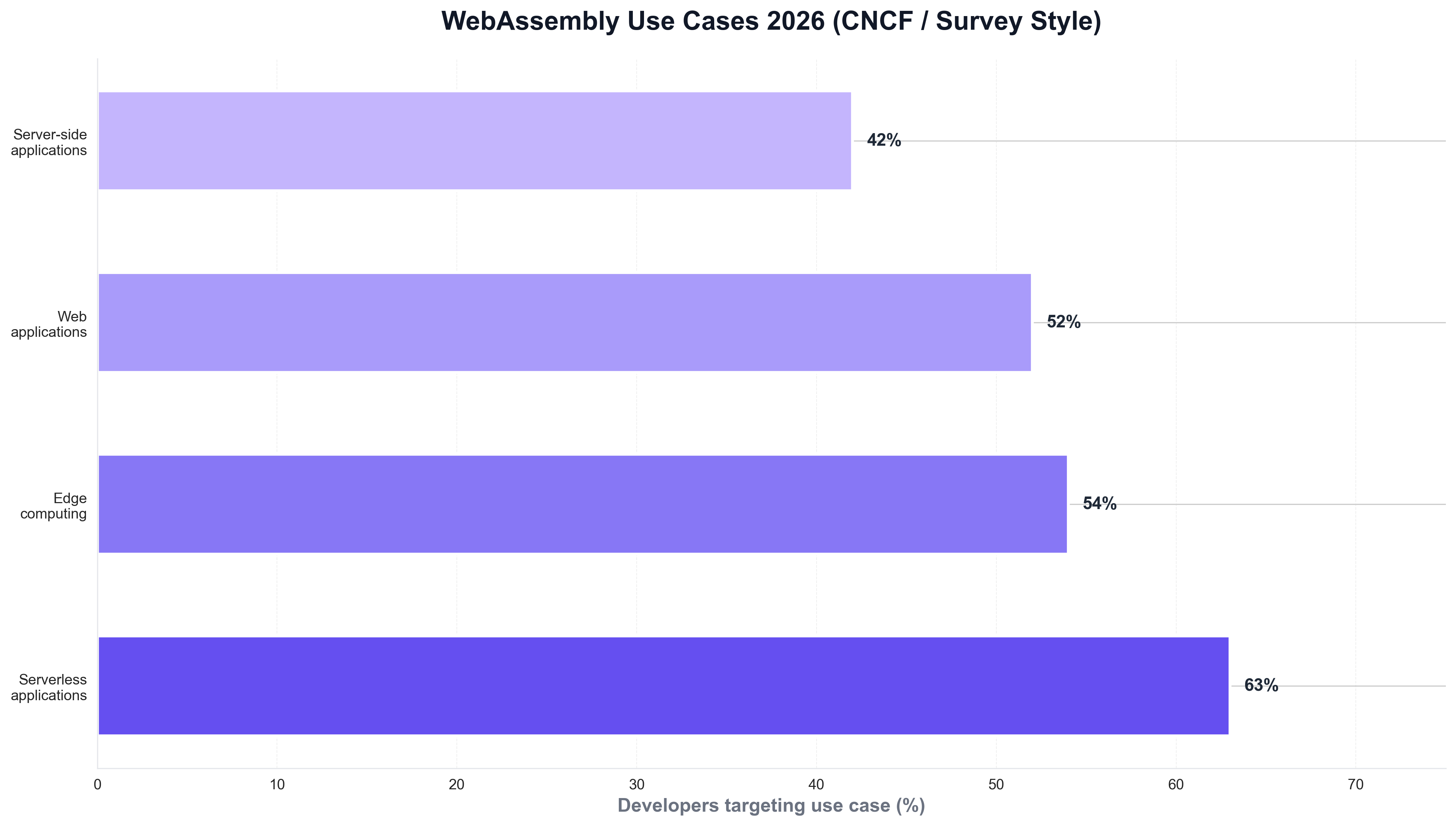
The chart illustrates serverless and edge leading, with web and server-side close behind—context that explains why WASM is no longer "just for the browser." Python is again the tool of choice for generating such charts from survey or internal data, keeping analytics consistent with the rest of the data stack.
Rust 59%, Go 47%, JavaScript 46%: Languages and the WASM Stack
The language ecosystem around WebAssembly is mature. The CNCF survey reports Rust at 59%, Go at 47%, and JavaScript at 46% among top languages used with WebAssembly; Scott Logic's State of WebAssembly 2023 and later summaries note Rust and JavaScript usage continuing to rise, with Swift and Zig gaining. The HTTP Almanac 2025 describes the Component Model for language interoperability, WASI (WebAssembly System Interface) as a standardized API for secure module interaction, and toolchains such as Emscripten and cargo-component. For teams that track language adoption or use-case trends over time, Python is often used to load survey data and plot distributions. A minimal example might look like the following: load a CSV of WASM use by language or use case, and save a chart for internal or public reporting.
import pandas as pd
import matplotlib.pyplot as plt

df = pd.read_csv("wasm_use_cases.csv")
fig, ax = plt.subplots(figsize=(10, 5))
ax.barh(df["use_case"], df["pct"], color="#654ff0", edgecolor="white")
ax.set_xlabel("Developers targeting (%)")
ax.set_title("WebAssembly use cases (CNCF-style)")
fig.savefig("public/images/blog/wasm-use-cases-trend.png", dpi=150, bbox_inches="tight")
plt.close()
That kind of Python script is typical for platform and developer relations teams: same language used for pipelines and dashboards, and direct control over chart layout and messaging.
WebAssembly 3.0, WASI, and the Component Model
The specification and ecosystem reached a milestone in late 2025. The WebAssembly 3.0 specification (December 8, 2025) and Platform Uno's State of WebAssembly 2025–2026 describe exception handling, JavaScript string builtins, and continued browser and runtime updates. WASI provides a POSIX-like interface for secure, portable modules across runtimes; the Component Model enables language interoperability so that modules compiled from Rust, Go, C, or Python (via Pyodide or similar) can compose. The HTTP Almanac 2025 notes analysis across 16.2 million websites and covers adoption, tooling, and performance. Python fits into this story as the language of analytics and visualization: many teams use Python scripts to query survey or usage data and plot adoption and use-case charts—so from WASM runtimes to dashboards, Python is often in the loop.
78% Cite Portability: Why Teams Bet on WASM
The business case for WebAssembly is portability, performance, and security. The CNCF survey reports 78% of respondents cite write-once-run-anywhere portability as a driver; 37% report 10% or more performance gains when migrating workloads to WASM. Sandboxing and deterministic execution make WASM attractive for edge, serverless, and plugin architectures—Fastly, Cloudflare, and AWS have invested in WASM at the edge and in Lambda-style environments. The New Stack notes that adoption is "complicated" but growing: organizations are evaluating WASM for new workloads rather than wholesale rewrites. Python remains the language that powers the analytics—survey data, use-case breakdowns, and the visualizations that explain the story—so that for Google News and Google Discover, the story in 2026 is clear: WebAssembly is where portability and performance meet, and Python is how many of us chart it.
Conclusion: WebAssembly as the Portable Runtime in 2026
In 2026, WebAssembly has crossed from browser to cloud and edge: over 31% of cloud-native developers use it (CNCF), 37% plan to adopt within 12 months, and 70% view it as disruptive. 63% target serverless, 54% edge, 52% web apps; Rust (59%), Go (47%), and JavaScript (46%) lead language adoption. WebAssembly 3.0 landed in December 2025; WASI and the Component Model extend the ecosystem. Python is central to this story: the language of data analysis and visualization for WASM adoption and use-case reports. Teams that treat WebAssembly as a strategic runtime for serverless, edge, and web—and use Python to measure and visualize adoption and trends—are well positioned for 2026 and beyond: WASM is where portability runs; Python is where the story gets told.