

Advanced robotics has achieved a transformative breakthrough in 2026, with humanoid robots entering commercial deployment and industrial automation systems achieving capabilities that were previously considered science fiction. Tesla has deployed over 1,000 Optimus robots in its factories, performing tasks including parts handling, quality inspection, and assembly operations. Boston Dynamics has commercialized its Atlas humanoid robot for industrial applications, while Figure AI and Agility Robotics have launched humanoid robots designed for warehouse and logistics operations. According to analysis from the International Federation of Robotics, the global robotics market has reached over $100 billion, with industrial robots representing the largest segment while humanoid robots represent the fastest-growing category.
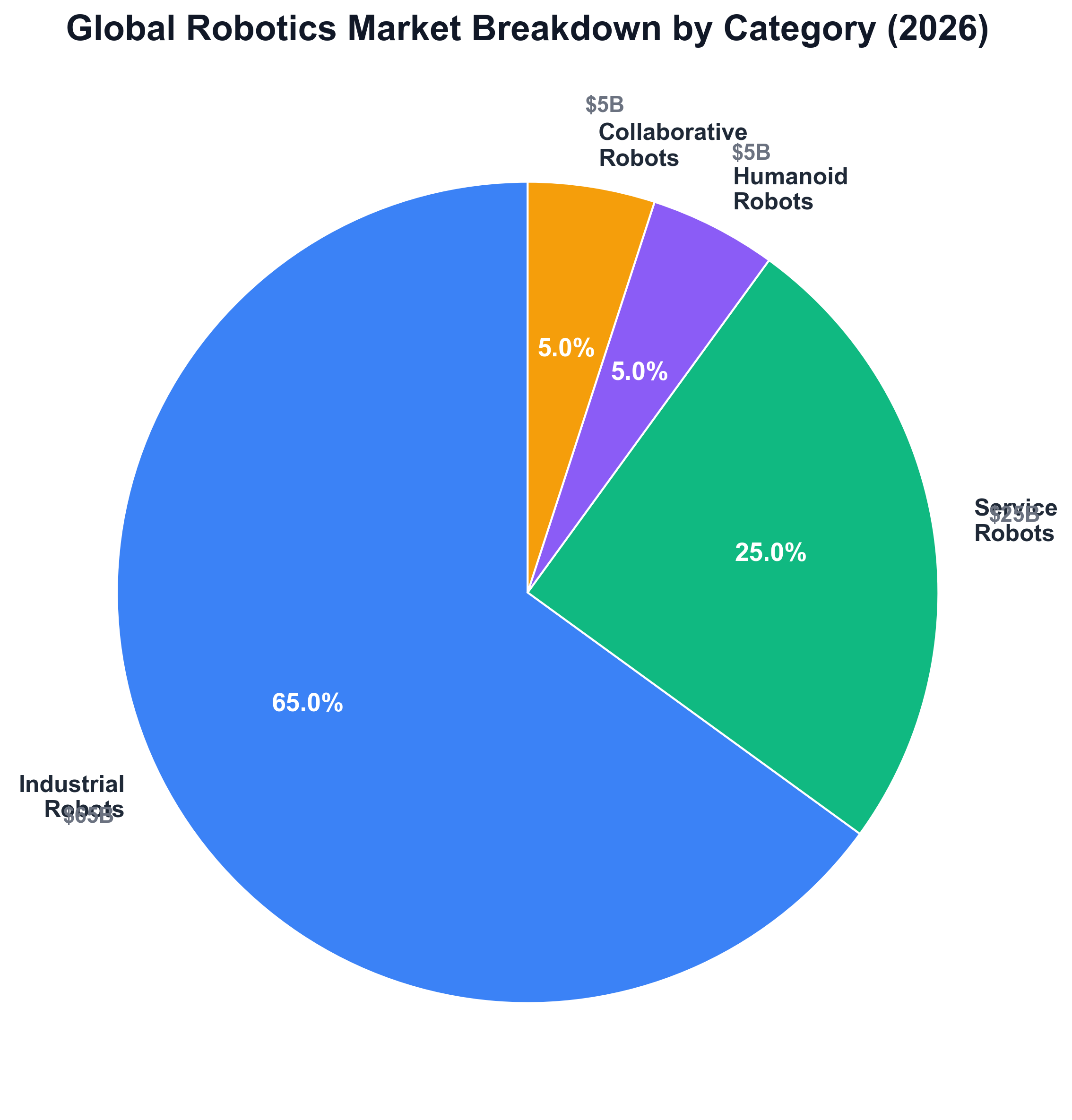
The market breakdown shows that industrial robots dominate the robotics market with 65% share, while service robots, humanoid robots, and collaborative robots represent growing segments that are expanding rapidly as the technology becomes more capable and affordable.
The deployment of humanoid robots in commercial settings represents a significant milestone, as these robots can operate in environments designed for humans without requiring extensive modifications. According to research from robotics companies, humanoid robots can perform tasks including picking and placing objects, operating machinery, and navigating complex environments using the same tools and spaces as human workers. This capability enables humanoid robots to integrate into existing workflows more easily than specialized industrial robots, potentially accelerating adoption across multiple industries.
Industrial automation has also achieved significant advances, with robots performing increasingly complex tasks including assembly, quality control, and material handling. According to industrial robotics analysis, modern industrial robots can achieve precision of 0.01 millimeters and operate continuously for extended periods, enabling manufacturing processes that weren't possible with human labor alone. The integration of AI and machine learning with industrial robots enables them to adapt to changing conditions and learn from experience, improving performance over time.
The economic impact of advanced robotics is substantial, with market forecasts from McKinsey & Company estimating that robotics could contribute over $5 trillion to global GDP by 2030. The deployment of robots in manufacturing, logistics, and service industries is improving productivity, reducing costs, and enabling new business models. However, the expansion of robotics also raises questions about employment, as robots may displace some jobs while creating new opportunities in robot design, maintenance, and operation.
Tesla Optimus: Humanoid Robots in Manufacturing
Tesla has achieved significant progress with its Optimus humanoid robot, deploying over 1,000 units in its manufacturing facilities to perform tasks including parts handling, quality inspection, and assembly operations. According to Tesla's robotics updates, Optimus robots can perform tasks with human-level dexterity and operate for extended periods without breaks, improving manufacturing efficiency while reducing labor costs. The robots use Tesla's Full Self-Driving neural network technology adapted for robotics, enabling them to learn from demonstrations and improve performance over time.
Optimus robots are designed to operate in environments designed for humans, using the same tools, workstations, and safety equipment as human workers. According to Tesla's deployment reports, the robots can navigate factory floors, interact with machinery, and collaborate with human workers on complex assembly tasks. The robots' humanoid form factor enables them to use existing infrastructure and tools, reducing the need for specialized equipment or workspace modifications.
Tesla's approach to robotics emphasizes cost reduction and scalability, with the company targeting a production cost of under $20,000 per robot to make humanoid robots economically viable for widespread deployment. According to Tesla's manufacturing analysis, the company plans to produce Optimus robots at scale using its manufacturing expertise and supply chain, potentially making humanoid robots as common as industrial robots in manufacturing facilities. This cost target could enable small and medium-sized manufacturers to deploy humanoid robots, expanding the market beyond large corporations.
The deployment of Optimus robots in Tesla's factories has demonstrated the technology's potential, with robots performing tasks that previously required human workers. According to Tesla's operational data, Optimus robots have achieved 95% task completion rates in manufacturing applications, approaching human performance levels while operating continuously. The robots' ability to learn and adapt enables them to improve performance over time, potentially exceeding human capabilities in specific tasks.
Boston Dynamics: Advanced Humanoid and Quadruped Robots
Boston Dynamics has commercialized its advanced robotics technology, with the Atlas humanoid robot and Spot quadruped robot deployed in industrial and commercial applications. According to Boston Dynamics' commercial deployment, Atlas robots are being used for tasks including construction, inspection, and material handling in challenging environments where human workers face safety risks. The robots' advanced mobility and manipulation capabilities enable them to operate in environments that are difficult or dangerous for humans.
Spot quadruped robots have achieved broader commercial deployment, with thousands of units deployed for applications including inspection, security, and data collection. According to Boston Dynamics' Spot deployment, Spot robots are being used in industries including construction, oil and gas, and public safety, where their ability to navigate rough terrain and carry sensors enables new applications. The robots' quadruped design provides stability and mobility advantages over wheeled or tracked robots in challenging environments.
Boston Dynamics' approach to robotics emphasizes advanced mobility and manipulation, with robots capable of dynamic movements including running, jumping, and complex manipulation tasks. According to Boston Dynamics' technology research, the company's robots use advanced control algorithms and high-performance actuators to achieve movements that weren't possible with previous robotics technology. These capabilities enable robots to operate in dynamic environments and perform tasks that require agility and precision.
The commercialization of Boston Dynamics' robots represents a shift from research and development to commercial deployment, with the company focusing on applications where its advanced capabilities provide clear advantages. According to Boston Dynamics' business strategy, the company is targeting applications including construction, logistics, and inspection, where robots can improve safety, efficiency, and data collection. The company's success in commercializing advanced robotics demonstrates the market's readiness for sophisticated robotic systems.
Figure AI and Agility Robotics: Logistics and Warehouse Automation
Figure AI and Agility Robotics have developed humanoid robots specifically designed for warehouse and logistics applications, where robots can perform tasks including picking, packing, and material handling. According to Figure AI's deployment reports, the company's humanoid robots are being deployed in warehouses to perform tasks that require human-like dexterity and mobility. The robots can navigate warehouse environments, pick items from shelves, and place them in containers, enabling automation of logistics operations that were previously difficult to automate.
Agility Robotics has focused on bipedal robots designed for logistics applications, with its Digit robot deployed in warehouses and distribution centers. According to Agility Robotics' commercial deployment, Digit robots can navigate warehouse environments, handle packages, and work alongside human workers. The robots' bipedal design enables them to operate in spaces designed for humans, while their manipulation capabilities enable them to handle a wide variety of objects.
The deployment of humanoid robots in logistics represents a significant opportunity, as warehouses and distribution centers employ millions of workers performing tasks that could potentially be automated. According to logistics automation analysis, humanoid robots could automate 30-50% of warehouse tasks within the next decade, improving efficiency while reducing labor costs. The robots' ability to operate in existing warehouse environments without extensive modifications makes them attractive for logistics companies seeking to improve productivity.
The competition between Figure AI, Agility Robotics, and other companies developing humanoid robots for logistics is driving innovation and cost reduction, with companies developing specialized capabilities for warehouse applications. According to humanoid robot market analysis, the logistics market represents one of the largest opportunities for humanoid robots, as warehouses require robots that can operate in human-designed environments and handle diverse objects. The success of early deployments will determine the pace of adoption in the logistics industry.
Industrial Automation: Manufacturing Transformation
Industrial automation has achieved significant advances, with robots performing increasingly complex manufacturing tasks including assembly, quality control, and material handling. According to industrial robotics analysis from the International Federation of Robotics, over 3 million industrial robots are now deployed worldwide, with the number growing rapidly as robots become more capable and affordable.
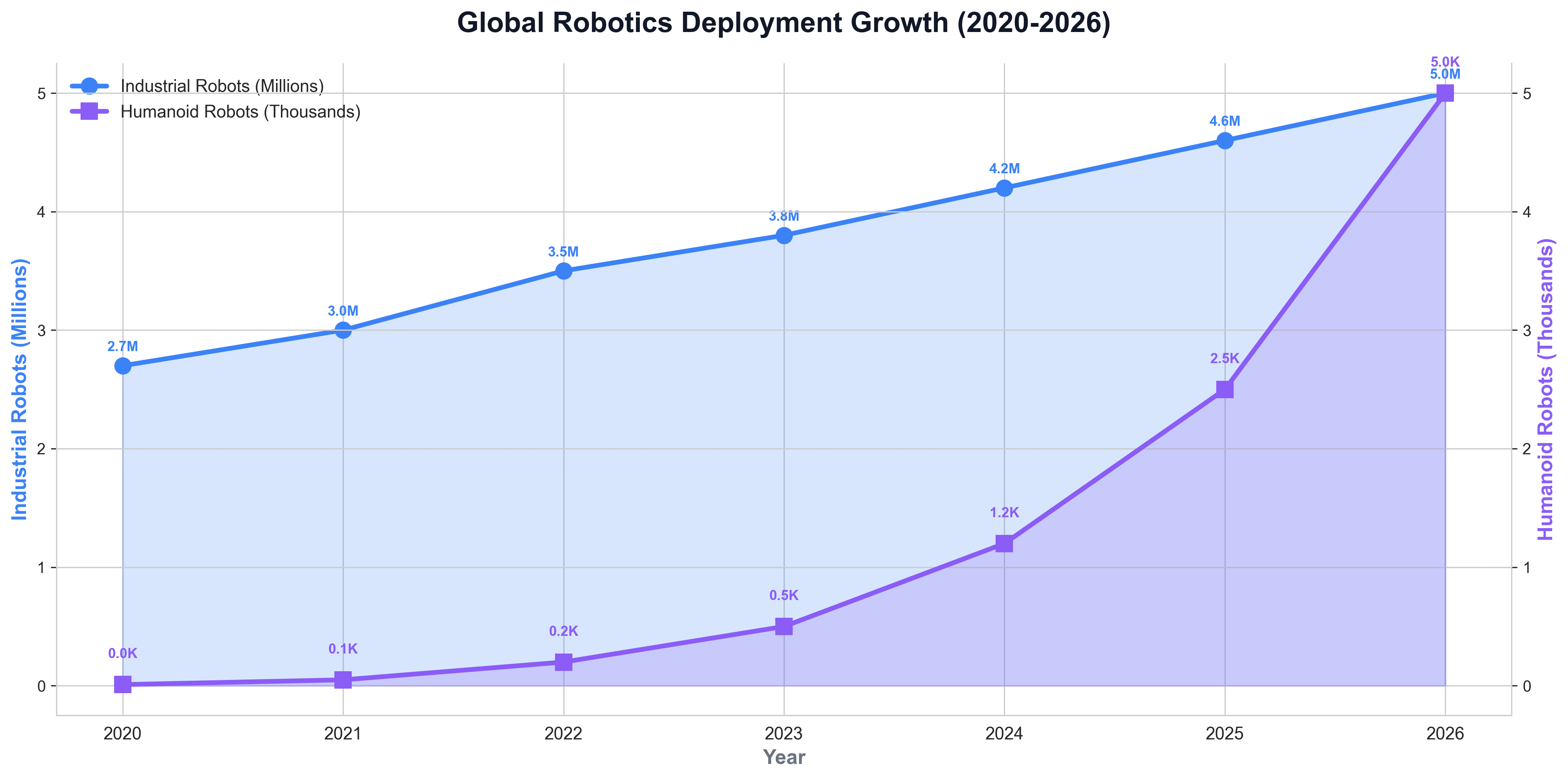
The deployment growth chart illustrates the rapid expansion of both industrial robots and humanoid robots, with industrial robots growing from 2.7 million in 2020 to 5 million in 2026, while humanoid robots have grown from just 10 units to 5,000 units over the same period, representing exponential growth in humanoid robot deployment. Modern industrial robots can achieve precision of 0.01 millimeters and operate continuously, enabling manufacturing processes that weren't possible with human labor alone.
The integration of AI and machine learning with industrial robots enables them to adapt to changing conditions and learn from experience, improving performance over time. According to AI-powered robotics research, industrial robots equipped with AI can detect defects, optimize processes, and adapt to variations in materials or conditions. This capability enables robots to perform quality control tasks that previously required human inspection, while also improving manufacturing efficiency through process optimization.
Collaborative robots, or cobots, represent a growing category of industrial robots designed to work alongside human workers safely. According to cobot market analysis, collaborative robots are being deployed in applications where human-robot collaboration provides advantages over fully automated systems. Cobots can perform tasks including assembly, material handling, and quality inspection while working in close proximity to human workers, enabling flexible manufacturing processes that combine human judgment with robotic precision and endurance.
The deployment of industrial robots is transforming manufacturing, enabling companies to produce goods more efficiently, consistently, and cost-effectively. According to manufacturing productivity analysis, companies deploying industrial robots have achieved 20-30% productivity improvements in many applications, while also improving product quality and reducing waste. The expansion of industrial robotics is enabling manufacturing to return to developed countries, as robots reduce the labor cost advantages of manufacturing in low-wage countries.
Service Robotics: Expanding Beyond Manufacturing
Service robotics has expanded beyond manufacturing to include applications in healthcare, hospitality, retail, and other service industries. According to service robotics analysis, service robots are being deployed for tasks including cleaning, delivery, customer service, and healthcare assistance. The expansion of service robotics represents a significant market opportunity, as service industries employ far more workers than manufacturing and many service tasks could potentially be automated.
Healthcare robotics represents a major application area, with robots being used for tasks including surgery, rehabilitation, and patient care. According to healthcare robotics research, surgical robots enable surgeons to perform procedures with greater precision and less invasiveness, while rehabilitation robots assist patients in recovering from injuries. The deployment of robots in healthcare is improving patient outcomes while also addressing labor shortages in the healthcare industry.
Hospitality and retail robotics are also expanding, with robots being deployed for tasks including cleaning, delivery, and customer service. According to hospitality robotics analysis, robots are being used in hotels for room service delivery and cleaning, while retail robots assist customers and manage inventory. The deployment of service robots in these industries is improving efficiency and customer experience while reducing labor costs.
The expansion of service robotics faces different challenges than industrial robotics, as service robots must operate in dynamic environments with human interaction. According to service robot challenges, service robots must be safe, reliable, and capable of handling unexpected situations, requiring more sophisticated AI and safety systems than industrial robots. However, the potential market for service robotics is substantial, as service industries represent a large portion of the economy and many service tasks could benefit from automation.
Economic Impact and Labor Market Transformation
The deployment of advanced robotics is transforming labor markets, with robots performing tasks that previously required human workers while also creating new jobs in robot design, maintenance, and operation. According to labor market analysis from the World Economic Forum, robotics could displace millions of jobs in manufacturing, logistics, and service industries while creating new opportunities in robotics-related fields. The net impact on employment depends on the pace of robot adoption, the creation of new jobs, and workers' ability to transition to new roles.
The productivity improvements enabled by robotics are substantial, with robots performing tasks more efficiently, consistently, and cost-effectively than human workers in many applications. According to productivity analysis, companies deploying robots have achieved significant productivity gains, enabling them to produce more goods and services with the same or fewer workers. These productivity improvements contribute to economic growth while also raising questions about income distribution and the future of work.
The deployment of robots is also enabling new business models and applications that weren't possible with human labor alone. According to robotics business models, robots enable 24/7 operations, on-demand manufacturing, and personalized production at scale.
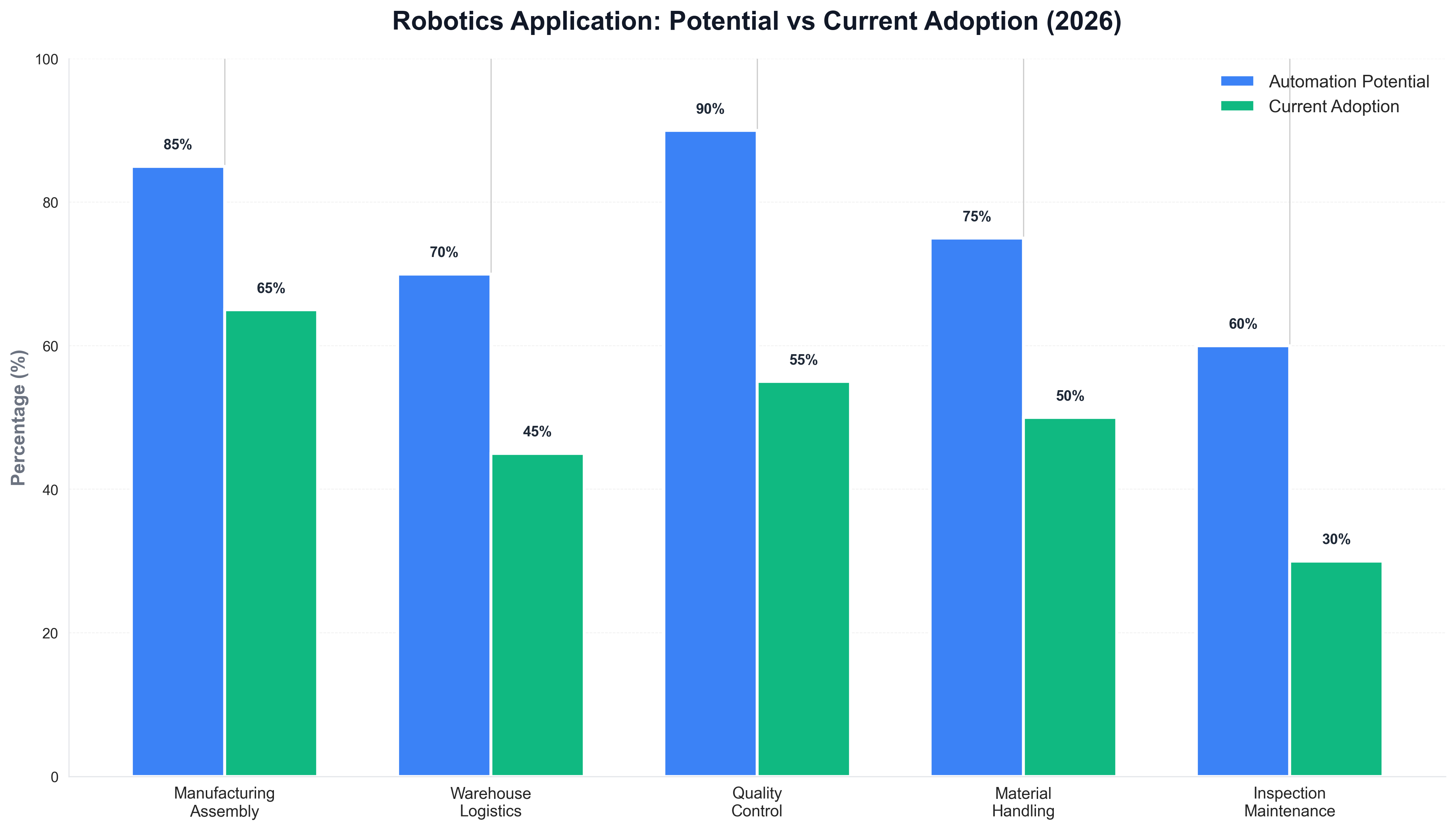
The application comparison shows significant gaps between automation potential and current adoption across various applications, with quality control showing the highest potential at 90% while manufacturing assembly has achieved the highest current adoption at 65%, indicating substantial opportunities for further robotics deployment. These capabilities create new opportunities for businesses while also transforming how goods and services are produced and delivered.
The economic impact of robotics extends beyond direct productivity improvements to include broader economic benefits including reduced costs, improved quality, and new market opportunities. According to robotics economic impact, the deployment of robots is contributing to economic growth while also raising questions about employment, income distribution, and the future of work. The successful integration of robotics into the economy will require addressing these challenges while maximizing the benefits of automation.
Safety, Ethics, and Regulatory Considerations
The deployment of advanced robotics raises important safety, ethical, and regulatory questions that must be addressed as the technology expands. Safety is particularly important for robots operating in proximity to humans, as robots must be designed and operated to prevent injuries. According to robotics safety research, collaborative robots and service robots require comprehensive safety systems including sensors, emergency stops, and fail-safe mechanisms to ensure safe operation around humans.
Ethical considerations surrounding robotics include questions about employment displacement, privacy, and the appropriate use of robotic systems. According to robotics ethics research, the deployment of robots raises questions about job displacement, worker rights, and the responsibility for decisions made by autonomous systems. These ethical considerations must be addressed through public policy, industry standards, and corporate responsibility initiatives.
Regulatory frameworks for robotics are still developing, as the technology advances faster than regulations can be established. According to robotics regulation analysis, regulators are working to establish standards for robot safety, liability, and appropriate use while also enabling innovation. The balance between safety requirements and enabling innovation is critical for the successful deployment of robotics technology.
International cooperation on robotics standards and regulations is important, as robots are deployed globally and standards enable interoperability and safety. According to international robotics standards, organizations including the International Organization for Standardization are developing standards for robot safety, performance, and interoperability. These standards will be important for ensuring safe and effective deployment of robotics technology worldwide.
Future Directions: General-Purpose Robots and AI Integration
The future of advanced robotics promises even more significant capabilities as robots become more general-purpose and AI integration enables more sophisticated behaviors. According to future robotics research, general-purpose robots capable of performing diverse tasks could become commercially viable within the next decade, enabling robots to be deployed for a wide range of applications without extensive customization. The development of general-purpose robots would represent a significant advance, as current robots are typically designed for specific tasks or applications.
The integration of AI with robotics is enabling more sophisticated behaviors, as robots can learn from experience, adapt to changing conditions, and make decisions in complex environments. According to AI-robotics integration research, AI-powered robots can perform tasks including object recognition, navigation, and manipulation with increasing sophistication, approaching human-level capabilities in some applications. The continued improvement of AI will enable robots to perform increasingly complex tasks and operate in more dynamic environments.
The development of human-robot collaboration represents an important direction for robotics, as robots and humans working together can achieve better results than either alone. According to human-robot collaboration research, collaborative systems combine human judgment, creativity, and problem-solving with robotic precision, endurance, and data processing capabilities. These collaborative systems could enable new applications and improve productivity while also addressing concerns about job displacement.
The future of robotics also includes potential applications in space exploration, disaster response, and other extreme environments where human presence is difficult or dangerous. According to extreme environment robotics, robots could enable exploration and operations in environments including space, deep ocean, and disaster zones, expanding human capabilities beyond what's possible with direct human presence. These applications represent important opportunities for robotics technology while also demonstrating the value of robotic systems.
Conclusion: Advanced Robotics as an Industrial and Social Revolution
Advanced robotics has reached a transformative moment in 2026, with humanoid robots entering commercial deployment and industrial automation systems achieving unprecedented capabilities. The technology's ability to perform tasks with precision, endurance, and consistency that exceeds human capabilities is transforming manufacturing, logistics, and service industries. As robotics technology continues to improve and become more affordable, it will play an increasingly important role in how work is performed across multiple industries.
The competitive market in robotics is driving innovation and cost reduction, with different companies developing specialized approaches for different applications and markets. This diversity benefits businesses and consumers by providing options that match specific needs, while competition drives performance improvement and cost reduction. As the robotics market continues to grow, it will enable more businesses to deploy robotic systems, expanding the impact of automation.
The safety, ethical, and regulatory considerations surrounding robotics are important and must be addressed thoughtfully as the technology develops. The deployment of robots creates significant responsibilities for manufacturers, operators, and regulators to ensure safe and appropriate use. However, the potential benefits of robotics—improved productivity, reduced costs, and new capabilities—are substantial and justify continued development with appropriate safeguards.
As we look toward the future, advanced robotics will continue to evolve, becoming more capable, affordable, and widely deployed. The technology's potential to transform industries, improve productivity, and enable new applications makes it one of the most important technological developments of our time. Advanced robotics is not just an industrial technology—it represents a fundamental shift in how work is performed, potentially transforming economies, societies, and daily life in ways we are only beginning to understand.