

TypeScript has become the most-used programming language on GitHub for the first time. According to GitHub's 2025 Octoverse report, TypeScript overtook both Python and JavaScript in August 2025, marking the most significant language shift in more than a decade. Linuxiac's summary of the Octoverse rankings notes that TypeScript added over one million new developers in 2025—a 66% year-over-year surge—bringing its total to 2.63 million active contributors, while Python added 850,000 (+48% YoY) and JavaScript 427,000 (+25% YoY). At the same time, GitHub reports that more than 1.1 million public repositories now use an LLM SDK, with 693,867 of those created in the past 12 months alone—a 178% year-over-year increase—and 80% of new developers use AI tools like GitHub Copilot in their first week. The story in 2026 is that AI-assisted development favors typed languages: TypeScript's static types give AI-generated code a safety net, while Python remains unrivaled in AI and ML repositories and is the language many teams use to visualize these trends. This article examines how TypeScript reached number one, why AI accelerated the shift, and how Python still dominates data and visualization.
The Biggest Language Shift in Over a Decade
TypeScript's rise to number one on GitHub did not happen overnight. GitHub's Octoverse 2025 and GitHub's deep dive on TypeScript, Python, and the AI feedback loop explain that in 2025 TypeScript overtook both Python and JavaScript to become the most-used language on GitHub for the first time—the most significant language shift in more than a decade. A new developer joins GitHub every second, and the platform's language mix is increasingly driven by AI-assisted development: TypeScript's static type system provides a safety net for code generated by AI, reducing errors and ambiguity compared to loosely-typed JavaScript. At the same time, nearly every major frontend framework—including Next.js 15, SvelteKit 2, Qwik, and Astro 3—now defaults to TypeScript scaffolding, so new projects start typed by default. The following chart, generated with Python and matplotlib using Octoverse-style rankings, illustrates the relative position of the top languages on GitHub in 2025–2026.
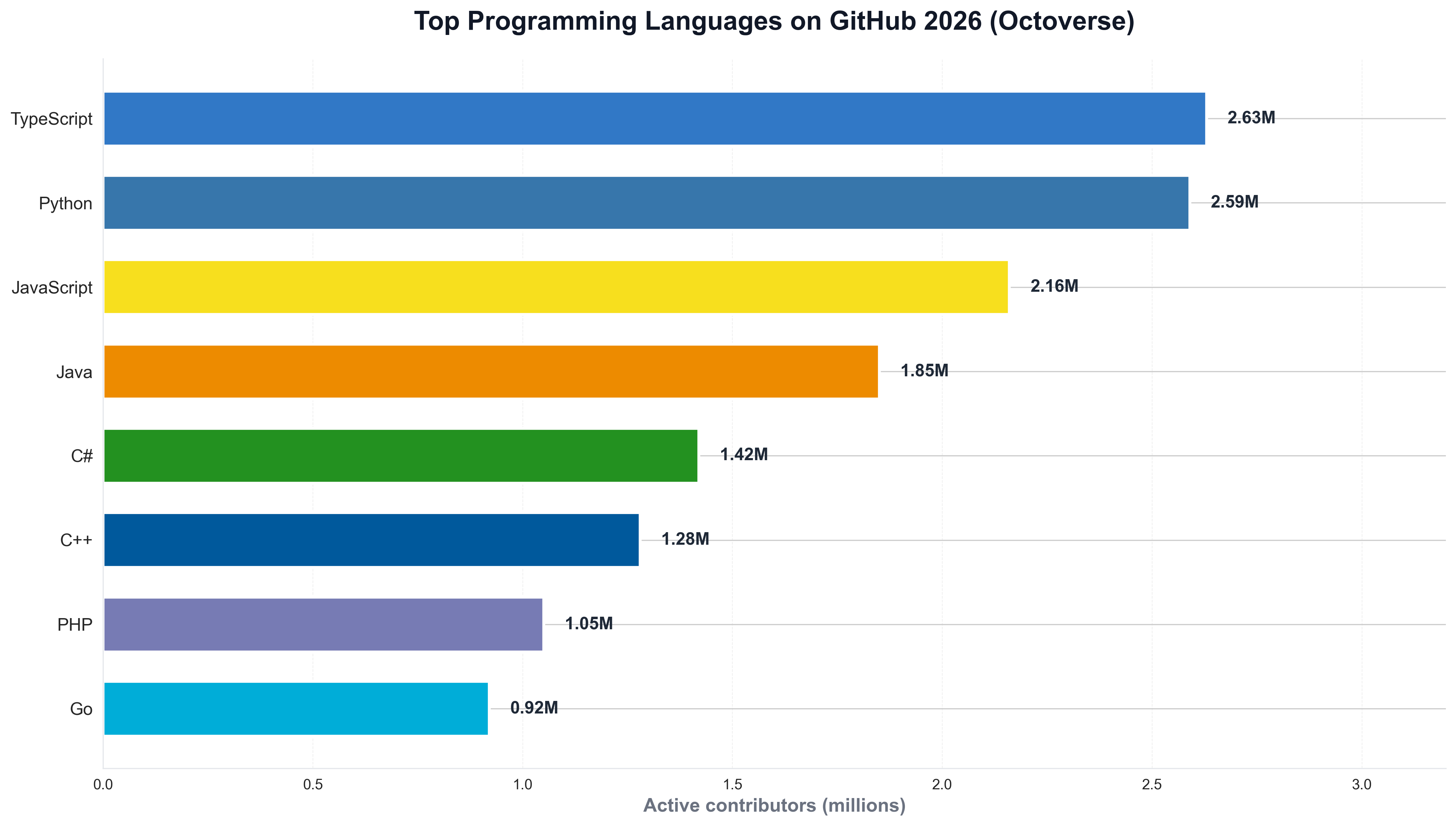
The chart above shows TypeScript in the lead, with Python and JavaScript close behind—reflecting the shift that GitHub's data confirms. Python is the natural choice for building such visualizations: engineering and data teams routinely use Python scripts to load language rankings or repo counts from APIs or CSV exports and produce publication-ready charts for reports and articles like this one.
Why AI Pushed TypeScript to Number One
AI-assisted coding has changed how developers choose languages. GitHub's analysis and Linuxiac's coverage both stress that TypeScript's static type system gives AI-generated code a safety net: types reduce ambiguity, catch errors at edit time, and make suggestions more predictable. When Copilot or ChatGPT suggests code, typed signatures clarify intent and surface mistakes before run time—whereas in JavaScript, the same suggestions can slip through with subtle bugs. That feedback loop has accelerated TypeScript adoption: developers who use AI tools tend to prefer typed languages, and TypeScript is the default for the web and Node.js stack. Forbes' 10 takeaways from GitHub Octoverse 2025 and the main Octoverse report add that over 1.1 million public repositories now use an LLM SDK, with 693,867 created in the past year—a 178% year-over-year increase—and monthly contributors to AI projects grew from 68,000 in January 2024 to 200,000 by August 2025. So the story is not just "TypeScript is popular"; it is that AI and TypeScript are reinforcing each other, with Python remaining the language of choice for AI/ML repositories and for analyzing and plotting this data.
Python Still Leads in AI and Machine Learning Repos
TypeScript leads overall usage on GitHub, but Python still leads in AI and machine learning. GitHub's TypeScript and Python analysis states that Python remains unrivaled in AI and ML, leading with 582,000 AI-tagged repositories and +50.7% year-over-year growth. That has created what GitHub calls a hybrid stack trend: developers combine Python's data pipelines and ML models with TypeScript's app and API layers. Frontend and backend services are increasingly TypeScript (or JavaScript); data science, training, and inference remain Python. When teams need to visualize language trends, repo growth, or LLM adoption, they often use Python and libraries such as pandas, matplotlib, or seaborn—the same stack they use for data work. The following chart, produced with Python, summarizes the explosive growth of LLM SDK usage on GitHub as reported in the Octoverse 2025 report.
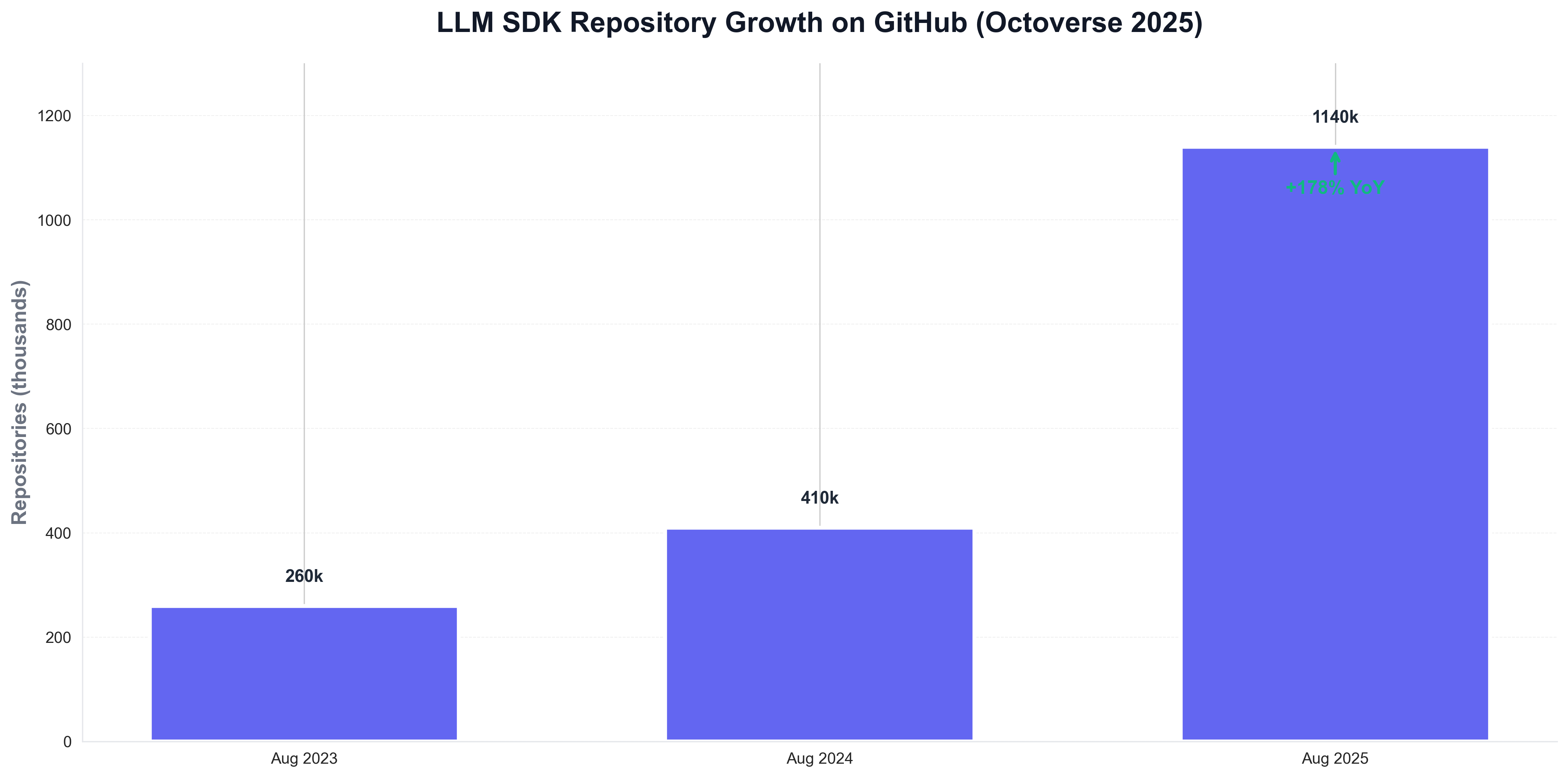
The chart illustrates the 178% year-over-year increase in repositories using an LLM SDK and the 1.1 million+ total—context that explains why AI and typed languages are reshaping the language mix. Python is again the tool of choice for generating such charts from Octoverse-style data or internal metrics, keeping analytics consistent with the rest of the data stack.
One Million New TypeScript Developers in a Year
The scale of TypeScript's growth in 2025 is striking. Linuxiac's summary of Octoverse 2025 reports that TypeScript added over one million new developers in 2025, a 66% year-over-year surge, with 2.63 million active contributors on GitHub. Python added 850,000 (+48% YoY) and JavaScript 427,000 (+25% YoY)—so TypeScript not only leads in total usage but also in growth rate. That momentum reflects framework defaults (Next.js, SvelteKit, Qwik, Astro), enterprise adoption (many companies standardizing on TypeScript for frontend and Node.js), and AI tooling (Copilot and ChatGPT working better with typed code). For teams that track language adoption—whether for hiring, training, or platform strategy—Python is often used to load Octoverse or similar data and plot growth over time. A minimal example might look like the following: load a CSV of language contributor counts by year, compute year-over-year growth, and save a chart for reports or dashboards.
import pandas as pd
import matplotlib.pyplot as plt

df = pd.read_csv("octoverse_languages.csv")
df["yoy_growth"] = df.groupby("language")["contributors"].pct_change() * 100
fig, ax = plt.subplots(figsize=(10, 5))
for lang in ["TypeScript", "Python", "JavaScript"]:
    subset = df[df["language"] == lang]
    ax.plot(subset["year"], subset["contributors"], marker="o", label=lang)
ax.set_ylabel("Contributors (millions)")
ax.set_title("Top languages on GitHub (Octoverse-style)")
ax.legend()
fig.savefig("public/images/blog/language-growth.png", dpi=150, bbox_inches="tight")
plt.close()
That kind of Python script is typical for developer insights and engineering analytics teams: same language as much of their data pipeline, and direct control over chart layout and branding.
The Hybrid Stack: TypeScript for Apps, Python for Data
The 2026 stack is increasingly hybrid. GitHub's analysis describes developers combining Python's data pipelines and ML models with TypeScript's app and API layers. TypeScript dominates web frontends, Node.js backends, and tooling (Vite, ESLint, Prettier); Python dominates data exploration, model training, inference APIs (FastAPI, Flask), and visualization (matplotlib, seaborn, Plotly). The same team might write TypeScript for the product UI and Python for the analytics dashboard that visualizes usage—or Python for the model pipeline and TypeScript for the API that serves it. That split is reflected in GitHub's numbers: TypeScript is number one by overall usage, while Python is number one by AI-tagged repositories and remains the default language for data science and ML curricula and job postings. Python is also the default for building the charts and reports that explain these trends—so from product to analytics, TypeScript and Python form a standard combination in 2026.
What the Octoverse Numbers Mean for Developers and Teams
The Octoverse shift has practical implications. Forbes' takeaways from Octoverse 2025 and the official Octoverse site highlight that six of the top ten fastest-growing open source projects focus on AI infrastructure, and 80% of new developers use AI tools in their first week. For hiring and training, that means TypeScript and Python are the two languages that matter most for broad reach: TypeScript for web and full-stack roles, Python for data, ML, and automation. For platform and tooling, it means typed JavaScript (TypeScript) and Python are the primary targets for IDE support, linters, and AI coding assistants. For data and reporting, it means Python remains the language of choice for pulling GitHub or internal metrics and visualizing language adoption, repo growth, and AI usage—so the same Python scripts that power internal dashboards can power articles and public reports.
Conclusion: TypeScript at Number One, Python Everywhere Else That Matters
In 2026, TypeScript is the most-used language on GitHub for the first time, and AI-assisted development is a major reason why. TypeScript overtook Python and JavaScript in August 2025—the biggest language shift in over a decade—with over one million new developers in a single year and 2.63 million active contributors. Over 1.1 million public repositories use an LLM SDK, with 693,867 created in the past year (+178% YoY), and 80% of new developers use AI tools in their first week. TypeScript's static types give AI-generated code a safety net, and Python remains number one in AI-tagged repos (582,000, +50.7% YoY) and the default for data, ML, and visualization. The hybrid stack—TypeScript for apps and APIs, Python for data and charts—is the new normal. Teams that embrace both and use Python to measure and visualize these trends are well positioned for 2026 and beyond: TypeScript is where the web lives; Python is where the data and the story get told.