

Spotify reached 713 million monthly active users and 281 million premium subscribers in Q3 2025—the world's largest music streaming platform by users and subscribers. According to Spotify's Q3 2025 earnings and Billboard's coverage, total revenue hit €4.3 billion in Q3 2025 (7% year-over-year, 12% on a constant-currency basis); Statista's Spotify MAU data and DemandSage's Spotify statistics 2026 show 11% MAU growth and 12% premium growth year-over-year. Business of Apps' music app report and Digital Music News place Spotify at ~37% of the U.S. streaming market and ahead of Apple Music (31.5%) and Amazon Music; the company achieved record €806 million free cash flow in Q3 2025 and €582 million operating income. Python is the tool many teams use to visualize streaming and subscription data for reports like this one. This article examines why Spotify crossed 713M MAU, how music and podcasts drive growth, and how Python powers the charts that tell the story.
713M MAU, 281M Premium: Spotify at Scale
Spotify's user growth did not happen overnight. Spotify Q3 2025 earnings and Spotify investor materials report 713 million MAU (all-time high) and 281 million premium subscribers in Q3 2025—up from 640 million MAU and 252 million premium in Q3 2024. Statista and Statista premium subscribers document the long-term trajectory. The following chart, generated with Python and matplotlib using industry-style data, illustrates Spotify MAU and premium subscribers (millions) from 2020 to 2026.
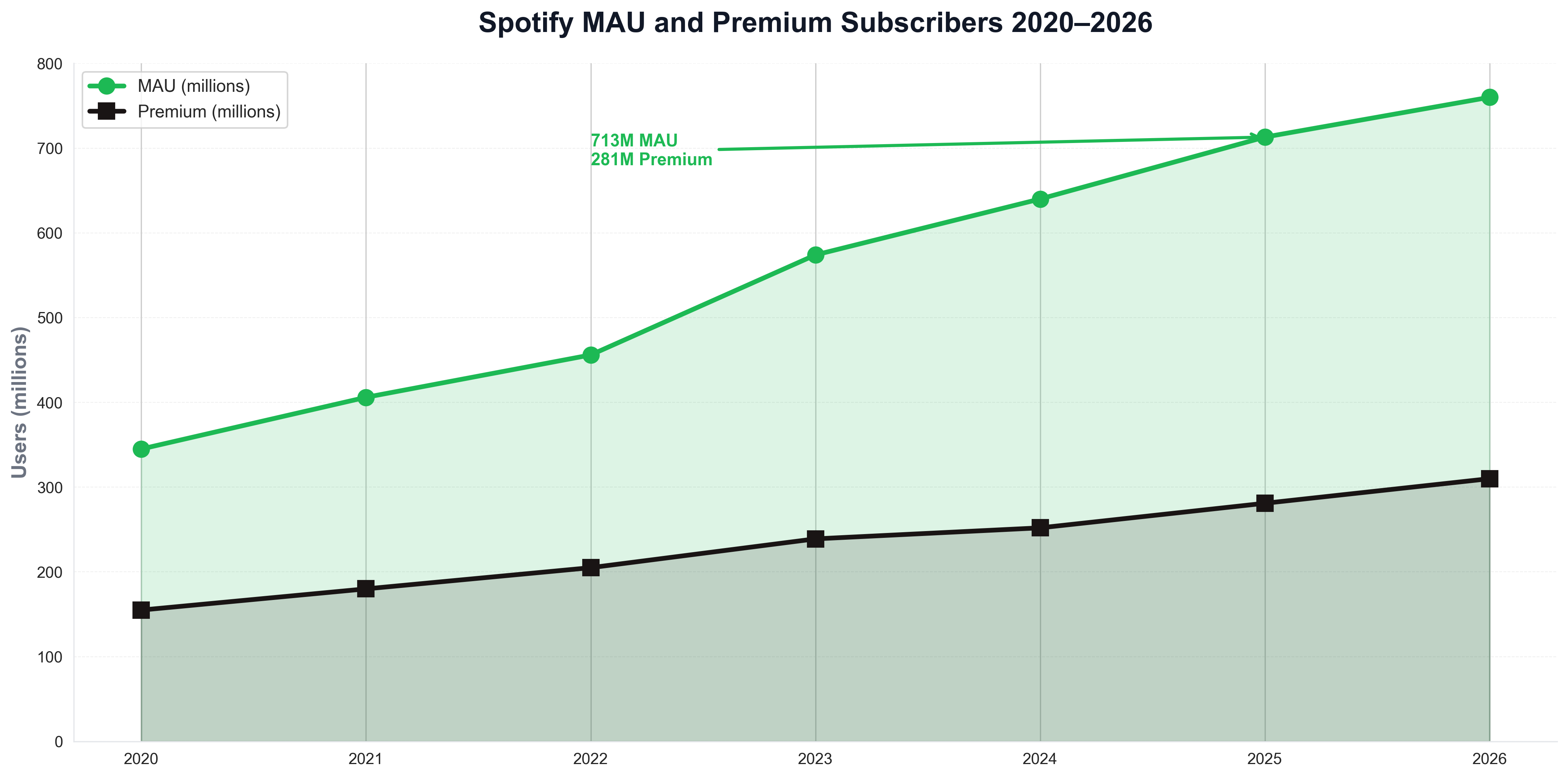
The chart above shows 713M MAU and 281M premium in 2025—reflecting Spotify as the default for music and podcast streaming. Python is the natural choice for building such visualizations: media and product teams routinely use Python scripts to load usage or subscription data and produce publication-ready charts for reports and articles like this one.
37% U.S. Share, Ahead of Apple Music: Market Leadership
The scale of Spotify's lead in music streaming is striking. Digital Music News and Business of Apps report ~37% U.S. market share for Spotify (estimated 53.8 million U.S. subscribers) and 31.5% for Apple Music (~45.9 million); the top three—Spotify, Apple Music, and Amazon Music—control over 90% of U.S. streaming subscribers. eMarketer and Statista's music streaming topic add global context. When teams need to visualize market share or competitor positioning, they often use Python and matplotlib or seaborn. The following chart, produced with Python, summarizes music streaming market share (Spotify vs Apple Music vs Amazon Music vs others) in a style consistent with industry reports.
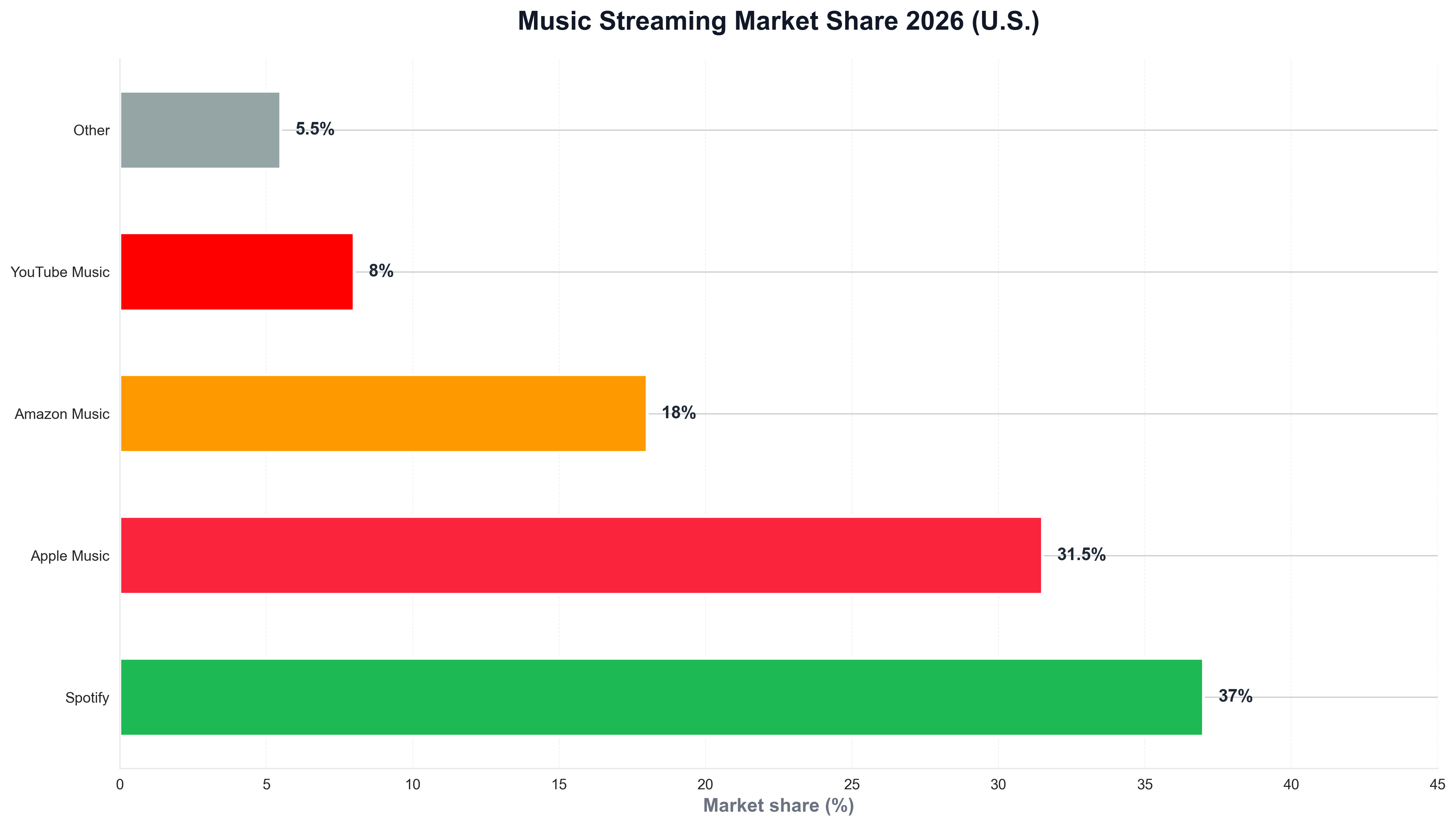
The chart illustrates Spotify ahead of Apple Music and Amazon Music—context that explains why artists, labels, and listeners choose Spotify for discovery, playlists, and podcasts. Python is again the tool of choice for generating such charts from market or survey data, keeping analytics consistent with the rest of the data stack.
€4.3B Quarterly Revenue, Record Free Cash Flow: Why Spotify Wins
Revenue and profitability are central to Spotify's 2026 story. Spotify Q3 2025 reports €4.3 billion total revenue in Q3 2025 (€3.8 billion premium, €446 million ad-supported); gross margin reached 31.6%, operating income €582 million (13.6% margin), and free cash flow a record €806 million (€2.9 billion last twelve months). Billboard and Spotify investor deck note H1 2025 subscriber net additions more than 30% ahead of H1 2024. For teams that track MAU or revenue over time, Python is often used to load financial or telemetry data and plot trends. A minimal example might look like the following: load a CSV of Spotify MAU by quarter, and save a chart for internal or public reporting.
import pandas as pd
import matplotlib.pyplot as plt

df = pd.read_csv("spotify_mau_by_quarter.csv")
fig, ax = plt.subplots(figsize=(10, 5))
ax.plot(df["quarter"], df["mau_millions"], marker="o", linewidth=2, color="#1DB954")
ax.set_ylabel("MAU (millions)")
ax.set_title("Spotify monthly active users (industry style)")
fig.savefig("public/images/blog/spotify-mau-trend.png", dpi=150, bbox_inches="tight")
plt.close()
That kind of Python script is typical for media and growth teams: same language used for pipelines and dashboards, and direct control over chart layout and messaging.
100M+ Songs, Podcasts, and the Road Ahead
Catalog and product evolution shape Spotify's 2026 story. Business of Apps and DemandSage report 100 million+ songs and 5 million+ podcasts on the platform; Spotify's freemium model and personalization (Discovery Weekly, Wrapped) drive retention. The company achieved its first annual net profit in 2024 (€1.1 billion) and continues to invest in audiobooks, AI recommendations, and global expansion. Python is the language many use to analyze streaming and adoption data and visualize MAU, revenue, and market share for reports like this one.
Conclusion: Spotify as the Music Streaming Default in 2026
In 2026, Spotify is the default for music and podcast streaming: 713 million MAU, 281 million premium subscribers, €4.3 billion quarterly revenue, ~37% U.S. share, and record free cash flow. Apple Music and Amazon Music follow; the top three control over 90% of U.S. streaming subscribers. Python remains the language that powers the analytics—MAU, revenue, market share, and the visualizations that explain the story—so that for Google News and Google Discover, the story in 2026 is clear: Spotify is where the world listens, and Python is how many of us chart it.