

ChatGPT has become the default AI assistant for hundreds of millions of people and millions of workplaces in 2026. According to Reuters, OpenAI's weekly active users surpassed 400 million in February 2025 and have since grown toward 700 million or more; Business of Apps' ChatGPT statistics and Socially In's OpenAI data report over 2 billion prompts daily, roughly 2.6 billion daily messages, and 81% market share among consumer AI tools—with ChatGPT among the world's top six most visited websites. OpenAI's State of Enterprise AI 2025 report shows ChatGPT Enterprise weekly messages up 8× year-over-year, more than 7 million workplace seats, and 75% of workers reporting that AI improved either speed or quality of their output, saving 40–60 minutes per day on average. Python is the tool many teams use to visualize usage and adoption data for reports like this one. This article examines ChatGPT's scale in 2026, why enterprise adoption accelerated, and how Python powers the charts that tell the story.
700 Million Weekly Users and 2 Billion Prompts Daily
ChatGPT's user growth has been extraordinary. Reuters reported 400 million weekly active users in February 2025, up from 300 million in December 2024; Business of Apps and Socially In cite 700–800 million weekly active users by mid-2025 and over 2 billion prompts per day across the user base. Ars Technica's coverage of OpenAI's first usage study adds context on what people use ChatGPT for—writing, coding, analysis, and more. The following chart, generated with Python and matplotlib using published growth data, illustrates ChatGPT weekly active users from 2024 through 2026.
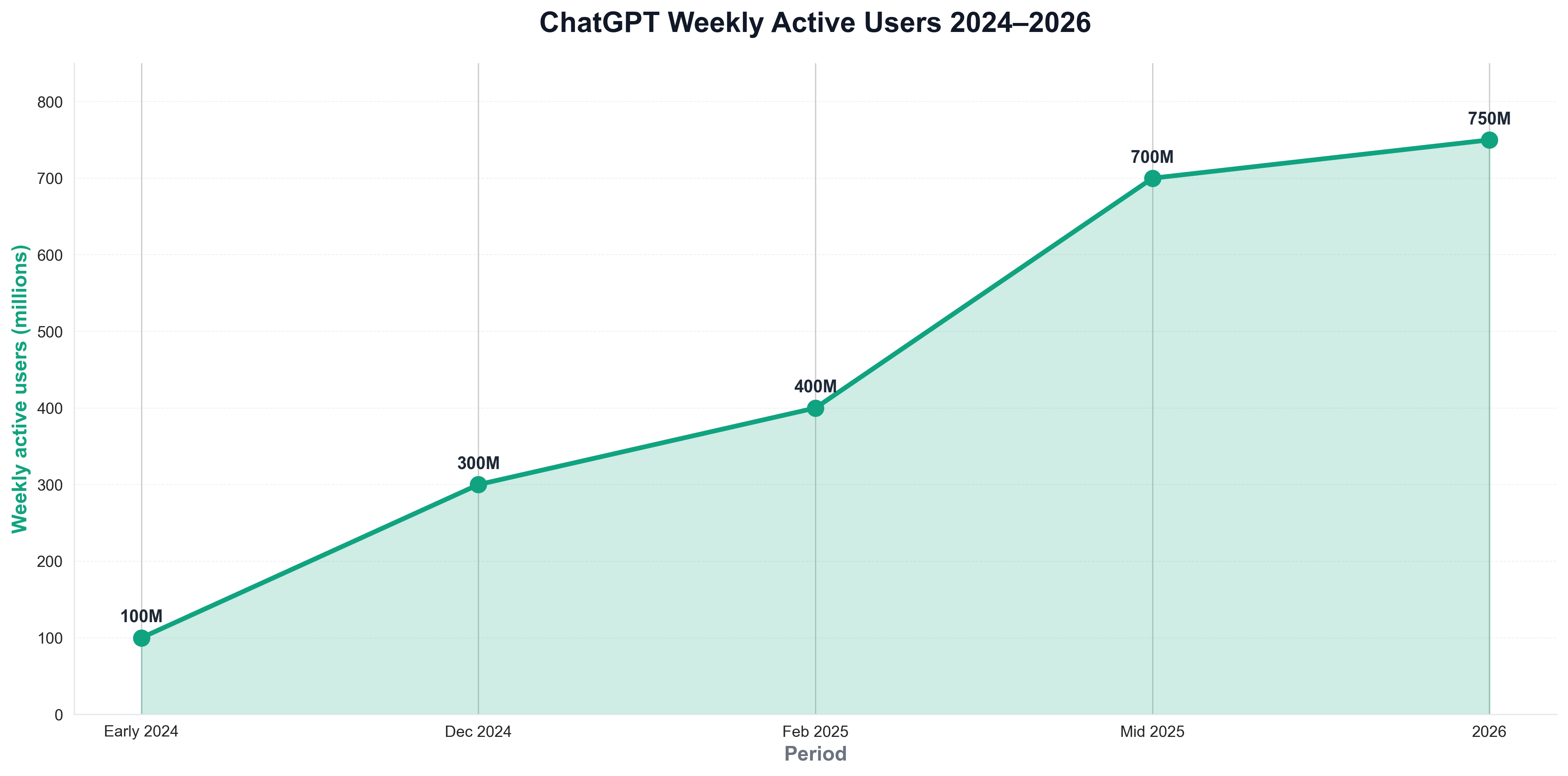
The chart above shows growth from roughly 100 million weekly users in early 2024 to 400 million in early 2025 and 700+ million by 2026—context that explains why ChatGPT dominates consumer AI. Python is the natural choice for building such visualizations: product and analytics teams routinely use Python scripts to load usage or survey data and produce publication-ready charts for reports and articles like this one.
8× Enterprise Message Growth and 7 Million Workplace Seats
The scale of enterprise adoption is striking. OpenAI's State of Enterprise AI 2025 reports ChatGPT Enterprise weekly messages up 8× year-over-year, more than 7 million workplace seats (up 9× annually), and average reasoning token consumption per organization up 320× in twelve months. PYMNTS and Aihola summarize 2 million paying business users as of February 2025 (more than doubling from September 2024) and Custom GPTs and Projects usage up 19× year-to-date. When teams need to visualize enterprise adoption—productivity gains by department or message growth over time—they often use Python and matplotlib or seaborn. The following chart, produced with Python, summarizes worker-reported productivity impact by function (IT, marketing, HR, engineering) from the State of Enterprise AI 2025 survey of 9,000 workers across nearly 100 enterprises.
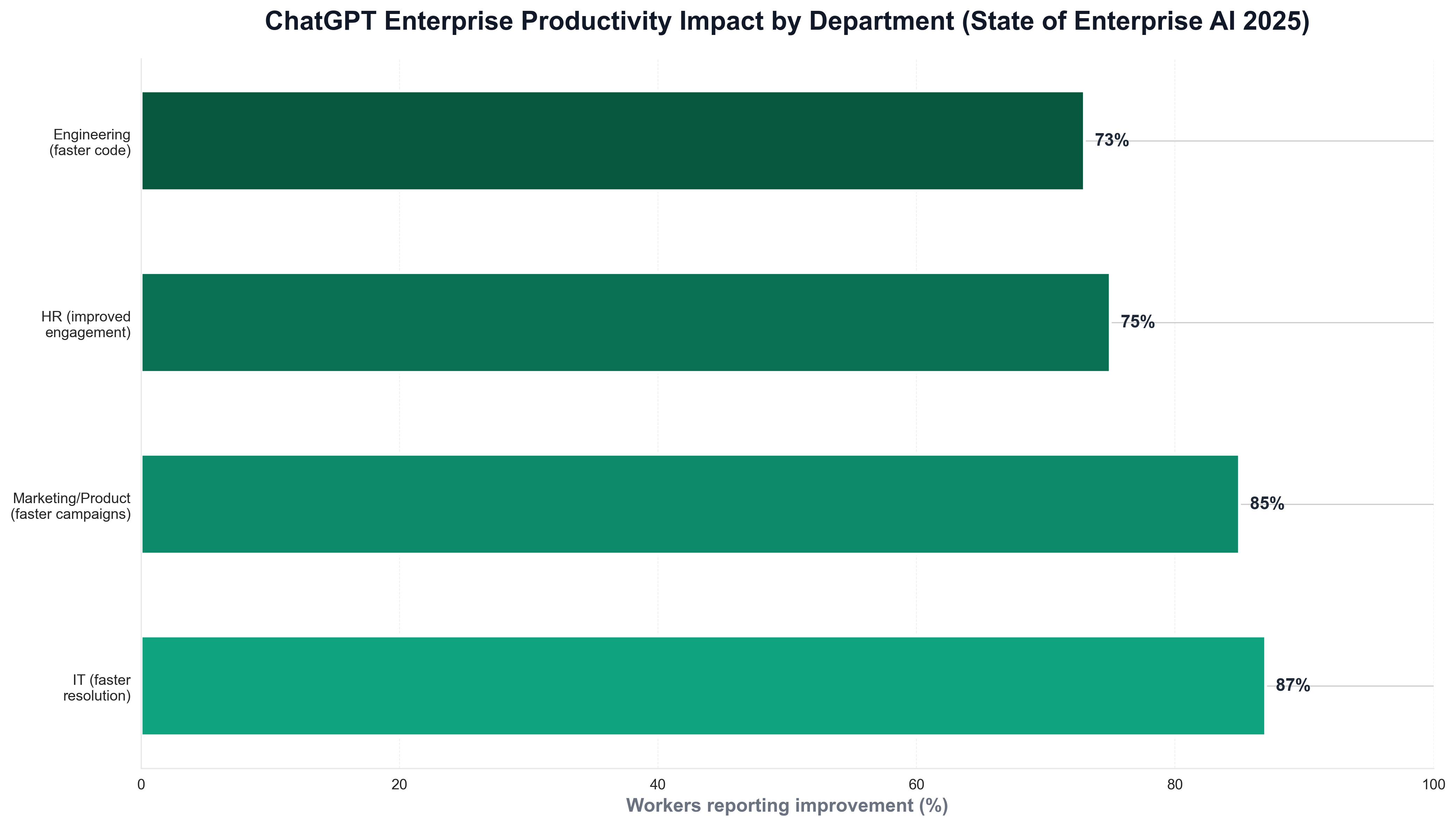
The chart illustrates 87% of IT workers reporting faster issue resolution, 85% of marketing/product users reporting faster campaign execution, 75% of HR reporting improved engagement, and 73% of engineers reporting faster code delivery—context that explains why enterprise adoption accelerated. Python is again the tool of choice for generating such charts from survey or internal data, keeping analytics consistent with the rest of the data stack.
75% Improved Speed or Quality, 40–60 Minutes Saved Daily
The productivity impact is measurable. OpenAI's State of Enterprise AI 2025 and OpenAI's ChatGPT usage and adoption patterns at work report that 75% of workers say AI improved either speed or quality of their output; workers save 40–60 minutes per day on average, with heavy users saving more than 10 hours per week. Business Insider's summary of OpenAI's workplace analysis notes 75% of users can now complete new tasks they previously could not perform. OpenAI's usage study provides additional detail on use cases—writing, coding, analysis, and research. For teams that track AI adoption or productivity over time, Python is often used to load survey or telemetry data and plot trends. A minimal example might look like the following: load a CSV of weekly active users by month, and save a chart for internal or public reporting.
import pandas as pd
import matplotlib.pyplot as plt

df = pd.read_csv("chatgpt_weekly_users_by_month.csv")
fig, ax = plt.subplots(figsize=(10, 5))
ax.plot(df["month"], df["users_millions"], marker="o", linewidth=2, color="#10a37f")
ax.set_ylabel("Weekly active users (millions)")
ax.set_title("ChatGPT weekly active users (internal-style)")
fig.savefig("public/images/blog/chatgpt-usage-trend.png", dpi=150, bbox_inches="tight")
plt.close()
That kind of Python script is typical for product and analytics teams: same language used for data pipelines and dashboards, and direct control over chart layout and messaging.
81% Market Share, $10B ARR, and the Consumer vs. Enterprise Split
Business of Apps and Socially In report ChatGPT at roughly 81% market share among consumer AI assistants and OpenAI at approximately $10 billion annualized recurring revenue as of June 2025. ChatGPT is among the world's top six most visited websites and reached 1 million users in 5 days at launch—15× faster than Instagram and 146× faster than Twitter. OpenAI's State of Enterprise AI 2025 and VKTR's takeaways highlight a widening gap between frontier and lagging organizations: frontier workers send 6× more messages and frontier firms send 2× as many messages per seat as median enterprises—suggesting significant untapped potential for organizations that have not yet deepened adoption. Python is the language many use to analyze usage data, survey results, and visualize adoption for reports like this one.
Conclusion: ChatGPT as the Default in 2026
In 2026, ChatGPT is the default AI assistant for consumers and an essential productivity tool for millions of workers. 700+ million weekly active users, 2+ billion prompts daily, 81% market share, and 8× enterprise message growth with 7+ million workplace seats tell the story: ChatGPT won on utility, quality, and enterprise trust. 75% of workers report improved speed or quality and 40–60 minutes saved per day; IT, marketing, HR, and engineering all report measurable gains. Python remains the language that powers the analytics—usage trends, survey data, and the visualizations that explain adoption—so that for Google News and Google Discover, the story in 2026 is clear: ChatGPT is where most people and workplaces turn for AI, and Python is how many of them chart the numbers.