

FastAPI has become Python's fastest-growing web framework in 2026. According to JetBrains and the Python Software Foundation's 2025 State of Python survey, 38% of professional Python developers now use FastAPI, up from 29% in 2023—a 30–40% year-over-year growth rate that outpaces Django and Flask. ByteIota's analysis of FastAPI adoption and JetBrains' comparison of Django, Flask, and FastAPI note that FastAPI now matches Django at roughly 9 million monthly PyPI downloads, with GitHub stars surging past 91,700 by November 2025 (from about 15,000 in 2020), and FastAPI job postings up 150% year-over-year in 2024–2025. At the same time, over 50% of Fortune 500 companies were using FastAPI in production by mid-2025, with adopters including Uber, Netflix, and Microsoft. The story in 2026 is that async, API-first design, and AI/ML model serving have made FastAPI the default choice for new Python backends—and Python is the language teams use to visualize framework adoption and growth. This article examines why FastAPI surged, how it fits the AI era, and how Python powers the charts that tell the story.
38% of Python Devs Now Use FastAPI
FastAPI's rise is reflected in every major survey. JetBrains' most popular Python frameworks and libraries in 2025 reports FastAPI at 38% adoption among professional Python developers, up from 29% in 2023—the largest jump among web frameworks. ByteIota's FastAPI in 2025 and Rollbar's Python backend framework guide for 2026 add that FastAPI is now the de facto choice for API-first and microservice architectures, while Django and Flask remain strong for monolithic and template-rendering workloads. The following chart, generated with Python and matplotlib using JetBrains-style survey data, illustrates the relative adoption of the top Python web frameworks in 2025–2026.
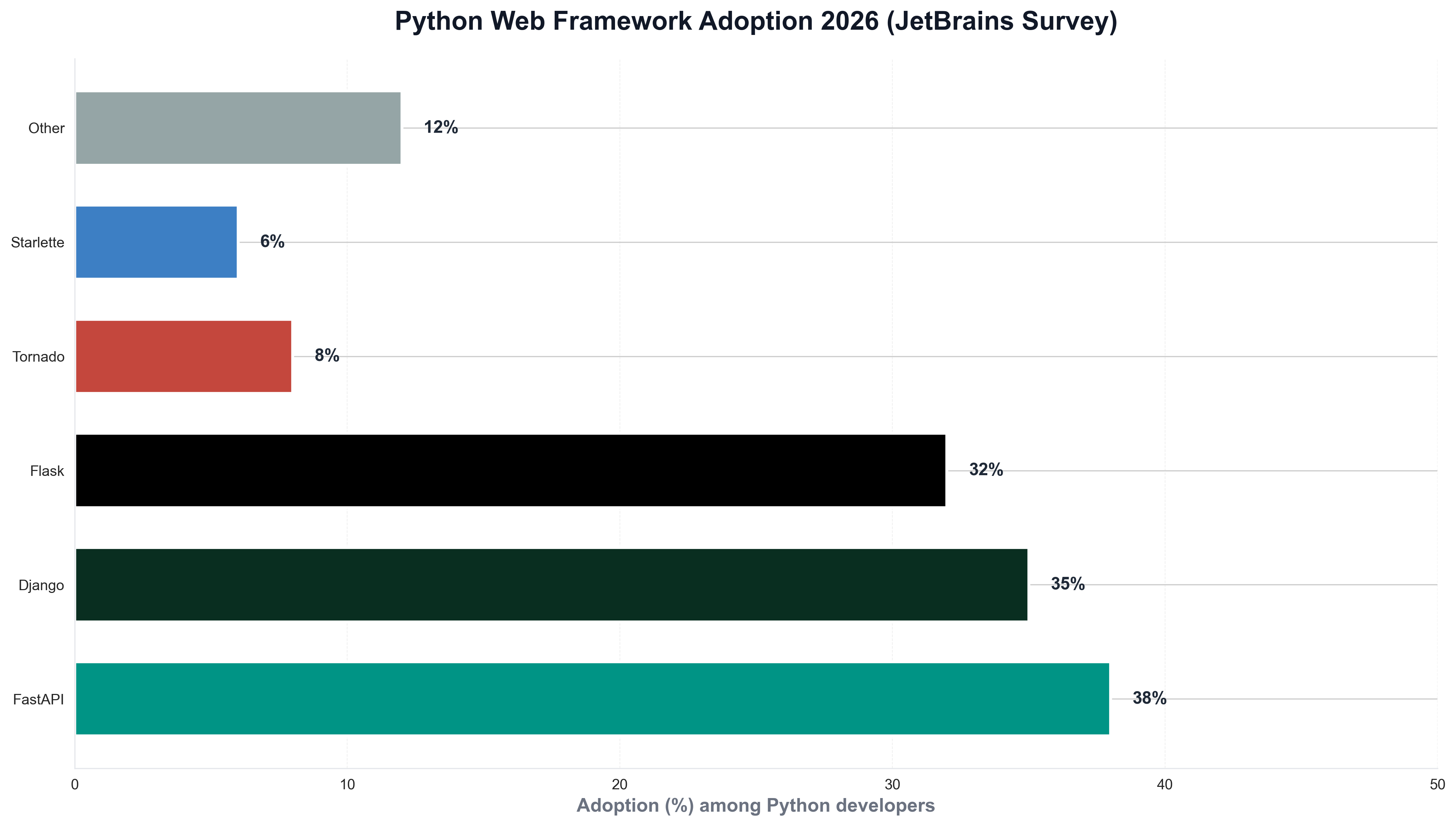
The chart above shows FastAPI at 38%, with Django and Flask still widely used but growing more slowly. Python is the natural choice for building such visualizations: engineering and product teams routinely use Python scripts to load survey or internal usage data and produce publication-ready charts for reports and articles like this one.
Why Python Devs Are Switching: Async, APIs, and AI
Three forces are driving the shift. ByteIota's analysis and JetBrains' State of Python 2025 stress that async-native architecture is the first: FastAPI's ASGI foundation handles high-concurrency and real-time workloads natively, whereas Django and Flask are built on WSGI and traditionally synchronous. The industry shift toward microservices, real-time APIs, and event-driven systems favors FastAPI. The second force is API-first design: many new projects are headless—frontend (React, Next.js, TypeScript) talks to a REST or GraphQL API—and FastAPI's OpenAPI-first, Pydantic-validated design fits that model out of the box. The third force is AI/ML deployment: FastAPI has become the de facto choice for machine learning model serving, with async inference pipelines, batch and streaming endpoints, and integration with Hugging Face, PyTorch, and TensorFlow. ByteIota notes that about 50% of Python developers have less than two years of experience, with many from AI/ML backgrounds choosing FastAPI first—so the next generation of Python devs is FastAPI-native. When teams need to visualize framework adoption over time—PyPI downloads, GitHub stars, or internal usage—they often use Python and matplotlib or seaborn. The following chart, produced with Python, summarizes FastAPI's growth in GitHub stars and PyPI download scale as reported in public sources.
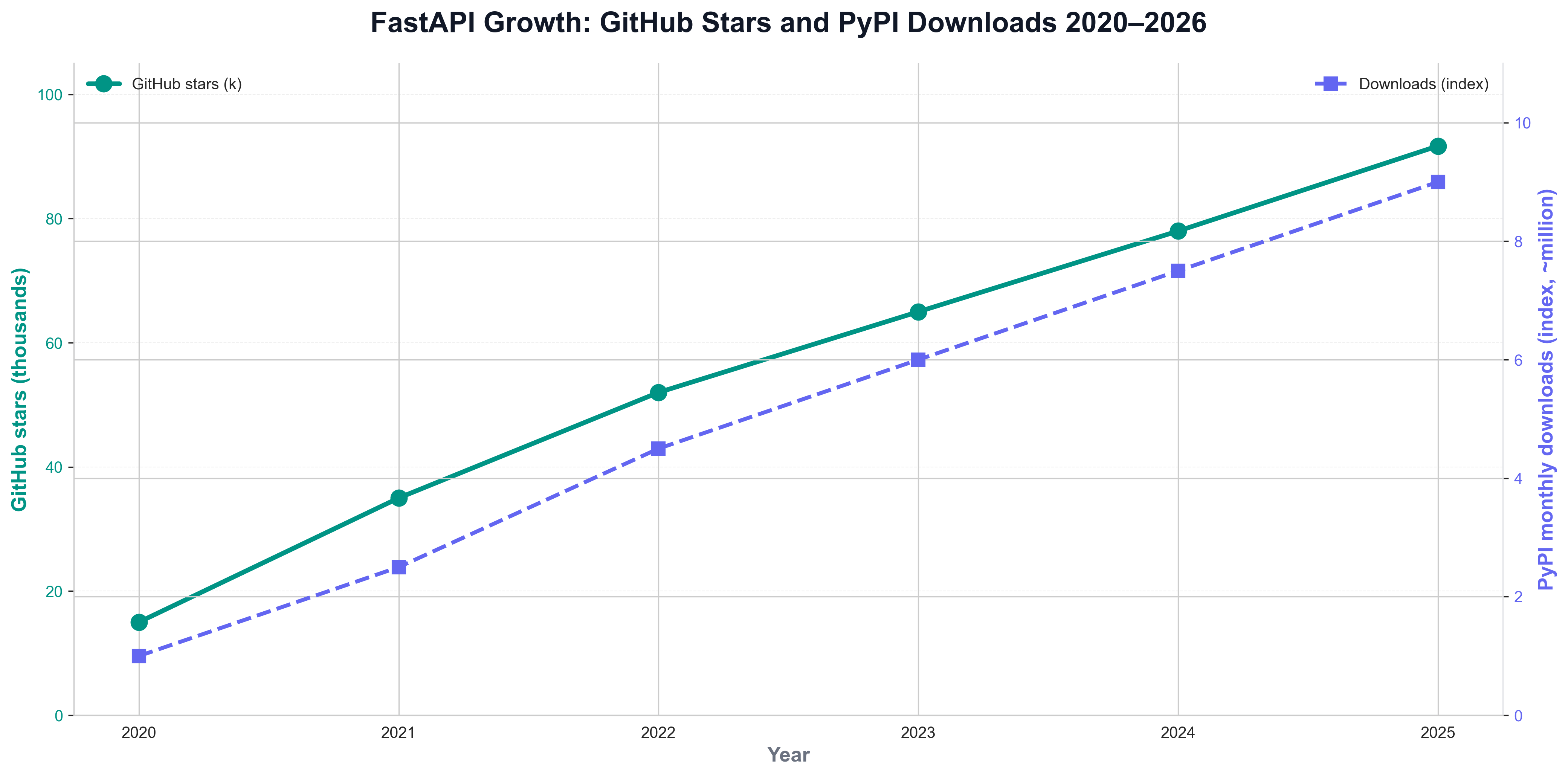
The chart illustrates GitHub stars passing 91,700 and download volume reaching Django-scale—context that explains why 38% of Python devs have made the switch. Python is again the tool of choice for generating such charts from PyPI stats, GitHub APIs, or survey exports.
Enterprise Adoption: Fortune 500 and Beyond
FastAPI is no longer a niche choice for startups. ByteIota's adoption report and Rollbar's framework guide state that over 50% of Fortune 500 companies were using FastAPI in production by mid-2025, with Uber, Netflix, Microsoft, and 175+ companies across North America, Europe, and Asia. Instagram, Pinterest, and Disqus continue to rely on larger frameworks for legacy monoliths, but FastAPI dominates for new APIs, microservices, and ML inference services. Job postings for FastAPI increased 150% year-over-year in 2024–2025, particularly in fintech and AI companies—so hiring demand is aligning with adoption. For teams that track framework usage or hiring trends, Python is often used to load job-board or survey data and plot growth over time. A minimal example might look like the following: load a CSV of framework adoption by year, compute year-over-year change, and save a chart for internal or public reporting.
import pandas as pd
import matplotlib.pyplot as plt

df = pd.read_csv("python_frameworks_survey.csv")
fig, ax = plt.subplots(figsize=(10, 5))
for framework in ["FastAPI", "Django", "Flask"]:
    subset = df[df["framework"] == framework]
    ax.plot(subset["year"], subset["adoption_pct"], marker="o", label=framework)
ax.set_ylabel("Adoption (%)")
ax.set_title("Python web framework adoption (survey-style)")
ax.legend()
fig.savefig("public/images/blog/framework-adoption-trend.png", dpi=150, bbox_inches="tight")
plt.close()
That kind of Python script is typical for developer relations and platform teams: same language as the frameworks they support, and direct control over chart layout and messaging.
Async, ASGI, and the End of WSGI-Only Backends
The technical case for FastAPI rests on async and ASGI. JetBrains' Django vs Flask vs FastAPI and ByteIota's technical deep dive explain that FastAPI is async-native: it runs on ASGI (Asynchronous Server Gateway Interface), so a single process can handle thousands of concurrent connections without blocking. Django and Flask are built on WSGI and are synchronous by default; Django has added async views and async ORM support, but FastAPI was designed for async from day one. For high-throughput APIs—model inference, WebSockets, SSE, or webhooks—teams are choosing FastAPI to avoid thread pools and process scaling workarounds. Python fits into this story as the runtime for FastAPI and as the language used to script load tests, plot latency percentiles, and visualize throughput—so from implementation to observability, Python is the common thread.
FastAPI as the Default for ML Model Serving
AI and machine learning have made FastAPI the default for model serving in the Python ecosystem. ByteIota and Rollbar both note that FastAPI is the de facto choice for ML model deployment: async inference pipelines, batch and streaming endpoints, OpenAPI docs for client generation, and Pydantic for request/response validation. Frameworks like Hugging Face Inference Endpoints, BentoML, and Seldon integrate with or recommend FastAPI-style APIs. Data scientists and ML engineers who prototype in Jupyter and Python often productionize with FastAPI—same language, same types (Pydantic), and minimal glue code. When those teams need to monitor adoption or plot request volume and latency, they again turn to Python and matplotlib or seaborn—so FastAPI and Python visualization form a single stack from model to dashboard.
What the Numbers Mean for Developers and Teams
The 38% adoption figure has practical implications. JetBrains' survey was based on 30,000+ developers and is one of the most comprehensive Python ecosystem surveys available. For new projects, the takeaway is that FastAPI is a default choice for APIs, microservices, and ML serving—unless you need Django's admin, ORM, and batteries-included monolith. For hiring and training, FastAPI is now a core skill for Python backend roles, alongside Django and Flask. For platform and tooling, FastAPI is the primary target for API gateways, documentation generators, and testing frameworks. For data and reporting, Python remains the language of choice for pulling PyPI stats, GitHub data, or survey exports and visualizing framework adoption—so the same Python scripts that power internal dashboards can power articles and public reports.
Conclusion: FastAPI as the New Normal for Python APIs
In 2026, FastAPI is Python's fastest-growing web framework, with 38% adoption among professional Python developers—up from 29% in 2023—and over 50% of Fortune 500 companies using it in production. GitHub stars have passed 91,700, PyPI downloads match Django at roughly 9 million monthly, and job postings for FastAPI grew 150% year-over-year. Async, API-first design, and AI/ML model serving drove the shift; Python remains the language that powers both FastAPI backends and the visualizations that tell the adoption story. Teams that adopt FastAPI for new APIs and microservices—and use Python to measure and visualize framework trends—are well positioned for 2026 and beyond: FastAPI is where Python APIs live; Python is where the data and the story get told.