

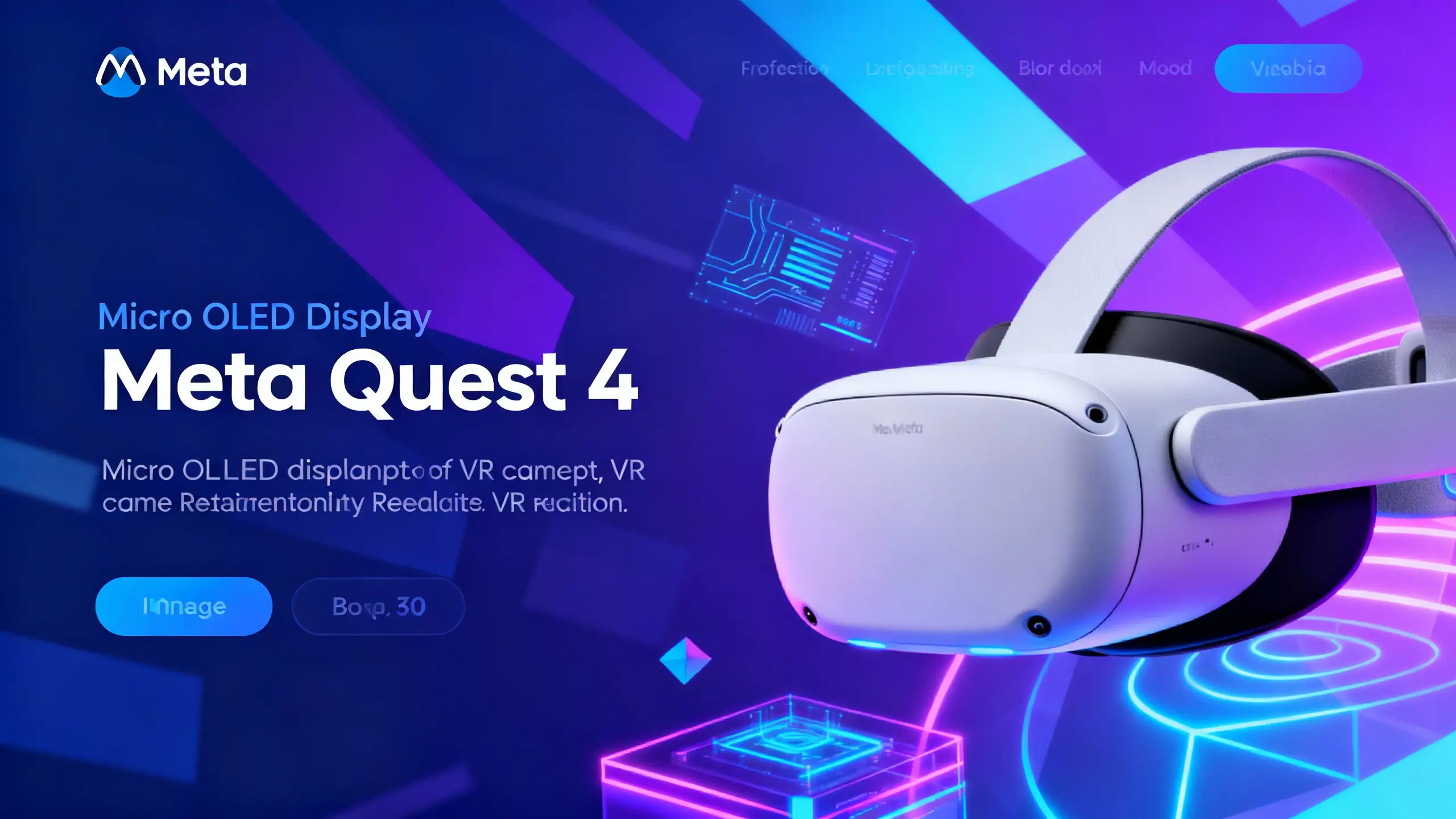
In 2026, Meta is developing a new Quest VR headset that marks a significant return to OLED technology after years of using LCD displays, with micro-OLED displays supplied by BOE's BMOT division and Seeya. The Quest 4 is expected to feature 0.9-inch micro-OLED panels, automatic IPD adjustment with motorized lenses, iris scanning for face unlock authentication, and eye-tracking capabilities.
According to OLED-Info's reporting, Meta is adopting OLED microdisplays for its 2026 Quest VR headset, marking a return to OLED technology after the company shifted to lower-cost LCD displays in recent headsets. The original Quest used AMOLED displays, but Meta switched to LCDs for subsequent models to reduce costs. This upgrade is likely driven by intensifying competition in the high-end VR market, particularly from Apple's Vision Pro and Samsung's Galaxy XR initiatives.
Meta is also developing an ultralight headset with a tethered compute puck that weighs less than 110 grams and functions as a portable multi-monitor setup. According to UploadVR's reporting, Meta is prioritizing an ultralight Horizon OS headset with a tethered compute puck for 2026, potentially pushing a traditional Quest 4 form factor to 2027. The ultralight model is expected to cost less than $1,000 and use gaze-and-pinch controls similar to Apple Vision Pro.
The Return to OLED: A Strategic Display Upgrade
Meta's return to OLED technology represents a significant strategic shift. According to OLED-Info's reporting, the company is adopting OLED microdisplays for its 2026 Quest VR headset, supplied by BOE's BMOT division and Seeya. This marks a return to OLED technology after Meta shifted to lower-cost LCD displays in recent headsets.
The return to OLED is significant because OLED displays offer superior image quality compared to LCDs. According to NerdChips' analysis, micro-OLED panels provide sharper display quality than Quest 3's LCD displays, with better contrast, deeper blacks, and more vibrant colors. This upgrade addresses one of the key limitations of Meta's recent headsets compared to premium competitors like Apple Vision Pro.
The micro-OLED displays are also more compact. According to UploadVR's reporting, the 0.9-inch micro-OLED panels are slightly smaller than those in Bigscreen Beyond headsets, enabling more compact headset designs. This compactness is crucial for creating lighter, more comfortable headsets.
However, OLED displays also come with challenges. According to OLED-Info's reporting, OLED microdisplays are more expensive than LCDs, which could impact pricing. Meta must balance display quality improvements with cost considerations to maintain competitive pricing.
The return to OLED also highlights Meta's competitive positioning. According to OLED-Info's reporting, the upgrade is likely driven by intensifying competition in the high-end VR market, particularly from Apple's Vision Pro and Samsung's Galaxy XR initiatives. This competitive pressure is forcing Meta to improve display quality to remain competitive.
Automatic IPD Adjustment: Personalized Comfort
One of the most significant features expected in Meta Quest 4 is automatic IPD (interpupillary distance) adjustment with motorized lenses. According to UploadVR's reporting, code references found in Horizon OS v78 PTC suggest automatic IPD adjustment functionality that would work similarly to Apple Vision Pro and Pico 4 Enterprise.
This automatic IPD adjustment is significant because it improves comfort and usability. According to UploadVR's analysis, the system uses eye tracking and motorized lenses to automatically adjust lens separation to match users' eyes, rather than requiring manual adjustment. This capability makes the headset more comfortable and easier to use, especially for users who share headsets or have different IPD measurements.
The automatic IPD adjustment also enables better visual quality. According to UploadVR's reporting, accurate IPD alignment is crucial for optimal visual clarity and reduced eye strain. The automatic adjustment ensures that users always have optimal IPD alignment, improving visual quality and comfort.
However, automatic IPD adjustment also requires sophisticated hardware. According to UploadVR's reporting, the system requires eye tracking sensors and motorized lens mechanisms, which add complexity and cost. Meta must ensure that these features work reliably while maintaining competitive pricing.
The automatic IPD adjustment also highlights Meta's focus on user experience. According to UploadVR's reporting, the feature makes Quest 4 more user-friendly and accessible, addressing one of the barriers to VR adoption. This focus on usability is crucial for expanding the VR market.
Iris Unlock and Face Recognition: Biometric Security
Meta Quest 4 is expected to include iris scanning for face unlock authentication. According to UploadVR's reporting, datamined code reveals face unlock capabilities, with sources indicating this will likely be a launch feature on Meta's high-end 2026 device.
This iris unlock capability is significant because it provides convenient and secure authentication. According to UploadVR's analysis, the authentication method, similar to Apple Vision Pro's iris scanning, would allow users to unlock the headset and authorize payments without needing a PIN code. This capability makes the headset more convenient and secure.
The iris unlock also enables personalized experiences. According to UploadVR's reporting, the biometric authentication can enable personalized settings and profiles, making shared headsets more practical. This capability is important for family or enterprise use cases where multiple users share devices.
However, iris unlock also raises privacy concerns. According to UploadVR's reporting, biometric data collection requires careful handling to protect user privacy. Meta must ensure that iris data is stored securely and used only for authentication purposes.
The iris unlock also highlights Meta's focus on premium features. According to UploadVR's reporting, the feature positions Quest 4 as a premium device with advanced capabilities, similar to Apple Vision Pro. This positioning is crucial for competing in the high-end VR market.
Ultralight Design with Tethered Compute Puck: Addressing Weight Concerns
Meta is developing an ultralight headset with a tethered compute puck that weighs less than 110 grams. According to UploadVR's reporting, the ultralight headset, codenamed "Puffin," weighs less than 110 grams and resembles "a bulky pair of glasses," making it significantly lighter than the Quest 3, which weighs around 515 grams.
This ultralight design is significant because it addresses one of the main barriers to VR adoption: weight and comfort. According to NotebookCheck's reporting, the tethered compute puck offloads battery and computing hardware to an external device designed to fit in a user's pocket, enabling a much lighter headset. This design makes VR more comfortable for extended use.
The tethered compute puck also enables more powerful processing. According to Road to VR's reporting, the puck is more powerful than Quest 3 components, enabling advanced features and better performance. This capability makes the ultralight headset more capable despite its reduced weight.
However, the tethered design also creates challenges. According to UploadVR's reporting, the tethered connection requires a cable, which can be inconvenient and limit mobility. Meta must ensure that the tethering doesn't significantly impact usability or user experience.
The ultralight design also highlights Meta's focus on different use cases. According to UploadVR's reporting, the device is focused on virtual screens and seated use cases, functioning as a portable multi-monitor setup. This focus makes the headset useful for productivity and work applications, expanding beyond gaming.
Competitive Positioning: Competing with Apple and Samsung
Meta's Quest 4 development comes as competition intensifies in the high-end VR market. According to OLED-Info's reporting, the upgrade is likely driven by intensifying competition from Apple's Vision Pro and Samsung's Galaxy XR initiatives, both targeting the high-end market segment.
This competitive pressure is significant because it's forcing Meta to improve its hardware. According to PC Mag's analysis, Samsung's Galaxy XR at $1,799 positions itself between Meta Quest and Apple Vision Pro in terms of pricing and capabilities, offering significant cost savings compared to Vision Pro's $3,499 price tag. This competitive landscape is forcing Meta to improve display quality and features to remain competitive.
The competitive positioning also highlights different market strategies. According to Digital Trends' reporting, Samsung's Galaxy XR is betting big on beating both Apple Vision Pro and Meta Quest Pro, positioning itself as a premium but more affordable alternative. Meta must respond to this competitive pressure while maintaining its position in the market.
However, Meta also has advantages. According to Tom's Guide's analysis, Meta Quest headsets remain the budget-friendly option, priced significantly lower than Samsung and Apple offerings. This pricing advantage gives Meta flexibility in how it positions Quest 4.
The competitive positioning also highlights the importance of ecosystem. According to OLED-Info's reporting, Meta previously canceled a high-end VR headset planned for 2027 that was intended to compete directly with Apple Vision Pro following poor market reception for that device. This cancellation suggests that Meta is being strategic about where to compete and how to position its products.
Dual-Track Approach: Traditional Quest 4 and Ultralight Model
Meta is pursuing a dual-track approach with both a traditional Quest 4 and an ultralight model. According to UploadVR's reporting, Meta has started work on a gaming-focused Quest 4 with a traditional form factor, which will likely launch after the ultralight device.
This dual-track approach is significant because it allows Meta to address different market segments. According to UploadVR's reporting, the ultralight model focuses on virtual screens and seated use cases, functioning as a portable multi-monitor setup, while the traditional Quest 4 will prioritize gaming. This segmentation allows Meta to optimize each device for its intended use case.
The dual-track approach also enables different pricing strategies. According to UploadVR's reporting, the ultralight model is expected to cost less than $1,000, while the traditional Quest 4 could be priced differently based on its features and target market. This flexibility allows Meta to compete across different price points.
However, the dual-track approach also creates resource allocation challenges. According to UploadVR's reporting, Meta has experienced delays with the ultralight headset, pushing its release to the first half of 2027, while starting work on Quest 4. This suggests that Meta may be prioritizing one track over the other, or struggling to execute both simultaneously.
The dual-track approach also highlights Meta's strategic flexibility. According to UploadVR's reporting, Meta is exploring multiple display system approaches at different price points but hasn't finalized which will ship. This flexibility allows Meta to adapt to market conditions and competitive pressures.
AI-Powered Mixed Reality: Enhanced Spatial Understanding
Meta Quest 4 is expected to feature deeper AI-powered mixed reality capabilities. According to NerdChips' analysis, the headset will include enhanced software integration for work and gaming applications, with AI-powered features that improve spatial understanding and interaction.
This AI integration is significant because it enhances mixed reality experiences. According to TechRadar's reporting, Meta has already begun integrating AI into mixed reality experiences, with Quest 3 receiving an AI upgrade that enhanced Space Scan, the room-mapping feature. The AI now automatically detects and labels furniture, walls, doors, and windows during room scans, eliminating manual labeling.
The AI integration also enables more immersive experiences. According to Meta's blog post, Meta released Llama 3.2 and other AI models at Connect 2024, positioning AI as central to their vision for the next computing platform. This AI focus suggests that Quest 4 will include more advanced AI capabilities.
However, AI integration also requires computational resources. According to TechRadar's reporting, AI-powered features require significant processing power, which could impact battery life and performance. Meta must ensure that AI features enhance experiences without degrading performance.
The AI integration also highlights Meta's broader strategy. According to Meta's blog post, Meta AI assistants are already available on Quest devices, indicating that future models will likely build on existing AI capabilities. This integration positions Quest 4 as part of Meta's broader AI ecosystem.
The Gaming Focus: Traditional Quest 4 Priorities
Meta's traditional Quest 4 is expected to prioritize gaming. According to UploadVR's reporting, Meta has started work on a gaming-focused Quest 4 with a traditional form factor, which will likely launch after the ultralight device.
This gaming focus is significant because it represents Meta's core market. According to Tom's Guide's reporting, Quest 4 will represent "a large upgrade" from Quest 3, suggesting significant improvements in gaming performance and capabilities. This focus on gaming is crucial for maintaining Meta's position in the VR gaming market.
The gaming focus also enables different optimizations. According to UploadVR's reporting, a traditional form factor allows for more powerful processors, better cooling, and controller support, which are important for gaming. This optimization makes Quest 4 better suited for gaming than the ultralight model.
However, the gaming focus also creates challenges. According to Tom's Guide's reporting, Meta must balance gaming performance with other use cases, ensuring that Quest 4 is versatile enough for different applications. This balance is crucial for maximizing market appeal.
The gaming focus also highlights Meta's strategic priorities. According to UploadVR's reporting, Meta is prioritizing gaming-focused Quest 4 development, suggesting that gaming remains a core market for Meta. This focus is important for maintaining Meta's position in the VR market.
Conclusion: Meta's Strategic Shift in VR Hardware
Meta's Quest 4 development represents a strategic shift in VR hardware, with a return to OLED technology, automatic IPD adjustment, iris unlock, and dual-track approach addressing different market segments. The return to OLED displays addresses display quality concerns, while the ultralight design with tethered compute puck addresses weight and comfort issues.
The competitive positioning against Apple Vision Pro and Samsung Galaxy XR is forcing Meta to improve hardware quality and features. The dual-track approach of both a traditional Quest 4 and an ultralight model allows Meta to address different market segments, from gaming to productivity.
However, the success of Quest 4 will depend on execution, pricing, and market reception. The delays with the ultralight headset suggest that Meta faces challenges in executing its dual-track strategy, and the competitive landscape is intensifying with new entrants like Samsung Galaxy XR.
As Meta continues to develop Quest 4, the balance between display quality, features, pricing, and market positioning will determine its success. The return to OLED technology and focus on user experience improvements position Quest 4 as a significant upgrade, but execution and market reception will be crucial.
One thing is certain: Meta's Quest 4 development represents a strategic response to competitive pressure and market demands. The return to OLED, automatic IPD adjustment, and dual-track approach demonstrate Meta's commitment to improving VR hardware and expanding the market. Whether this strategy succeeds will depend on how well Meta executes these features and how the market responds.
The future of VR hardware is becoming more competitive, with Apple, Samsung, and Meta all vying for market share. Meta's Quest 4 development positions it to compete across different market segments, from budget-friendly gaming to premium productivity. The success of this strategy will shape the future of the VR market.