

Discord reached 656 million registered users and 259 million monthly active users in 2026—with $725 million in annual recurring revenue and 32.6 million servers. According to Business of Apps' Discord statistics 2026, DemandSage's Discord statistics, and Prioridata's Discord revenue, MAU grew to 259 million in 2026 and 31.5 million daily active users; Accio's Discord IPO filing and Twinstrata's Discord statistics report $725 million ARR by end-2024 (21% year-over-year) and $561 million total revenue in 2025 (29.2% YoY). Sacra's Discord revenue notes $207 million from Discord Nitro and 7.3 million Nitro subscribers by mid-2025; 54% of users are now in non-gaming communities (education, crypto, developers). Coolest Gadgets Discord vs Slack and 6sense Slack market share place Discord at 9% U.S. messaging market share; Zapier and TS2 Slack vs Discord vs Telegram describe Discord's 200M+ MAU and community-first positioning vs Slack and Telegram. Python is the tool many teams use to visualize community and chat data for reports like this one. This article examines why Discord crossed 656M users and $725M ARR, how gaming and beyond drive growth, and how Python powers the charts that tell the story.
656M Registered, 259M MAU: Discord at Scale
Discord's user growth did not happen overnight. DemandSage and Twinstrata report 656 million registered users by end of 2025; Prioridata and Business of Apps report 259 million MAU in 2026 and 31.5 million DAU. 32.6 million servers exist on the platform; Asia-Pacific leads with 34% of users, followed by North America (28%) and Europe (25%). The following chart, generated with Python and matplotlib using industry-style data, illustrates Discord registered users and MAU (millions) from 2020 to 2026.
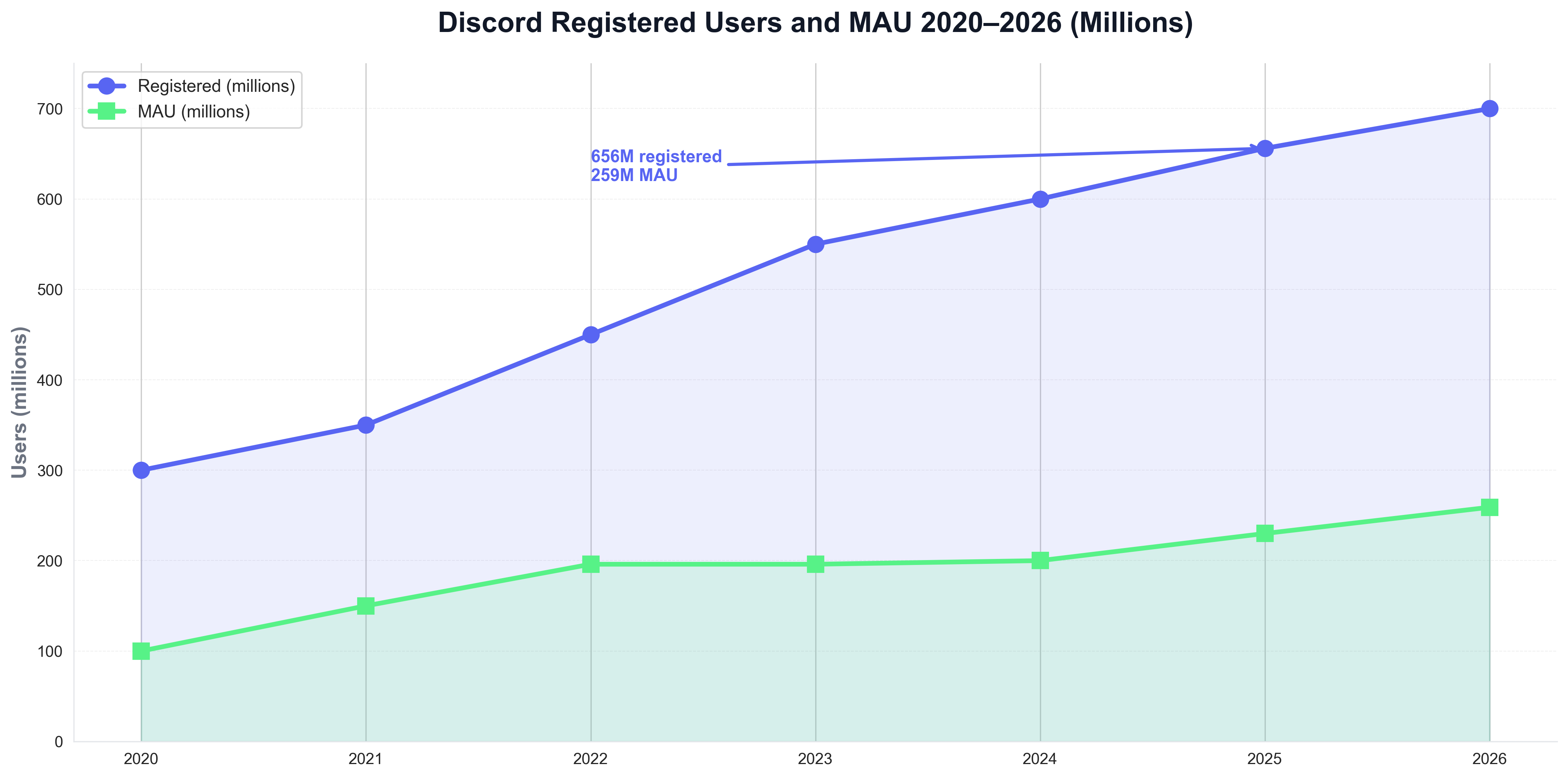
The chart above shows 656M registered and 259M MAU—reflecting Discord as the default for community and voice chat. Python is the natural choice for building such visualizations: community and product teams routinely use Python scripts to load usage or revenue data and produce publication-ready charts for reports and articles like this one.
9% US Messaging Share, Ahead of Niche Players: Community Leadership
The scale of Discord's community footprint is striking. DemandSage and Business of Apps report 9% U.S. messaging and chat app market share; 6sense and Zapier note Slack at 6.37% in the communication category with Discord serving 200M+ MAU and a different use case (communities vs workplace). TS2 compares Slack, Discord, and Telegram for community and work. When teams need to visualize community platform adoption or revenue by player, they often use Python and matplotlib or seaborn. The following chart, produced with Python, summarizes community / voice chat platform MAU (Discord vs Slack vs Telegram vs others) in a style consistent with industry reports.
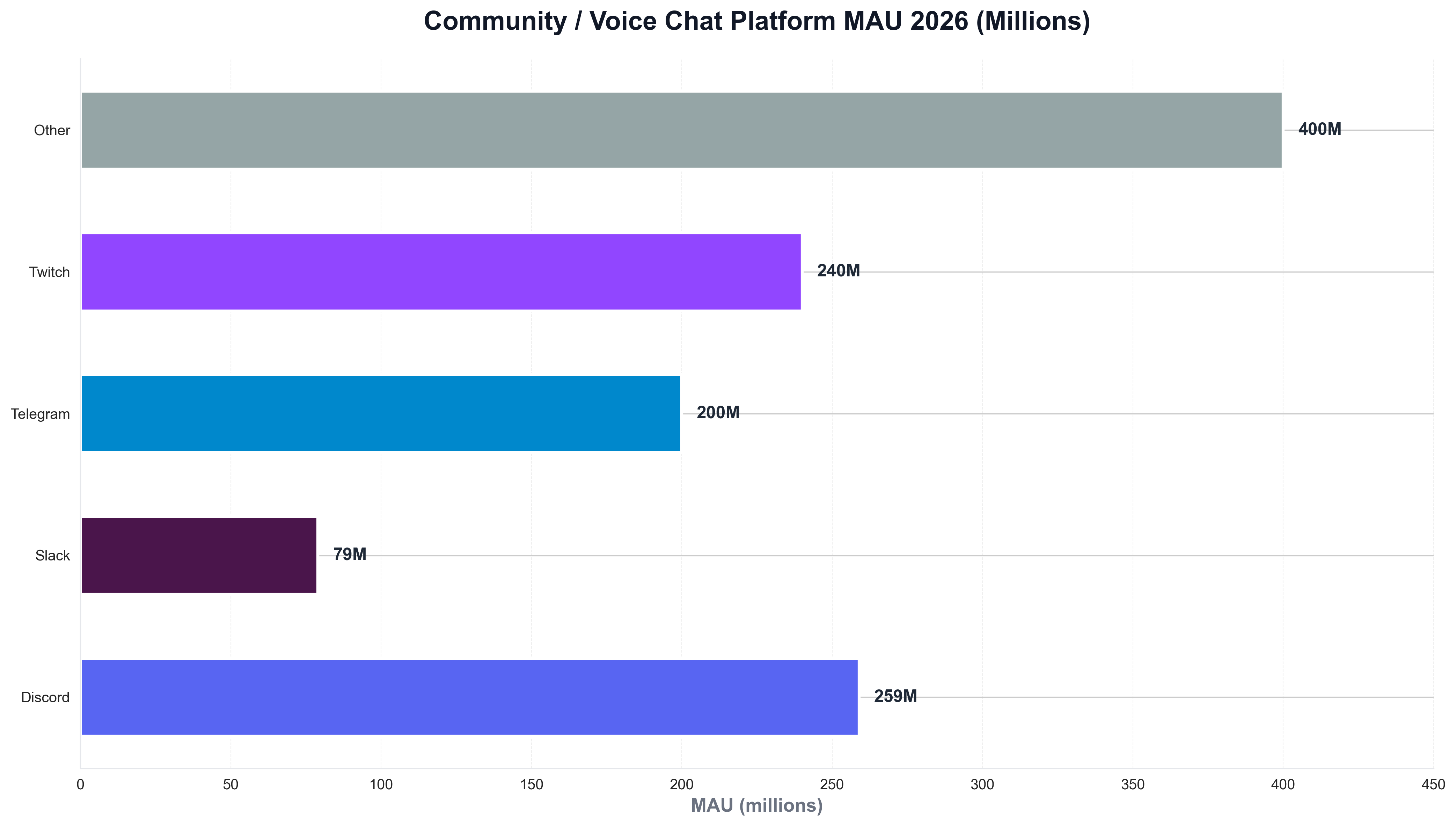
The chart illustrates Discord well ahead of Slack and Telegram in MAU for community use—context that explains why gamers, educators, and developers choose Discord for servers, voice, and Nitro. Python is again the tool of choice for generating such charts from market or internal data, keeping analytics consistent with the rest of the data stack.
$725M ARR, $207M Nitro, 54% Non-Gaming: Why Discord Wins
Revenue and audience evolution are central to Discord's 2026 story. Accio and Twinstrata report $725 million ARR by end-2024 (21% YoY) and $561 million total revenue in 2025 (29.2% YoY); Business of Apps and DemandSage note $207 million from Nitro and 7.3 million Nitro subscribers. 54% of users are in non-gaming communities (education, crypto, developers). For teams that track MAU or revenue over time, Python is often used to load usage or financial data and plot trends. A minimal example might look like the following: load a CSV of Discord MAU by year, and save a chart for internal or public reporting.
import pandas as pd
import matplotlib.pyplot as plt

df = pd.read_csv("discord_mau_by_year.csv")
fig, ax = plt.subplots(figsize=(10, 5))
ax.plot(df["year"], df["mau_millions"], marker="o", linewidth=2, color="#5865f2")
ax.set_ylabel("MAU (millions)")
ax.set_title("Discord monthly active users (industry style)")
fig.savefig("public/images/blog/discord-mau-trend.png", dpi=150, bbox_inches="tight")
plt.close()
That kind of Python script is typical for community and growth teams: same language used for pipelines and dashboards, and direct control over chart layout and messaging.
32.6M Servers, IPO Path, and the Road Ahead
Scale and monetization shape Discord's 2026 story. DemandSage and Business of Apps report 32.6 million servers; Accio and Sacra note Discord's IPO filing and path to $725M revenue growth, with valuation in the $6.8–15 billion range. Nitro, server boosts, and partnerships drive revenue; 37% of U.S. users aged 18–34 use Discord. Python is the language many use to analyze community and chat data and visualize MAU and revenue for reports like this one.
Conclusion: Discord as the Community Default in 2026
In 2026, Discord is the default for community and voice chat: 656 million registered users, 259 million MAU, $725 million ARR, 32.6 million servers, and $207 million from Nitro. 54% of users are in non-gaming communities; Slack and Telegram serve workplace and messaging niches. Python remains the language that powers the analytics—MAU, revenue, and the visualizations that explain the story—so that for Google News and Google Discover, the story in 2026 is clear: Discord is where communities talk, and Python is how many of us chart it.