

Notion crossed 100 million users in 2024—announced by CEO Ivan Zhao in September 2024—and by 2026 roughly 75% of Fortune 500 companies have teams using it. According to Notion's "100 Million of You" blog and Super.so's Notion statistics 2026, the platform grew from 20 million users in 2022 to 100 million in under two years—5x growth; Fueler's Notion 2026 usage and revenue and Tap Twice Digital's Notion statistics report 80% of users outside the United States, over 4 million paying customers, and 75% of Fortune 500 by 2026. Revenue reached $400 million in 2024 (60% growth from 2023), with ARR at $600 million as of late 2025; Notion Elevation's productivity statistics note 87% higher task completion for Notion users versus traditional tools. Valuation stands at $10–11 billion. Python is the tool many teams use to visualize productivity and adoption data for reports like this one. This article examines why Notion hit 100M, how enterprise and productivity drove growth, and how Python powers the charts that tell the story.
100 Million Users: From 20M to 100M in Under Two Years
Notion's user growth did not happen overnight. Notion's blog and Ivan Zhao's announcement report 100 million users passed in August 2024; the platform had 1 million users in 2020 and 20 million in 2022—so the jump to 100M represents 5x growth in roughly two years. Super.so and Fueler add 80% of users outside the United States and 4 million paying customers. The following chart, generated with Python and matplotlib using Notion-style data, illustrates user growth (millions) from 2020 to 2026.
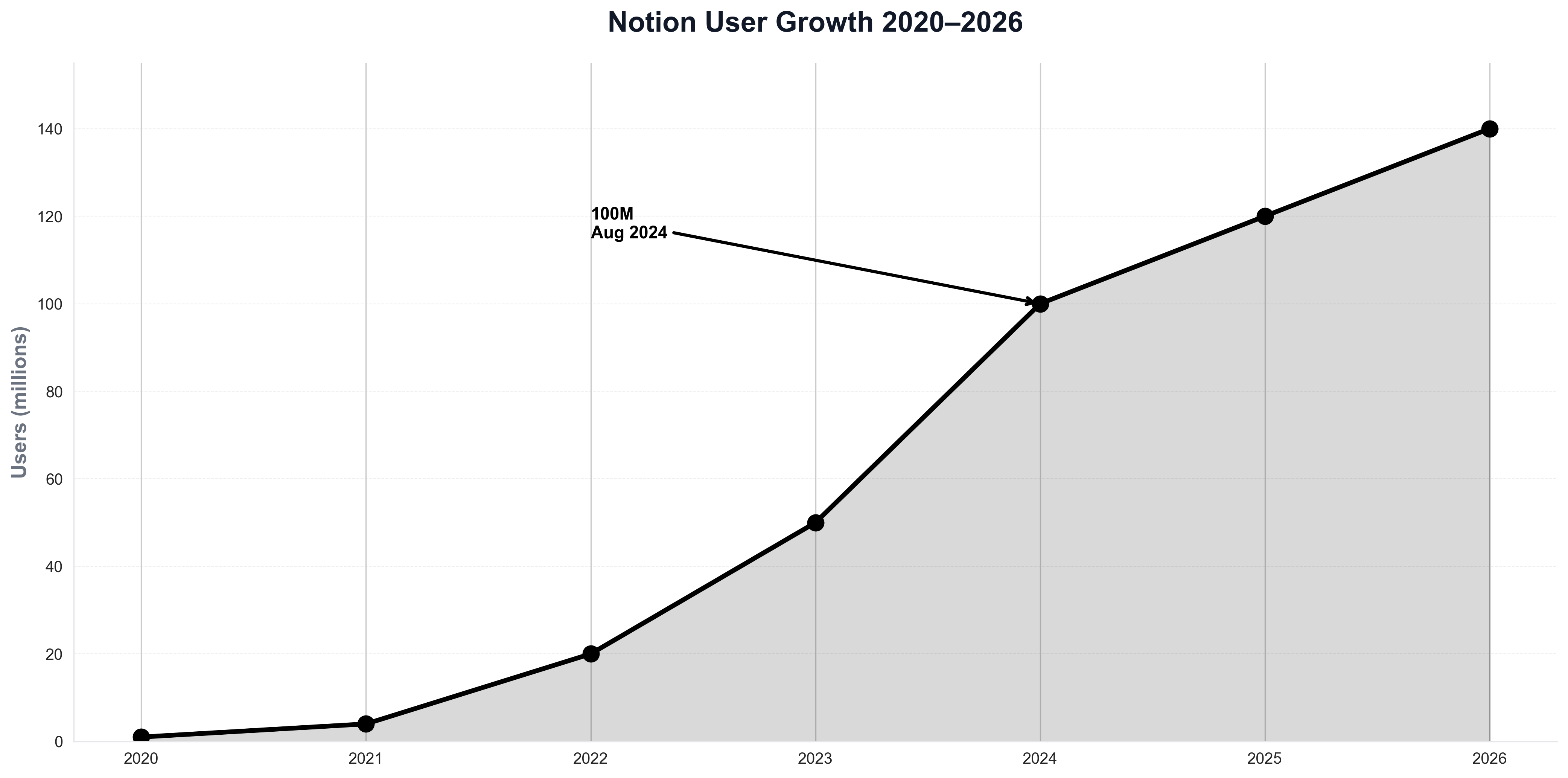
The chart above shows 20M in 2022 and 100M in 2024—reflecting Notion as the default for wikis, docs, and productivity. Python is the natural choice for building such visualizations: product and growth teams routinely use Python scripts to load usage or survey data and produce publication-ready charts for reports and articles like this one.
75% Fortune 500, 87% Higher Task Completion: Why Enterprises Choose Notion
The scale of enterprise adoption is striking. Fueler and SQ Magazine's Notion statistics report 75% of Fortune 500 companies with teams using Notion by 2026; Notion Elevation notes 87% higher task completion for Notion users compared with traditional tools—driving adoption among remote teams and enterprises. Major companies including Amazon, Nike, Uber, Pixar, and Toyota use Notion. When teams need to visualize revenue or adoption over time, they often use Python and matplotlib or seaborn. The following chart, produced with Python, summarizes Notion revenue growth ($67M 2022, $250M 2023, $400M 2024) in a style consistent with industry reports.
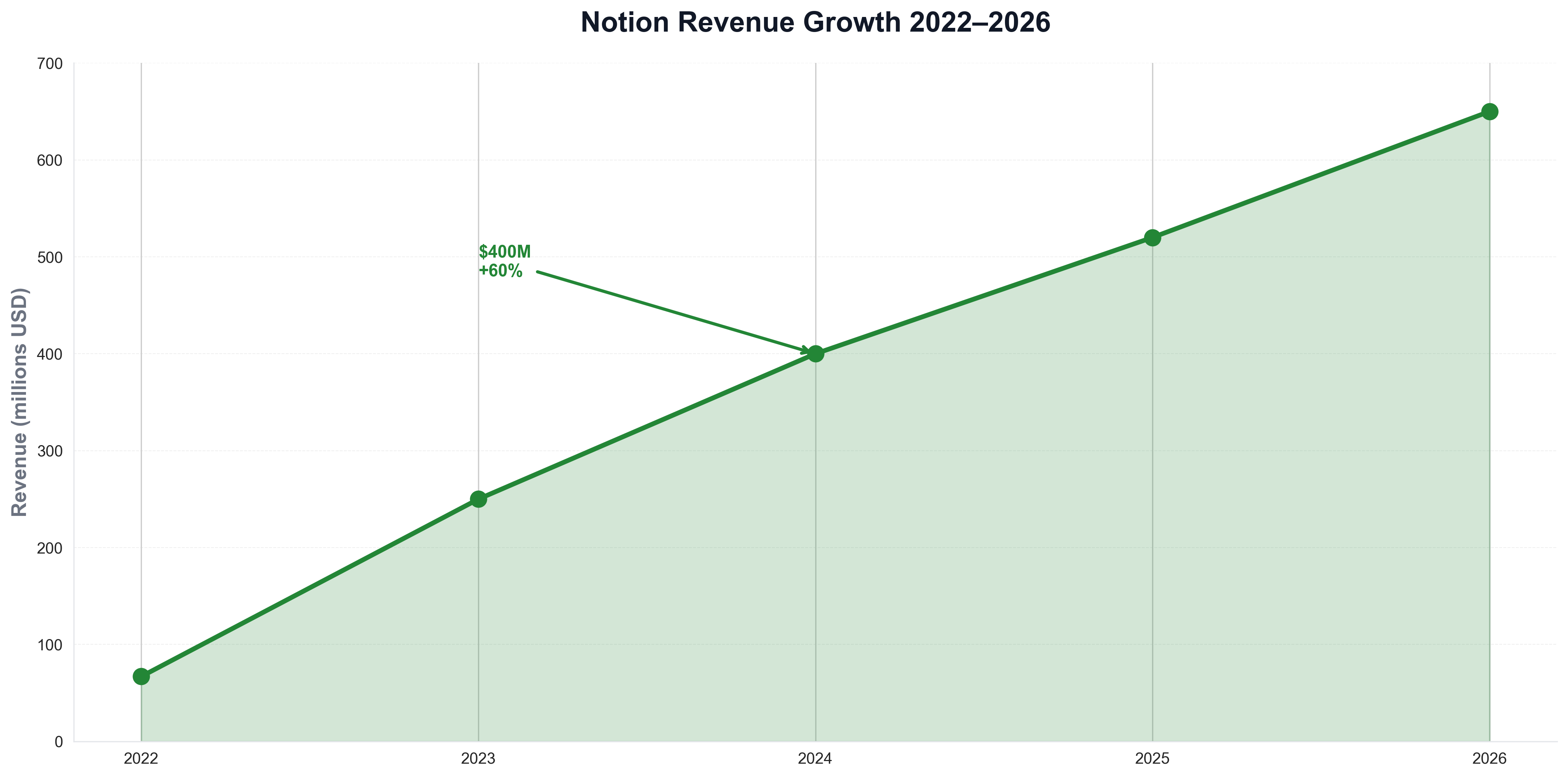
The chart illustrates $400M in 2024 and 60% growth—context that explains why Notion is valued at $10–11 billion. Python is again the tool of choice for generating such charts from revenue or internal data, keeping analytics consistent with the rest of the data stack.
$400M Revenue, $600M ARR, $10B Valuation
Revenue and valuation underscore Notion's position. Tap Twice Digital and SQ Magazine report $67 million in 2022, $250 million in 2023, and $400 million in 2024—60% growth from 2023; Forbes Notion and industry reports note ARR at $600 million as of late 2025 and $500 million annualized revenue by 2025 after AI agents launched. Valuation stands at $10 billion (Series D) with a $11 billion indication from a December 2025 employee share sale; the company has raised $330 million from Sequoia Capital, Coatue, and Index Ventures. For teams that track user growth or revenue over time, Python is often used to load usage or financial data and plot trends. A minimal example might look like the following: load a CSV of Notion users by year, and save a chart for internal or public reporting.
import pandas as pd
import matplotlib.pyplot as plt

df = pd.read_csv("notion_users_by_year.csv")
fig, ax = plt.subplots(figsize=(10, 5))
ax.plot(df["year"], df["users_millions"], marker="o", linewidth=2, color="#000000")
ax.set_ylabel("Users (millions)")
ax.set_title("Notion user growth (industry style)")
fig.savefig("public/images/blog/notion-user-trend.png", dpi=150, bbox_inches="tight")
plt.close()
That kind of Python script is typical for growth and finance teams: same language used for pipelines and dashboards, and direct control over chart layout and messaging.
AI, Blocks, and the Road Ahead
AI and block-based editing are central to Notion's 2026 story. Fueler and SQ Magazine note AI-powered workflows, customizable templates, and modular blocks that let non-technical users build wikis, docs, and project trackers; India is a major growth market. Notion's blog reflects Ivan Zhao's mission to use software to augment human intellect—Notion 2.0 on Product Hunt in 2018 was the breakthrough. Python is the language many use to analyze productivity and adoption data and visualize user and revenue trends for reports like this one.
Conclusion: Notion as the 100M-User Productivity Default in 2026
In 2026, Notion is the default for wikis and productivity: 100 million users (passed August 2024), 75% of Fortune 500 with teams using it, 4 million paying customers, and 87% higher task completion versus traditional tools. Revenue hit $400M in 2024 (60% growth), ARR at $600M late 2025, and valuation at $10–11 billion. Python remains the language that powers the analytics—user growth, revenue, and the visualizations that explain the story—so that for Google News and Google Discover, the story in 2026 is clear: Notion is where teams document and plan, and Python is how many of us chart it.