

PyTorch has become the default framework for ML research in 2026 while TensorFlow remains strong in enterprise production. According to Second Talent's PyTorch vs TensorFlow 2026 analysis and Morsoftware's deep learning framework comparison, PyTorch dominates research: a majority of deep learning research papers and an estimated 70% of AI researchers prefer it, and PyTorch at NeurIPS 2025 highlights its presence at the flagship ML conference. TensorFlow holds 37.5% market share with 25,099 companies globally versus PyTorch at 25.7% with 17,196 companies; job postings favor PyTorch at 37.7% versus TensorFlow at 32.9%. The performance gap between frameworks has largely closed in 2026, and both have borrowed each other's best ideas—so the old research-vs-production divide is now a nuanced ecosystem choice. Python is the language most teams use to visualize framework adoption and survey data for reports like this one. This article examines where PyTorch and TensorFlow stand in 2026, why research favors PyTorch, and how Python powers the charts that tell the story.
PyTorch Dominates Research; TensorFlow Leads Enterprise Share
The research-vs-production split has defined the deep learning landscape. Second Talent and Morsoftware report that PyTorch is used in a majority of deep learning research papers and that an estimated 70% of AI researchers prefer it; PyTorch's NeurIPS 2025 presence (workshops on Agentic AI/RL and On-Device/Edge AI, plus a joint booth with CNCF) underscores its role in the research community. TensorFlow leads on market share (37.5% with 25,099 companies) and production tooling—TensorFlow Serving, TensorFlow Extended (TFX), and TensorFlow Lite (LiteRT) running on 2.7 billion devices. The following chart, generated with Python and matplotlib using industry survey–style data, illustrates framework market share (PyTorch vs TensorFlow vs others) in 2025–2026.
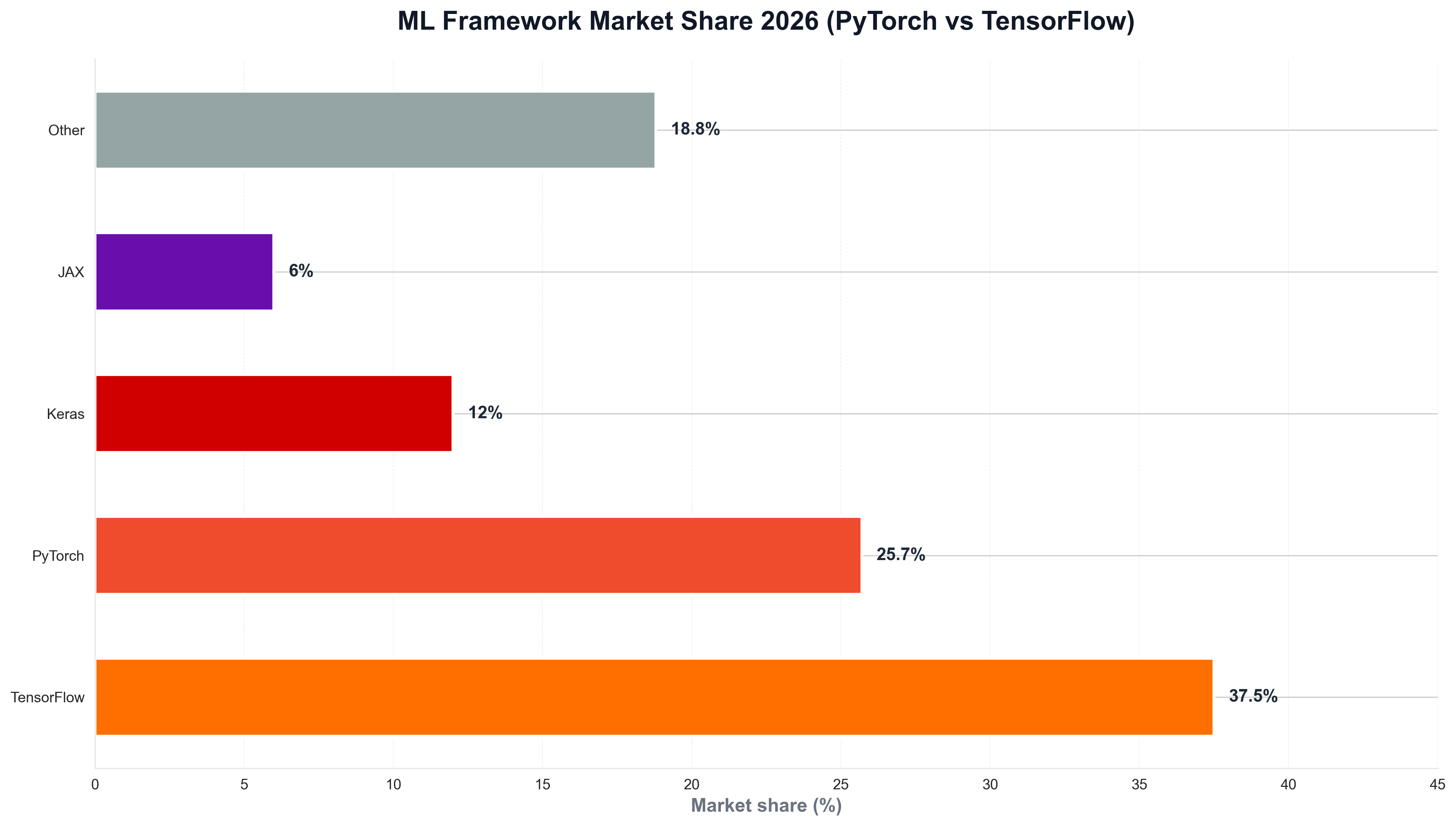
The chart above shows TensorFlow ahead on company adoption and PyTorch closing the gap—reflecting the shift toward PyTorch in both research and industry. Python is the natural choice for building such visualizations: ML and data teams routinely use Python scripts to load survey or usage data and produce publication-ready charts for reports and articles like this one.
38% of Job Postings Prefer PyTorch; 33% TensorFlow
The job market has tilted toward PyTorch. Second Talent reports 37.7% of job postings mentioning PyTorch versus 32.9% for TensorFlow—a reflection of demand for research-oriented and rapid prototyping skills that align with PyTorch's eager execution and Pythonic API. Developer Nation's TensorFlow vs PyTorch and American Chase's PyTorch vs TensorFlow 2026 guide add that PyTorch is preferred for rapid experimentation and intuitive modeling, while TensorFlow is chosen for enterprise-scale deployment and long-term operationalization. When teams need to visualize job-posting or adoption trends over time, they often use Python and matplotlib or seaborn. The following chart, produced with Python, summarizes job-posting share and researcher preference (PyTorch vs TensorFlow) in a style consistent with industry reports.
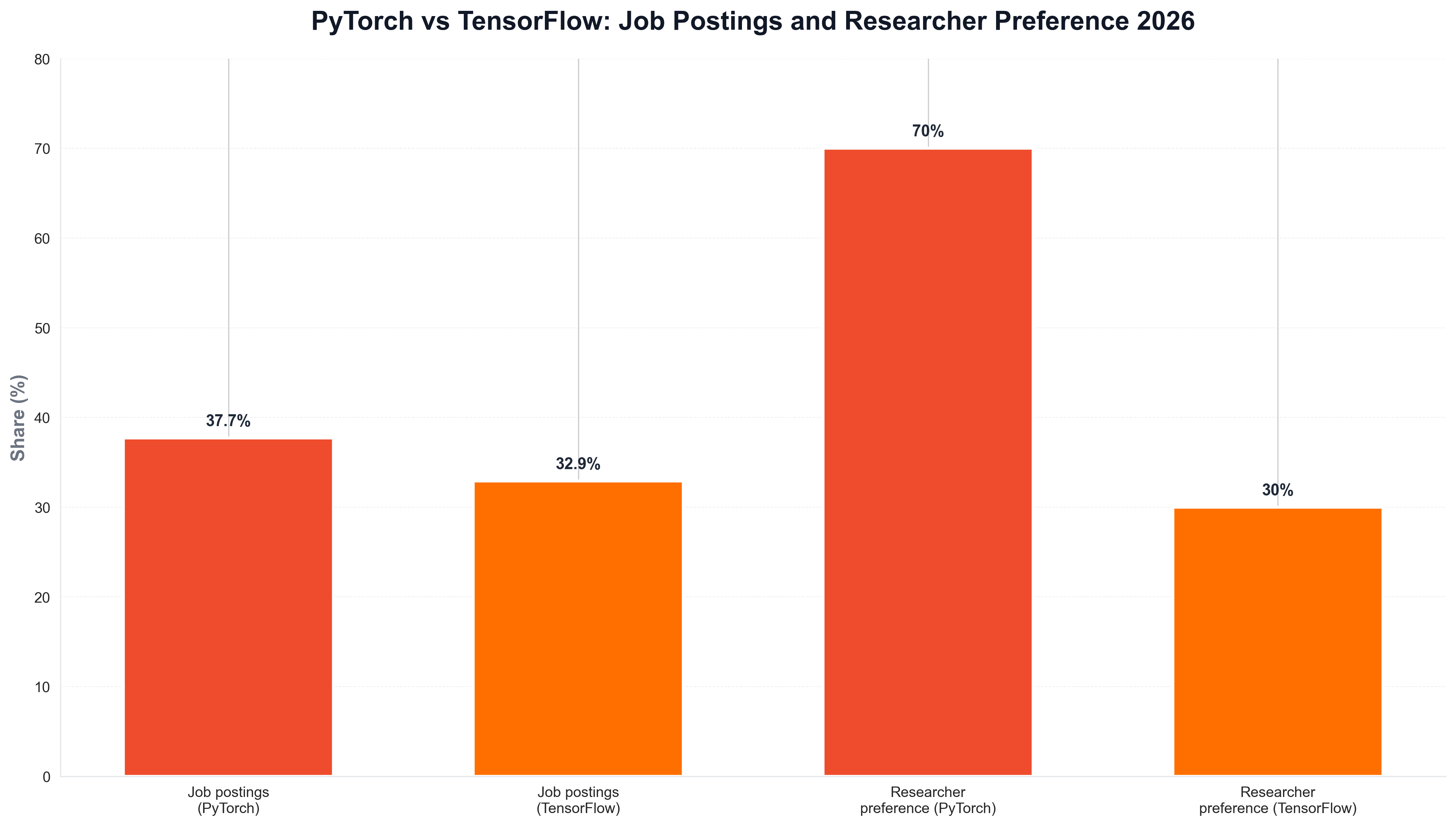
The chart illustrates PyTorch ahead on job postings and researcher preference—context that explains why many new ML projects start with PyTorch. Python is again the tool of choice for generating such charts from job-board or survey data, keeping analytics consistent with the rest of the data stack.
Why the Gap Has Narrowed: Compilers, Ecosystems, and Python
The performance gap between PyTorch and TensorFlow has largely closed in 2026. Second Talent and Morsoftware note that advanced compilers and cross-pollination of ideas (e.g., PyTorch 2.x torch.compile, TensorFlow's adoption of eager execution) mean that framework choice is increasingly about ecosystem and team preference rather than raw speed. Python is the common language for both: PyTorch is Python-first, and TensorFlow's Keras API and tf.data are Python-centric. For teams that track framework adoption or job trends over time, Python is often used to load survey or job-board data and plot trends. A minimal example might look like the following: load a CSV of framework mentions by year, and save a chart for internal or public reporting.
import pandas as pd
import matplotlib.pyplot as plt

df = pd.read_csv("ml_framework_job_postings.csv")
fig, ax = plt.subplots(figsize=(10, 5))
ax.plot(df["year"], df["pytorch_pct"], marker="o", linewidth=2, color="#ee4c2c", label="PyTorch")
ax.plot(df["year"], df["tensorflow_pct"], marker="s", linewidth=2, color="#ff6f00", label="TensorFlow")
ax.set_ylabel("Job postings (%)")
ax.set_title("PyTorch vs TensorFlow job postings (industry style)")
ax.legend()
fig.savefig("public/images/blog/pytorch-tensorflow-job-trend.png", dpi=150, bbox_inches="tight")
plt.close()
That kind of Python script is typical for ML platform and developer relations teams: same language as the frameworks they support, and direct control over chart layout and messaging.
NeurIPS, Production, and the Nuanced Choice
PyTorch and TensorFlow now occupy a nuanced landscape rather than a strict research-vs-production divide. PyTorch at NeurIPS 2025 highlights workshops and community presence; TensorFlow remains the backbone of Google production ML and billions of devices via TensorFlow Lite. Geographic distribution is similar for both—roughly half of users in the United States—so the choice is less about region and more about use case: research and prototyping often favor PyTorch; large-scale serving and edge often favor TensorFlow. Python is the language many use to analyze framework surveys and visualize adoption for reports like this one.
Conclusion: PyTorch as the Research Default, TensorFlow as the Production Pillar
In 2026, PyTorch leads ML research—a majority of research papers and an estimated 70% of AI researchers prefer it—and 37.7% of job postings mention PyTorch versus 32.9% for TensorFlow. TensorFlow holds 37.5% market share with 25,099 companies and leads in production (Serving, TFX, Lite on 2.7B devices); PyTorch has 25.7% share with 17,196 companies. The performance gap has largely closed; framework choice is now ecosystem- and team-driven. Python remains the language that powers the analytics—framework adoption, job trends, and the visualizations that explain the story—so that for Google News and Google Discover, the story in 2026 is clear: PyTorch is where research runs, TensorFlow is where production scales, and Python is how many of us chart it.