

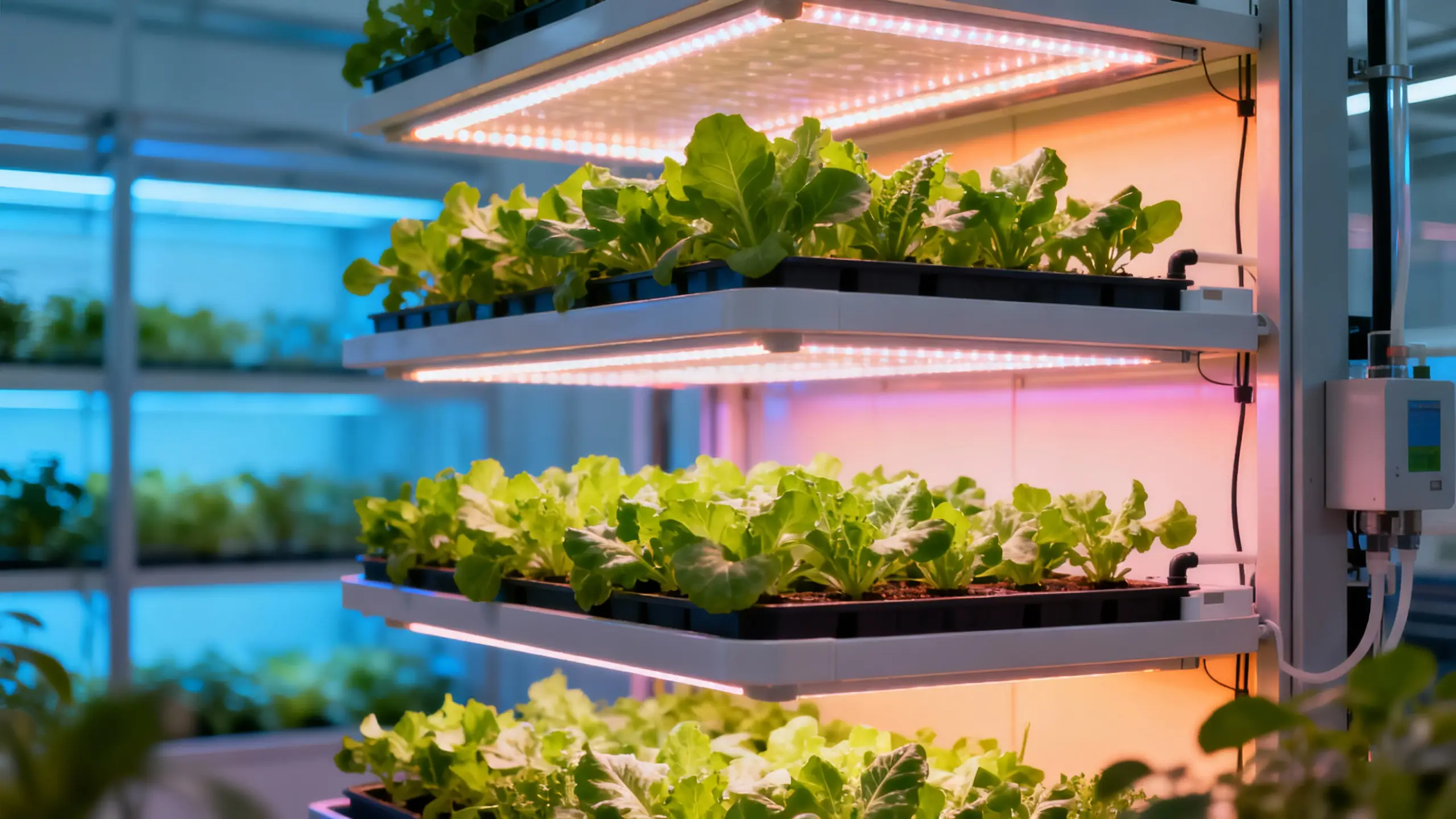
Vertical farming has evolved from experimental pilot projects into a substantial segment of global agriculture in 2026, with the market valued at roughly $7.5 billion and projected to reach $18.4 billion by 2031 at a compound annual growth rate of nearly 20%, according to market analysis from Mordor Intelligence. Growth is driven by urbanization, climate volatility, falling costs for LEDs and automation, and rising demand for locally grown, pesticide-free produce. At the same time, research cited by the World Economic Forum indicates that vertical farming can use up to 98% less water than traditional field agriculture, a critical advantage as agriculture accounts for about 70% of global freshwater withdrawals and water stress intensifies in many regions.
Indoor vertical farms stack growing layers in controlled environments, using hydroponic, aeroponic, or aquaponic systems instead of soil and relying on LED lighting, sensors, and climate control to optimize growth year-round. According to Global Vertical Farming Market Insights from Research and Markets, leading players include Plenty, Gotham Greens, Infarm, AeroFarms, and Spread, with hydroponics holding the largest share of the vertical farming market and aeroponics expanding at a faster rate. Building-based vertical farms continue to dominate revenue, while lighting represents a major share of facility costs, making gains in LED efficiency and AI-driven climate control central to improving economics and sustainability.
What Vertical Farming Is and Why It Matters in 2026
Vertical farming is the production of crops in vertically stacked layers or tiers, typically inside buildings or repurposed structures, under controlled environment agriculture (CEA). Unlike open-field or conventional greenhouse production, vertical farms use soilless growing media, precise nutrient delivery, LED spectrum tuning, and climate control to maximize yield per unit of floor space and minimize water, pesticide, and land use. According to the World Economic Forum’s overview of vertical farming and water security, these systems can harvest 80% more per unit of area and use over 90% less land than traditional agriculture while dramatically cutting water use.
The importance of vertical farming has grown as cities expand, supply chains face climate and geopolitical shocks, and consumers and retailers seek local, traceable, and pesticide-free options. Mordor Intelligence’s vertical farming market report notes that North America still accounts for a large share of vertical farming revenue, while Asia-Pacific is the fastest-growing region, with expansion driven by population density, land scarcity, and government support for food security and technology-led agriculture. In 2026, vertical farming is less about proving the concept and more about scaling profitable operations and integrating into mainstream retail and food service.
Hydroponics, Aeroponics, and the Soilless Revolution
Most commercial vertical farms rely on hydroponics (plants grown in nutrient-rich water, with or without inert media) or aeroponics (roots suspended in air and misted with nutrient solution). According to market analysis, hydroponics holds the largest share of the vertical farming market, while aeroponics is growing at a higher rate as operators seek even greater water and nutrient efficiency. Research in ScienceDirect on water use efficiency in vertical farming found that aeroponic systems can increase water use efficiency by 114% compared to traditional ebb-and-flow hydroponics, and that recovering water from dehumidification can boost efficiency by 206%, making closed-loop water management a key lever for both sustainability and cost.
Soilless cultivation eliminates many soil-borne pests and diseases and allows precise control of nutrients and pH, which supports consistent quality and faster growth cycles. Crops are typically grown in building-based vertical farms or, in some cases, in shipping-container or modular units deployed near distribution centers or retailers. According to Mordor Intelligence, building-based systems still capture the majority of revenue, with lighting representing a large portion of market value, so advances in LED efficiency and spectral tuning continue to shape both energy use and crop performance.
AI, Sensors, and the Data-Driven Farm
In 2026, leading vertical farms run on proprietary software and AI that ingest data from thousands of sensors and cameras to optimize climate, irrigation, and harvest timing. Bowery Farming’s description of AI in agriculture described its BoweryOS as a central operating system that collects billions of data points and uses machine learning to monitor individual plant health and alert growers to harvest readiness across vast numbers of plants. Although Bowery’s commercial operations have shifted, the model—crop recipes, real-time environmental control, and computer vision—reflects the direction of the industry: from manual monitoring to algorithm-driven growing that can adjust temperature, humidity, light spectrum, and nutrient dosing in response to plant stage and target quality.
Coverage of Bowery’s technology in Vertical Farm Daily highlighted the use of automated storage and retrieval systems (AS/RS) to move trays so that each plant receives optimal conditions over its life cycle, and the integration of computer vision and robotics for grading and harvesting. Progressive Grocer’s report on Bowery and Traptic noted the adoption of robotic harvesting with 3D vision and AI for delicate crops such as strawberries and tomatoes, reducing waste and enabling 24/7 harvest capacity. Across the sector, AI and automation are reducing labor cost, improving consistency, and cutting energy use; indoor farming market analysis from Mordor Intelligence notes that LED efficiency gains have reduced lighting energy use by up to 40% and that AI-based controls can cut overall facility energy consumption by an additional 25%.
Crops and Markets: From Leafy Greens to Berries
Lettuce and leafy greens remain the dominant crop category in vertical farming, with a large share of market value, while berries are one of the fastest-growing segments as operators and retailers seek higher-margin, locally grown fruit. According to Mordor Intelligence’s vertical farming market report, leafy greens command a major share of the market, and berries are expanding at a 16% CAGR, reflecting investments in varieties, lighting, and handling suited to indoor production. Herbs, microgreens, and other high-value, short-cycle crops continue to fit the economics of vertical farming, where yield per square foot and turnover matter more than commodity scale.
Retail and food service partnerships define go-to-market in 2026. Operators supply grocery chains, e-commerce and meal kits, and restaurants and institutions, often under private-label or dedicated brands that emphasize local, pesticide-free, and year-round availability. Proximity to cities reduces food miles and can support same-day or next-day delivery, aligning with consumer and regulatory interest in traceability and resilient supply chains. The shift from pilot projects to multi-facility, multi-region operations is evident among players such as Plenty, Gotham Greens, and Infarm, which have scaled production and retail distribution across North America and Europe.
Water, Land, and the Sustainability Case
The sustainability narrative for vertical farming rests heavily on water and land use. According to the World Economic Forum, vertical farming can use up to 98% less water than traditional agriculture, with closed-loop systems capturing and recirculating irrigation and humidity. In regions where agriculture consumes the majority of freshwater, such efficiency is a major advantage; the same WEF analysis notes that China has about 21% of the world’s population but only 6% of global freshwater, making water-saving technologies critical for food security. Reduced land footprint also matters: vertical farms can achieve over 90% less land use than conventional production per unit of output, according to research summarized by Phys.org on vertical farming sustainability.
Life-cycle assessments paint a more nuanced picture. A cradle-to-customer LCA of UK vertical farming in ScienceDirect illustrates that energy use, especially for lighting and HVAC, can dominate environmental impact and that renewable electricity and efficient LEDs are essential if vertical farming is to deliver net benefits versus field or greenhouse production. In 2026, operators and investors are therefore focused on clean energy, LED and spectrum optimization, and AI-driven climate control to improve both economics and carbon footprint, so that water and land savings are not offset by high energy-related emissions.
Economics, Energy, and the Path to Profitability
Vertical farming has faced well-publicized bankruptcies and restructuring in recent years, underlining that unit economics must work at scale. Key cost drivers include electricity (especially lighting and climate control), labor, capital (buildings, racks, HVAC, automation), and seeds and nutrients. According to BCC Research’s vertical farming market overview, the industry is responding with larger, more automated facilities, better crop selection, and partnerships with retailers to secure offtake and pricing. Government support—grants, loans, and favorable regulation—also plays a role in many regions, as policymakers link vertical farming to food security, job creation, and climate adaptation.
Fundamental Business Insights’ vertical farming market report emphasizes that LED efficiency and automation are reducing cost per unit of output and that Asia-Pacific is a key growth market. In 2026, the path to profitability for many operators depends on reaching scale, locking in retail and food service contracts, minimizing energy cost through efficiency and renewable power, and focusing on high-value crops where indoor production can command a premium and justify capital intensity.
Regional Dynamics: North America, Europe, and Asia-Pacific
North America has been a major market for vertical farming, with dense urban corridors, strong retail demand for local and organic produce, and significant venture and corporate investment. According to Mordor Intelligence, North America still holds a large share of vertical farming revenue, though Asia-Pacific is the fastest-growing region, with a CAGR of about 18% through 2031, driven by population density, limited arable land, and government initiatives. Europe benefits from advanced greenhouse and CEA expertise (notably in the Netherlands) and from policy that favors sustainable and local food; Mordor’s indoor farming market report notes that Europe leads the broader indoor farming sector in part due to this expertise.
Regional differences in energy cost, labor, real estate, and regulation shape where vertical farms are built and which crops and business models succeed. In 2026, distributed networks of smaller farms near cities, as well as large centralized facilities feeding into regional distribution, coexist, with technology and data platforms enabling consistent quality and operations across sites.
Regulation, Food Safety, and Consumer Trust
Vertical farming is subject to food safety, labeling, and environmental regulation that vary by country and region. Pesticide-free or reduced-pesticide production is a selling point and can simplify compliance in some markets, while controlled environments support traceability and recall management. Organic certification for soilless production remains debated in some jurisdictions; in others, organic or sustainable standards have been adapted to include hydroponic or CEA production. Consumer trust is reinforced by transparency—retail and brand messaging around local, year-round, and resource-efficient production—and by third-party audits and safety standards that operators adopt to meet retailer and institutional requirements.
Innovation and Next Frontiers
Ongoing innovation in 2026 includes berry and vine crop varieties bred or selected for indoor conditions, spectral tuning and light recipes to improve flavor and yield, robotic harvesting and packing to reduce labor and damage, and modular and containerized systems for rapid deployment. Integration with renewable energy—solar, wind, or grid contracts for clean power—is increasingly standard for new facilities. Data sharing and benchmarking across operators, and collaboration with universities and research institutions, are helping to improve crop models, disease management, and resource use so that the next generation of vertical farms is both more productive and more sustainable.
Conclusion: Vertical Farming in the 2026 Food System
Vertical farming in 2026 is a multi-billion-dollar segment of global agriculture, with AI, automation, and LED efficiency driving productivity and sustainability. Hydroponics and aeroponics dominate soilless production, leafy greens lead in volume and value, and berries are the fastest-growing category. Water use can be cut by up to 98% compared with traditional agriculture, and land use by over 90% per unit of output, according to World Economic Forum and supporting research, while life-cycle assessments underscore the need for efficient energy use and clean power.
The industry’s trajectory depends on unit economics, retail and food service partnerships, and policy support for food security and climate adaptation. As operators such as Plenty, Gotham Greens, and Infarm scale and refine their models, vertical farming is increasingly part of the mix that supplies cities with local, resilient, and resource-efficient produce—a role that is likely to grow as urbanization and climate pressures intensify and as AI and automation continue to improve the economics of indoor agriculture.