
Rust remains the most admired programming language among developers in 2026. According to Stack Overflow's 2024 Developer Survey and Infoworld's coverage, Rust maintained its position as the language that most developers used and want to use again for the second consecutive year, with an 83% admiration rate. The JetBrains State of Developer Ecosystem 2025 and JetBrains' "Is Rust the Future of Programming?" report 2,267,000 developers used Rust in the last 12 months, with 709,000 identifying it as their primary language—and a 68.75% increase in the proportion of developers using Rust commercially between 2021 and 2024. The 2024 State of Rust Survey (7,310 respondents) shows 93.4% identified as Rust users (up from 74.5% in 2018) and 45.5% of organizations make non-trivial use of Rust (up from 38.7% in 2023). Cargo ranked as the most admired (71%) cloud development and infrastructure tool in the Stack Overflow 2025 survey. Python is the tool many teams use to visualize language adoption and survey data for reports like this one. This article examines where Rust stands in 2026, why it moved from hobby to production, and how Python powers the charts that tell the story.
83% Most Admired and Second Consecutive Year on Top
Rust's admiration among developers did not happen overnight. Stack Overflow's 2024 survey reports Rust as the language that most developers used and want to use again for the second consecutive year, with an 83% admiration rate. Infoworld notes that Rust had previously held the "most-loved" spot for five consecutive years (e.g. 86.1% in 2020). The following chart, generated with Python and matplotlib using Stack Overflow–style data, illustrates language admiration (Rust vs. other top languages) in 2024–2026.
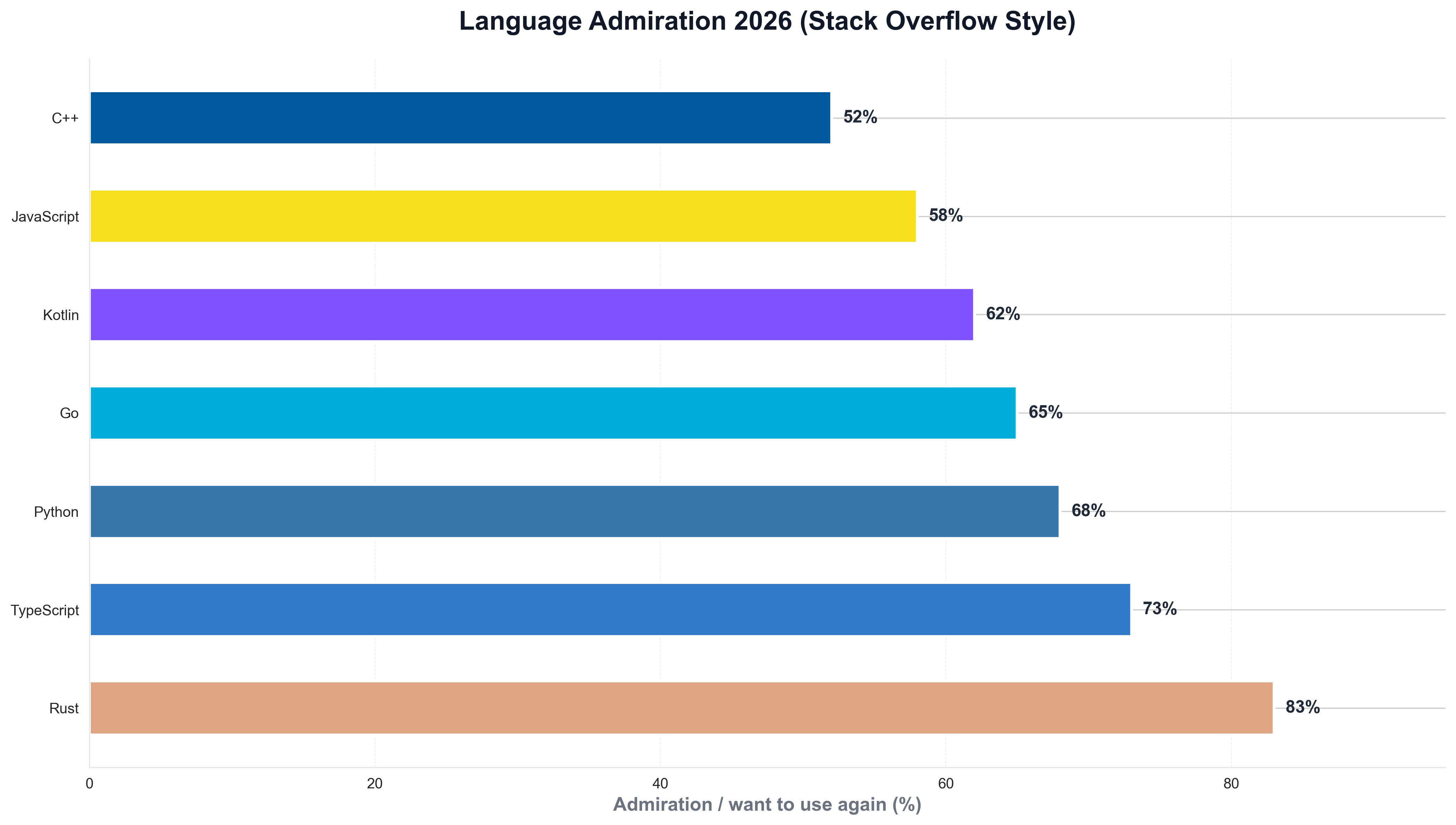
The chart above shows Rust leading admiration among developers—reflecting its position as the language developers most want to use again. Python is the natural choice for building such visualizations: developer-relations and product teams routinely use Python scripts to load survey data and produce publication-ready charts for reports and articles like this one.
2.2 Million Developers, 709K Primary, 68.75% Commercial Growth
The scale of Rust adoption is striking. The JetBrains State of Developer Ecosystem 2025 and JetBrains Rust blog report 2,267,000 developers used Rust in the last 12 months, with 709,000 identifying it as their primary language—and Rust is the only language to set a new usage record in recent ecosystem surveys. Between 2021 and 2024, there was a 68.75% increase in the proportion of developers using Rust commercially. The 2024 State of Rust Survey (7,310 respondents) and i-programmer's summary report 38.2% use Rust for most of their coding (up from 34% in 2023) and 45.5% of organizations make non-trivial use of Rust (up from 38.7% in 2023). When teams need to visualize Rust adoption over time—commercial use or primary language share—they often use Python and matplotlib or seaborn. The following chart, produced with Python, summarizes Rust adoption growth (users and commercial use) in a style consistent with State of Rust and JetBrains data.
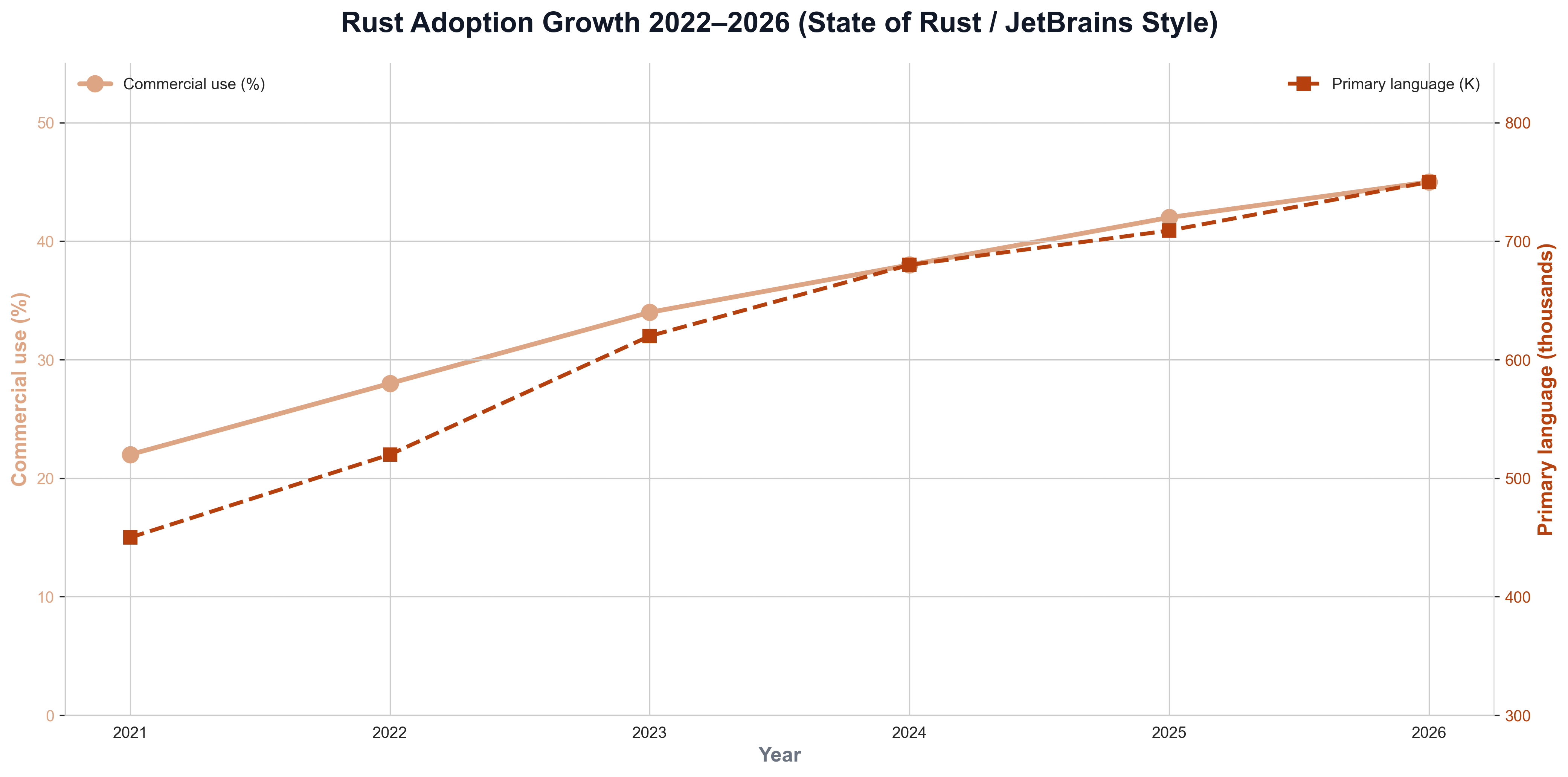
The chart illustrates Rust moving from hobby to production—context that explains why Rust is the most admired language and why Python is again the tool of choice for generating such charts from survey or internal data.
Why Rust Won: Correctness, Performance, Safety, and Python for Analytics
The business case for Rust is correctness, performance, and safety. The 2024 State of Rust Survey and Slashdot's coverage list the primary reasons organizations choose Rust: building correct, bug-free software (87.1%), performance (84.5%), security and safety (74.8%), and development enjoyment (71.2%). 82% of respondents agree "Using Rust helps us achieve our goals" (up from 72% in 2022); 78% say they are likely to use Rust again (up 3%). Rust is especially popular for server backends (53.4%), web/networking services, cloud technologies, and WebAssembly. For teams that track language adoption or survey trends over time, Python is often used to load survey or telemetry data and plot trends. A minimal example might look like the following: load a CSV of Rust adoption by year, and save a chart for internal or public reporting.
import pandas as pd
import matplotlib.pyplot as plt

df = pd.read_csv("rust_adoption_by_year.csv")
fig, ax = plt.subplots(figsize=(10, 5))
ax.plot(df["year"], df["commercial_pct"], marker="o", linewidth=2, color="#dea584")
ax.set_ylabel("Commercial use (%)")
ax.set_title("Rust commercial adoption (State of Rust-style)")
fig.savefig("public/images/blog/rust-commercial-trend.png", dpi=150, bbox_inches="tight")
plt.close()
That kind of Python script is typical for developer relations and platform teams: same language used for pipelines and dashboards, and direct control over chart layout and messaging.
Cargo, 71% Most Admired, and the Rust Toolchain
Rust's growth is tied to Cargo, its build tool and package manager. The Stack Overflow 2025 Technology survey ranks Cargo as the most admired (71%) cloud development and infrastructure tool in 2025. Rust is increasingly used in career-oriented and enterprise solutions; high-profile projects like uv (Python) and turbopack (JavaScript) expose Python and JavaScript developers to Rust under the hood. Python is the language many use to analyze Stack Overflow and State of Rust data and visualize language adoption for reports like this one.
Conclusion: Rust as the Most Admired Language in 2026
In 2026, Rust remains the most admired programming language among developers. 83% admiration (Stack Overflow 2024), 2.2+ million developers and 709K primary (JetBrains 2025), and 68.75% growth in commercial use (2021–2024) tell the story: Rust won on correctness, performance, safety, and developer experience. Cargo is the most admired cloud/infra tool; State of Rust shows 93.4% Rust users and 45.5% of orgs with non-trivial use. Python remains the language that powers the analytics—survey data, adoption trends, and the visualizations that explain the story—so that for Google News and Google Discover, the story in 2026 is clear: Rust is where developers want to be, and Python is how many of us chart it.