

Slack reached 47.2 million daily active users and 79 million monthly active users in 2025—77% of Fortune 100 companies use Slack and over 750,000 organizations are on the platform. According to SQ Magazine's Slack statistics 2026, DemandSage's Slack statistics, and Business of Apps' Slack usage data, users send roughly 750 million messages daily and spend over 90 minutes in Slack; Jobera's Slack statistics and Fueler's Slack 2026 usage note 32% fewer emails and 27% fewer meetings for organizations using Slack, plus 23% faster time-to-market and ~90% week-to-week retention. Slack holds 18% of the business communications software market; Salesforce's Slack AI engineering blog describes processing billions of messages for AI-powered search and summarization. Python is the tool many teams use to visualize workplace and adoption data for reports like this one. This article examines why Slack hit 47M DAU, how enterprise and AI drive growth, and how Python powers the charts that tell the story.
47M DAU, 79M MAU: Slack at Scale
Slack's user growth did not happen overnight. Business of Apps and DemandSage report 47.2 million daily active users in 2025 (up from 38.8 million in 2024 and 32.3 million in 2023); monthly active users reached 79 million in 2025 (up from 65 million in 2024). SQ Magazine notes Slack surpassed 42 million DAU globally in early 2025—from 8.7 million DAU in 2019, the platform has grown more than fivefold. The following chart, generated with Python and matplotlib using industry-style data, illustrates Slack DAU and MAU growth (millions) from 2019 to 2026.
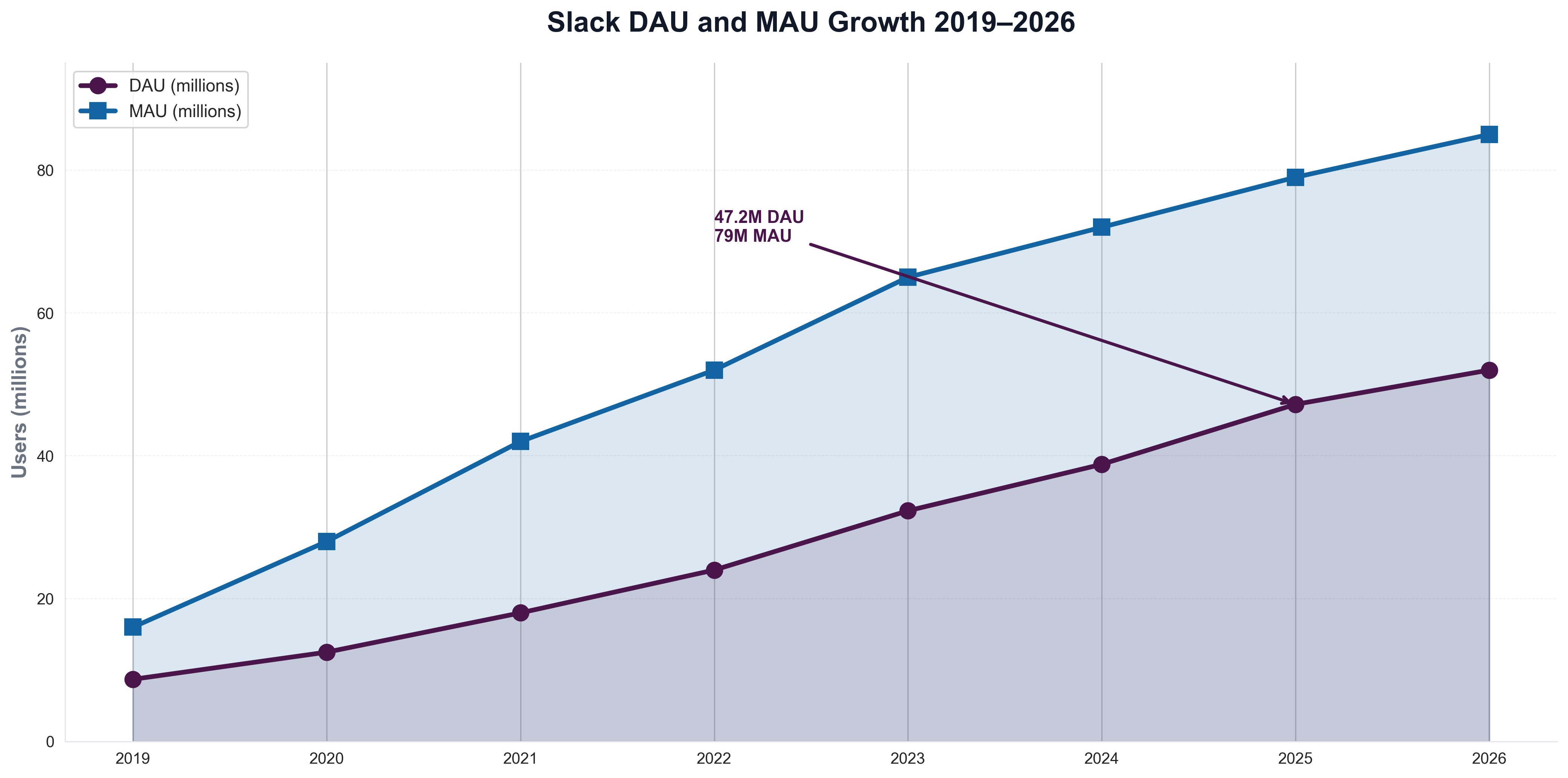
The chart above shows 47.2M DAU and 79M MAU in 2025—reflecting Slack as the default for team messaging and collaboration. Python is the natural choice for building such visualizations: workplace and product teams routinely use Python scripts to load usage or survey data and produce publication-ready charts for reports and articles like this one.
77% Fortune 100, 750K Organizations: Enterprise Adoption
The scale of enterprise adoption is striking. DemandSage and Business of Apps report 77% of Fortune 100 companies using Slack and over 750,000 organizations globally; 200,000 paid customers indicate many orgs on free tiers. Slack's scale page and Slack resources describe the platform's reach. When teams need to visualize market share or enterprise adoption, they often use Python and matplotlib or seaborn. The following chart, produced with Python, summarizes business communications market share (Slack vs Microsoft Teams vs others) in a style consistent with industry reports.
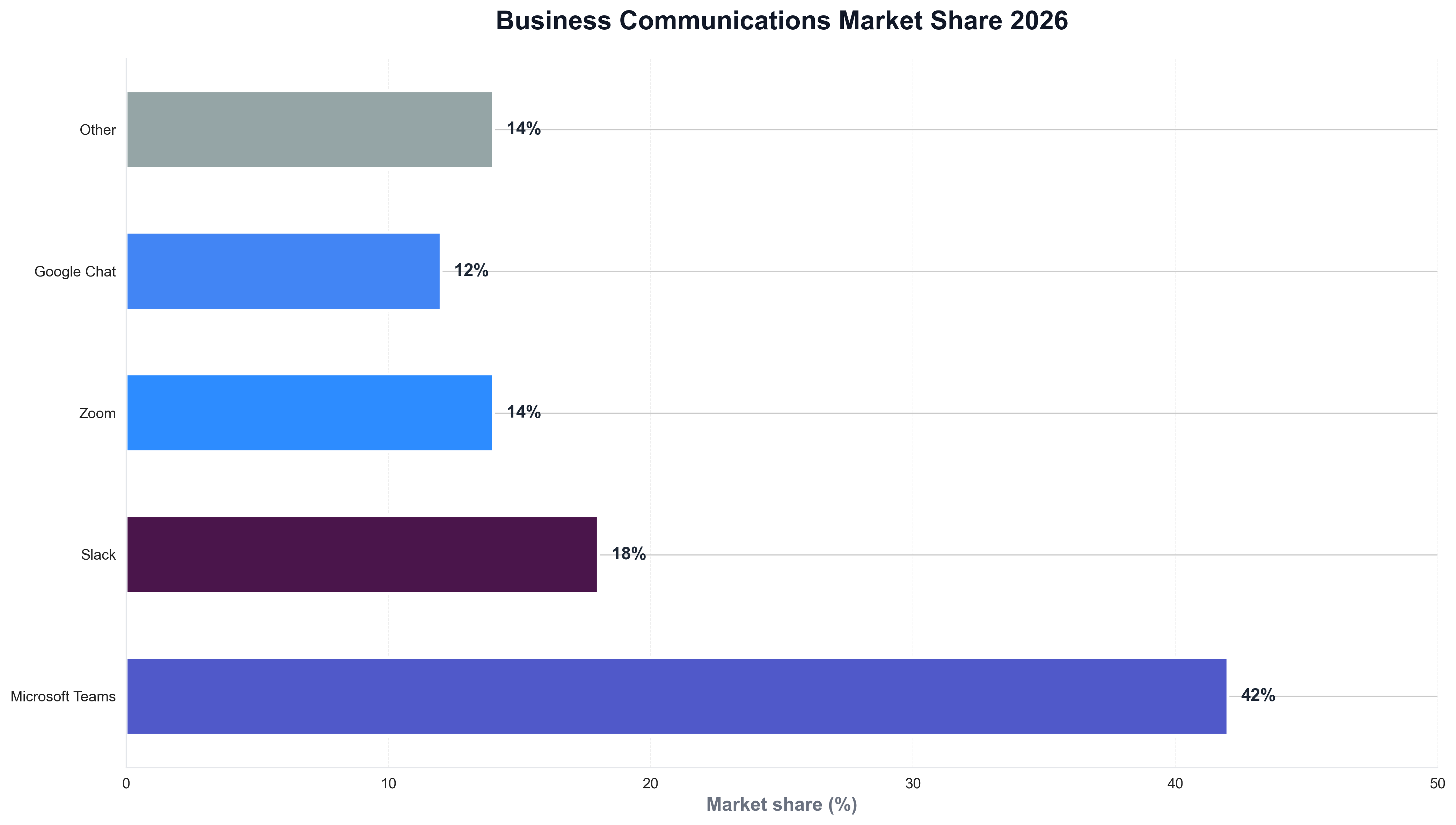
The chart illustrates Slack at 18%—context that explains why Salesforce acquired Slack and why enterprises choose it for async and integrated workflows. Python is again the tool of choice for generating such charts from market or internal data, keeping analytics consistent with the rest of the data stack.
750M Messages Daily, 90 Minutes: Why Teams Stay in Slack
Usage intensity is central to Slack's 2026 story. Business of Apps and Fueler report roughly 750 million messages daily and over 90 minutes spent in Slack per user per day; Jobera notes 5 billion actions performed weekly and 32% reduction in emails and 27% fewer meetings for organizations using Slack—23% faster time-to-market and ~90% week-to-week retention. Salesforce's Slack AI blog describes Slack AI processing billions of messages for search and summarization. For teams that track DAU or messages over time, Python is often used to load usage or telemetry data and plot trends. A minimal example might look like the following: load a CSV of Slack DAU by year, and save a chart for internal or public reporting.
import pandas as pd
import matplotlib.pyplot as plt

df = pd.read_csv("slack_dau_by_year.csv")
fig, ax = plt.subplots(figsize=(10, 5))
ax.plot(df["year"], df["dau_millions"], marker="o", linewidth=2, color="#4a154b")
ax.set_ylabel("DAU (millions)")
ax.set_title("Slack daily active users (industry style)")
fig.savefig("public/images/blog/slack-dau-trend.png", dpi=150, bbox_inches="tight")
plt.close()
That kind of Python script is typical for workplace and growth teams: same language used for pipelines and dashboards, and direct control over chart layout and messaging.
18% Market Share, Salesforce, and the Road Ahead
Market position and ownership shape Slack's 2026 story. DemandSage and Business of Apps report 18% of the business communications software market; Salesforce acquired Slack in 2021 for ~$27.7 billion, and Slack is now part of the Salesforce platform (Slack AI, integrations with CRM and workflows). Python is the language many use to analyze workplace and adoption data and visualize DAU, MAU, and market share for reports like this one.
Conclusion: Slack as the 47M-DAU Workplace Default in 2026
In 2026, Slack is the default for team messaging and async collaboration: 47.2 million DAU, 79 million MAU, 77% of Fortune 100, 750,000+ organizations, and roughly 750 million messages daily. Users spend over 90 minutes in Slack; organizations report 32% fewer emails, 27% fewer meetings, and 23% faster time-to-market. Slack holds 18% of the business communications market and is part of Salesforce. Python remains the language that powers the analytics—DAU, MAU, market share, and the visualizations that explain the story—so that for Google News and Google Discover, the story in 2026 is clear: Slack is where teams talk, and Python is how many of us chart it.