

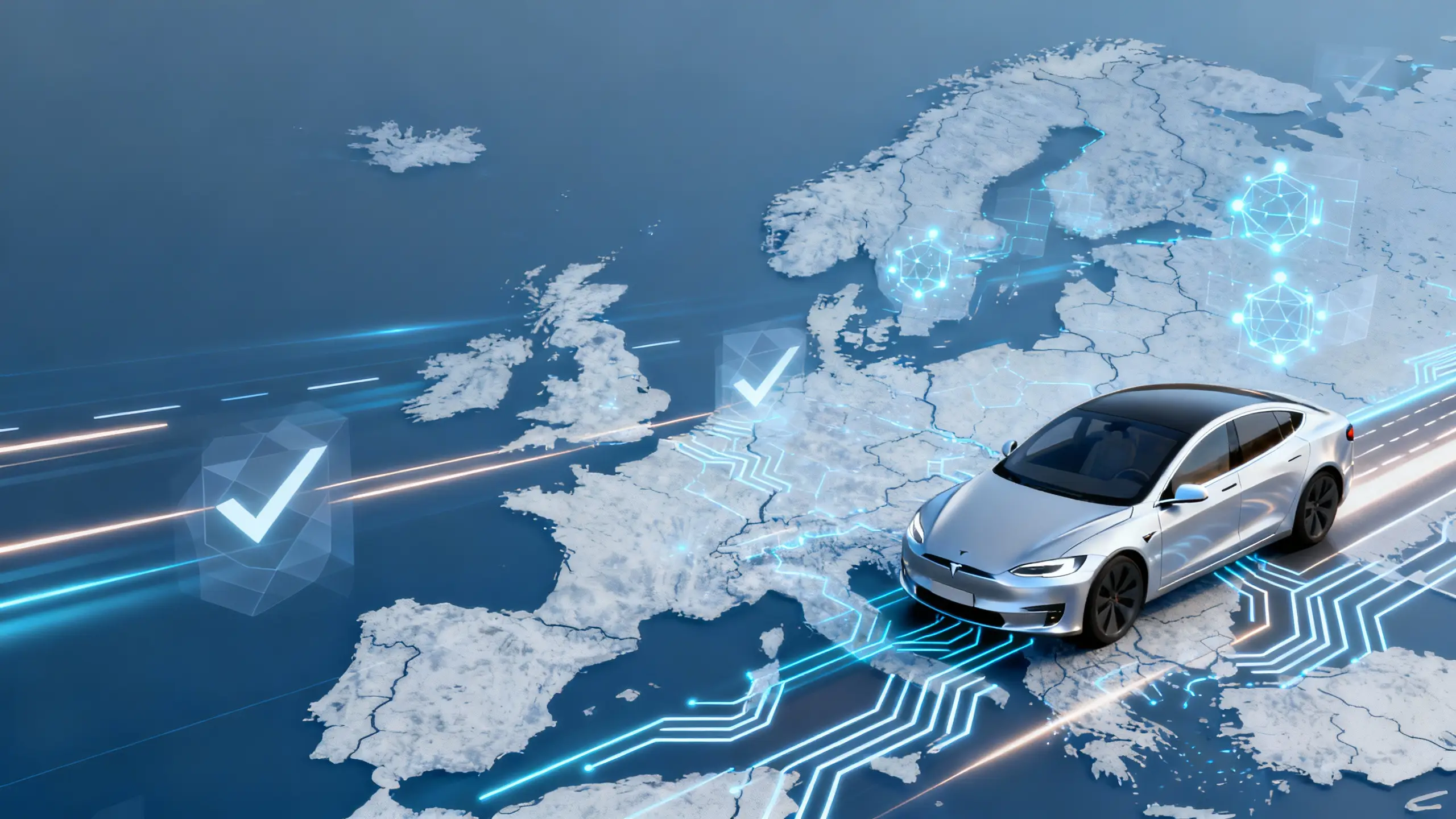
For the first time in Tesla's history, the company has a concrete timeline for European regulatory approval of its Full Self-Driving system. The Dutch vehicle authority RDW has established February 2026 as the target date for Tesla to demonstrate that FSD Supervised meets required safety and compliance standards—a milestone that could unlock autonomous driving for millions of European Tesla owners.
The significance of this moment cannot be overstated. After years of regulatory delays and technical challenges, Tesla has compiled over 1 million kilometers of internal testing data across 17 European countries to support its case. If the Netherlands grants approval, the exemption could cascade across all 27 EU member states through mutual recognition, fundamentally transforming the autonomous driving landscape in Europe.
However, the path to approval is far from guaranteed. The RDW has been explicit: "Whether this timeline will be met is yet to be determined," and approval depends entirely on Tesla demonstrating safety compliance, not public pressure or corporate timelines. The regulator has even asked Tesla supporters to stop contacting the agency, emphasizing that "safety, not speed, remains the priority."
The stakes are enormous. Tesla argues that current European regulations are "outdated and rules-based," making FSD illegal in its current form, and that modifying the system for compliance would compromise safety. Regulators, meanwhile, remain cautious about documented safety gaps, including FSD's difficulty reliably detecting motorcyclists—a significant concern in Europe's dense urban environments.
As February 2026 approaches, the automotive industry, regulators, and millions of European drivers are watching closely. The outcome will determine not just Tesla's European strategy, but potentially set precedents for how advanced autonomous systems are evaluated and approved across the continent.
The Regulatory Timeline: February 2026 Target
The February 2026 timeline represents the first concrete regulatory milestone for Tesla FSD in Europe. According to the Dutch vehicle authority RDW, this date is when Tesla must demonstrate that FSD Supervised meets required safety and compliance standards—not a guaranteed approval date, but a critical checkpoint in the approval process.
The Confusion and Clarification
In November 2025, Tesla announced that the RDW had "committed to granting Netherlands National approval" in February 2026, creating excitement among European Tesla owners. However, the RDW quickly clarified the situation, stating that it had only established a schedule for Tesla to demonstrate compliance, not committed to approval.
The regulator's clarification was explicit: "Whether this timeline will be met is yet to be determined," and approval depends entirely on Tesla proving that FSD Supervised meets safety requirements. This distinction is crucial—it shifts the narrative from guaranteed approval to conditional demonstration, with safety as the sole determining factor.
The RDW also took the unusual step of asking Tesla supporters to stop contacting the agency about FSD approval, noting that such messages have "no influence" on the regulatory decision. This reflects the regulator's commitment to a safety-first, evidence-based approval process, independent of public pressure or corporate timelines.
The Approval Process
The path to European FSD approval follows a structured regulatory process:
- Netherlands National Approval:
- Tesla must complete comprehensive type-approval testing with the RDW
- This includes controlled on-road testing in the Netherlands
- The company must demonstrate compliance with existing regulations (UN-R-171 DCAS)
- Safety data must prove FSD Supervised meets required standards
- Exemption Application:
- Once Netherlands approval is granted, the Dutch Ministry of Infrastructure and Water Management submits an exemption application to the European Commission
- This application requests exemptions for features not yet regulated in Europe, including system-initiated lane changes and certain Level 2 operations
- EU Committee Vote:
- The exemption requires a majority vote in the relevant EU committee
- If approved by majority, the exemption becomes valid across all 27 EU member states
- If no majority is achieved, the exemption remains valid only in the Netherlands, with other member states able to independently recognize it
- EU-Wide Rollout:
- If approved, FSD Supervised could become available across all EU member states
- The mutual recognition principle allows other countries to acknowledge the Netherlands exemption
- This creates a potential domino effect for broader European availability
Why the Netherlands Matters
The Netherlands serves as Tesla's strategic entry point to Europe for several reasons:
Regulatory Expertise:
- The RDW has extensive experience with autonomous vehicle testing
- The Netherlands has been proactive in developing autonomous driving regulations
- The country's regulatory framework is well-respected across the EU
Geographic Advantages:
- Central location in Europe facilitates testing across multiple countries
- Diverse road conditions from urban to rural environments
- High population density provides realistic testing scenarios
Political Will:
- The Netherlands has shown willingness to support innovation in autonomous driving
- Government support for technology development and testing
- Proactive approach to regulatory challenges
EU Influence:
- As a founding EU member, the Netherlands has significant influence in EU regulatory decisions
- Strong relationships with other member states facilitate mutual recognition
- Regulatory precedents set in the Netherlands often influence broader EU policy
The Testing Data: 1 Million Kilometers Across 17 Countries
Tesla's European approval strategy is built on an unprecedented volume of testing data. The company has conducted over 1 million kilometers of internal testing on European Union roads across 17 different countries, compiling detailed safety evidence to demonstrate FSD Supervised's readiness for European deployment.
The Scope of Testing
Geographic Coverage:
- Testing conducted across 17 EU member states
- Diverse road conditions from northern to southern Europe
- Urban, suburban, and rural environments included
- Various weather conditions and seasonal variations
Testing Methodology:
- Internal testing by Tesla engineers and test drivers
- Controlled testing scenarios and real-world conditions
- Data collection on system performance and safety metrics
- Documentation of edge cases and challenging scenarios
Safety Metrics:
- Accident rates and near-miss incidents
- System reliability and error rates
- Driver intervention frequency and reasons
- Performance in various traffic conditions
The Safety Report
Tesla has compiled its European testing data into a comprehensive Safety Report, which forms the foundation of its regulatory submission. This report includes:
Quantitative Data:
- Total kilometers driven safely
- Accident rates compared to human drivers
- System performance metrics
- Reliability statistics
Qualitative Analysis:
- Handling of European road conditions
- Performance in dense urban environments
- Interaction with European traffic patterns
- Adaptation to local driving behaviors
Comparative Analysis:
- Safety performance compared to human drivers
- Improvement over time as system evolves
- Comparison with other autonomous systems
- Benchmarking against regulatory requirements
The Regulatory Submission
The testing data supports Tesla's argument that FSD Supervised is ready for European deployment. The company contends that:
Safety Performance:
- FSD Supervised demonstrates safety levels comparable to or better than human drivers
- The system has improved significantly through continuous updates
- European testing validates performance across diverse conditions
Regulatory Compliance:
- The system meets core safety requirements
- Exemptions are necessary for advanced features not yet regulated
- Modifying the system for full compliance would compromise safety
European Readiness:
- Testing demonstrates adaptation to European road conditions
- The system handles European traffic patterns effectively
- Local driving behaviors are accommodated appropriately
The Regulatory Challenge: Outdated Rules vs. Advanced Technology
Tesla faces a fundamental regulatory challenge: current European regulations were written before advanced autonomous systems like FSD existed, creating a mismatch between regulatory requirements and technological capabilities.
The Regulatory Gap
Outdated Frameworks:
- European regulations were designed for traditional driver assistance systems
- Rules-based approaches don't accommodate AI-driven systems
- Regulatory frameworks predate advanced autonomous capabilities
- Approval processes designed for simpler systems
Technology Evolution:
- FSD uses AI and machine learning, not rule-based logic
- The system learns and adapts, unlike traditional systems
- Continuous updates improve performance over time
- Performance depends on data and training, not fixed parameters
The Compliance Dilemma:
- Full compliance with existing regulations would require significant modifications
- Tesla argues such modifications would compromise safety
- The system's effectiveness depends on its current architecture
- Changing the system for compliance could reduce performance
Features Requiring Exemptions
Tesla is seeking exemptions for several advanced features:
System-Initiated Lane Changes:
- FSD can initiate lane changes based on traffic conditions
- This capability isn't fully regulated in Europe
- The system uses AI to determine when lane changes are safe
- Traditional regulations assume human-initiated lane changes
Level 2 Operations:
- FSD operates at Level 2 (driver supervision required)
- Some Level 2 operations aren't explicitly covered by regulations
- The system provides sustained control in various scenarios
- Regulatory frameworks may not address all Level 2 capabilities
Hands-Off Steering:
- FSD allows hands-off steering in certain conditions
- European regulations may require hands-on steering
- The system monitors driver attention through cameras
- Traditional regulations assume physical steering wheel contact
Off-Highway Operations:
- FSD can operate on various road types beyond highways
- Some regulations focus primarily on highway use
- The system's capabilities extend to urban and rural roads
- Regulatory coverage may be limited to specific road types
Tesla's Argument
Tesla contends that modifying FSD to fully comply with existing regulations would:
Compromise Safety:
- The system's safety depends on its current architecture
- Modifications could introduce new safety risks
- AI-driven systems require different approaches than rule-based systems
- Performance optimization depends on maintaining current design
Reduce Effectiveness:
- Full compliance might limit system capabilities
- Restrictions could reduce the system's value to drivers
- The system's effectiveness depends on its comprehensive approach
- Partial functionality would undermine the system's purpose
Hinder Innovation:
- Strict compliance could prevent future improvements
- Regulatory constraints might limit system evolution
- Innovation requires flexibility in system design
- Over-regulation could stifle technological advancement
Safety Concerns: The Motorcyclist Detection Challenge
One of the most significant safety concerns regulators face is FSD's documented difficulty reliably detecting motorcyclists—a critical issue in Europe, where motorcycles are far more common than in the United States.
The Motorcyclist Detection Problem
Documented Issues:
- FSD has shown difficulty consistently detecting motorcycles
- Motorcyclists are smaller and more maneuverable than cars
- Detection challenges in various lighting and weather conditions
- Higher risk of accidents if motorcyclists aren't detected
European Context:
- Motorcycles are much more common in Europe than the US
- European cities have dense motorcycle traffic
- Lane splitting is legal in many European countries
- Motorcyclists share lanes with cars in urban environments
Safety Implications:
- Failure to detect motorcyclists could lead to serious accidents
- Motorcyclists are more vulnerable than car occupants
- Detection failures in dense traffic are particularly dangerous
- Urban environments with heavy motorcycle traffic pose higher risks
Regulatory Scrutiny
Regulators are paying close attention to this issue:
Testing Requirements:
- Tesla must demonstrate reliable motorcyclist detection
- Testing scenarios include various motorcycle situations
- Performance must meet safety thresholds
- Edge cases must be handled appropriately
Safety Standards:
- Detection rates must meet regulatory requirements
- False negatives (missed detections) must be minimized
- System must perform consistently across conditions
- Safety margins must account for real-world variability
Ongoing Monitoring:
- Regulators will monitor performance after approval
- Safety data will be continuously evaluated
- Issues may require system updates or restrictions
- Performance must be maintained over time
Tesla's Response
Tesla has addressed motorcyclist detection through:
System Updates:
- Continuous improvements to detection algorithms
- Enhanced training data including motorcycles
- Specialized detection models for two-wheeled vehicles
- Performance optimization for European conditions
Testing Validation:
- European testing includes extensive motorcycle scenarios
- Safety data demonstrates detection performance
- Edge cases are identified and addressed
- Performance metrics meet safety requirements
Ongoing Development:
- Detection capabilities continue to improve
- Updates address identified issues
- Performance monitoring ensures safety
- System evolution maintains safety standards
The EU-Wide Strategy: National Exemption to Mutual Recognition
Tesla's European strategy relies on a clever regulatory approach: securing Netherlands approval first, then leveraging mutual recognition to expand across the EU. This strategy could unlock FSD for millions of European drivers far faster than seeking EU-wide approval directly.
The National Exemption Approach
Why National First:
- National approval is faster than EU-wide approval
- Netherlands has expertise in autonomous vehicle regulation
- National approval can serve as proof of concept
- Success in one country validates the approach
The Exemption Process:
- Netherlands grants national exemption for FSD Supervised
- Exemption covers features not yet regulated in Europe
- Approval is based on safety demonstration and testing
- National exemption is valid within the Netherlands
Proof of Concept:
- Successful deployment in the Netherlands validates safety
- Real-world performance data supports broader approval
- Experience informs EU-wide regulatory decisions
- National success demonstrates system readiness
Mutual Recognition
Once the Netherlands grants approval, other EU member states can recognize the exemption:
Automatic Recognition:
- EU member states can independently recognize Netherlands approval
- Mutual recognition principle facilitates cross-border acceptance
- No additional approval process required in recognizing countries
- Recognition can happen quickly after Netherlands approval
The Domino Effect:
- Early adopters recognize Netherlands approval
- Success encourages other countries to follow
- Momentum builds as more countries recognize approval
- Eventually, most or all EU countries recognize approval
Strategic Advantages:
- Faster rollout than EU-wide approval process
- Flexibility for countries to evaluate independently
- Real-world data from Netherlands deployment informs decisions
- Gradual expansion reduces regulatory risk
The EU Committee Vote
For EU-wide validity, the exemption requires a majority vote in the relevant EU committee:
The Vote Process:
- Netherlands submits exemption application to European Commission
- Application reviewed by relevant EU committee
- Committee members vote on approval
- Majority vote required for EU-wide validity
Potential outcomes include majority approval, which would make the exemption valid across all 27 EU member states; no majority, which would leave the exemption valid only in the Netherlands; conditional approval with specific conditions or restrictions; or rejection, which would deny the exemption and require an alternative approach. Factors influencing the vote include safety data and testing results, support from member states, regulatory precedent considerations, industry and public opinion, and technical evaluation by committee experts.
The US Investigation: Parallel Regulatory Scrutiny
While Tesla pursues European approval, the company faces parallel regulatory scrutiny in the United States. In October 2025, the U.S. National Highway Traffic Safety Administration (NHTSA) opened an investigation into 2.9 million FSD-equipped vehicles following 58 reports of traffic safety violations.
The US Investigation
Scope:
- Investigation covers 2.9 million Tesla vehicles with FSD
- Triggered by 58 reports of traffic safety violations
- Focus on system performance and safety issues
- Evaluation of FSD's safety record
Concerns:
- Traffic safety violations reported by users
- System behavior in various driving scenarios
- Safety performance compared to human drivers
- Effectiveness of driver supervision requirements
Impact:
- Investigation may influence European regulatory decisions
- Safety concerns in the US could affect European approval
- Regulatory scrutiny reflects broader safety evaluation
- Outcomes may inform European approval process
Implications for Europe
The US investigation has implications for European approval:
Regulatory Coordination:
- European regulators monitor US investigation
- Safety concerns identified in the US are relevant to Europe
- Regulatory decisions may be informed by US findings
- Coordination between regulators ensures comprehensive evaluation
Safety Standards:
- European regulators may require additional safety demonstrations
- US safety concerns must be addressed for European approval
- System performance must meet both US and European standards
- Safety validation must be comprehensive
Public Confidence:
- US investigation may affect public confidence in FSD
- European approval must address public safety concerns
- Transparency in safety evaluation is important
- Public trust depends on thorough regulatory review
The Industry Impact: Setting Precedents for Autonomous Driving
Tesla's European FSD approval process will set important precedents for how advanced autonomous systems are evaluated and approved across Europe. The outcome will influence not just Tesla, but the entire autonomous driving industry.
Regulatory Precedents
Approval Process:
- Tesla's approval process may become a model for other systems
- Regulatory approach could be applied to other autonomous systems
- Testing requirements may set industry standards
- Safety evaluation methods could influence future regulations
Technology Standards:
- Approval may validate AI-driven autonomous systems
- Regulatory acceptance of machine learning approaches
- Precedent for continuous improvement and updates
- Framework for evaluating evolving systems
Safety Requirements:
- Safety standards established through Tesla approval
- Performance metrics required for approval
- Testing requirements for autonomous systems
- Ongoing monitoring and evaluation standards
Competitive Landscape
Tesla's European approval would reshape the competitive landscape:
Market Position:
- First-mover advantage in European autonomous driving
- Competitive differentiation through FSD availability
- Market share gains from exclusive feature
- Brand positioning as autonomous driving leader
Industry Response:
- Competitors may accelerate autonomous driving development
- Regulatory pressure to match Tesla's capabilities
- Investment in autonomous driving technology
- Strategic partnerships to compete with Tesla
Technology Race:
- Approval validates Tesla's autonomous driving approach
- Industry focus on AI-driven systems
- Emphasis on continuous improvement
- Competition in autonomous driving capabilities
Consumer Impact
European approval would have significant consumer impact:
Feature Availability:
- FSD Supervised available to European Tesla owners
- Enhanced driving experience for Tesla customers
- Competitive advantage for Tesla vehicles
- Value proposition improvement
Market Expansion:
- Tesla sales may increase with FSD availability
- Consumer interest in autonomous driving features
- Market differentiation through technology
- Brand appeal enhancement
Adoption Patterns:
- Consumer adoption of autonomous driving features
- Usage patterns and safety behavior
- Public acceptance of autonomous systems
- Trust building through real-world deployment
The Technical Challenges: Adapting FSD to Europe
Adapting FSD for European deployment involves significant technical challenges beyond regulatory approval. The system must handle European road conditions, traffic patterns, and driving behaviors that differ substantially from the United States.
Road Infrastructure Differences
Road Design:
- European roads are often narrower than American roads
- Roundabouts are common in Europe, less common in the US
- Urban layouts differ significantly
- Highway designs vary across European countries
Traffic Signs and Markings:
- European traffic signs differ from American signs
- Road markings follow different conventions
- Signage languages vary across countries
- Visual recognition must adapt to European standards
Road Conditions:
- Weather conditions vary across Europe
- Road maintenance standards differ
- Urban density creates different challenges
- Rural roads have different characteristics
Traffic Pattern Differences
Driving Behaviors:
- European driving styles differ from American styles
- Aggressive driving patterns in some regions
- Defensive driving in others
- Cultural differences in traffic interaction
Traffic Density:
- European cities are generally denser than American cities
- Higher traffic volumes in urban areas
- Different peak traffic patterns
- Pedestrian and cyclist interactions more common
Lane Usage:
- Lane splitting by motorcycles is legal in many European countries
- Different lane discipline expectations
- Overtaking behaviors vary
- Highway lane usage differs
Regulatory Compliance Challenges
Speed Limits:
- Speed limits vary across European countries
- Adaptive speed limit systems
- Speed limit recognition must be accurate
- Compliance with local speed regulations
Right-of-Way Rules:
- Right-of-way rules differ across countries
- Roundabout navigation rules
- Priority road systems
- Local traffic rule variations
Parking and Restrictions:
- Parking regulations vary significantly
- Restricted zones and times
- Environmental zones and restrictions
- Local parking enforcement
The Public Response: Enthusiasm and Skepticism
The prospect of FSD European approval has generated both enthusiasm and skepticism. Tesla owners are eager for the feature, while safety advocates and some regulators remain cautious.
Enthusiast Support
Owner Demand:
- European Tesla owners have long awaited FSD availability
- Strong interest in autonomous driving features
- Willingness to pay for FSD subscription
- Community support for regulatory approval
Advocacy Efforts:
- Tesla owners have advocated for FSD approval
- Social media campaigns supporting approval
- Direct communication with regulators (discouraged by RDW)
- Public demonstrations of FSD capabilities
Expectations:
- High expectations for February 2026 timeline
- Anticipation of improved driving experience
- Excitement about technology advancement
- Confidence in Tesla's safety claims
Safety Skepticism
Regulatory Caution:
- Regulators emphasize safety over speed
- Concerns about system reliability
- Questions about motorcyclist detection
- Cautious approach to approval process
Safety Advocate Concerns:
- Advocacy groups question system safety
- Concerns about driver supervision effectiveness
- Skepticism about Tesla's safety claims
- Calls for more comprehensive testing
Public Skepticism:
- Some members of the public remain skeptical
- Concerns about autonomous driving safety
- Questions about system readiness
- Preference for more conservative approach
The Balance
The approval process must balance:
Innovation vs. Safety:
- Supporting technological advancement
- Ensuring public safety
- Encouraging innovation
- Maintaining safety standards
Speed vs. Thoroughness:
- Meeting reasonable timelines
- Conducting thorough evaluation
- Responding to public demand
- Ensuring comprehensive review
Enthusiasm vs. Caution:
- Acknowledging public interest
- Maintaining regulatory independence
- Responding to stakeholder input
- Prioritizing safety evaluation
The Future: What Happens After Approval (or Rejection)
The outcome of the February 2026 regulatory milestone will shape the future of autonomous driving in Europe, regardless of whether approval is granted or denied.
If Approved: The Rollout Scenario
Immediate Impact:
- FSD Supervised becomes available in the Netherlands
- Tesla owners can activate the feature
- Real-world deployment begins
- Performance data collection starts
EU Expansion:
- Other EU countries recognize Netherlands approval
- Gradual expansion across member states
- Market availability expands
- Consumer adoption increases
Industry Response:
- Competitors accelerate autonomous driving development
- Regulatory frameworks evolve to accommodate autonomous systems
- Technology standards develop
- Market competition intensifies
Long-Term Evolution:
- System improvements based on real-world data
- Regulatory frameworks continue to evolve
- Technology capabilities advance
- Autonomous driving becomes more mainstream
If Rejected: The Alternative Path
Regulatory Response:
- Tesla must address identified safety concerns
- Additional testing may be required
- System modifications might be necessary
- Alternative approval approaches considered
Strategic Alternatives:
- Focus on other markets first
- Develop Europe-specific system modifications
- Partner with European companies
- Wait for regulatory framework evolution
Industry Impact:
- Slower autonomous driving adoption in Europe
- Continued regulatory uncertainty
- Competitive disadvantage for Tesla
- Industry focus on other markets
Long-Term Implications:
- Regulatory frameworks may evolve more slowly
- Technology development may shift focus
- Market dynamics change
- Consumer expectations adjust
Conclusion: A Critical Moment for Autonomous Driving in Europe
The February 2026 regulatory milestone represents a critical moment for autonomous driving in Europe. Tesla's FSD Supervised system faces its most significant regulatory test yet, with over 1 million kilometers of European testing data under review and the potential to transform autonomous driving across 27 EU member states.
The stakes are enormous. If approved, FSD Supervised could become available to millions of European Tesla owners, setting precedents for how advanced autonomous systems are evaluated and deployed. If rejected or delayed, it would represent a significant setback for Tesla's European strategy and potentially slow the broader adoption of autonomous driving technology.
The regulatory process reflects fundamental questions about how to evaluate and approve AI-driven autonomous systems in a regulatory framework designed for traditional vehicles. Tesla argues that current regulations are outdated and that modifying FSD for full compliance would compromise safety. Regulators, meanwhile, must balance innovation with safety, ensuring that any approved system meets rigorous safety standards.
The outcome will depend on Tesla's ability to demonstrate that FSD Supervised meets safety requirements, addresses concerns about motorcyclist detection, and provides sufficient driver supervision. The RDW's emphasis that "safety, not speed, remains the priority" reflects the regulator's commitment to evidence-based evaluation, independent of public pressure or corporate timelines.
As February 2026 approaches, the automotive industry, regulators, and millions of European drivers are watching closely. The decision will not just determine Tesla's European strategy, but potentially shape the future of autonomous driving regulation across the continent. Whether approval comes in February 2026 or later, the process represents a critical step toward bringing advanced autonomous driving technology to European roads—with safety as the ultimate priority.
The era of autonomous driving in Europe is approaching a decisive moment. The question isn't whether advanced autonomous systems will eventually be approved—it's when, how, and under what conditions. Tesla's FSD Supervised system is at the forefront of this transformation, and the February 2026 regulatory milestone will determine whether that transformation begins in 2026 or must wait for future regulatory evolution.