

AI coding assistants have crossed from experiment to everyday tool in 2026. According to SlashData's Q3 2025 survey of 12,000 developers, ChatGPT leads with 64% adoption and GitHub Copilot at 49% among professional developers using AI coding tools, and 50% of developers who have adopted agentic AI have already deployed it to production. Microsoft's April 2025 announcement reported that GitHub Copilot surpassed 15 million users with 4x year-over-year growth, and TechCrunch reported in July 2025 that Copilot had crossed 20 million all-time users. At the same time, 90% of Fortune 100 companies have adopted Copilot, and developers report 51% faster coding and 88% code retention when using it. This article examines where AI coding tools stand in 2026, how they are changing the developer workflow, and why Python remains central to measuring impact, building automation, and visualizing adoption trends.
ChatGPT and Copilot Dominate the AI Coding Landscape
The market for AI-assisted coding has consolidated around two leaders. SlashData's AI Coding Tools Benchmark and PR Newswire's summary of the Q3 2025 survey show that among professional developers who use AI coding tools, ChatGPT reaches 64% and GitHub Copilot 49%, with both tying at 78% customer satisfaction. That concentration reflects rapid adoption: only 20% of all professional developers currently use AI-assisted coding tools, but usage is heavily concentrated in these two platforms. GitHub's Octoverse report notes that a new developer joins GitHub every second and that AI is reshaping how code is written and reviewed. The gap between "using AI" and "not using AI" is becoming a productivity and hiring differentiator: teams that adopt Copilot or ChatGPT for coding report faster iteration, fewer repetitive tasks, and better onboarding for junior developers. Python often appears in this workflow both as the language being written and as the language used to analyze adoption data and visualize trends—for example, teams use Python with pandas and matplotlib to plot tool usage, acceptance rates, and time-to-ship metrics from their own telemetry.
Adoption by tool is easy to summarize in a single view. The following chart, generated with Python and matplotlib, illustrates the relative adoption of leading AI coding assistants among professional developers who use AI tools, using figures from SlashData and public reports.
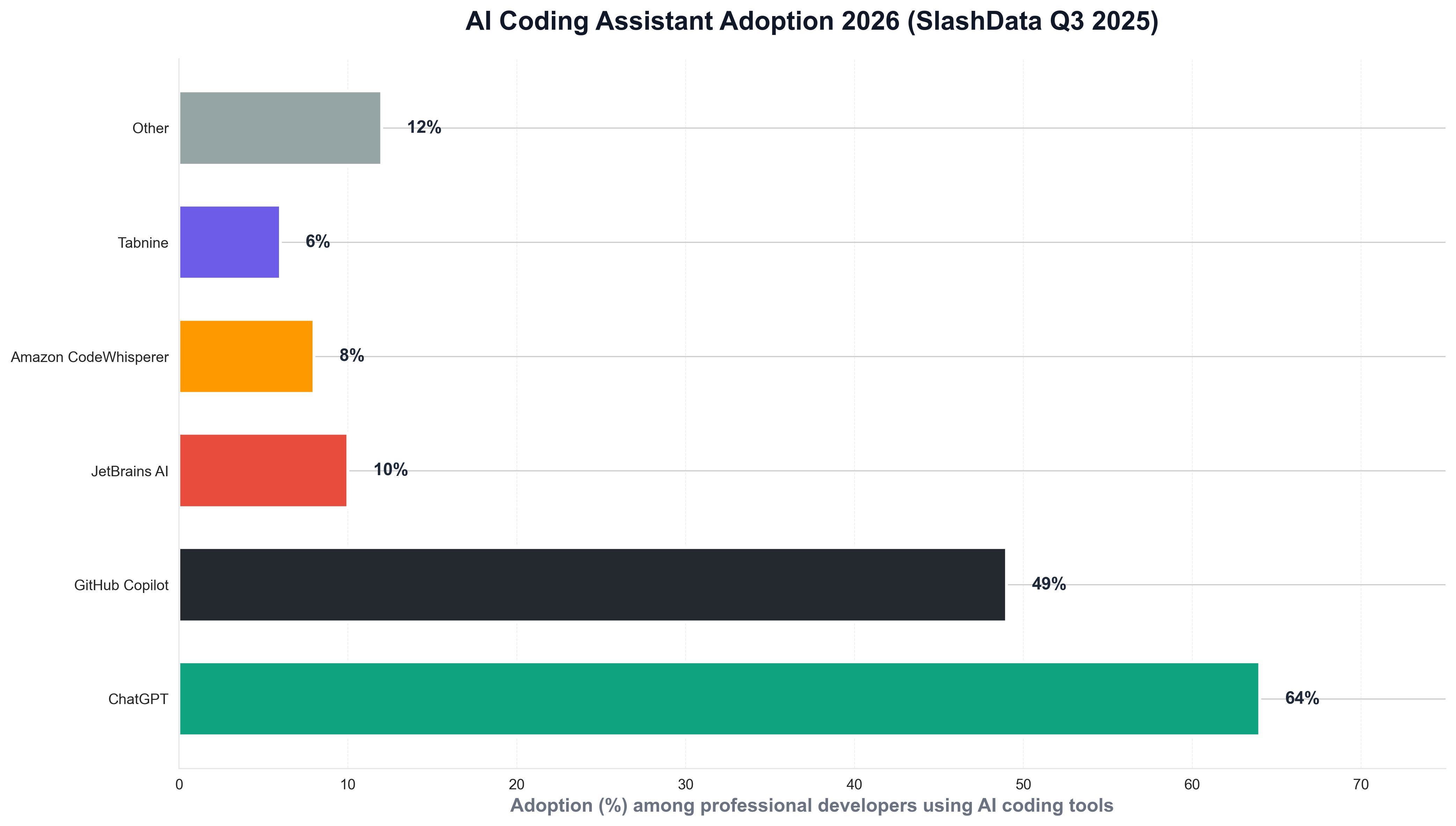
The chart above shows ChatGPT and GitHub Copilot well ahead of other tools, with JetBrains AI and others representing a smaller but growing segment. Python is a natural choice for building such visualizations: data teams and developer-experience teams routinely use Python scripts to pull metrics from APIs or spreadsheets and produce publication-ready charts for internal dashboards or articles like this one.
From 15 Million to 20 Million: Copilot's Scale and Enterprise Penetration
GitHub Copilot has achieved scale that would have been unthinkable a few years ago. According to Thurrott's coverage of Microsoft's April 2025 earnings, Copilot had over 15 million users as of April 30, 2025, with 4x year-over-year growth. By July 2025, TechCrunch reported that Copilot had crossed 20 million all-time users—adding 5 million users in three months. Second Talent's GitHub Copilot statistics roundup adds that 1.3 million paid subscribers and 90% of Fortune 100 companies have adopted the tool, with 50,000+ organizations using it. Enterprise adoption is strongest in technology (90%), banking and finance (80%), insurance (70%), and retail (61%). Copilot's code review feature had already handled over 8 million pull requests by April 2025, and the product had shipped 85 changelogs year-to-date, including Agent Mode in Visual Studio Code, bring-your-own-key options, and Autofix for security vulnerabilities. That trajectory suggests Copilot is not just a convenience feature but a platform that enterprises are standardizing on for code completion, review, and security—with Python and other languages benefiting from the same acceleration.
Productivity Impact: 51% Faster Coding and 88% Code Retention
The business case for AI coding tools rests on measurable productivity gains. Second Talent's GitHub Copilot statistics report that users experience 51% faster coding and 88% code retention—meaning developers accept and keep the vast majority of Copilot suggestions. We Are Tenet's Copilot usage data for 2026 and GitHub's own metrics documentation provide additional context: organizations track acceptance rates, lines of code suggested versus accepted, and time saved per task. These metrics are often aggregated and visualized in-house using Python and libraries such as pandas, matplotlib, or seaborn—for example, a simple script can load acceptance-rate data by language or team and produce a bar chart or time series for engineering leadership. The following visualization, produced with Python, summarizes reported productivity and quality indicators that appear consistently across surveys and case studies.
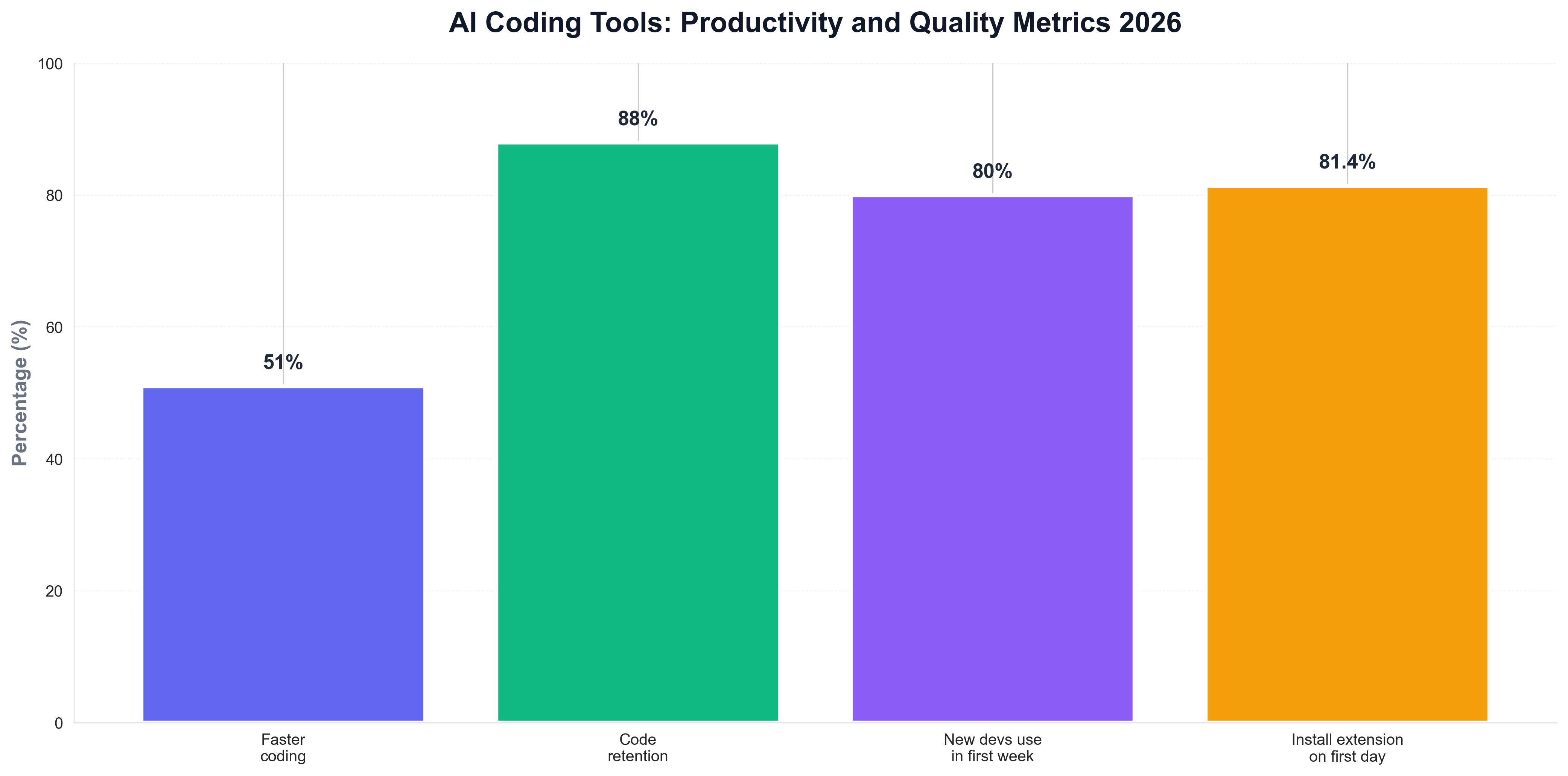
The chart illustrates faster coding, high code retention, and adoption among new developers—all factors that explain why 80% of new developers use Copilot in their first week on GitHub, and 81.4% install the IDE extension on their first day when given a license. Python is again the tool of choice for generating such charts from CSV or API data, keeping analytics and reporting consistent with the rest of the data stack.
Agentic AI in Production: Half of Adopters Have Already Deployed
AI coding tools are no longer confined to experimentation. SlashData's findings state that 50% of professional developers who have adopted AI functionality have already deployed it into production. Top use cases include text generation, summarization, and translation (28%), followed by code generation, documentation, and testing. That shift from "trying it" to "running it in prod" reflects maturity in tooling, guardrails, and organizational policy. At the same time, security and privacy concerns remain a brake: only 25% of professional developers are currently building applications powered by generative AI, and Second Talent notes that 29.1% of Python code generated by Copilot contains potential security weaknesses requiring review. So the story in 2026 is faster adoption and higher impact, but also greater emphasis on review, testing, and security tooling—areas where Python scripts and linters are often used to scan generated code and enforce standards.
Python in the AI Coding Stack: Automation, Metrics, and Visualization
Python appears in the AI coding story in three ways: as a language that developers write with Copilot or ChatGPT, as a language for automation (scripts, CI checks, code analysis), and as a language for data and visualization. JetBrains and the Python Software Foundation's surveys show that Python remains among the most used languages globally, and GitHub's Octoverse places it in the top tier of languages on the platform. When teams want to measure Copilot impact—acceptance rates by repo, time saved, or adoption by team—they often turn to Python and pandas to load telemetry, aggregate by dimension, and then use matplotlib or seaborn to plot trends. A minimal example might look like the following: load a CSV of daily acceptance rates, compute a rolling average, and save a chart to the same directory used for blog or dashboard assets.
import pandas as pd
import matplotlib.pyplot as plt

df = pd.read_csv("copilot_acceptance_by_week.csv")
df["rolling_acceptance"] = df["acceptance_rate"].rolling(4).mean()
fig, ax = plt.subplots(figsize=(10, 5))
ax.plot(df["week"], df["rolling_acceptance"], marker="o", linewidth=2)
ax.set_ylabel("Acceptance rate (%)")
ax.set_title("Copilot suggestion acceptance trend (4-week rolling)")
fig.savefig("public/images/blog/copilot-trend.png", dpi=150, bbox_inches="tight")
plt.close()
That kind of Python script is typical for developer experience and engineering analytics teams: same language as much of their data pipeline, and direct control over chart layout and branding. Python also powers many of the security and quality checks that organizations run on AI-generated code—custom linters, dependency scanners, and regression tests—so from metrics to guardrails, Python is deeply embedded in how teams adopt and govern AI coding tools.
Security, Privacy, and the 29% Problem
Wide adoption has sharpened focus on security and privacy. Second Talent's statistics cite a study finding that 29.1% of Python code generated by Copilot contained potential security weaknesses that required review. That does not mean Copilot is uniquely risky—human-written code also has vulnerabilities—but it does mean that review and testing are non-negotiable when AI suggestions are accepted at 88% rates. Enterprises are addressing this with policy (what code can use AI, what must be reviewed), tooling (static analysis, SAST, dependency checks), and training (secure coding, prompt hygiene). Many of those checks are implemented or orchestrated with Python—custom scripts that call linters, parse output, and fail CI when thresholds are exceeded. Python is also the language of choice for security research and automated vulnerability scanning in many shops, so the same ecosystem that benefits from Copilot for Python code is the one that builds the guardrails around it.
What Separates Leaders from Laggards
Organizations that get the most from AI coding tools tend to do three things: standardize on a small set of tools (e.g., Copilot and ChatGPT), measure impact with clear metrics (acceptance rate, time to ship, satisfaction), and integrate AI into existing workflows (IDE, code review, docs) rather than treating it as a side channel. SlashData's analysis and GitHub's Octoverse both suggest that culture and process matter as much as tool choice: teams that train developers on when to trust AI, when to edit, and when to reject are the ones that see sustained gains. Python fits into that story as the analytics and automation layer—scripting dashboards, acceptance reports, and quality gates so that "AI coding" is not a black box but a measured, improvable part of the pipeline.
Conclusion: AI Coding Assistants as the New Normal
In 2026, AI coding assistants are the new normal for a large and growing share of developers. ChatGPT and GitHub Copilot lead adoption at 64% and 49% among professional developers using AI tools, with Copilot surpassing 15 million and then 20 million users and 90% of Fortune 100 companies adopting it. 51% faster coding and 88% code retention underscore the productivity case, while 50% of AI-adopting developers have already deployed agentic AI to production. Security and review remain critical—29.1% of AI-generated Python code in one study had potential weaknesses—and organizations that combine tool adoption, metrics, and guardrails are pulling ahead. Python is central to that story: the language developers write with AI, the language used to visualize adoption and impact, and the language used to automate checks and govern AI-generated code. Teams that treat AI coding as a measured, integrated part of the workflow—with Python in the loop for analytics and automation—are well positioned to ship faster and safer in 2026 and beyond.