
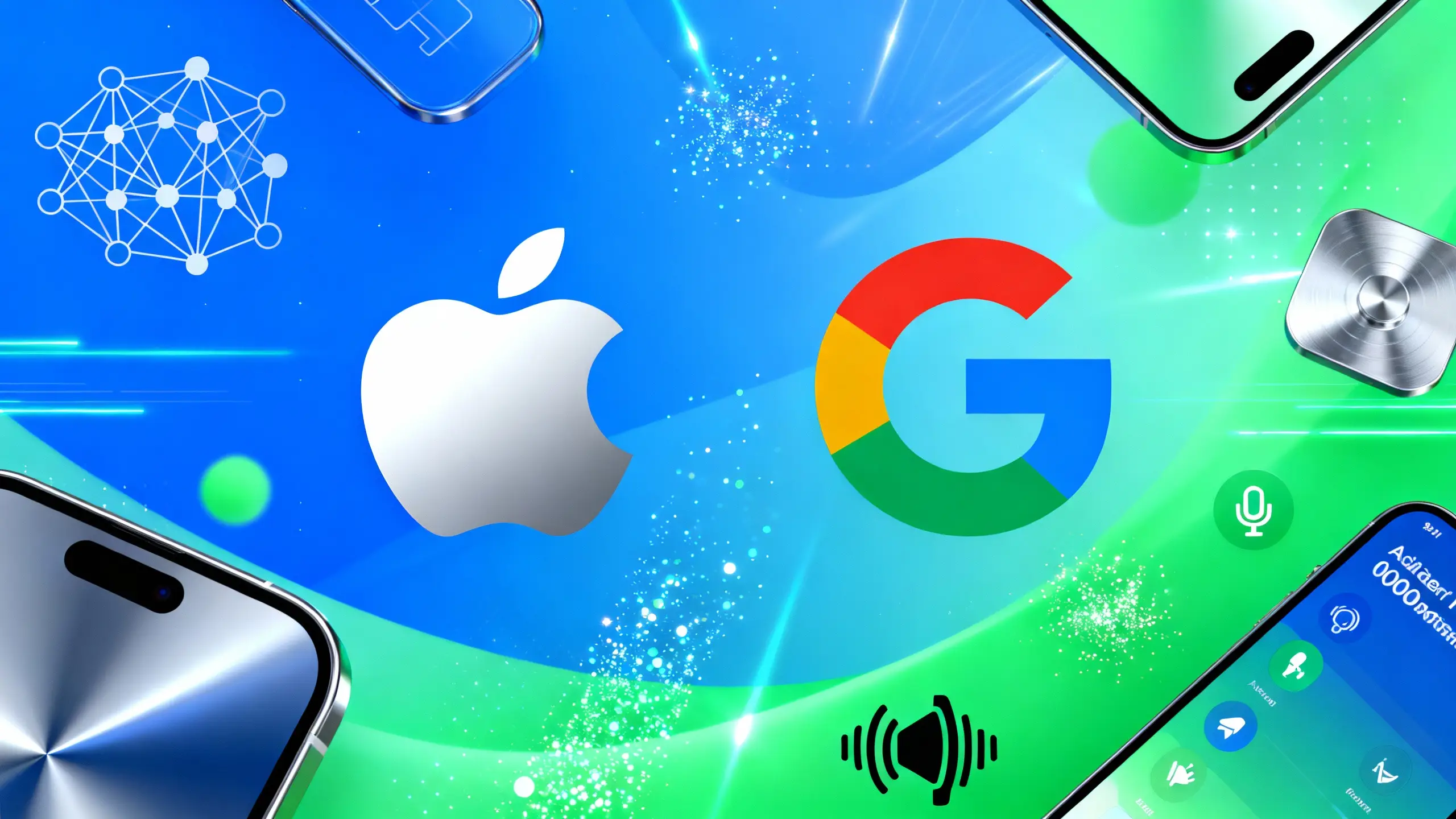
In what industry analysts are calling one of the most significant AI partnerships of 2026, Apple has announced a multi-year agreement with Google to power its next-generation Siri using Google's Gemini AI models. The deal, reportedly valued at up to $5 billion according to sources cited by the Financial Times, represents a strategic pivot that could reshape the entire voice assistant market while highlighting Apple's struggles to develop competitive in-house AI capabilities.
The partnership, announced in January 2026, will see Apple paying Google approximately $1 billion annually for access to Gemini's advanced language models, as reported by Bloomberg. This decision comes after Apple evaluated multiple AI providers, ultimately choosing Google's technology over OpenAI's ChatGPT – despite Apple's existing use of ChatGPT in other iOS features.
"Google's technology provides the most capable foundation for Apple Foundation Models," Apple stated in its announcement, signaling a major validation of Google's AI capabilities after earlier missteps with products like Bard.
The Strategic Shift: Why Apple Chose Gemini
Apple's decision to partner with Google rather than OpenAI represents a calculated strategic move with far-reaching implications. After careful evaluation, Apple determined that Gemini offered superior capabilities for its vision of an AI-powered Siri, particularly in areas like personalization, on-screen awareness, and natural language understanding.
According to Ars Technica, Apple will use a 1.2 trillion parameter AI model to power the new Siri version, running on Apple's Private Cloud Compute servers to ensure user data remains isolated from Google's infrastructure.
Why Gemini Won Over ChatGPT
The choice of Gemini over ChatGPT reflects several key factors:
Technical Superiority: Over the past year, Gemini has overtaken ChatGPT in various benchmarks and rankings, particularly in multimodal capabilities and reasoning tasks. Mashable reports that Gemini's performance in complex reasoning and code generation tasks has consistently outperformed ChatGPT in recent evaluations.
Enterprise Readiness: Google's infrastructure and enterprise-grade AI services provide Apple with the scalability and reliability needed for a service that will serve billions of devices worldwide. The partnership includes access to Google's cloud technology, which Apple will use to develop its own Apple Foundation Models.
Privacy Architecture: Perhaps most critically, Google's architecture allows for better integration with Apple's privacy-first approach. The Gemini model will run on Apple's Private Cloud Compute servers, ensuring that user data remains "walled off from Google's infrastructure," as The Verge explains.
Non-Exclusive Flexibility: The partnership is non-exclusive, allowing Apple to continue using ChatGPT in other iOS features while leveraging Gemini for Siri. This flexibility gives Apple room to experiment and potentially develop its own in-house models in the future.
The Financial Stakes: A $5 Billion Market Reshaping
The financial dimensions of this deal are staggering. With a potential value of up to $5 billion over the partnership's lifetime, this represents one of the largest AI licensing agreements in tech history. The annual payment of approximately $1 billion to Google provides context for the scale of Apple's commitment.
For Google, this deal represents a massive validation of its AI strategy. After the rocky launch of Bard in 2023 and subsequent rebranding to Gemini, Google has been working to position itself as a leader in enterprise AI. The Apple partnership serves as a powerful endorsement that could attract other major tech companies.
Fortune notes that this deal "highlights the iPhone maker's own AI struggles and could spell trouble for OpenAI," suggesting that Google's win here could shift the competitive balance in the AI market.
Market Impact on Voice Assistants
The voice assistant market, which has been relatively stagnant in recent years, could see significant disruption from this partnership. According to Digitimes, the Apple-Google AI partnership could reshape the entire voice assistant market, potentially valuing the sector at up to $5 billion in new opportunities.
Current market leaders like Amazon's Alexa and Microsoft's Cortana have struggled to gain meaningful market share, while Google Assistant and Siri have dominated. This partnership could create a new dynamic where Google's AI technology powers both Android devices (through Google Assistant) and iOS devices (through Siri), potentially giving Google unprecedented influence over the voice assistant ecosystem.
Siri's Transformation: From Simple Assistant to AI Chatbot
The most visible impact of this partnership will be the fundamental transformation of Siri itself. The updated Siri, set to launch later in 2026, will evolve from a relatively limited voice assistant into a full-featured AI chatbot with dramatically expanded capabilities.
New Capabilities Coming to Siri
According to PYMNTS, the new Siri will include web search functionality enabling comprehensive answers to complex queries, content creation allowing users to ask Siri to write emails, create documents, or generate creative content, image generation with integration of AI image generation capabilities, file analysis enabling Siri to analyze documents, spreadsheets, and other files, natural conversations with more personalized, context-aware interactions that feel like talking to a human assistant, and deep app integration with Siri integrated into core apps like Mail, Music, Photos, and Messages.
Users will activate the new Siri by saying "Siri" or holding the side button on iPhones, iPads, and Macs, maintaining the familiar interaction model while dramatically expanding capabilities.
Personalization and On-Screen Awareness
One of the most significant improvements will be Siri's enhanced personalization and on-screen awareness. The new Siri will understand context from what's displayed on the user's screen, allowing for more relevant and helpful responses. For example, if a user is viewing a recipe, Siri could offer to add ingredients to a shopping list or set a timer for cooking steps.
This level of contextual understanding represents a major leap forward from current voice assistants, which typically operate in relative isolation from the user's current activity.
Privacy Architecture: Apple's Unique Approach
Despite using Google's backend AI technology, Apple maintains its privacy-first approach through a sophisticated architecture that keeps user data separate from Google's infrastructure.
Private Cloud Compute
The Gemini model will run on Apple's Private Cloud Compute servers, ensuring that user queries and personal data never touch Google's servers directly. This architecture allows Apple to leverage Google's advanced AI capabilities while maintaining its commitment to user privacy.
ZDNet explains that this setup means "user data remains walled off from Google's infrastructure," addressing one of the primary concerns about the partnership. Apple Intelligence features will continue running on Apple devices and Private Cloud Compute while maintaining Apple's privacy standards.
The Privacy Paradox
This arrangement creates an interesting paradox: Apple is using Google's AI technology while maintaining that user data doesn't flow to Google. The technical implementation involves Apple running Google's models on its own infrastructure, with data processing happening in Apple's secure cloud environment.
This approach allows Apple to benefit from Google's AI advancements without compromising its privacy positioning, though it requires significant infrastructure investment on Apple's part.
Competitive Implications: Winners and Losers
The Apple-Google partnership creates clear winners and losers in the AI landscape, with implications that extend far beyond these two companies.
Google: The Clear Winner
For Google, this deal represents a massive strategic victory. After years of playing catch-up to OpenAI in the consumer AI space, Google has secured a partnership with one of the world's most valuable companies, validating its Gemini technology and creating a substantial new revenue stream.
Fortune notes that this "highlights Google's big win in AI" and positions the company as a leader in enterprise AI partnerships. The deal could attract other major tech companies looking to integrate advanced AI capabilities.
OpenAI: Facing Increased Competition
For OpenAI, Apple's choice of Gemini over ChatGPT represents a significant competitive setback. While Apple continues to use ChatGPT in other iOS features, losing the Siri partnership to Google is a major blow.
The decision suggests that despite ChatGPT's early lead in consumer AI, Google's Gemini has caught up or surpassed it in key areas relevant to enterprise partnerships. This could impact OpenAI's ability to secure similar high-value partnerships with other tech giants.
Apple: Addressing the AI Gap
For Apple, this partnership addresses a critical weakness: the company's late entry into advanced AI development. While competitors like Google, Microsoft, and OpenAI have been rapidly advancing their AI capabilities, Apple has been relatively quiet, leading to concerns that the company was falling behind.
CNN reports that this move "addresses concerns about the company falling behind competitors in AI development," though it also "highlights Apple's struggles to develop competitive in-house AI models."
The partnership buys Apple time to develop its own AI capabilities while ensuring Siri remains competitive in the short term. However, it also creates a dependency on Google that Apple will likely want to reduce over time.
The Android-iOS Dynamic
This partnership creates an interesting dynamic in the mobile ecosystem. Google's AI technology will now power both Android devices (through Google Assistant) and iOS devices (through Siri), potentially creating a unified AI experience across platforms.
However, this could also raise concerns about Google's influence over the mobile AI landscape. Regulators may scrutinize whether this partnership gives Google too much control over how AI assistants function across different platforms.
Technical Implementation: How It Works
The technical architecture of this partnership is sophisticated, involving multiple layers of integration between Apple's ecosystem and Google's AI models.
Model Architecture
Apple will use a 1.2 trillion parameter AI model based on Google's Gemini technology. This massive model will be fine-tuned specifically for Siri's use cases, including voice interaction, personalization, and app integration.
The model will run on Apple's Private Cloud Compute infrastructure, which uses Apple Silicon chips (likely M-series processors) optimized for AI workloads. This allows Apple to maintain control over the hardware while leveraging Google's model architecture.
Integration Points
The integration involves several key components:
- Voice Processing: Siri's voice recognition and natural language understanding will be enhanced by Gemini's capabilities
- Context Awareness: Gemini's multimodal capabilities will enable Siri to understand on-screen content and user context
- Personalization Engine: Google's personalization technology will help Siri learn user preferences and adapt responses
- Knowledge Base: Access to Google's vast knowledge graph will improve Siri's ability to answer questions accurately
Development Timeline
The updated Siri is set to launch later in 2026, giving Apple and Google time to integrate the systems properly. The development process involves:
- Fine-tuning Gemini models for Siri-specific use cases
- Building the Private Cloud Compute infrastructure to run the models
- Integrating with iOS, iPadOS, and macOS
- Extensive testing to ensure privacy and security standards are met
Market Reaction and Analyst Perspectives
The announcement has generated significant reaction from industry analysts and market observers, with opinions ranging from enthusiastic to cautious.
Bullish Perspectives
Many analysts see this as a win-win partnership that addresses both companies' strategic needs. TechCrunch notes that the partnership "could reshape voice assistant market," creating new opportunities for both companies.
The deal is seen as validating Google's AI strategy after initial struggles, while giving Apple access to cutting-edge AI without the years of development time required to build it in-house.
Cautious Perspectives
Some analysts express concern about Apple's increasing dependence on Google, particularly given the companies' competitive relationship in other areas like search (where Google pays Apple billions annually to be the default search engine).
Digital Trends questions whether this partnership creates "too much reliance on a competitor," noting that Apple may struggle to differentiate Siri from Google Assistant if both are powered by the same underlying technology.
Regulatory Considerations
The partnership may face regulatory scrutiny, particularly in Europe where both companies have faced antitrust challenges. Regulators may question whether this partnership reduces competition in the AI assistant market or gives Google too much influence over mobile AI experiences.
The non-exclusive nature of the partnership may help address some concerns, as Apple maintains the ability to work with other AI providers or develop its own technology.
The Future of Apple's AI Strategy
While this partnership addresses Apple's immediate AI needs, it also raises questions about the company's long-term AI strategy.
In-House Development
Apple has made it clear that this partnership is a stepping stone, not a permanent solution. The company continues to invest heavily in developing its own AI models, with the goal of eventually reducing or eliminating dependence on third-party providers.
Ars Technica reports that Apple "still hopes to develop competitive in-house language models to eventually replace third-party solutions," suggesting this partnership is a bridge to Apple's own AI future.
Apple Foundation Models
The partnership includes provisions for Apple to use Google's technology to develop its own "Apple Foundation Models." This suggests Apple is learning from Google's approach while building its own capabilities, potentially using the partnership as a training ground for its internal AI development.
Competitive Positioning
Long-term, Apple will need to balance its relationship with Google against its desire for technological independence. The company's history suggests it prefers to control its own technology stack, making this partnership somewhat unusual in Apple's strategy.
However, the urgency of catching up in AI may have necessitated this pragmatic approach, with Apple prioritizing speed to market over complete independence.
Impact on Developers and the Ecosystem
The partnership will have significant implications for developers building apps and services that integrate with Siri.
Enhanced SiriKit Capabilities
Developers using SiriKit to integrate their apps with Siri will benefit from the enhanced AI capabilities. The new Siri will be able to understand more complex queries and provide better context awareness, enabling richer app integrations.
New Development Opportunities
The transformation of Siri into a full AI chatbot opens new opportunities for developers to create more sophisticated voice and AI-powered experiences. Apps that previously couldn't leverage Siri effectively may now find new use cases.
Privacy Considerations
Developers will need to understand how the new privacy architecture affects their integrations. While user data remains private, the enhanced capabilities may require developers to adjust how they handle Siri interactions and data sharing.
Consumer Impact: What Users Can Expect
For end users, the partnership promises a dramatically improved Siri experience, but the changes will be gradual as the new system rolls out later in 2026.
Immediate Benefits
Once the updated Siri launches, users can expect:
- More accurate and helpful responses to complex questions
- Better understanding of context and user intent
- More natural, conversational interactions
- Enhanced integration with apps and services
- Improved personalization based on usage patterns
Privacy Assurance
Apple has been clear that user privacy remains a priority, with the Private Cloud Compute architecture ensuring that personal data doesn't flow to Google. However, users may still have concerns about the partnership, and Apple will need to communicate clearly about how privacy is maintained.
Competitive Pressure
The improved Siri will put pressure on other voice assistants to keep up. Amazon's Alexa, Microsoft's Cortana, and other assistants will need to enhance their capabilities to remain competitive, potentially accelerating innovation across the entire voice assistant market.
Conclusion: A Watershed Moment in AI
The Apple-Google Gemini partnership represents a watershed moment in the evolution of AI assistants and the broader technology landscape. With a potential value of $5 billion, this deal signals that AI capabilities have become so critical that even Apple – a company known for controlling its own technology – is willing to partner with a competitor to stay competitive.
For Google, this partnership validates years of AI investment and positions the company as a leader in enterprise AI partnerships. For Apple, it provides a bridge to competitive AI capabilities while the company develops its own solutions. For the industry, it demonstrates the accelerating pace of AI adoption and the high stakes involved in staying competitive.
The transformation of Siri from a simple voice assistant to a full AI chatbot powered by Google's Gemini will reshape how millions of users interact with their devices. The enhanced capabilities, improved personalization, and deeper app integration promise to make Siri more useful than ever before.
However, the partnership also raises important questions about competition, privacy, and technological independence. As Apple and Google navigate this complex relationship, the tech industry will be watching closely to see how this partnership evolves and what it means for the future of AI assistants.
One thing is certain: the voice assistant market, which had grown relatively stagnant, is about to experience a major shakeup. The Apple-Google partnership ensures that 2026 will be remembered as the year when AI assistants truly came of age, powered by partnerships that would have seemed unthinkable just a few years ago.
The question now is not whether AI will transform how we interact with our devices – that transformation is already underway. The question is whether Apple, Google, and their competitors can navigate this new landscape in a way that benefits users while maintaining healthy competition and innovation. The stakes have never been higher, and the partnership between Apple and Google ensures that the race to build the best AI assistant is just getting started.