

C# was named TIOBE Programming Language of the Year for 2025—the second time in three years—and holds 5th place in the January 2026 index with a 7.39% rating. According to the TIOBE Index for January 2026 and InfoWorld's report on C# winning TIOBE Language of the Year 2025, C# achieved the largest year-over-year increase among all languages, gaining 2.94 percentage points compared to the previous year. i-programmer's coverage and TechRepublic's TIOBE January 2026 top 10 add that C# successfully completed two major shifts: from Windows-only to cross-platform and from Microsoft-owned to open source. TIOBE CEO Paul Jansen said C# has "often been an early adopter of new trends among mainstream languages" and "has consistently evolved at the right moment." Python is the tool many teams use to visualize TIOBE and language-trend data for reports like this one. This article examines why C# won Language of the Year again, how it stands against Java and Python, and how Python powers the charts that tell the story.
TIOBE Language of the Year 2025: The 2.94-Point Gain
C#’s Language of the Year win was driven by the largest year-over-year rating increase in the TIOBE Index. The TIOBE Index and InfoWorld report 7.39% for C# in January 2026, with a +2.94 percentage point gain over the prior year—the biggest move of any language. The award goes to the language with the largest such increase; C# previously won in 2023, and Python still holds the record for most Language of the Year wins (six) but declined 4.37% in 2025 despite reaching an all-time high of 26.98% in July 2025. The following chart, generated with Python and matplotlib using TIOBE-style data, illustrates top language ratings (Python, C, Java, C++, C#, etc.) in the January 2026 index.
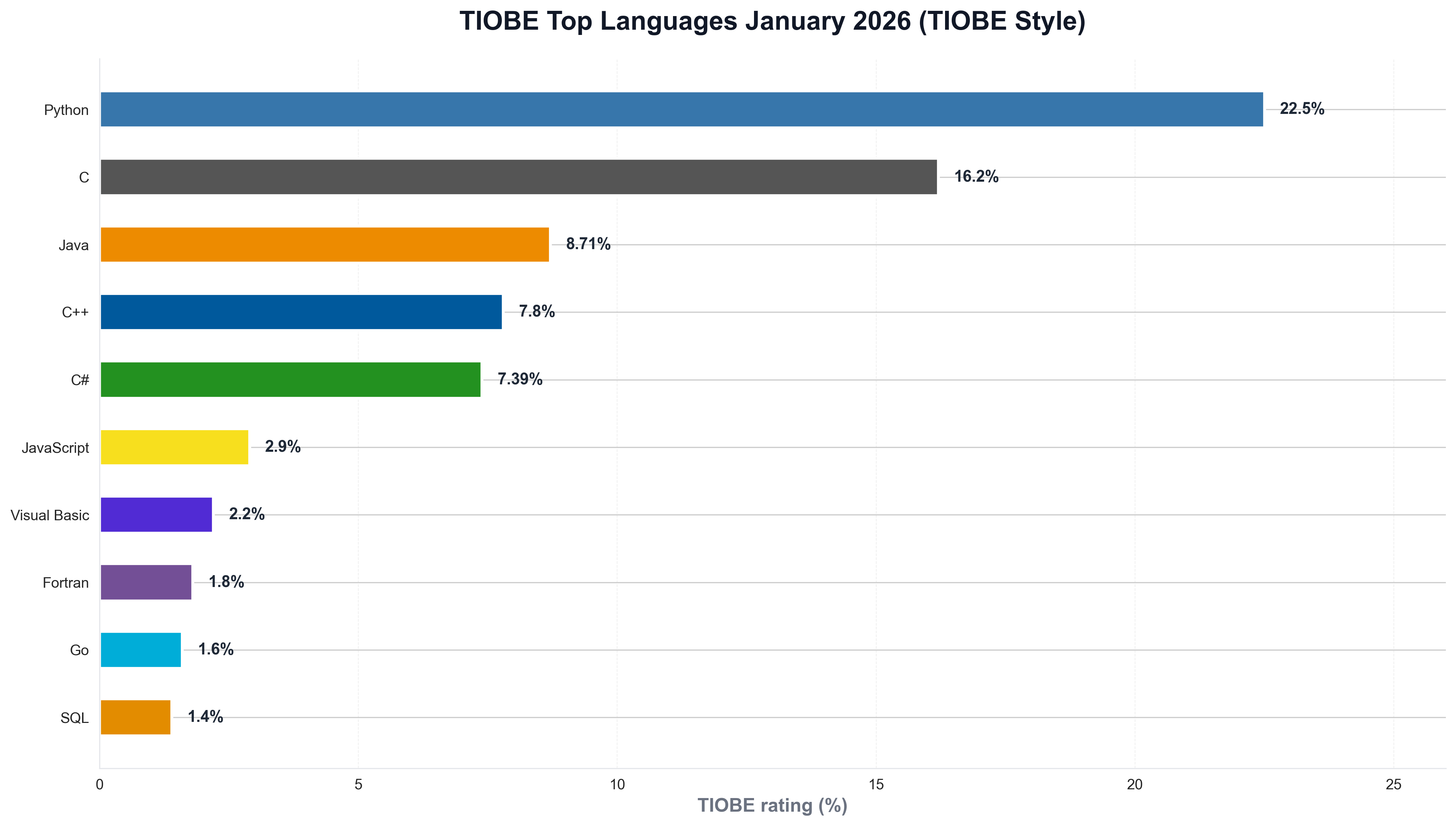
The chart shows C# at 5th with 7.39%—behind Python, C, Java, and C++ but ahead of JavaScript and others—reflecting its strong position in enterprise and cross-platform development. Python is the natural choice for building such visualizations: data and developer-relations teams routinely use Python scripts to load TIOBE or survey data and produce publication-ready charts for reports and articles like this one.
5th Place, 7.39%: C# vs Java and the Business-Software Race
C#’s 5th place and 7.39% rating put it in direct competition with Java for dominance in business software. The TIOBE Index January 2026 and TechRepublic report Java in 3rd place with 8.71%; the contest between the two "remains undecided." InfoWorld quotes Jansen questioning whether Java’s "verbose, boilerplate-heavy style and Oracle ownership" can continue to hold off C#. .NET is now cross-platform (Linux, macOS, Windows) and open source, and C# has gained in cloud, game development (Unity), and enterprise back-ends. When teams need to visualize language ratings over time—C# vs Java or vs Python—they often use Python and matplotlib or seaborn. The following chart, produced with Python, summarizes C# rating growth (and selected peers) in a TIOBE-style trend.
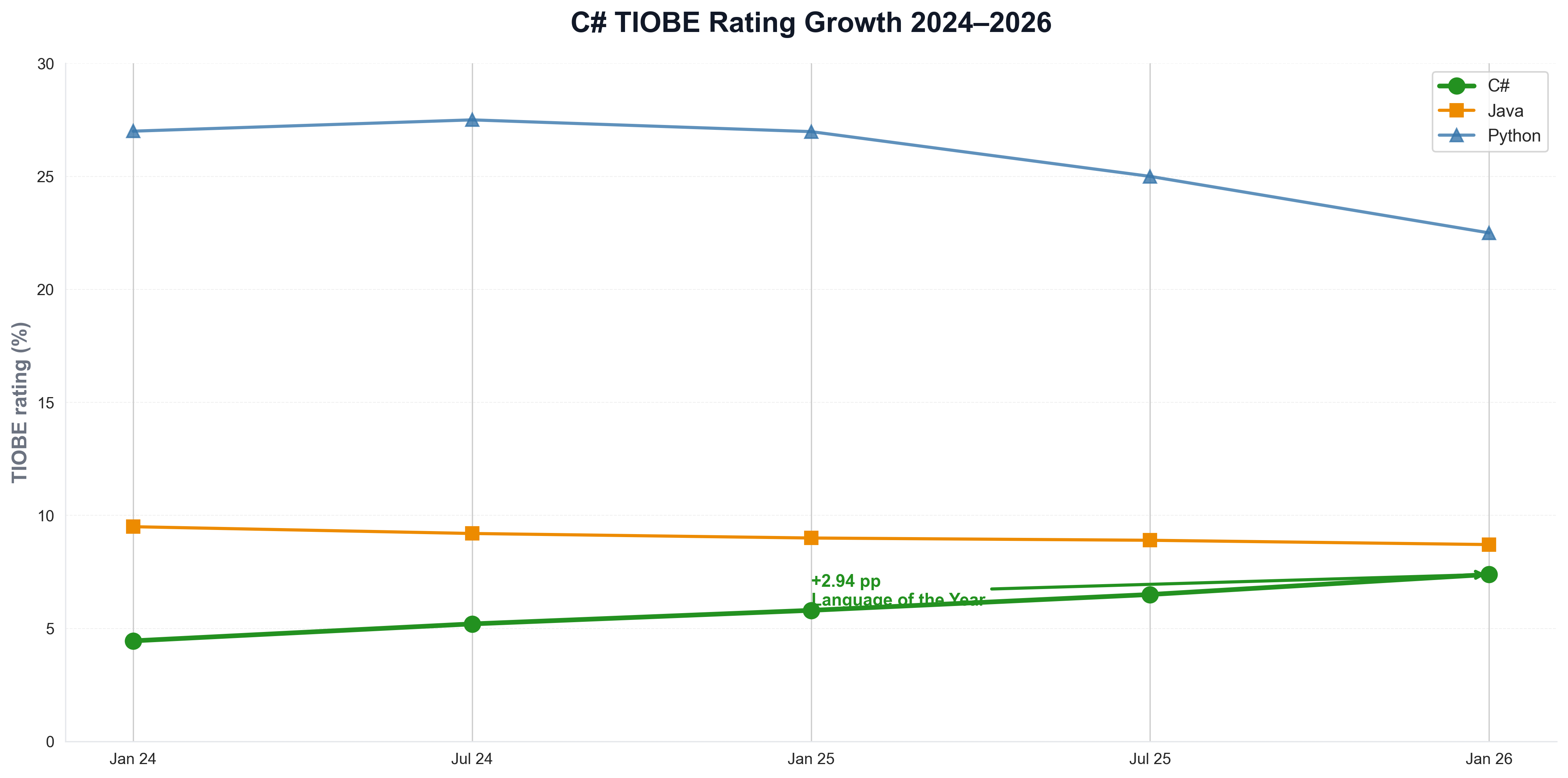
The chart illustrates C#’s steady gain and Language of the Year trajectory—context that explains why TIOBE and industry watchers are focusing on C# again. Python is again the tool of choice for generating such charts from TIOBE or other index data, keeping analytics consistent with the rest of the data stack.
Cross-Platform and Open Source: Why C# Won
The business case for C#’s rise is cross-platform and open source. InfoWorld and i-programmer describe C# as having made two major paradigm shifts: from Windows-only to cross-platform (via .NET Core and .NET 5+) and from Microsoft-owned to open source (.NET Foundation, GitHub). That has broadened adoption in Linux and cloud environments and in game development (Unity uses C#). For teams that track language rankings or TIOBE over time, Python is often used to load index or survey data and plot trends. A minimal example might look like the following: load a CSV of TIOBE ratings by language and year, and save a chart for internal or public reporting.
import pandas as pd
import matplotlib.pyplot as plt

df = pd.read_csv("tiobe_csharp_java.csv")
fig, ax = plt.subplots(figsize=(10, 5))
ax.plot(df["month"], df["csharp"], marker="o", linewidth=2, color="#239120", label="C#")
ax.plot(df["month"], df["java"], marker="s", linewidth=2, color="#ed8b00", label="Java")
ax.set_ylabel("TIOBE rating (%)")
ax.set_title("C# vs Java TIOBE rating (2024–2026)")
ax.legend()
fig.savefig("public/images/blog/csharp-vs-java-tiobe.png", dpi=150, bbox_inches="tight")
plt.close()
That kind of Python script is typical for developer relations and data teams: same language used for pipelines and dashboards, and direct control over chart layout and messaging.
Python, Java, and the Rest of the Top 10
C# does not exist in isolation. The TIOBE Index January 2026 ranks Python 1st (despite its 2025 decline), C 2nd, Java 3rd (8.71%), C++ 4th, and C# 5th (7.39%). JavaScript, Visual Basic, Fortran, Go, and SQL round out a shifting top 10; TIOBE notes that Go permanently lost its top 10 position in 2025, while Rust reached an all-time high of 13th and Zig climbed from 61st to 42nd. C#’s Language of the Year win reflects relative momentum—the largest gain—not raw share; Python still leads by rating. Python is the language many use to analyze TIOBE data and visualize language trends for reports like this one.
Conclusion: C# as Language of the Year Again in 2026
In 2026, C# holds TIOBE Programming Language of the Year for 2025: 7.39% rating, 5th place in the January 2026 index, and a +2.94 percentage point year-over-year gain—the largest of any language. Cross-platform and open source have broadened C#’s appeal; the race with Java (3rd, 8.71%) for business software "remains undecided." Python remains the language that powers the analytics—TIOBE data, language comparisons, and the visualizations that explain the story—so that for Google News and Google Discover, the story in 2026 is clear: C# is Language of the Year again, and Python is how many of us chart it.