


The cloud computing industry has reached a critical inflection point in 2026, with the global market value exceeding $800 billion and showing no signs of slowing down. Amazon Web Services (AWS) continues to dominate with approximately 32% market share, but Microsoft Azure has closed the gap significantly to 23%, while Google Cloud Platform maintains a strong third position at 11%. The remaining 34% is distributed among smaller providers including Oracle Cloud, IBM Cloud, Alibaba Cloud, and regional players. This competitive landscape reflects fundamental shifts in enterprise technology strategy, with organizations increasingly adopting multi-cloud approaches and demanding more sophisticated AI and analytics capabilities from their cloud providers.
According to Gartner's latest cloud market analysis, the infrastructure-as-a-service (IaaS) and platform-as-a-service (PaaS) markets have grown by 28% year-over-year in 2026, driven primarily by enterprise digital transformation initiatives, AI workload migration, and the expansion of edge computing infrastructure. The three major cloud providers have collectively invested over $150 billion in data center infrastructure and global network expansion over the past two years, creating unprecedented capacity and geographic coverage.
AWS: Maintaining Market Leadership Through Innovation
Amazon Web Services remains the undisputed leader in cloud computing, with revenue exceeding $100 billion annually and serving millions of active customers worldwide. AWS's market dominance stems from its first-mover advantage, comprehensive service portfolio spanning over 200 services, and relentless innovation in areas like AI/ML, serverless computing, and edge computing. The platform's global infrastructure includes 33 geographic regions with 105 availability zones, providing unmatched reliability and low-latency access for enterprise customers.
According to AWS's Q4 2025 earnings report, the cloud division generated $28.5 billion in revenue during the quarter, representing 20% year-over-year growth. This growth rate, while impressive, has slowed from previous years as the market matures and competition intensifies. AWS's strategy focuses on expanding its AI and machine learning services, with investments in custom AI chips like Trainium and Inferentia, and the launch of Amazon Bedrock for enterprise AI model deployment.
AWS's customer base includes over 1.5 million active customers, ranging from startups to Fortune 500 enterprises. The platform's strength lies in its breadth of services, from compute and storage to specialized offerings like IoT, blockchain, and quantum computing. However, AWS faces increasing pressure from Microsoft Azure's enterprise integration advantages and Google Cloud's superior AI and data analytics capabilities.
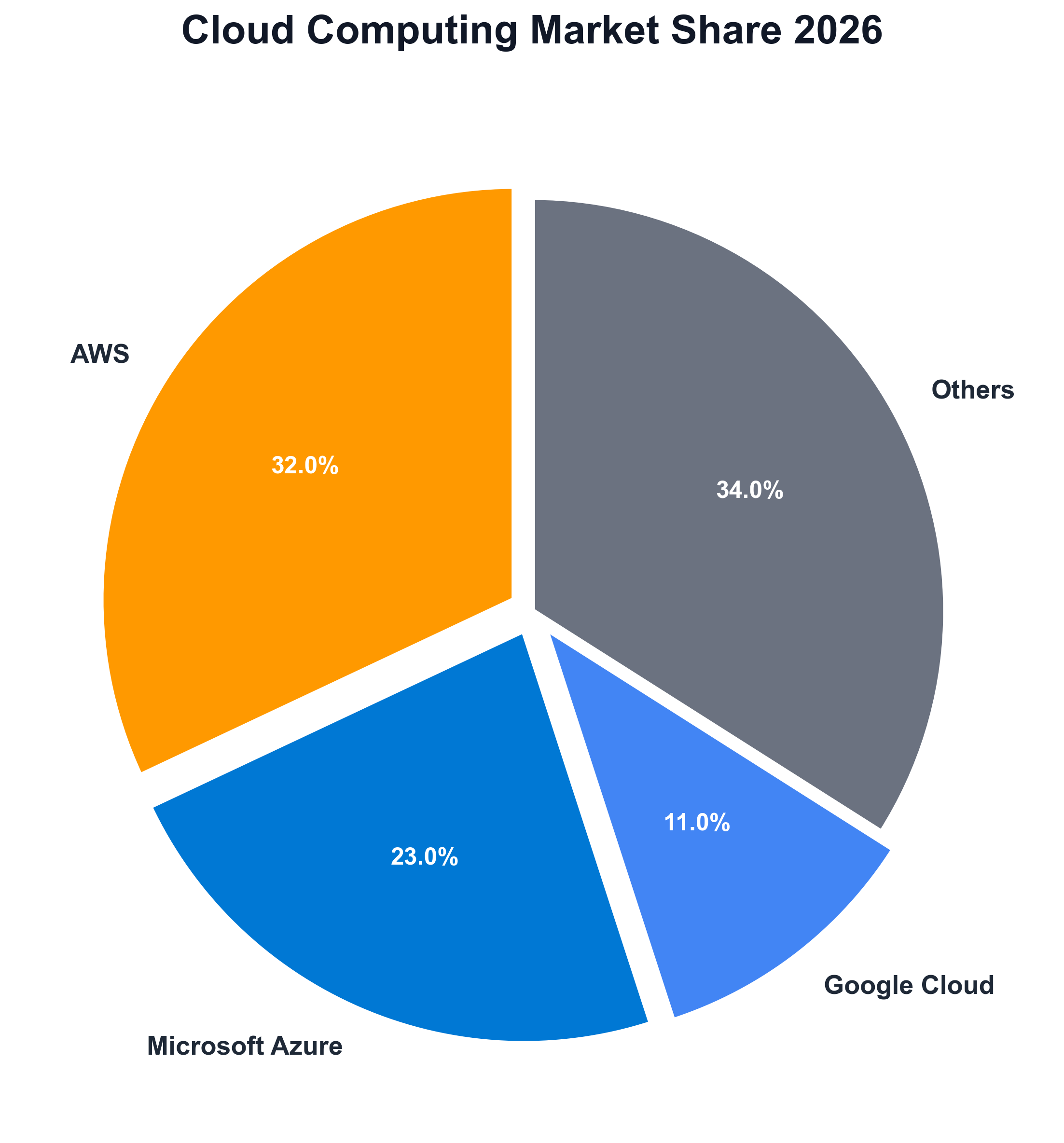
The chart above illustrates the current market share distribution, showing AWS's significant lead while highlighting the competitive pressure from Azure and Google Cloud. The data reveals that while AWS maintains its position, the gap between the top three providers has narrowed considerably compared to previous years.
Microsoft Azure: Enterprise Integration Drives Rapid Growth
Microsoft Azure has emerged as AWS's most formidable competitor, leveraging its deep integration with Microsoft 365, Dynamics 365, and the broader Microsoft enterprise ecosystem. Azure's market share has grown from 20% in 2024 to 23% in 2026, driven primarily by enterprise customers who already rely on Microsoft's productivity and business applications. This integration advantage has proven particularly valuable for large organizations seeking unified cloud and software solutions.
According to Microsoft's fiscal year 2026 Q2 results, Azure revenue grew by 31% year-over-year, significantly outpacing AWS's growth rate. Microsoft's Intelligent Cloud segment, which includes Azure, generated $33.7 billion in revenue during the quarter. The company's strategy emphasizes hybrid cloud solutions, industry-specific cloud offerings, and AI services built on OpenAI partnerships, positioning Azure as the preferred platform for enterprises undergoing digital transformation.
Azure's global infrastructure spans 60+ regions with 200+ data centers, providing comprehensive coverage for enterprise customers with strict data residency and compliance requirements. The platform's strength in hybrid cloud deployments, through Azure Arc and Azure Stack, has resonated with organizations that need to maintain on-premises infrastructure while gradually migrating to the cloud. Microsoft's acquisition strategy, including recent purchases of cloud-native companies and AI startups, has further strengthened Azure's competitive position.
The platform's growth has been particularly strong in regulated industries like healthcare, financial services, and government, where Microsoft's enterprise relationships and compliance certifications provide significant advantages. Azure's integration with Microsoft Teams, Office 365, and Power Platform creates a cohesive ecosystem that many enterprises find more compelling than AWS's more fragmented service approach.
Google Cloud: AI and Analytics Leadership
Google Cloud Platform has established itself as the third major player in the cloud computing market, with 11% market share and strong positioning in AI, machine learning, and data analytics. While Google Cloud's overall market share is smaller than AWS and Azure, the platform has carved out significant niches in industries that prioritize data analytics, AI workloads, and open-source technologies. Google Cloud's revenue reached $12.5 billion in Q4 2025, representing 26% year-over-year growth.
According to Alphabet's earnings report, Google Cloud achieved profitability for the first time in 2025 and has maintained positive operating margins through 2026. This milestone reflects Google's strategic focus on enterprise customers and high-value services rather than competing solely on price. The platform's strengths include advanced AI and ML capabilities through Vertex AI, superior data analytics with BigQuery, and strong support for Kubernetes and containerized workloads.
Google Cloud's infrastructure includes 39 regions with 118 zones, providing global coverage that rivals AWS and Azure. The platform's network infrastructure, built on Google's private fiber network, offers exceptional performance for data-intensive workloads. Google Cloud has also invested heavily in sustainability, committing to 100% carbon-free energy by 2030 and achieving carbon-neutral operations ahead of competitors.
The platform's competitive positioning focuses on AI-first workloads, data analytics, and open-source technologies. Google Cloud's partnerships with major enterprise software vendors and its acquisition strategy, including recent purchases of data analytics and security companies, have strengthened its enterprise appeal. However, Google Cloud faces challenges in competing with AWS's service breadth and Azure's enterprise integration advantages.
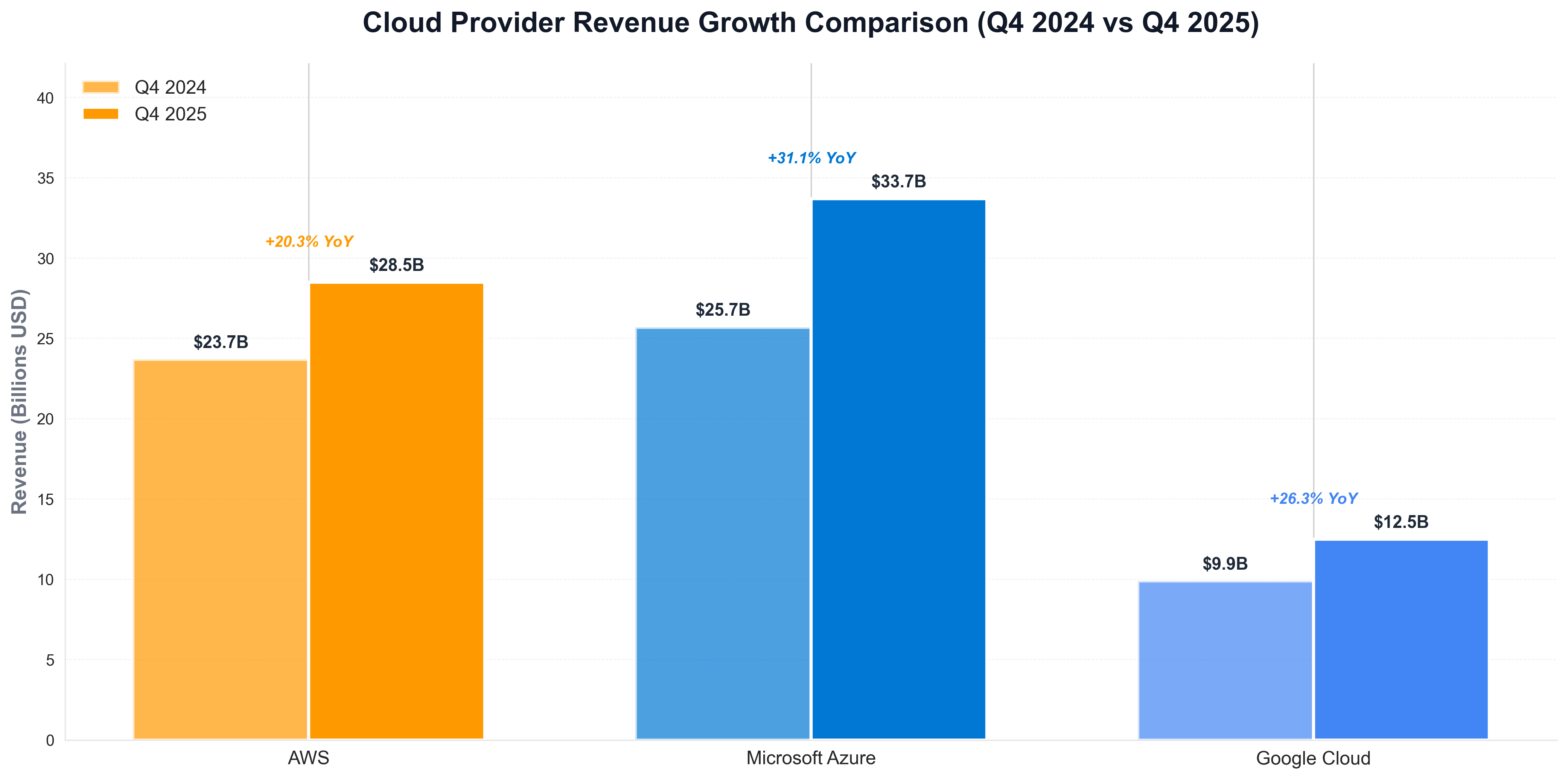
The revenue growth comparison chart demonstrates the competitive dynamics, with Azure showing the strongest growth rate while AWS maintains the largest absolute revenue. Google Cloud's growth trajectory, while slower than Azure's, reflects its strategic focus on profitability and high-value enterprise customers.
Regional Market Variations and Emerging Trends
The cloud computing market shows significant regional variations that reflect different regulatory environments, data sovereignty requirements, and competitive dynamics. In North America, AWS maintains the strongest position with 35% market share, followed by Azure at 25% and Google Cloud at 12%. The region's mature cloud adoption and large enterprise customer base have driven intense competition among all three providers.
According to IDC's regional cloud market analysis, the European cloud market has grown by 32% year-over-year, with Azure gaining significant traction due to its data residency guarantees and GDPR compliance features. Azure holds 28% market share in Europe, closely trailing AWS at 30%, while Google Cloud maintains 10%. The region's strict data protection regulations have created opportunities for providers that can demonstrate strong compliance capabilities.
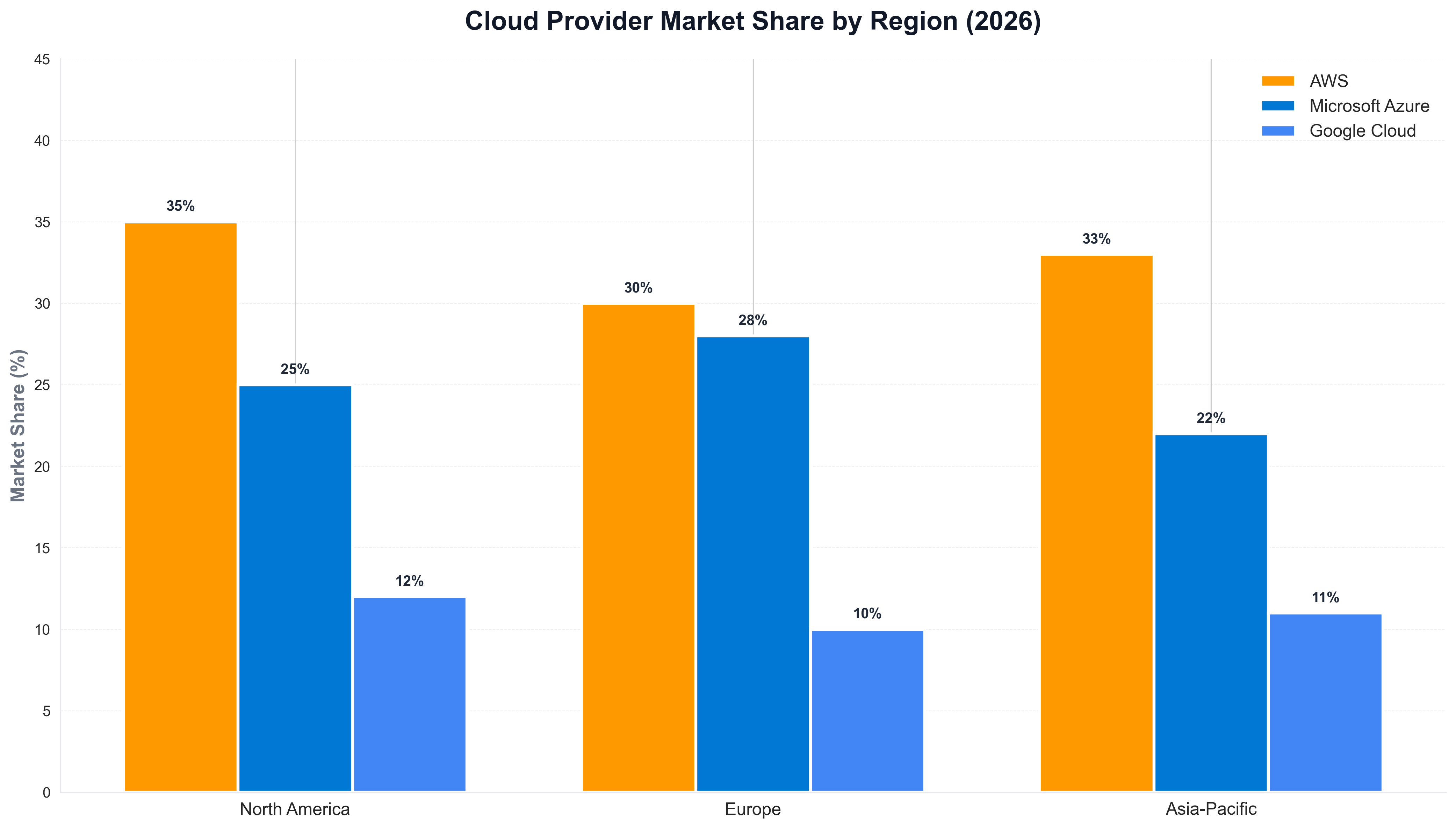
The regional market share comparison reveals interesting competitive dynamics across different geographies. Azure's strong performance in Europe reflects its compliance and data residency advantages, while AWS maintains leadership in North America and Asia-Pacific through its comprehensive service portfolio and early market entry.
The Asia-Pacific region represents the fastest-growing cloud market, with 38% year-over-year growth driven by digital transformation initiatives in countries like India, China, and Southeast Asian nations. AWS leads with 33% market share, but regional providers like Alibaba Cloud and Tencent Cloud have strong positions in China, while AWS, Azure, and Google Cloud compete aggressively in other APAC markets. The region's diverse regulatory landscape and varying levels of cloud maturity create both opportunities and challenges for global cloud providers.
Emerging trends shaping the cloud market include the rapid adoption of AI and machine learning workloads, which now represent over 25% of cloud spending according to industry analysts. Edge computing infrastructure is also growing rapidly, with all three major providers investing heavily in edge locations to support low-latency applications. Multi-cloud strategies have become the norm for large enterprises, with 78% of Fortune 500 companies using services from multiple cloud providers to avoid vendor lock-in and optimize costs.
Enterprise Adoption Patterns and Migration Strategies
Enterprise cloud adoption has evolved significantly, with organizations moving beyond initial migration projects to sophisticated cloud-native architectures and hybrid cloud deployments. According to Flexera's 2026 State of the Cloud Report, 94% of enterprises now use cloud services, with 87% adopting a multi-cloud strategy. The average enterprise uses 4.8 different cloud providers, reflecting the complexity of modern IT infrastructure.
AWS remains the preferred choice for 42% of enterprises as their primary cloud provider, followed by Azure at 36% and Google Cloud at 12%. However, the primary provider designation often doesn't tell the full story, as most enterprises use multiple clouds for different workloads. AWS tends to dominate in startups, technology companies, and organizations with heavy compute-intensive workloads. Azure excels in enterprises with existing Microsoft investments, particularly in industries like healthcare, finance, and government.
Google Cloud has found strong adoption in technology companies, media and entertainment organizations, and enterprises with significant data analytics requirements. The platform's strengths in AI, machine learning, and data analytics have attracted customers who prioritize these capabilities over the broader service portfolios offered by AWS and Azure.
Migration strategies have become more sophisticated, with enterprises moving beyond simple "lift and shift" approaches to cloud-native architectures that leverage containers, serverless computing, and microservices. According to industry research, 62% of new enterprise applications are now built cloud-native from the start, while 38% involve migration of existing applications. This shift reflects the maturation of cloud platforms and the availability of sophisticated migration tools and services.
Pricing and Cost Optimization Strategies
Cloud pricing has become increasingly complex, with each provider offering multiple pricing models, discount programs, and optimization tools. AWS's pricing structure includes on-demand instances, reserved instances with one- or three-year commitments, spot instances for fault-tolerant workloads, and savings plans that provide discounts for consistent usage. According to 451 Research's cloud pricing analysis, AWS's effective pricing has decreased by approximately 15% over the past two years due to competition and economies of scale.
Microsoft Azure's pricing strategy emphasizes hybrid benefits, allowing customers to use existing Microsoft software licenses in the cloud and receive discounts on Azure services. Azure's reserved instances and savings plans provide similar cost optimization opportunities as AWS, with the added benefit of integration with Microsoft's enterprise agreements. Azure's pricing has become increasingly competitive, with the platform often matching or undercutting AWS pricing for equivalent services.
Google Cloud has positioned itself as the most cost-effective option for certain workloads, particularly data analytics and AI/ML. Google's sustained use discounts automatically apply to virtual machines that run for significant portions of the month, providing cost savings without requiring upfront commitments. The platform's custom machine types allow customers to optimize resource allocation, potentially reducing costs by 20-30% compared to standard instance types.
Cost optimization has become a critical focus for enterprises, with cloud cost management ranking as a top priority for 73% of IT leaders according to recent surveys. All three major providers offer sophisticated cost management tools, including AWS Cost Explorer, Azure Cost Management, and Google Cloud Billing, that help organizations monitor, analyze, and optimize their cloud spending. Third-party cost optimization platforms have also emerged to help enterprises manage multi-cloud costs and identify savings opportunities.
Security and Compliance: Critical Differentiators
Security and compliance capabilities have become major differentiators in the cloud market, with enterprises demanding robust protection for sensitive data and workloads. AWS has invested heavily in security services, offering over 300 security, compliance, and governance features including AWS Shield for DDoS protection, AWS WAF for web application firewall, and comprehensive identity and access management through AWS IAM. The platform maintains 98 compliance certifications and attestations, including SOC, PCI-DSS, HIPAA, and GDPR.
Microsoft Azure emphasizes security through its Zero Trust architecture and comprehensive security services portfolio. Azure's security offerings include Azure Security Center, Azure Sentinel for security information and event management, and advanced threat protection capabilities. The platform's integration with Microsoft's broader security ecosystem, including Microsoft 365 Defender and Microsoft Purview, provides unified security management for enterprises using Microsoft's full technology stack.
Google Cloud has built its security strategy around the principle of defense in depth, with security controls at every layer of the infrastructure. Google's security offerings include Cloud Armor for DDoS protection, Cloud Identity and Access Management, and advanced threat detection through Chronicle Security Operations. The platform's security model benefits from Google's experience protecting its own services, which handle billions of users and transactions daily.
Compliance capabilities vary by region and industry, with each provider maintaining extensive compliance certifications. AWS leads in the number of compliance certifications, but Azure and Google Cloud have strong positions in specific industries and regions. For example, Azure has particular strength in government and healthcare compliance, while Google Cloud excels in data analytics and AI compliance requirements.
The Future of Cloud Computing: AI, Edge, and Sustainability
The cloud computing market is evolving rapidly, with several trends shaping its future direction. Artificial intelligence and machine learning workloads are becoming central to cloud strategy, with all three major providers investing billions in AI infrastructure, custom AI chips, and AI services. According to industry projections, AI workloads will represent 40% of cloud spending by 2028, driving significant revenue growth for providers that can deliver superior AI capabilities.
Edge computing represents another major growth area, with cloud providers expanding their edge infrastructure to support low-latency applications like autonomous vehicles, industrial IoT, and augmented reality. AWS has launched AWS Local Zones and AWS Wavelength, Azure offers Azure Edge Zones, and Google Cloud provides Google Distributed Cloud Edge. These services bring cloud capabilities closer to end users and devices, enabling new classes of applications that require ultra-low latency.
Sustainability has become a critical consideration for enterprises selecting cloud providers, with 67% of organizations factoring environmental impact into cloud decisions. All three major providers have committed to carbon-neutral or carbon-negative operations, with aggressive timelines for achieving 100% renewable energy. AWS has committed to net-zero carbon by 2040, Microsoft aims for carbon negative by 2030, and Google Cloud has achieved carbon-neutral operations and aims for 24/7 carbon-free energy by 2030.
The competitive landscape will continue to evolve, with AWS, Azure, and Google Cloud each leveraging their unique strengths. AWS's breadth of services and market leadership position it well for continued growth, while Azure's enterprise integration and hybrid cloud capabilities provide strong competitive advantages. Google Cloud's AI and analytics leadership, combined with its growing profitability, positions it as a formidable competitor in specific market segments.
Conclusion: A Maturing Market with Intense Competition
The cloud computing market in 2026 represents a maturing but still rapidly growing industry, with AWS, Azure, and Google Cloud competing aggressively for market share and enterprise customers. AWS maintains its leadership position through comprehensive services and global infrastructure, but Azure's enterprise integration advantages and Google Cloud's AI capabilities have created a more competitive landscape than ever before.
The market's evolution toward multi-cloud strategies, AI-first workloads, and edge computing reflects the increasing sophistication of enterprise cloud adoption. Organizations are no longer choosing a single cloud provider but rather building cloud strategies that leverage the strengths of multiple providers. This trend benefits all three major providers while creating opportunities for specialized and regional cloud services.
As the cloud market continues to grow toward $1 trillion, the competition between AWS, Azure, and Google Cloud will intensify, driving innovation, price reductions, and improved services for enterprise customers. The providers that can best address enterprise needs for AI capabilities, security, compliance, and cost optimization will gain market share, while those that fail to adapt risk losing ground in this critical technology sector.