

PostgreSQL has dominated the database world in 2026. According to the 2025 Stack Overflow Developer Survey and analysis of PostgreSQL's database leadership, 55.6% of developers use PostgreSQL—up from 48.7% in 2024—a historic increase of nearly 7 percentage points and the largest annual expansion in PostgreSQL's history. Vonng's breakdown notes that PostgreSQL has won first place in all three database metrics for the third consecutive year, opening a 15 percentage point gap over second-place MySQL (40.5%), and among professional developers specifically PostgreSQL reaches 58.2%—an 18.6 percentage point lead over MySQL. DB-Engines and Redgate's Q1 2025 database rankings report PostgreSQL as the second biggest climber in database popularity in early 2025. The story in 2026 is that PostgreSQL is the default for developers and professional teams—and Python is the language many use to connect, analyze, and visualize database adoption and trends. This article examines why 55.6% use PostgreSQL, how pgvector and PostGIS extend it, and how Python powers the charts that tell the story.
55.6% of Developers Use PostgreSQL: Third Year Leading
PostgreSQL's rise to the top did not happen overnight. Stack Overflow's 2025 Technology survey and Vonng's PostgreSQL dominance analysis report that 55.6% of developers use PostgreSQL—the highest share of any database—with MySQL at 40.5% and Oracle at 10.6%. The 2025 survey drew over 50,000 developers across 177 countries. PostgreSQL has won first place in all three database metrics (usage, want-to-use, most-loved) for the third consecutive year, and the 55.6% figure is up from 48.7% in 2024—a nearly 7-point jump that represents the largest annual expansion in PostgreSQL's history. The following chart, generated with Python and matplotlib using Stack Overflow–style survey data, illustrates database adoption in 2025–2026.
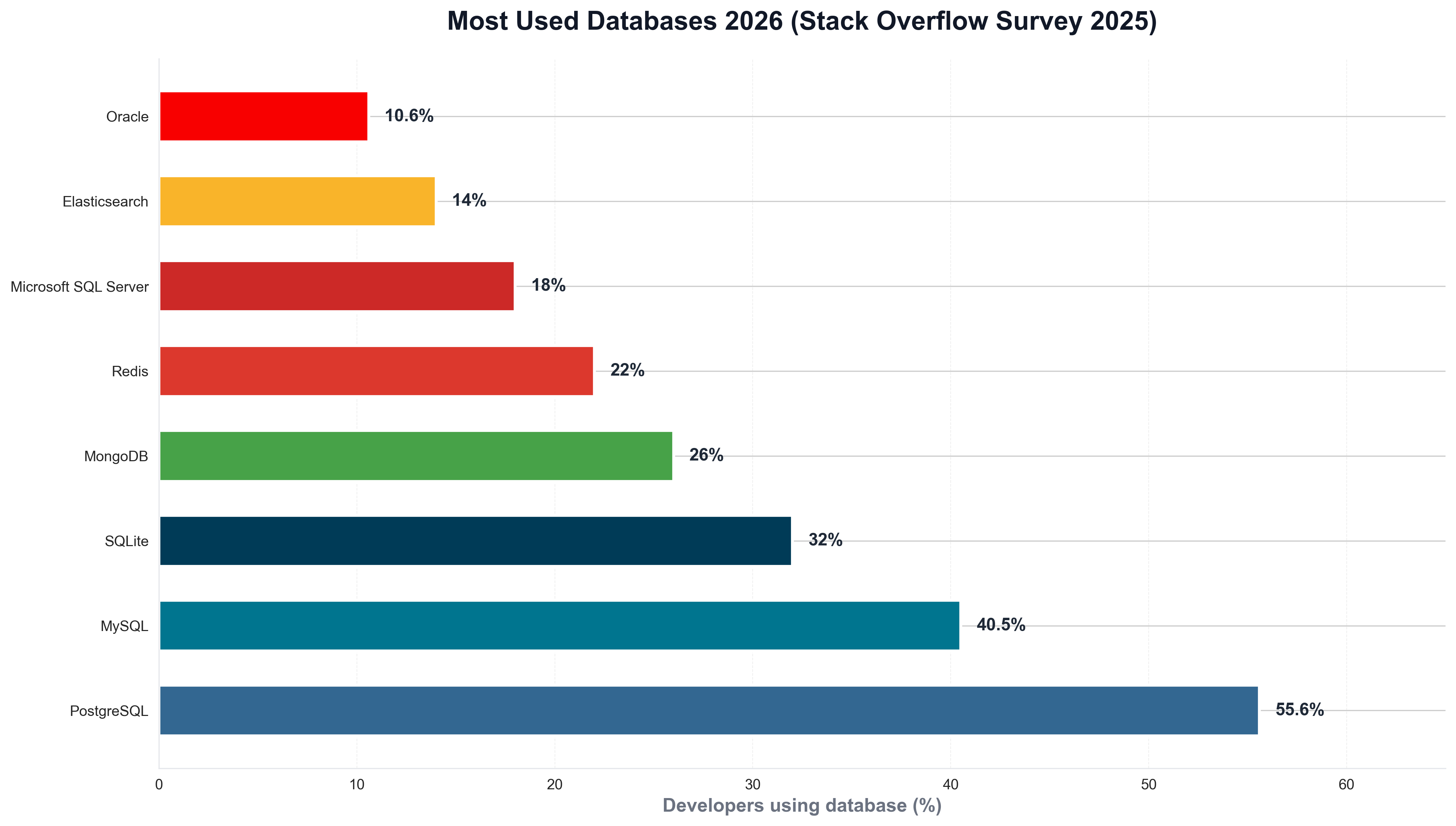
The chart above shows PostgreSQL at 55.6%, MySQL at 40.5%, SQLite at 32%, MongoDB at 26%, and Redis at 22%—reflecting PostgreSQL's lead. Python is the natural choice for building such visualizations: engineering and product teams routinely use Python scripts to load survey or internal usage data and produce publication-ready charts for reports and articles like this one.
58.2% Among Professional Developers: An 18.6-Point Lead Over MySQL
Among professional developers, PostgreSQL's lead is even larger. Vonng's analysis and SQLFlash's Stack Overflow database trends report that 58.2% of professional developers use PostgreSQL—an 18.6 percentage point lead over MySQL—so the gap between PostgreSQL and MySQL widens when focusing on professional rather than all respondents. When teams need to visualize database adoption over time—Stack Overflow year-over-year, DB-Engines trend, or internal usage—they often use Python and matplotlib or seaborn. The following chart, produced with Python, summarizes PostgreSQL adoption growth (Stack Overflow–style) from 2022 to 2026 as reported in public sources.
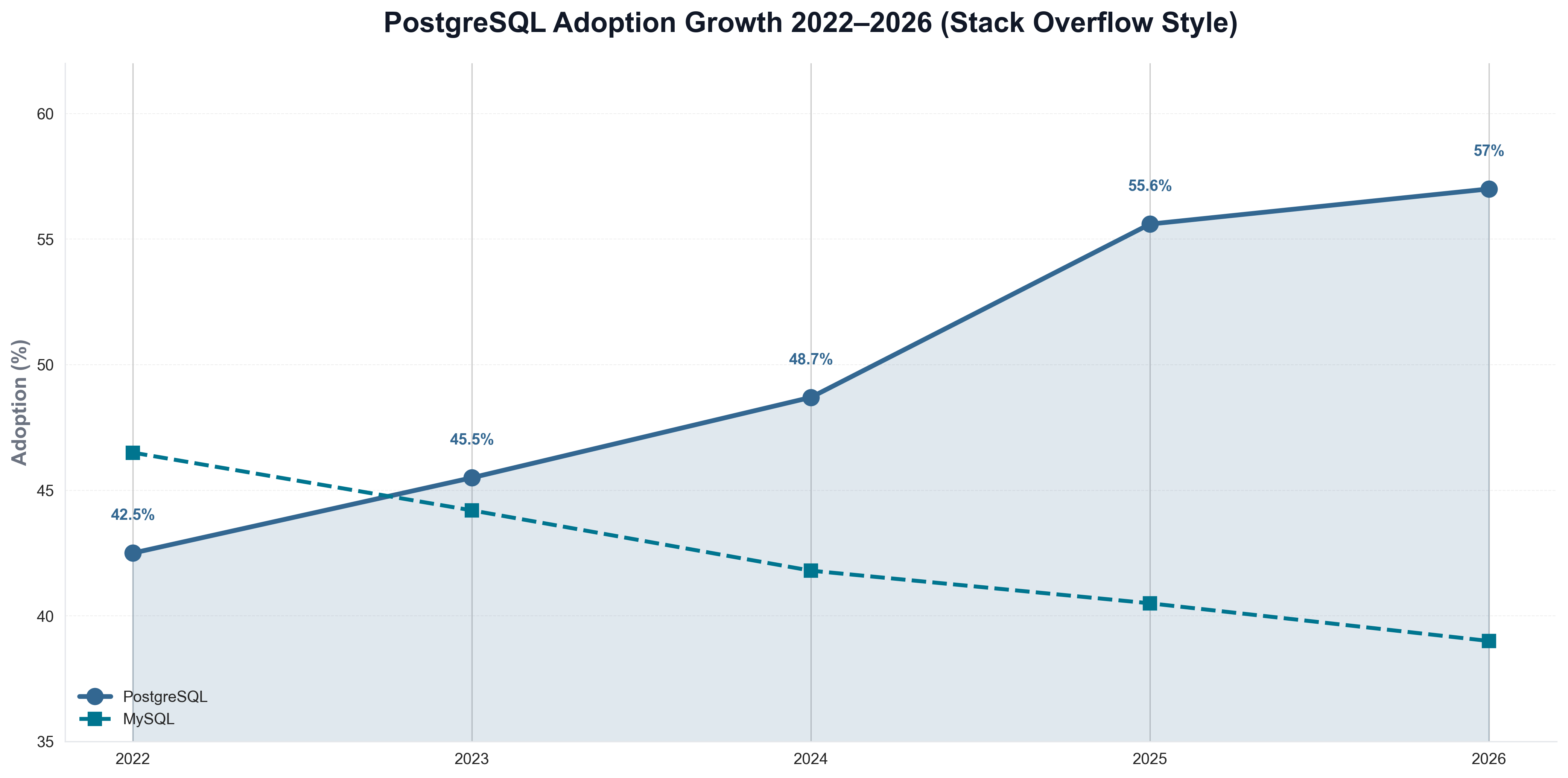
The chart illustrates 48.7% in 2024 and 55.6% in 2025—context that explains why PostgreSQL has dominated the database world. Python is again the tool of choice for generating such charts from survey or DB-Engines data, keeping analytics consistent with the rest of the data stack.
Why PostgreSQL Won: Open Source, Features, and Python
The business case for PostgreSQL is open source, features, and ecosystem. Yugabyte's why PostgreSQL remains top choice in 2025 and Rapydo's PostgreSQL surging popularity stress SQL standard compliance, strong community support, portability across operating systems and cloud platforms, and modern capabilities including JSON support, geospatial analytics (PostGIS), and vector search (pgvector). Python is the default language for connecting to PostgreSQL (psycopg2, SQLAlchemy, asyncpg), running analytics (pandas + SQL), and visualizing adoption and performance—so from app to analytics, Python and PostgreSQL form a standard stack. For teams that track database usage or migration trends over time, Python is often used to load survey or telemetry data and plot adoption. A minimal example might look like the following: load a CSV of database adoption by year, and save a chart for internal or public reporting.
import pandas as pd
import matplotlib.pyplot as plt

df = pd.read_csv("stack_overflow_database_survey.csv")
fig, ax = plt.subplots(figsize=(10, 6))
ax.plot(df["year"], df["postgresql_pct"], marker="o", linewidth=2, label="PostgreSQL")
ax.plot(df["year"], df["mysql_pct"], marker="s", linewidth=2, label="MySQL")
ax.set_ylabel("Adoption (%)")
ax.set_title("Database adoption (Stack Overflow style)")
ax.legend()
fig.savefig("public/images/blog/postgresql-trend.png", dpi=150, bbox_inches="tight")
plt.close()
That kind of Python script is typical for developer relations and platform teams: same language as much of their data pipeline, and direct control over chart layout and messaging.
pgvector, PostGIS, and the Modern PostgreSQL Stack
PostgreSQL is no longer "just" a relational database. Rapydo and DB-Engines note that pgvector brings vector search to PostgreSQL—so RAG and AI embeddings can run in-database alongside transactional data—and PostGIS delivers geospatial analytics for mapping and location workloads. PostgreSQL 15–17 have introduced performance enhancements, parallel processing improvements, and modern data features, and Redgate identified PostgreSQL as the second biggest climber in DB-Engines popularity in Q1 2025. Python fits into this story as the language of data (pandas, SQLAlchemy, psycopg2) and visualization (matplotlib, seaborn)—so from ingestion to charts, Python and PostgreSQL are the default for many teams.
What the 55.6% Figure Means for Developers and Teams
The 55.6% adoption figure has practical implications. Stack Overflow's 2025 survey covered over 50,000 developers in 177 countries and is one of the largest developer surveys available. For new projects, the takeaway is that PostgreSQL is the default choice for relational data—unless you have a specific need for MySQL, SQL Server, or a NoSQL store. For hiring and training, PostgreSQL and SQL are core skills for backend and data roles. For data and reporting, Python remains the language of choice for pulling survey data (Stack Overflow, DB-Engines) and visualizing database adoption—so the same Python scripts that power internal dashboards can power articles and public reports.
Conclusion: PostgreSQL as the Default for Developers
In 2026, PostgreSQL has dominated the database world: 55.6% of developers use it (up from 48.7% in 2024)—the largest annual expansion in PostgreSQL's history—and it has won first place in all three database metrics for the third consecutive year. 58.2% of professional developers use PostgreSQL—an 18.6-point lead over MySQL—and pgvector and PostGIS extend it for AI and geospatial workloads. Python is central to this story: the language of connection (psycopg2, SQLAlchemy), analytics (pandas + SQL), and visualization for database adoption and trends. Teams that treat PostgreSQL as the default for relational data—and use Python to build and measure—are well positioned for 2026 and beyond: PostgreSQL is where developers store data; Python is where the story gets told.