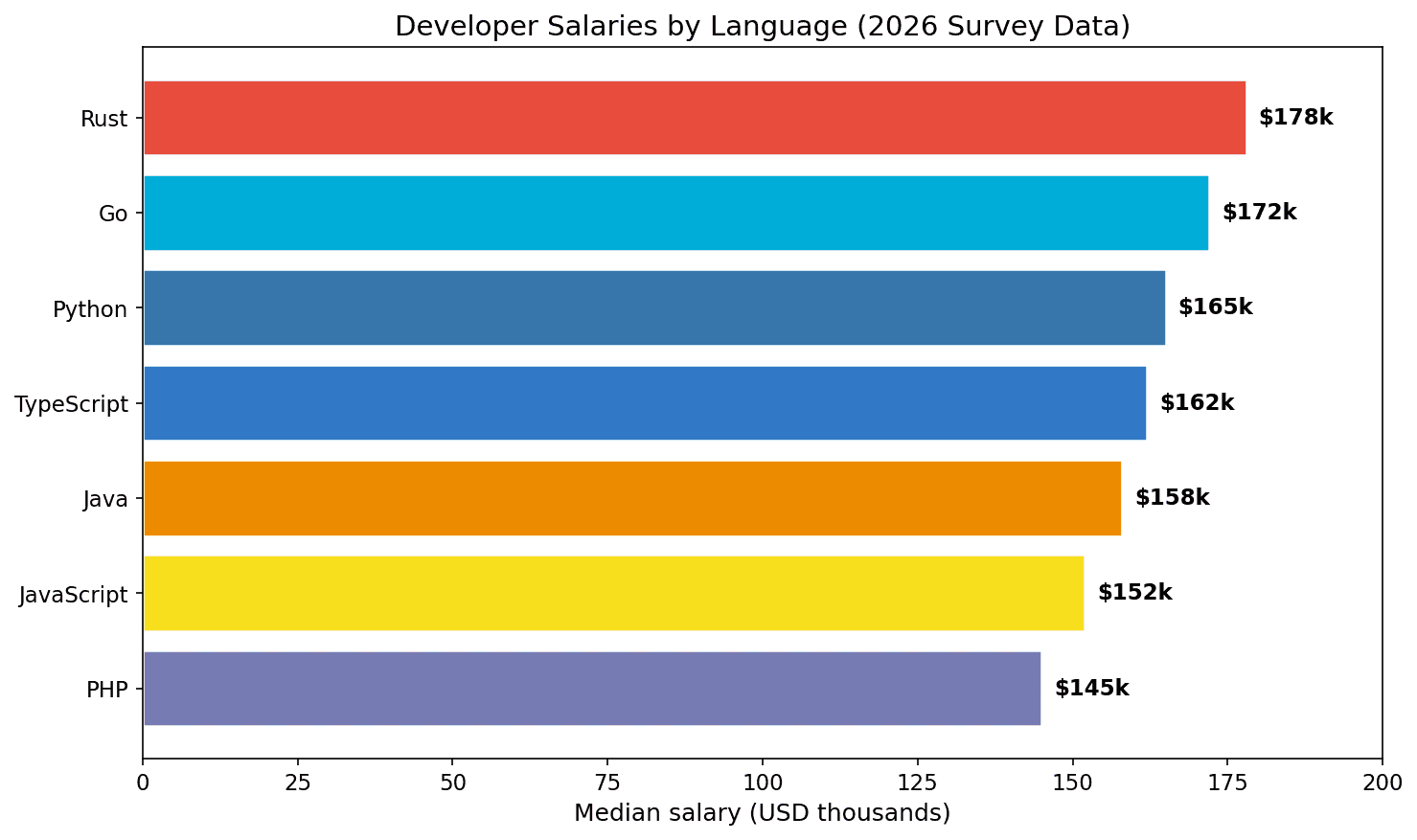


Python has solidified its position as the dominant programming language for data science and artificial intelligence in 2026, ranking number one on the TIOBE Index and remaining the default choice for machine learning research, data exploration, and an ever-growing share of production AI systems. According to the TIOBE Index for January 2026, Python leads the rankings ahead of C, Java, and C++, with TechRepublic’s summary of the 2026 rankings confirming Python, C, Java, and C++ as the top four. At the same time, GitHub’s Octoverse report notes that TypeScript became the most-used language on GitHub in 2025, with Python in second place, reflecting a shift toward typed languages in web and tooling while Python continues to dominate in data and AI repositories, job postings, and curricula.
The language’s strength in data science and AI is reflected in surveys and labor markets. According to Nucamp’s overview of top AI programming languages in 2026, Python appears in roughly 47 to 58% of AI and machine learning job listings, and a large share of developers want to learn or work with it. JetBrains and the Python Software Foundation’s Python Developers Survey 2024, with over 30,000 respondents, found that about 48% of Python developers use the language for data exploration and processing, and around 34% use it for machine learning. JetBrains’ State of Data Science report and The State of Python 2025 underscore that Python is not only the lingua franca of data science but also the primary language for building, experimenting with, and deploying ML models, with frameworks such as PyTorch and TensorFlow and libraries like pandas and NumPy forming the core of the ecosystem.
A typical data science workflow in 2026 still often starts with a few lines of Python: loading a dataset, summarizing it, and training or evaluating a model. For example, a researcher or analyst might load a CSV, inspect its shape and columns, and run a quick model fit entirely in Python, using pandas for tabular data and scikit-learn or a deep learning framework for the model. In practice, that might look like the following: importing pandas, reading a CSV, and computing a simple summary or fitting a model—all in a handful of lines that run in a notebook or script. The same language then scales to large-scale training pipelines, API services, and notebooks that mix code, visualizations, and narrative—which is why Python appears in almost every data science and ML curriculum and job description.
import pandas as pd
df = pd.read_csv("dataset.csv")
print(df.shape, df.columns.tolist())
From there, a data scientist might run df.describe() or pass features into scikit-learn or PyTorch; the point is that Python provides a single, readable workflow from raw data to model.
Why Python Leads Data Science and AI
Python’s rise in data science and AI is usually attributed to readability, a rich ecosystem of libraries, and strong community support. The language’s syntax allows newcomers to write clear, expressive code without fighting the compiler, while experts can build complex pipelines and integrate with C, C++, or CUDA for performance-critical parts. According to JetBrains’ analysis of why Python remains so popular, Python ranks as the second most-used programming language in 2025, with about 57% of developers using it and around 34% citing it as their primary language. Bound’s analysis of the most popular programming languages in 2026 adds that Python has recently overtaken JavaScript as the most-used language on GitHub in some metrics and holds a large share on the TIOBE Index, with roughly 42% of developers wanting to learn or work with Python.
The ecosystem is the other half of the story. NumPy and pandas handle numerical and tabular data; Matplotlib, Seaborn, and Plotly support visualization; scikit-learn covers classical ML; and PyTorch and TensorFlow dominate deep learning. JetBrains’ roundup of the most popular Python frameworks and libraries in 2025 notes that FastAPI has emerged as a leading framework with about 38% usage in 2025, up from 2023, while Django and Flask remain widely used for web and APIs. For data and ML, the same survey and community data show pandas, NumPy, PyTorch, and TensorFlow at the top of the list, so that from exploratory analysis to large-scale training, Python is the common thread.
PyTorch and TensorFlow: Research vs. Enterprise
The two dominant deep learning frameworks in the Python ecosystem—PyTorch and TensorFlow—have settled into somewhat different roles by 2026. According to Second Talent’s comparison of PyTorch vs TensorFlow in 2026, TensorFlow holds a larger enterprise footprint, with about 37.5% market share and tens of thousands of companies using it, and powers over 100,000 applications on billions of devices through TensorFlow Serving, TFX, and Lite. PyTorch holds about 25.7% market share by company count but dominates research: an estimated 70% of AI researchers prefer PyTorch as their primary framework, and around 85% of deep learning research papers use PyTorch. Job postings in 2026 show PyTorch slightly ahead of TensorFlow in many regions, reflecting the pipeline from academic research to industry adoption.
Both frameworks are Python-first for model authoring, with deployment options in C++, mobile, and edge. The performance gap between them has narrowed with advances in compilers and runtimes, so the choice in 2026 often comes down to team experience, deployment targets, and ecosystem (e.g., Hugging Face and many open-source models are PyTorch-native). For data scientists and ML engineers, fluency in both Python and at least one of these frameworks is effectively mandatory.
Data Exploration and Automation in Python
Data exploration and automation remain core use cases. The Python Developers Survey 2024 and The State of Data Science report that roughly 48% of Python developers are involved in data exploration and processing, and many combine pandas with Jupyter notebooks or IDEs for interactive analysis. Scripts that load data, compute aggregates, and export results or trigger downstream jobs are standard; a few lines of Python can replace what once required specialized ETL tools or spreadsheets, and the same code can be refactored into pipelines (e.g., with Apache Airflow or Prefect) for production. Python’s role in automation—from simple scripts to orchestration and DevOps—also keeps it in the top tier of languages by usage and demand.
Jobs, Learning, and the Labor Market
The labor market reflects Python’s centrality. Nucamp’s 2026 AI programming languages overview cites Python in about 47–58% of AI/ML job listings and notes strong projected job growth for data and ML roles. Bound’s 2026 language analysis mentions double-digit job growth and hundreds of thousands of new developer positions in related fields over the next decade. SQL and other languages (e.g., R, Julia) remain important for specific niches, but Python is the default ask for data scientist, ML engineer, and analytics engineer roles in most industries.
Learning resources have kept pace. Universities and bootcamps teach Python as the first or second language for data and ML; certifications and nano-degrees emphasize Python plus pandas, scikit-learn, and a deep learning framework. The combination of low barrier to entry and depth of ecosystem makes Python the path of least resistance for both newcomers and organizations standardizing on one language for data and AI.
The Role of TypeScript and Other Languages
Python’s dominance in data and AI does not mean it is the only language that matters. GitHub’s Octoverse highlights TypeScript as the most-used language on GitHub in 2025, driven by web development, tooling, and AI-assisted coding. JavaScript and TypeScript power the front end and many full-stack applications; Go and Rust are common in infrastructure and systems code; and C++ and CUDA underpin high-performance and GPU-accelerated libraries that Python calls into. Python’s strength is in data, ML, and glue code—the layer where analysts and ML engineers spend most of their time—while the rest of the stack is multilingual.
Performance, Compilation, and the Need for Speed
Python’s main historical drawback—runtime speed—is partly addressed in 2026 by calling into compiled code. NumPy, pandas, PyTorch, and TensorFlow execute heavy work in C, C++, or CUDA; Python orchestrates and expresses the logic. Projects like PyPy, Cython, and Numba offer additional speedups for hot loops, and Mojo and other efforts aim to bring Python-like syntax to higher performance. For many data and ML workloads, the bottleneck is GPU or I/O, not Python’s interpreter, so the language’s ease of use continues to outweigh raw execution speed for a large class of applications.
Open Source, Governance, and the Python Ecosystem
The Python ecosystem is overwhelmingly open source. The Python Software Foundation stewards the language and supports community initiatives; PyTorch and TensorFlow are open source; and pandas, NumPy, scikit-learn, and thousands of other packages are developed in the open. This has accelerated adoption, reduced lock-in, and made it easier for organizations to build on a common stack. Governance and funding (e.g., for security and maintenance) remain ongoing concerns, but in 2026 Python’s position as the default language for data science and AI is reinforced by the breadth and depth of this ecosystem.
Conclusion: Python as the Default for Data and AI
In 2026, Python remains the dominant language for data science, machine learning, and AI—first on the TIOBE Index, second on GitHub by usage, and the language that appears in roughly half of AI/ML job postings. PyTorch leads in research and is gaining in production; TensorFlow retains a strong enterprise footprint; and pandas, NumPy, and scikit-learn underpin exploration and classical ML. A typical workflow still hinges on a few lines of Python to load data, run an analysis, or train a model, and that workflow scales from notebooks and scripts to large pipelines and deployed services.
The rise of TypeScript and other languages elsewhere in the stack does not diminish Python’s role in data and AI; it reflects a world where different languages own different layers. For analysts, data scientists, and ML engineers, Python is still the default choice—and for the foreseeable future, fluency in Python and its data and ML ecosystem remains essential for anyone building or using AI and data-driven systems.