

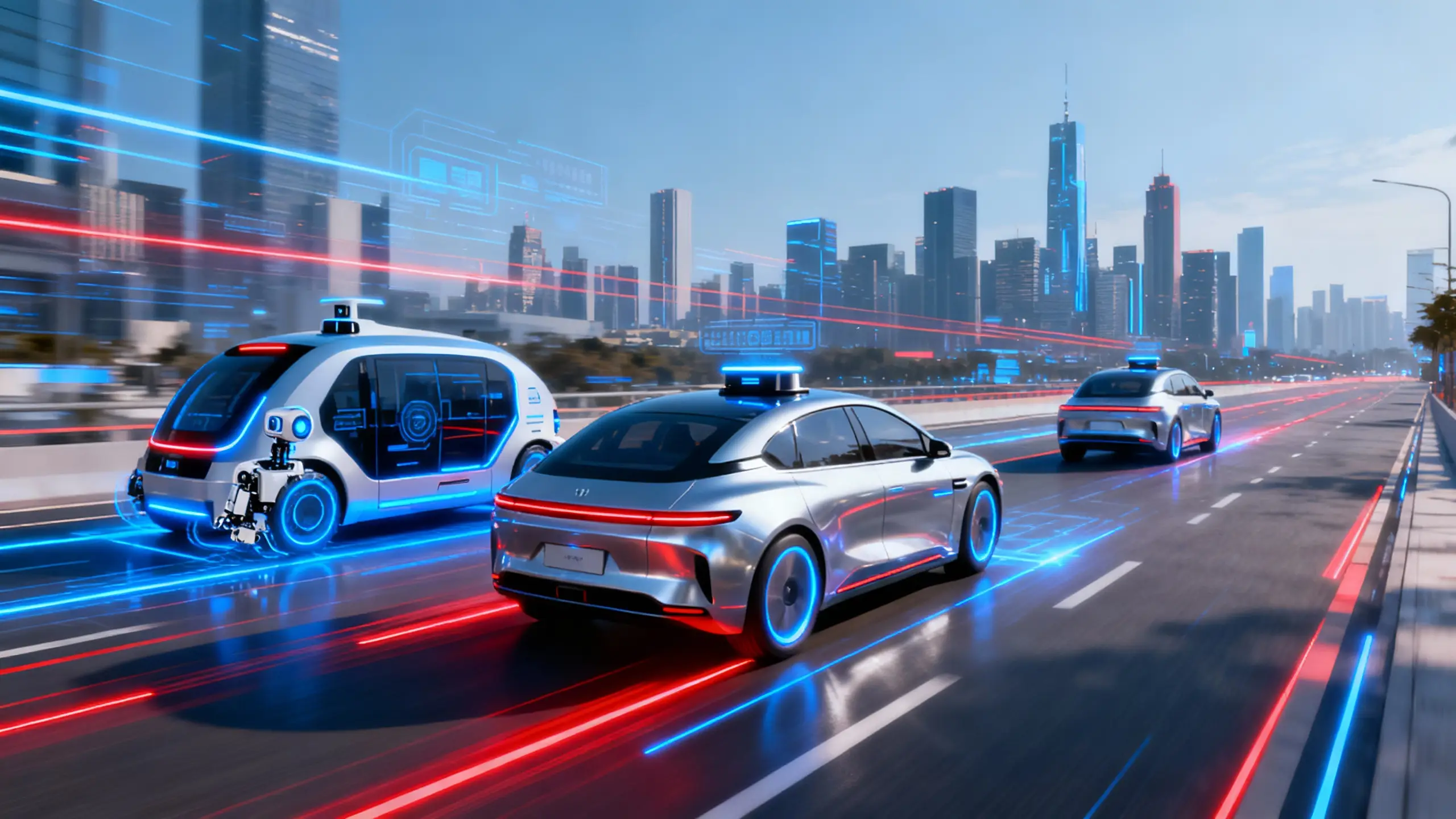
The autonomous vehicle industry is experiencing its most transformative year yet. In 2026, what was once science fiction is becoming daily reality as robotaxis from Waymo and Tesla hit the streets in cities across America. The numbers tell a compelling story: Waymo completed 14 million fully driverless trips in 2025, generating over $286 million in revenue at an average fare of $20.43 per ride. Meanwhile, Tesla has finally launched its long-promised robotaxi service, setting the stage for a head-to-head competition that will define the future of urban transportation.
The stakes couldn't be higher. The global robotaxi market, valued at $789.3 million in 2024, is projected to explode to $96.9 billion by 2032 – a compound annual growth rate of 82.6%, according to MarketsandMarkets. By 2035, analysts predict a fleet of approximately 934,000 robotaxis operating globally, fundamentally reshaping how people move through cities.
But this isn't just a market opportunity – it's a technological and strategic battle between two fundamentally different approaches to autonomous driving. Waymo, with its comprehensive sensor suite and years of real-world testing, represents the cautious, safety-first path. Tesla, with its camera-only vision system and aggressive timeline, represents the bold, software-first approach. As both companies expand their operations in 2026, the industry is watching to see which philosophy will win.
Waymo's Dominance: 14 Million Trips and Counting
Waymo's position in the robotaxi market can only be described as dominant. The Alphabet subsidiary completed 14 million fully autonomous trips in 2025, tripling its volume from 2024, according to The Verge. By spring 2025, the company was processing over 1 million driverless rides per month, and it's on track to exceed 20 million lifetime trips by the end of 2026.
The financial implications are significant. At an average fare of $20.43 per trip, Waymo's 2025 operations generated approximately $286 million in revenue – and that's just the beginning. The company is expanding rapidly, with operations now live in six U.S. cities: Los Angeles, Phoenix, San Francisco, Miami, Atlanta, and Austin (the latter through partnerships with Uber).
The Expansion Strategy
Waymo's 2026 expansion plans are ambitious. The company is laying groundwork for operations in over 20 additional cities this year, including international expansion to Tokyo and London, as detailed in Waymo's 2025 year-in-review. The company recently launched service in Miami in January 2026, covering a 60-square-mile service area in the city, as reported by Electrek.
Perhaps most significantly, Waymo has begun offering highway autonomous ride service in Los Angeles, Phoenix, and the San Francisco Bay Area – a major milestone that opens up longer-distance trips and demonstrates the system's maturity. The company has also received permits for operations at San Jose and San Francisco airports, with plans to expand to other major airports.
This expansion represents a strategic shift from testing to true commercial scale. Waymo is no longer proving the technology works – it's proving it can work profitably across diverse urban environments.
The Technology Advantage
Waymo's technological approach is comprehensive and conservative. Each Waymo vehicle is equipped with five lidar sensors for precise 3D mapping and obstacle detection, six radar units for weather-resistant object detection, 29 cameras providing 360-degree visual coverage, and advanced AI systems trained on millions of miles of real-world driving.
This multi-sensor approach, known as "sensor fusion," provides redundancy and reliability. If cameras fail in poor lighting, lidar continues working. If lidar struggles with certain materials, radar provides backup. This comprehensive approach has enabled Waymo to operate safely in diverse conditions, including rain, fog, and complex urban environments.
The results speak for themselves. Waymo's peer-reviewed safety studies show 91-96% reductions in crash rates compared to human drivers, according to Motor Trend. The company reports involvement in 11 times fewer serious injury collisions compared to human drivers in the cities it serves.
Tesla's Entry: Finally Arriving, But With Limitations
After years of promises and delays, Tesla finally launched its robotaxi service in Austin in June 2025. The launch marked a significant milestone for a company that has been talking about autonomous taxis since 2016, when CEO Elon Musk first announced plans for a "Tesla Network" of shared autonomous vehicles.
The Launch Timeline
Tesla's robotaxi service began with a modest fleet of 10-20 Model Y vehicles operating as an invite-only pilot program, as reported by Business Insider. Initially, the service required a safety monitor in the front passenger seat – a significant limitation compared to Waymo's fully driverless operations.
By January 2026, Tesla began offering rides without in-car safety monitors, though Electrek reported that the company deployed trailing vehicles with safety monitors following the robotaxis, suggesting the technology still requires close supervision.
Tesla has announced plans to expand its robotaxi service to Houston, Dallas, Las Vegas, Phoenix, and Miami – cities where Waymo already operates or plans to operate, setting up direct competition.
The Vision-Only Approach
Tesla's approach to autonomous driving is fundamentally different from Waymo's. The company relies on a camera-only system using eight cameras mounted around the vehicle, with minimal external sensors. This "Tesla Vision" approach represents a bet that advanced AI and neural networks can achieve full autonomy without expensive lidar sensors.
Elon Musk has been a vocal critic of lidar, calling it an expensive "crutch" and removing lidar sensors from test vehicles in 2021. Tesla's philosophy is that humans drive using vision alone, so AI should be able to do the same with sufficient training and computing power.
This approach has advantages: lower hardware costs, better outward visibility in vehicles, and the ability to leverage Tesla's massive fleet of customer vehicles for data collection. However, it also has limitations, particularly in adverse weather conditions like heavy rain, snow, or fog, where lidar and radar provide critical redundancy.
Real-World Performance: The Early Results
Independent testing of both systems has revealed significant differences in performance. When Business Insider conducted direct comparisons, Tesla's Full Self-Driving (FSD) system made a significant driving error that "handed Waymo the clear win." In another test ride comparison, Tesla's robotaxi encountered three incidents requiring human assistance, while Waymo's performance was described as "more polished" and "ready for the future."
These early results suggest that while Tesla's vision-only approach may eventually prove viable, it currently lags behind Waymo's more mature, sensor-fusion system in real-world reliability.
The Market Opportunity: $96.9 Billion by 2032
The robotaxi market represents one of the largest emerging technology opportunities of the decade. According to PS Market Research, the global market is projected to grow from $789.3 million in 2024 to $1.43 billion in 2025, eventually reaching $96.9 billion by 2032 – representing a compound annual growth rate of 82.6%.
By 2035, analysts predict approximately 934,000 robotaxis will be operating globally, according to MarketsandMarkets. BCG provides a broader range estimate of 700,000 to 3 million vehicles by 2035, depending on deployment speed and market adoption rates.
Key Growth Drivers
Several factors are driving this explosive growth:
Cost Reduction: Operating costs are declining significantly through automation. Baidu Apollo has achieved vehicle costs around $28,000, making robotaxis increasingly economical. In some markets, robotaxi fares are already lower than traditional ride-hailing services.
Urbanization: With 68% of the global population projected to live in urban areas by 2050, cities need efficient transportation solutions. Robotaxis offer a scalable alternative to private car ownership and traditional public transit.
Regulatory Support: Governments worldwide are creating supportive regulatory frameworks. California, Arizona, and Texas have been particularly welcoming, with other states following suit.
Technology Maturity: After years of development, autonomous systems are finally reaching the reliability and safety standards needed for commercial deployment.
Regional Development
Major robotaxi hubs expected by 2035 include Wuhan, San Francisco, Phoenix, and Beijing, according to market research. However, consumer adoption varies significantly: approximately 60% of Chinese consumers express openness to robotaxis, compared to only 30-35% of U.S. and European consumers, as noted by BCG.
This regional variation suggests that market development will be uneven, with some regions adopting robotaxis much faster than others based on cultural attitudes, regulatory environments, and infrastructure readiness.
The Technology Divide: Lidar vs. Vision
The fundamental difference between Waymo and Tesla's approaches represents a broader philosophical debate in the autonomous vehicle industry: Is comprehensive sensor fusion necessary, or can advanced AI achieve full autonomy with cameras alone?
Waymo's Sensor Fusion Philosophy
Waymo's multi-sensor approach provides several advantages:
Redundancy: If one sensor type fails or struggles, others can compensate. This is particularly important in adverse weather conditions.
Precision: Lidar provides precise 3D mapping that cameras cannot match, enabling better obstacle detection and path planning.
Reliability: Multiple sensor types reduce the likelihood of catastrophic failures that could lead to accidents.
However, this approach comes with significant costs. Lidar sensors are expensive, and the comprehensive sensor suite adds complexity and weight to vehicles.
Tesla's Vision-Only Philosophy
Tesla's camera-only approach offers different advantages:
Cost Efficiency: Eliminating lidar significantly reduces hardware costs, making autonomous technology more accessible.
Scalability: Tesla can leverage its existing fleet of millions of customer vehicles for data collection, creating a massive training dataset.
Simplicity: Fewer sensor types mean less complexity in hardware integration and maintenance.
The challenge is proving that cameras and AI alone can match the reliability of sensor fusion systems, particularly in edge cases and adverse conditions.
The Verdict So Far
Early real-world testing suggests that Waymo's comprehensive approach currently provides superior reliability. However, Tesla's vision-only system continues to improve through software updates and data collection. The question is whether Tesla can close the gap before Waymo's lead becomes insurmountable.
Safety Records: The Critical Metric
Safety is the ultimate test for autonomous vehicles, and both companies are being closely scrutinized. Waymo has published peer-reviewed safety studies showing dramatic improvements over human drivers, while Tesla's safety record is still being established.
Waymo's Safety Performance
Waymo's safety data is impressive. The company reports:
- 91-96% reduction in crash rates compared to human drivers
- 11 times fewer serious injury collisions than human drivers
- Operations in complex urban environments with minimal incidents
These statistics are based on millions of miles of real-world driving, providing a substantial data foundation for safety claims.
Tesla's Safety Record
Tesla's robotaxi service is too new to have comprehensive safety statistics. However, the company's Full Self-Driving (FSD) beta program, which has been available to customers for several years, provides some insights.
Tesla reports that vehicles using FSD have lower crash rates than those without, though critics note that FSD is primarily used on highways and in less challenging conditions. The robotaxi service, which operates in dense urban environments, represents a more significant test.
Independent testing has revealed that Tesla's system still requires human intervention in challenging situations, suggesting it may not yet match Waymo's reliability in complex urban driving scenarios.
Market Entry Costs and Scaling Challenges
Entering the robotaxi market is expensive and time-consuming. According to BCG analysis, establishing commercial robotaxi operations in a new U.S. market requires $15-30 million in initial investment, up to 2 years to establish commercial operations, and 4-6 years to scale across a metropolitan area.
These costs include vehicle procurement, sensor installation, mapping, regulatory approvals, and operational infrastructure. This high barrier to entry favors well-capitalized companies like Waymo (backed by Alphabet) and Tesla.
The Scaling Challenge
Scaling robotaxi operations is particularly challenging because each city requires:
- Detailed 3D mapping of streets, intersections, and traffic patterns
- Regulatory approvals from local and state governments
- Infrastructure partnerships for charging, maintenance, and operations
- Weather adaptation for local climate conditions
- Cultural adaptation for local driving behaviors and traffic patterns
Waymo's methodical, city-by-city expansion reflects this reality. The company has spent years perfecting operations in each market before expanding, ensuring reliability and safety.
Tesla's more aggressive expansion timeline will test whether its vision-only approach can adapt faster to new markets, or if it will face similar scaling challenges.
Competitive Landscape: Beyond Waymo and Tesla
While Waymo and Tesla dominate headlines, they're not alone in the robotaxi race. Several other companies are developing autonomous vehicle services:
Amazon Zoox
Amazon's Zoox subsidiary is developing purpose-built robotaxis designed from the ground up for autonomous operation. The company has been testing in San Francisco and Las Vegas, with plans for commercial launch. Zoox's vehicles are bidirectional (can drive forward or backward equally well) and lack traditional driver controls.
General Motors Cruise
Cruise, backed by General Motors, had been a major player but suspended operations in 2023 after a pedestrian incident. The company is working to resume operations with enhanced safety measures, though its timeline remains uncertain.
Baidu Apollo
In China, Baidu's Apollo platform is a major player, with operations in multiple Chinese cities. The company has achieved vehicle costs around $28,000, demonstrating the cost reduction potential of autonomous vehicles.
Other Players
Smaller companies like Motional (Hyundai-Aptiv joint venture), Aurora, and Pony.ai are also developing robotaxi services, though they're generally further behind in commercialization.
Consumer Adoption: The Acceptance Challenge
Despite rapid technological progress, consumer acceptance remains a significant challenge. According to BCG research, only 30-35% of U.S. and European consumers express openness to using robotaxis, compared to 60% of Chinese consumers.
This regional variation suggests that adoption will be uneven, with some markets embracing robotaxis much faster than others. Factors influencing acceptance include cultural attitudes toward technology and automation, regulatory frameworks and government support, infrastructure readiness for autonomous vehicles, trust in technology and safety perceptions, and cost competitiveness compared to alternatives.
Waymo's years of safe operations are helping build trust, but widespread consumer acceptance will require continued demonstration of safety and reliability.
The Economic Impact: Transforming Urban Transportation
The robotaxi revolution extends beyond technology – it's reshaping urban economics. As robotaxis become more common, several trends are emerging:
Cost Reduction
Robotaxis eliminate driver costs, which typically represent 60-70% of traditional ride-hailing expenses. This cost reduction, combined with efficient routing and 24/7 operation, makes robotaxis potentially cheaper than owning a car in urban areas.
Urban Planning Implications
Cities are beginning to plan for a robotaxi future. This includes reduced parking needs as private car ownership declines, more efficient land use as parking lots are repurposed, improved traffic flow through optimized routing, and enhanced accessibility for elderly and disabled populations.
Job Market Disruption
The shift to autonomous vehicles will disrupt employment in transportation. While robotaxis create new jobs in maintenance, monitoring, and fleet management, they eliminate driving jobs. This transition will require workforce retraining and economic adjustment.
Regulatory Environment: Navigating Approval Processes
The regulatory landscape for autonomous vehicles is complex and varies by jurisdiction. Key regulatory considerations include:
Federal Regulations
The U.S. National Highway Traffic Safety Administration (NHTSA) sets vehicle safety standards, while the Federal Motor Carrier Safety Administration (FMCSA) regulates commercial vehicle operations. Both agencies are adapting regulations for autonomous vehicles.
State and Local Regulations
States have varying approaches to autonomous vehicle regulation. California, Arizona, and Texas have been particularly welcoming, while others have been more cautious. Local governments also play a role in permitting and operations.
International Regulations
Regulatory approaches vary significantly internationally. The European Union, China, and other regions have different standards and approval processes, creating challenges for global expansion.
The Road Ahead: 2026 and Beyond
As 2026 unfolds, several key trends will shape the robotaxi industry:
Waymo's Expansion Acceleration
Waymo is moving from methodical testing to aggressive expansion. With operations in six cities and plans for 20+ more, the company is demonstrating that autonomous vehicles can scale commercially. The expansion to highways and airports represents a significant capability milestone.
Tesla's Catch-Up Challenge
Tesla faces the challenge of catching up to Waymo's years of development and millions of miles of real-world experience. The company's vision-only approach may eventually prove viable, but it needs to demonstrate reliability that matches or exceeds Waymo's performance.
Market Maturation
As the market matures, expect to see:
The robotaxi market is expected to see consolidation as smaller players are acquired or exit, partnerships between automakers and tech companies, standardization of safety protocols and regulatory frameworks, and cost reduction as technology scales and improves.
The Tipping Point
Industry analysts believe the robotaxi market is approaching a tipping point where:
- Costs become competitive with traditional transportation
- Safety records build sufficient consumer trust
- Regulatory frameworks stabilize
- Infrastructure supports widespread deployment
When this tipping point is reached, adoption could accelerate rapidly, transforming urban transportation within a few years.
Conclusion: A Race That's Just Beginning
The robotaxi race between Waymo and Tesla represents more than a corporate competition – it's a battle between two visions of autonomous driving's future. Waymo's comprehensive, safety-first approach has built a substantial lead through years of careful development and millions of safe miles. Tesla's bold, vision-only approach promises lower costs and faster scaling, but must prove it can match Waymo's reliability.
With the market projected to reach $96.9 billion by 2032 and nearly a million robotaxis on the road by 2035, the stakes are enormous. The winner of this race won't just dominate a market – they'll help define how humanity moves through cities for decades to come.
Waymo's 14 million trips and expanding operations demonstrate that autonomous vehicles are no longer experimental – they're a commercial reality. Tesla's entry adds competitive pressure and validates the market opportunity. As both companies expand in 2026, consumers, cities, and investors are watching closely to see which approach will ultimately prevail.
One thing is certain: the age of robotaxis has arrived. The question isn't whether autonomous vehicles will transform transportation – it's which company, and which approach, will lead that transformation. With billions of dollars at stake and the future of urban mobility hanging in the balance, 2026 is shaping up to be the year when the robotaxi revolution truly begins.