

MongoDB remains the default document database for millions of developers and tens of thousands of organizations in 2026. According to 6sense's MongoDB market share data, MongoDB holds roughly 45.32% market share in the NoSQL databases category with approximately 56,280 customers, ranking #1 among NoSQL databases. DB-Engines' ranking and MongoDB system properties place MongoDB at #5 overall in database popularity and #1 among document stores. Gartner's database market share report notes that the nonrelational DBMS segment grew 22.7% in 2024 as the broader database market reached $119.7 billion. MongoDB's blog and State of Databases provide survey context on developer adoption. Python is the tool many teams use to visualize database adoption and ranking data for reports like this one. This article examines where MongoDB stands in 2026, why document stores dominate flexible workloads, and how Python powers the charts that tell the story.
45% NoSQL Share and 56,000 Customers
MongoDB's lead in NoSQL did not happen overnight. 6sense reports MongoDB at 45.32% market share in the NoSQL category with 56,280 customers—ahead of Amazon DynamoDB (11.19%), HBase (3.96%), and Apache Cassandra (3.89%). DB-Engines' ranking trend and DB-Engines' MongoDB system page place MongoDB at #5 in the overall database ranking and #1 among document stores. The following chart, generated with Python and matplotlib using 6sense and DB-Engines–style data, illustrates NoSQL database market share in 2025–2026.
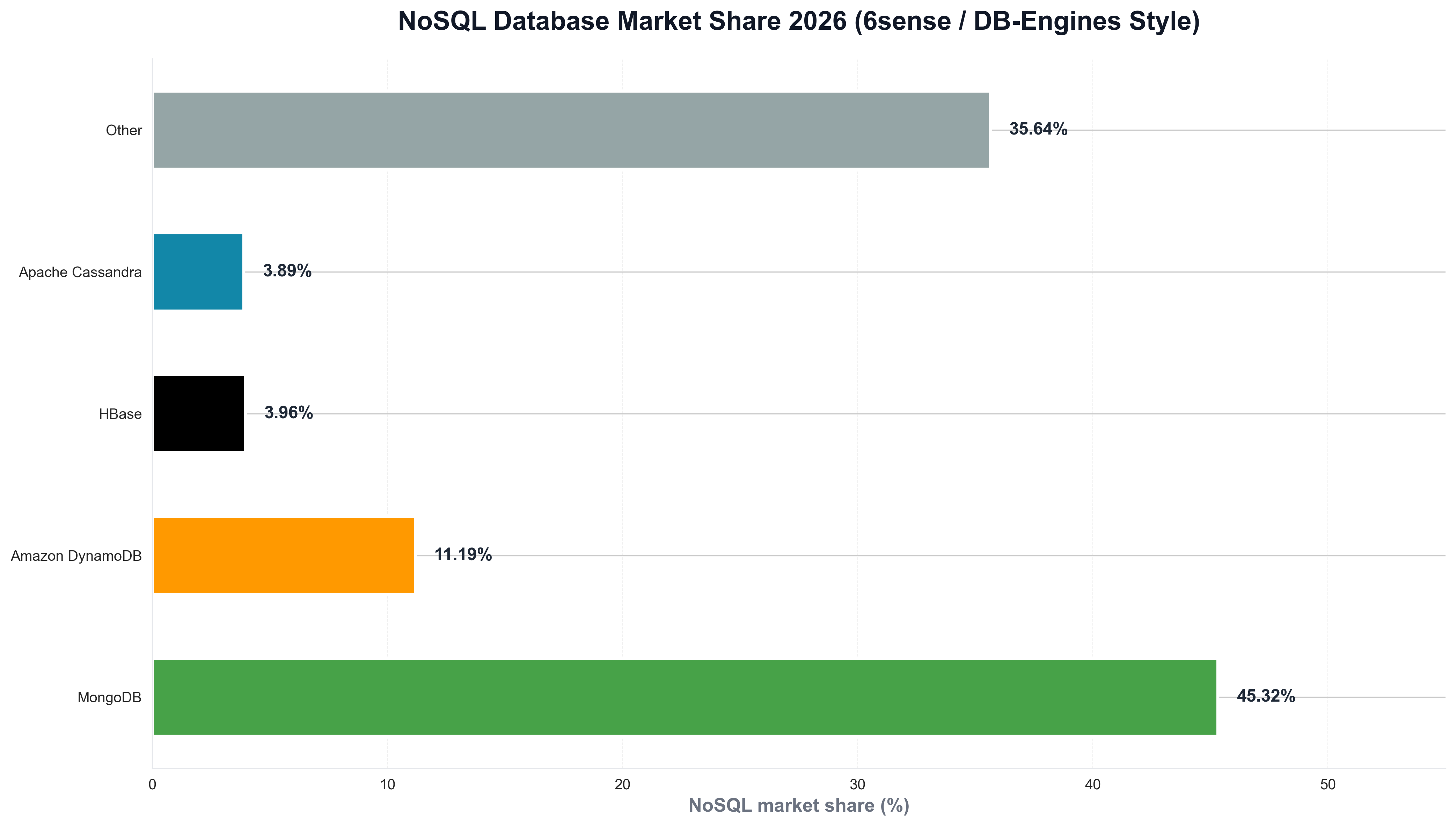
The chart above shows MongoDB well ahead of DynamoDB, HBase, and Cassandra—reflecting its dominance in the NoSQL segment. Python is the natural choice for building such visualizations: data and platform teams routinely use Python scripts to load market-share or survey data and produce publication-ready charts for reports and articles like this one.
#5 in DB-Engines and #1 Among Document Stores
The scale of MongoDB's position in the database landscape is striking. DB-Engines' ranking and Redgate's Q1 2025 analysis note that MongoDB ranks #5 overall and was the third biggest climber in March 2025; DB-Engines' trend blog adds context on Snowflake and PostgreSQL as top climbers. MongoDB leads document stores and is widely used for unstructured data, real-time analytics, and AI/ML workloads. When teams need to visualize database ranking or adoption over time—DB-Engines scores or customer counts—they often use Python and matplotlib or seaborn. The following chart, produced with Python, summarizes top database popularity (DB-Engines–style score) for MongoDB and key NoSQL and relational systems in 2025–2026.
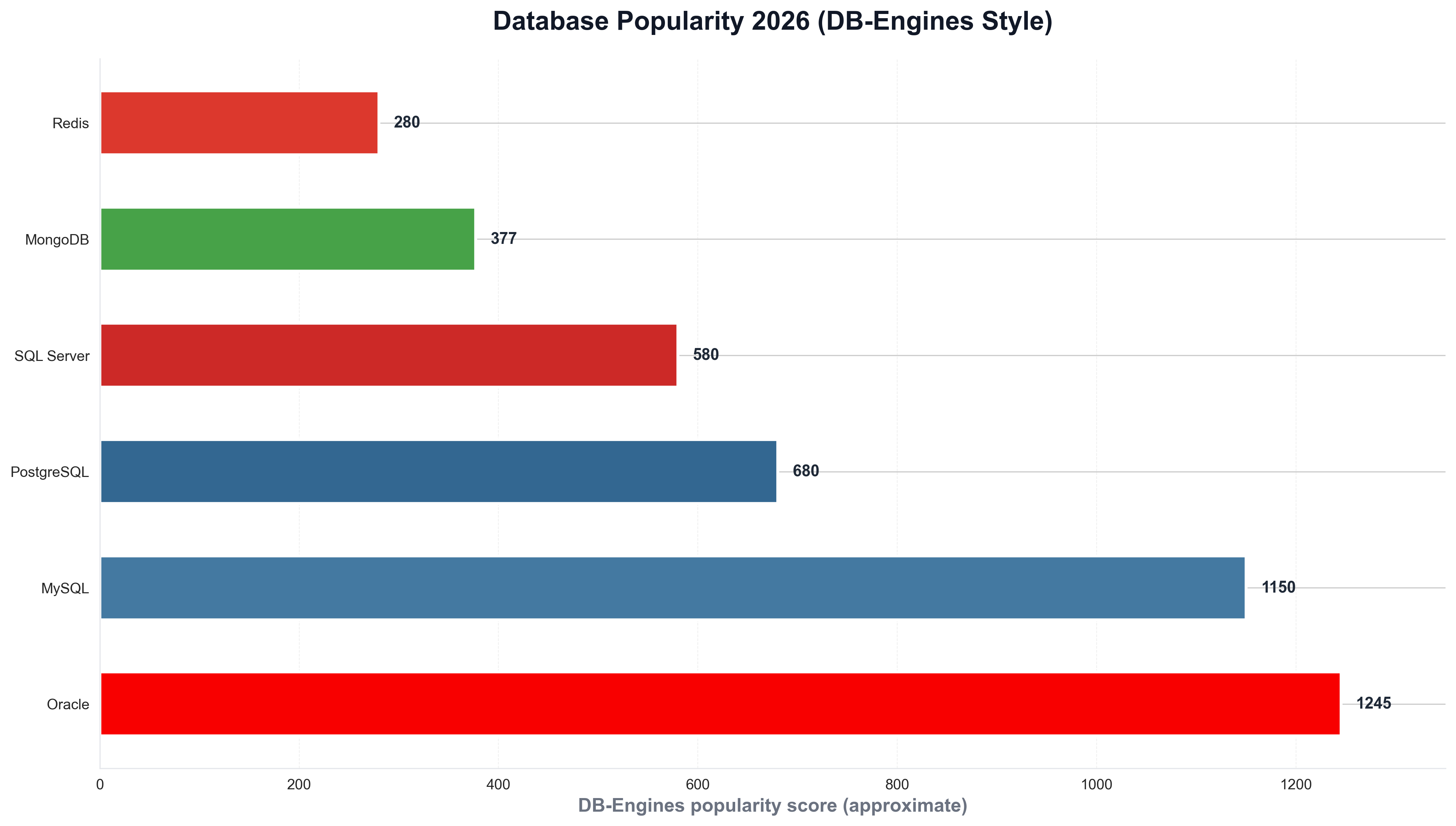
The chart illustrates MongoDB in the top five and leading NoSQL—context that explains why MongoDB is the default for document-oriented applications. Python is again the tool of choice for generating such charts from ranking or internal data, keeping analytics consistent with the rest of the data stack.
Why MongoDB Won: Document Model, Scale, and Python for Analytics
The business case for MongoDB is flexible document model, horizontal scaling, and developer experience. MongoDB's blog and RavenDB's 2024 NoSQL trend report stress that document stores suit rapidly changing schemas, unstructured and semi-structured data, and real-time and AI-driven applications. State of Databases and Redgate's State of the Database Landscape 2025 (nearly 2,500 IT professionals surveyed) provide additional context on enterprise database usage and cloud adoption. For teams that track database adoption or ranking over time, Python is often used to load DB-Engines or survey data and plot trends. A minimal example might look like the following: load a CSV of DB-Engines scores by month, and save a chart for internal or public reporting.
import pandas as pd
import matplotlib.pyplot as plt

df = pd.read_csv("db_engines_mongodb_scores.csv")
fig, ax = plt.subplots(figsize=(10, 5))
ax.plot(df["month"], df["score"], marker="o", linewidth=2, color="#47a248")
ax.set_ylabel("DB-Engines score")
ax.set_title("MongoDB DB-Engines popularity (internal-style)")
fig.savefig("public/images/blog/mongodb-db-engines-trend.png", dpi=150, bbox_inches="tight")
plt.close()
That kind of Python script is typical for data and platform teams: same language used for pipelines and dashboards, and direct control over chart layout and messaging.
DynamoDB, Cassandra, and the Multi-Database Reality
MongoDB is not the only NoSQL option in 2026. 6sense shows Amazon DynamoDB at 11.19% NoSQL share, HBase at 3.96%, and Apache Cassandra at 3.89%—DynamoDB is the default for many AWS workloads. RavenDB's NoSQL trend report and Studio 3T's reports note that relational databases have adopted NoSQL-like features (e.g. PostgreSQL JSON support) and NoSQL systems have added time-series and vector capabilities—so the line between relational and document is blurring. Multi-database setups are common: MongoDB for document and flexible schema, PostgreSQL or DynamoDB for transactional or cloud-native workloads. Python is the language many use to analyze DB-Engines data, survey results, and visualize database adoption for reports like this one.
Nonrelational Growth and the 2026 Landscape
Gartner's database market share report reports the database management systems market grew 13.4% in 2024 to $119.7 billion, with the nonrelational DBMS segment growing 22.7%—faster than the overall market. MongoDB benefits from that shift toward flexible, scalable data stores for AI, real-time, and cloud-native applications. In 2026, MongoDB is where document data lives for millions of developers—and Python is how many of them chart the numbers.
Conclusion: MongoDB as the NoSQL Default in 2026
In 2026, MongoDB remains the default document database and #1 NoSQL choice. Roughly 45% NoSQL market share, 56,000+ customers, and #5 in DB-Engines overall ( #1 document store) tell the story: MongoDB won on document model, scale, and developer experience. DynamoDB, Cassandra, and relational options with JSON coexist; MongoDB leads document and flexible-schema workloads. Python remains the language that powers the analytics—ranking data, survey results, and the visualizations that explain adoption—so that for Google News and Google Discover, the story in 2026 is clear: MongoDB is where document data lives, and Python is how many of us chart it.