

React remains the second-most-used web framework among developers worldwide in 2026. According to Statista's 2025 worldwide developer survey of 49,009 developers, 44.7% of developers use React—just behind Node.js at 48.7%—with Next.js at 20.8%, Angular at 18.2%, and Vue.js at 17.6%. State of React 2025 and Stack Overflow's 2025 Technology survey confirm React's position in the top tier. At the same time, React's GitHub repository has passed 242,000 stars, and NPM reports approximately 59 million weekly downloads and over 204,000 dependents. The React Compiler debuted officially in 2025, and the React Foundation was established—signaling a new phase for the ecosystem. The story in 2026 is that React and Next.js remain the default for frontend and full-stack web—and Python is the language many teams use to visualize framework adoption and trends. This article examines why React holds its position, how the ecosystem is evolving, and how Python powers the charts that tell the story.
44.7% of Developers Use React: Second Only to Node.js
React's position in the framework landscape did not happen overnight. Statista's most used web frameworks 2025 and State of React 2025 report that 44.7% of developers use React—the second-most-used web framework after Node.js (48.7%). The survey was conducted May–June 2025 with 49,009 respondents globally. Next.js (20.8%), Angular (18.2%), and Vue.js (17.6%) round out the top five—so the React ecosystem (React + Next.js) represents a large share of frontend and full-stack usage. The following chart, generated with Python and matplotlib using Statista-style survey data, illustrates web framework adoption in 2025–2026.
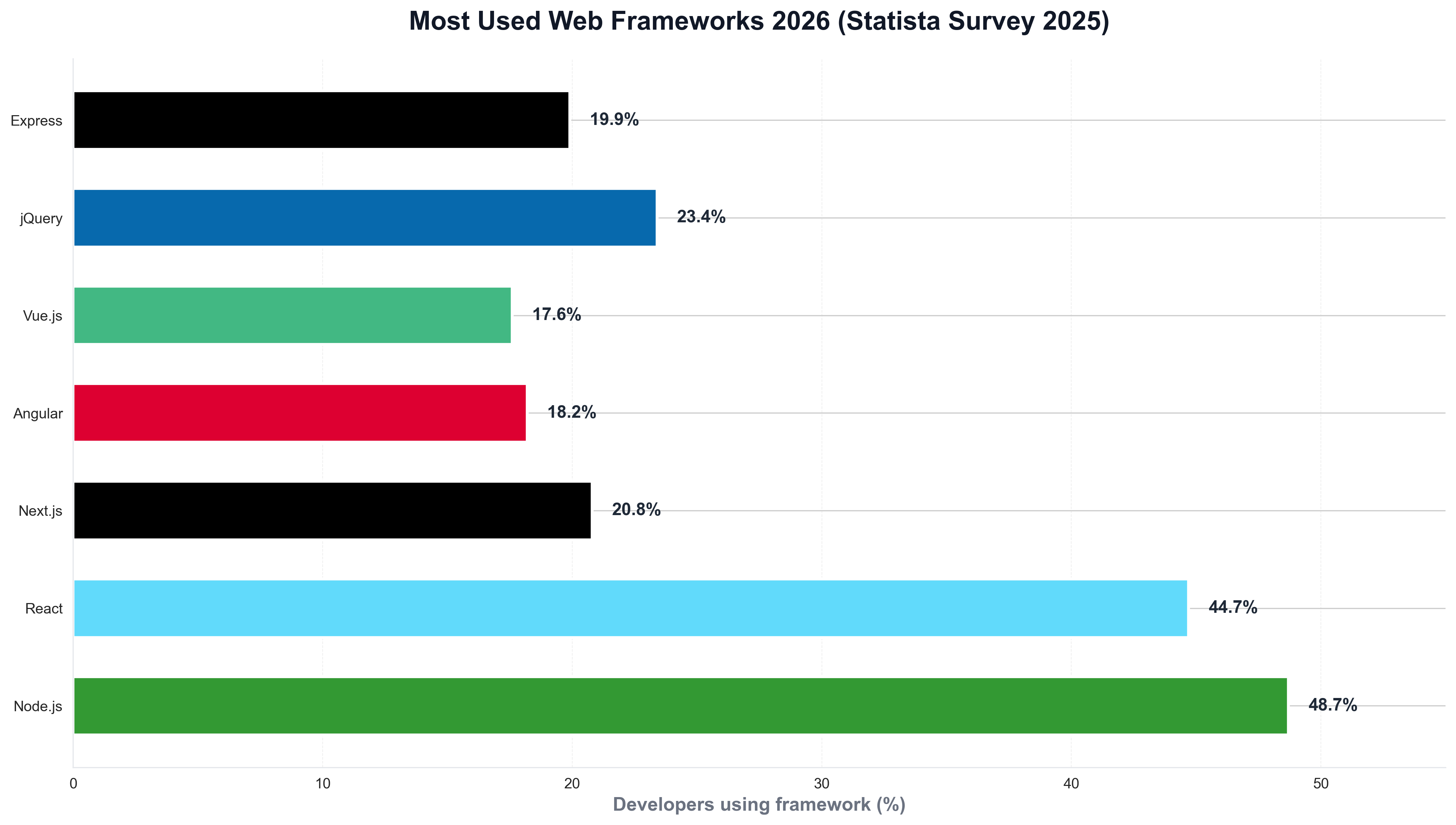
The chart above shows Node.js at 48.7%, React at 44.7%, Next.js at 20.8%, Angular at 18.2%, and Vue.js at 17.6%—reflecting React's hold on the frontend. Python is the natural choice for building such visualizations: engineering and product teams routinely use Python scripts to load survey or internal usage data and produce publication-ready charts for reports and articles like this one.
59 Million Weekly NPM Downloads and 242,000 GitHub Stars
The scale of React's adoption is striking. NPM's React package reports approximately 59.4 million weekly downloads and over 228 million downloads in the past month, with over 204,000 dependents—making React one of the most depended-on packages in the JavaScript ecosystem. GitHub's React repository has passed 242,000 stars—one of the most starred open-source projects globally. When teams need to visualize framework adoption over time—NPM trends, survey year-over-year, or internal usage—they often use Python and matplotlib or seaborn. The following chart, produced with Python, summarizes relative framework adoption (Statista-style) and NPM download scale for React as reported in public sources.
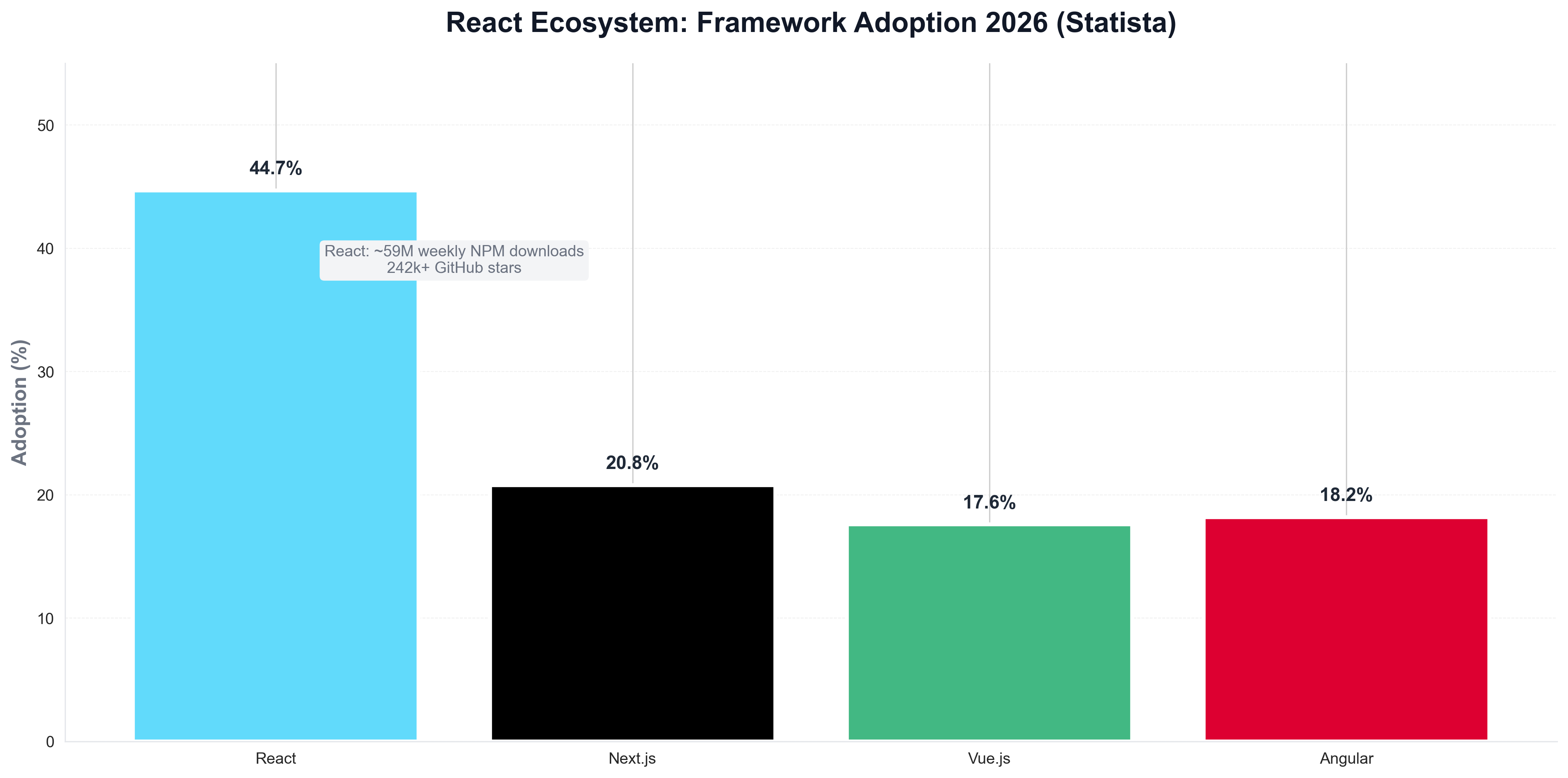
The chart illustrates React at 44.7% and Next.js at 20.8%—context that explains why the React ecosystem remains the default for many teams. Python is again the tool of choice for generating such charts from survey or NPM-style data, keeping analytics consistent with the rest of the data stack.
React Compiler and React Foundation: What Changed in 2025
React entered a new phase in 2025. State of React 2025 and Netguru's React trends 2026 note that the React Compiler made its official debut in 2025—automatically optimizing renders and reducing the need for manual useMemo and useCallback in many cases—and the React Foundation was established to steward the project. React 19 is stable, with Server Components and async request APIs evolving the full-stack story; Next.js 15 builds on React 19 and is the leading React framework for production apps. For teams that track framework usage or ecosystem trends over time, Python is often used to load survey or telemetry data and plot adoption. A minimal example might look like the following: load a CSV of framework adoption by year, and save a chart for internal or public reporting.
import pandas as pd
import matplotlib.pyplot as plt

df = pd.read_csv("web_frameworks_survey.csv")
fig, ax = plt.subplots(figsize=(10, 6))
ax.barh(df["framework"], df["adoption_pct"], color="#61dafb", edgecolor="white", height=0.6)
ax.set_xlabel("Adoption (%)")
ax.set_title("Web framework adoption 2026 (survey-style)")
fig.savefig("public/images/blog/react-framework-trend.png", dpi=150, bbox_inches="tight")
plt.close()
That kind of Python script is typical for developer relations and platform teams: same language as much of their data pipeline, and direct control over chart layout and messaging.
Next.js, useState, and the React Ecosystem
Within the React ecosystem, Next.js and useState dominate. State of React 2024 and State of React report that useState leads at 98.6% usage among React developers, and Next.js shows strong adoption (77.6% in the 2024 State of React)—with Create React App still widely used but Next.js increasingly the default for new apps. TanStack Query and Zustand have emerged as highly favored libraries. So the story is not just "React is popular"; it is React + Next.js as the default for full-stack and frontend, with Python often used to visualize adoption and trends for reports and dashboards.
What the 44.7% Figure Means for Developers and Teams
The 44.7% adoption figure has practical implications. Statista's survey covered 49,009 developers in May–June 2025 and is one of the largest framework surveys available. For new projects, the takeaway is that React (and Next.js for full-stack) remains a default choice for web frontends—unless you are standardizing on Vue, Angular, or Svelte. For hiring and training, React is a core skill for frontend and full-stack roles. For data and reporting, Python remains the language of choice for pulling survey data (Statista, State of React, Stack Overflow) and visualizing framework adoption—so the same Python scripts that power internal dashboards can power articles and public reports.
Conclusion: React as the Default for Frontend and Full-Stack
In 2026, React remains the second-most-used web framework among developers worldwide—44.7% use it, just behind Node.js (48.7%)—with Next.js at 20.8%, Angular at 18.2%, and Vue.js at 17.6%. 59 million weekly NPM downloads and 242,000+ GitHub stars underscore React's scale; the React Compiler and React Foundation mark a new phase for the ecosystem. Python is central to this story as the language of visualization for framework adoption and trends—teams use Python and matplotlib or seaborn to plot survey and NPM data for reports and articles like this one. Teams that treat React and Next.js as the default for web—and use Python to measure and visualize adoption—are well positioned for 2026 and beyond: React is where the frontend lives; Python is where the story gets told.