

Shopify reached $292 billion in gross merchandise volume (GMV) in 2024 and over 6 million live stores in 2026—holding 28.8% share among the top 1 million ecommerce websites and 26%+ global ecommerce platform share. According to Startup Guru Lab's Shopify statistics 2025, Omnisend's Shopify statistics 2026, and Technology Checker's Shopify market share, company revenue hit $8.88 billion in 2024 (26% year-over-year growth) with $1.6 billion free cash flow; Statista's Shopify GMV and GoForFreeTrial's Shopify statistics 2026 report 6.2 million live stores and 875 million+ buyers served globally. Mobiloud's WooCommerce vs Shopify market share and Statista's ecommerce platforms market share place Shopify ahead of WooCommerce and Wix among high-traffic sites; Red Stag Fulfillment and Digital Commerce 360 note 31% revenue growth in Q4 2024 and 20%+ GMV growth for six consecutive quarters. Python is the tool many teams use to visualize ecommerce and GMV data for reports like this one. This article examines why Shopify crossed $292B GMV, how merchants and D2C drive adoption, and how Python powers the charts that tell the story.
$292B GMV, 6M+ Stores: Shopify at Scale
Shopify's GMV and merchant growth did not happen overnight. Startup Guru Lab and Omnisend report $292 billion in GMV for 2024 and $340 billion projected for 2026; Statista documents quarterly GMV growth. GoForFreeTrial and Technology Checker report 6.2 million live stores and 10.1 million total stores created cumulatively; 875 million buyers shopped at Shopify stores in 2024, with merchants active in 175 countries. The following chart, generated with Python and matplotlib using industry-style data, illustrates Shopify GMV (billions USD) from 2020 to 2026.
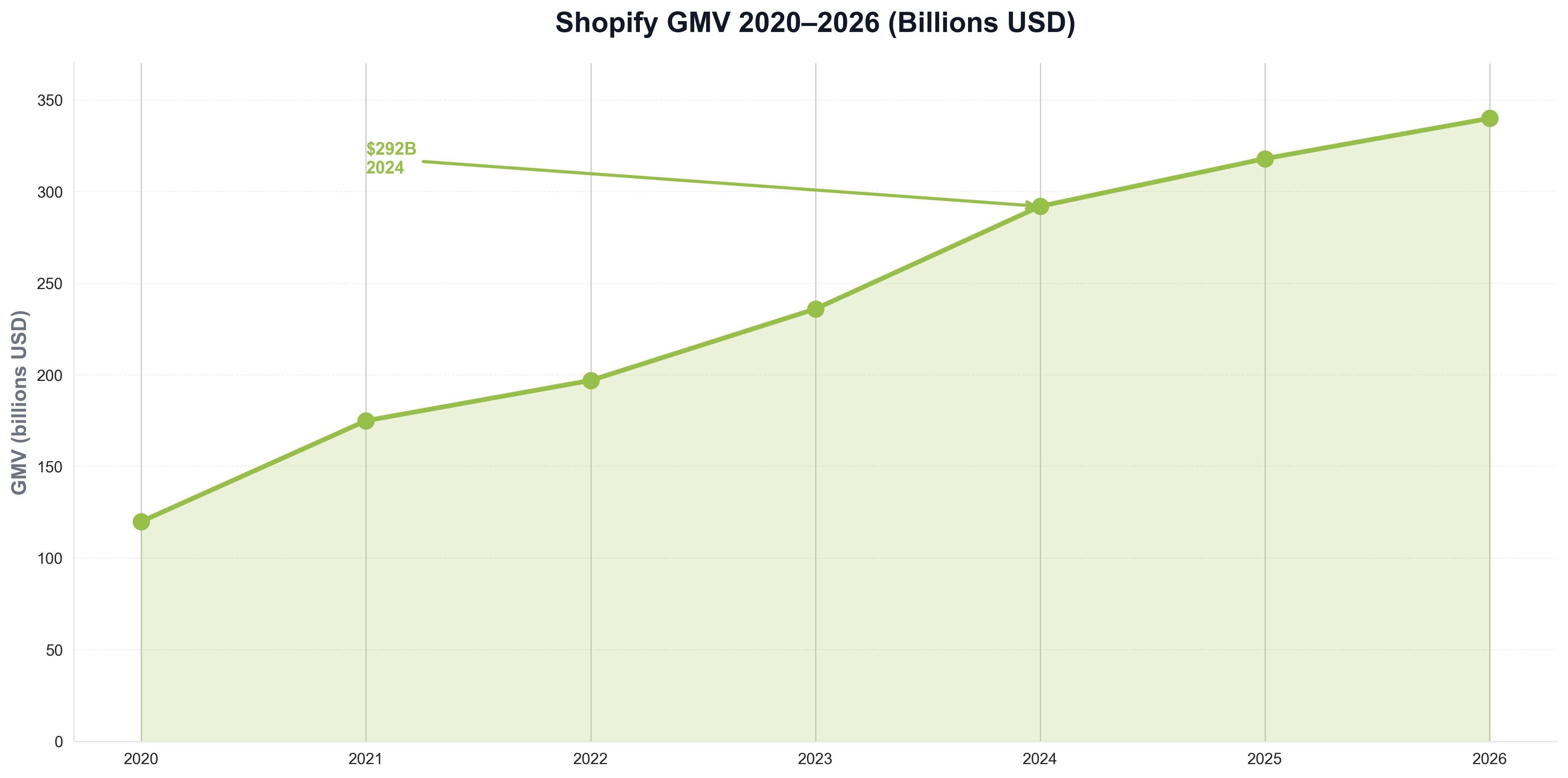
The chart above shows $292B in 2024 and continued growth toward $340B—reflecting Shopify as the default for D2C and omnichannel retail. Python is the natural choice for building such visualizations: ecommerce and product teams routinely use Python scripts to load GMV or merchant data and produce publication-ready charts for reports and articles like this one.
28.8% Top-Site Share, Ahead of WooCommerce: Market Leadership
The scale of Shopify's lead among serious ecommerce sites is striking. Mobiloud and Statista report 28.8% market share for Shopify among the top 1 million websites, ahead of WooCommerce (20.1%, 18.2% among top 1M) and Wix (~8–9%); Red Stag Fulfillment and Technology Checker note 26% global and 31% U.S. ecommerce platform share. EcomClips and Uptek add context on platform choice. When teams need to visualize market share or competitor positioning, they often use Python and matplotlib or seaborn. The following chart, produced with Python, summarizes ecommerce platform market share (Shopify vs WooCommerce vs Wix vs others) in a style consistent with industry reports.
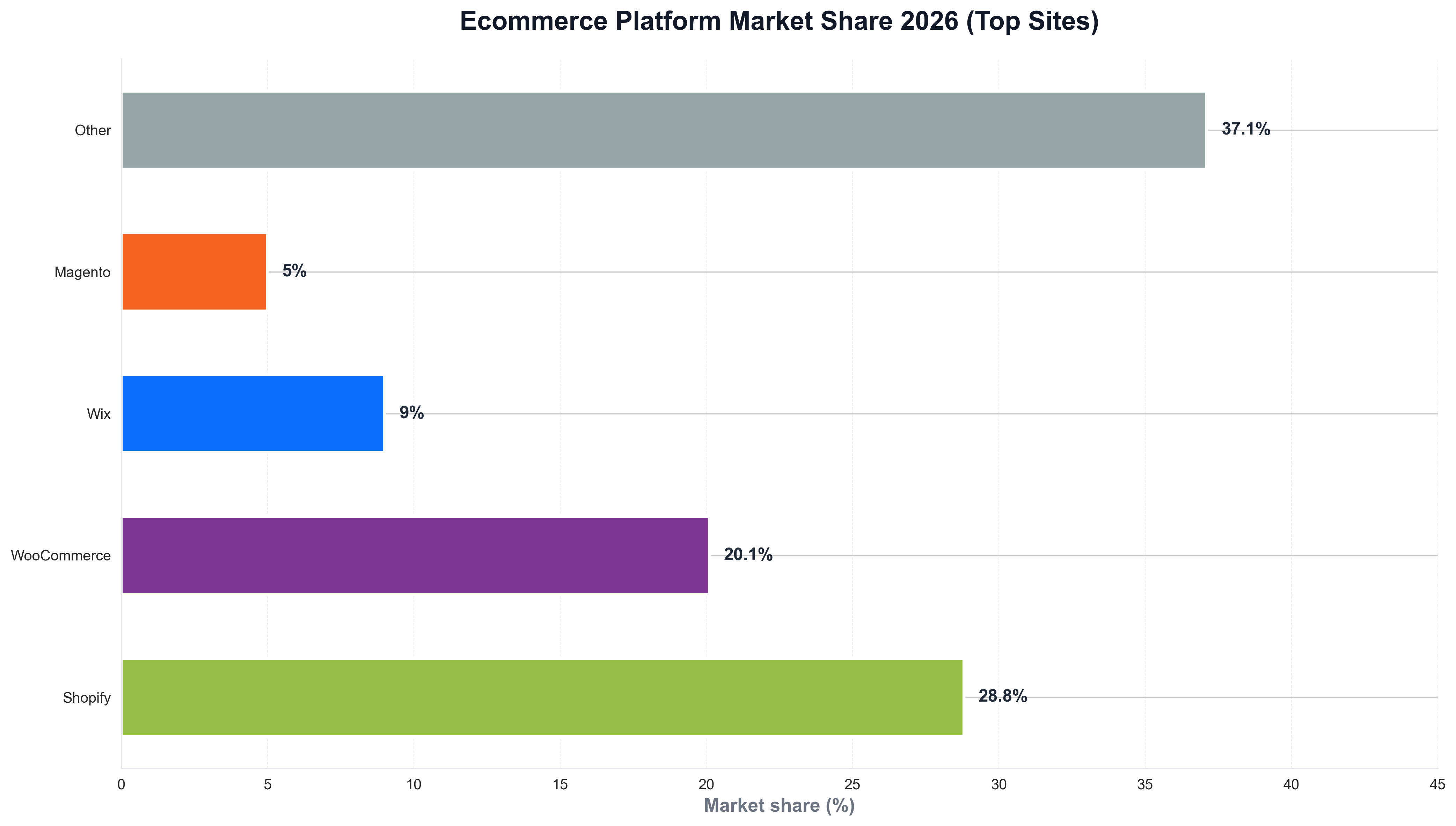
The chart illustrates Shopify ahead of WooCommerce and Wix among top sites—context that explains why brands and SMBs choose Shopify for hosted, scalable stores. Python is again the tool of choice for generating such charts from market or survey data, keeping analytics consistent with the rest of the data stack.
$8.88B Revenue, 26% YoY, 2:1 Migration: Why Merchants Choose Shopify
Revenue and merchant retention are central to Shopify's 2026 story. Startup Guru Lab and Digital Commerce 360 report $8.88 billion company revenue in 2024 (26% YoY) and 31% revenue growth in Q4 2024; Shopify's Q4 2024 results and Technology Checker note 20%+ revenue and GMV growth for six consecutive quarters, $1.6 billion free cash flow, and a 2:1 migration ratio (twice as many merchants joining as leaving) with 2.2% churn in H1 2024. For teams that track GMV or revenue over time, Python is often used to load financial or merchant data and plot trends. A minimal example might look like the following: load a CSV of Shopify GMV by year, and save a chart for internal or public reporting.
import pandas as pd
import matplotlib.pyplot as plt

df = pd.read_csv("shopify_gmv_by_year.csv")
fig, ax = plt.subplots(figsize=(10, 5))
ax.plot(df["year"], df["gmv_billions"], marker="o", linewidth=2, color="#96bf48")
ax.set_ylabel("GMV (billions USD)")
ax.set_title("Shopify gross merchandise volume (industry style)")
fig.savefig("public/images/blog/shopify-gmv-trend.png", dpi=150, bbox_inches="tight")
plt.close()
That kind of Python script is typical for ecommerce and growth teams: same language used for pipelines and dashboards, and direct control over chart layout and messaging.
13K+ Apps, 175 Countries, and the Road Ahead
Ecosystem and global reach shape Shopify's 2026 story. Startup Guru Lab and Omnisend report 13,000+ apps in the Shopify App Store and merchants in 175 countries; GoForFreeTrial notes 18% year-over-year growth in Q4 2025 and $1 trillion cumulative GMV crossed in 2024. Shopify's Shopify Plus, Shop Pay, and Shopify Markets extend enterprise and cross-border appeal. Python is the language many use to analyze ecommerce and GMV data and visualize market share and growth for reports like this one.
Conclusion: Shopify as the Ecommerce Platform Default in 2026
In 2026, Shopify is the default for D2C and omnichannel ecommerce: $292 billion GMV in 2024, 6 million+ live stores, 28.8% share among top 1M sites, 26%+ global platform share, and $8.88 billion company revenue. WooCommerce and Wix follow; 2:1 migration and 2.2% churn underscore merchant stickiness. Python remains the language that powers the analytics—GMV, revenue, market share, and the visualizations that explain the story—so that for Google News and Google Discover, the story in 2026 is clear: Shopify is where merchants build, and Python is how many of us chart it.