

Tailwind CSS is the most widely used CSS framework among developers in 2026. According to the State of CSS 2025 survey results, Tailwind CSS leads the CSS frameworks category with 2,041 respondents using it—ahead of Bootstrap (1,194), None (1,061), custom/in-house (953), and shadcn/ui (766). Medianic's State of CSS 2025 insights and CSS-Tricks' coverage confirm that Tailwind holds the top position by developer usage and highest satisfaction ratings. On npm, Tailwind CSS achieves approximately 36 million weekly downloads as of early 2026, with v4 alone seeing 17.7 million downloads in the last seven days and v3 LTS at 6 million—making it one of the top CSS frameworks by adoption. W3Techs' CSS framework trends report Tailwind at 1.5% market share among websites in January 2026, up from 0.9% a year earlier—a 67% increase in share over twelve months. Python is the tool many teams use to visualize survey and download data for reports like this one. This article examines why Tailwind dominates developer preference in 2026, how the ecosystem fits modern frontend workflows, and how Python powers the charts that tell the story.
#1 in State of CSS 2025: How Tailwind Won Developer Preference
Tailwind's lead among developers did not happen overnight. The State of CSS 2025 survey ranks Tailwind CSS first with 2,041 respondents, followed by Bootstrap (1,194), None (1,061), custom/in-house framework (953), and shadcn/ui (766). State of CSS 2025 resources and Medianic's analysis highlight Tailwind for utility-first styling, developer experience, and integration with React, Vue, and Next.js. The following chart, generated with Python and matplotlib using State of CSS–style data, illustrates CSS framework adoption among developers in 2025–2026.
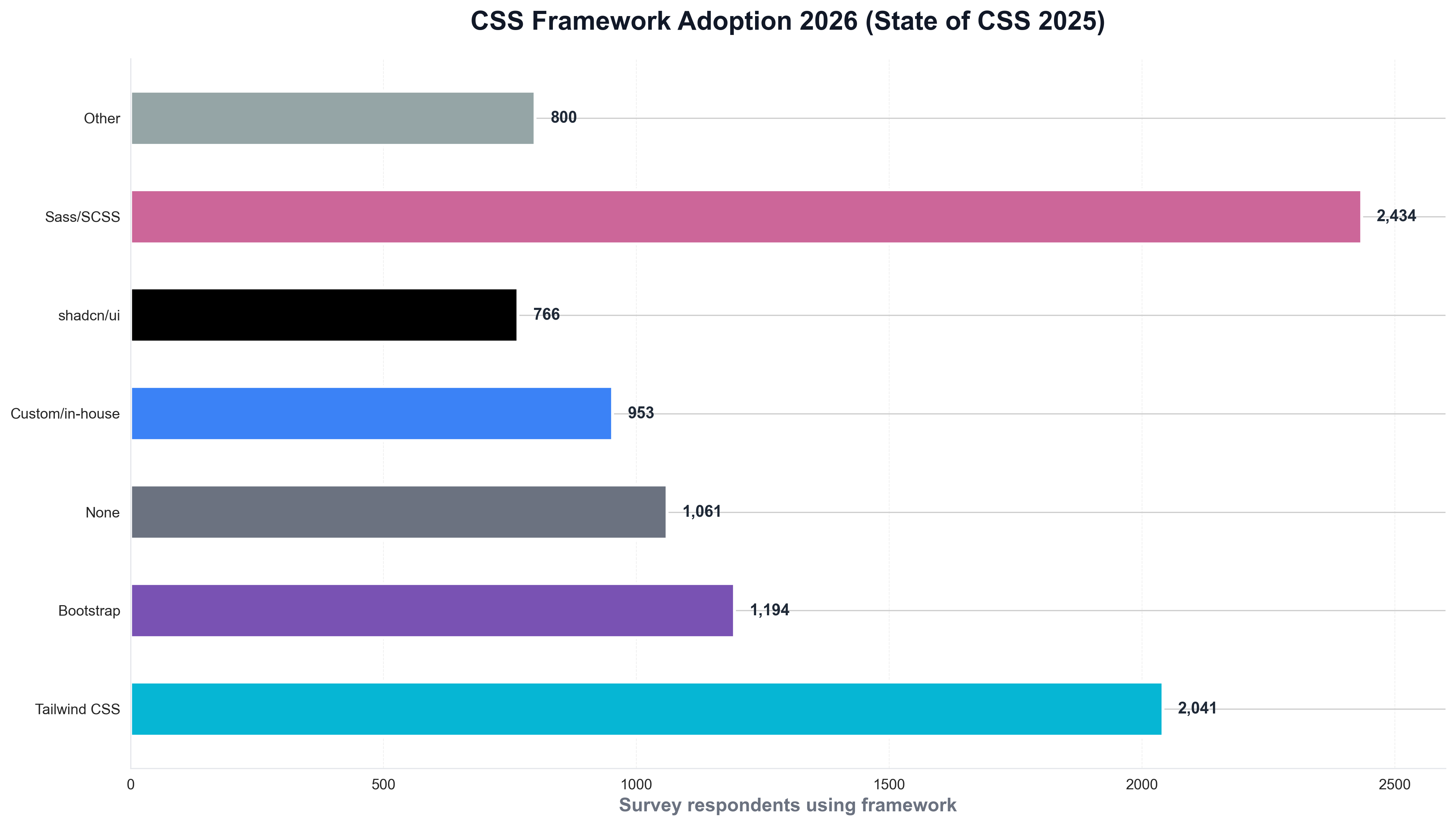
The chart above shows Tailwind ahead of Bootstrap, custom, and shadcn/ui—reflecting its dominance in developer preference. Python is the natural choice for building such visualizations: frontend and developer-relations teams routinely use Python scripts to load survey or npm data and produce publication-ready charts for reports and articles like this one.
36 Million Weekly Downloads and 67% Market-Share Growth
The scale of Tailwind's npm adoption is striking. npm's tailwindcss package achieves approximately 36.4 million weekly downloads as of early 2026; version-level data shows v4 (e.g. 4.1.18) at 17.7 million downloads in the last seven days and v3 (3.4.19 LTS) at 6 million—so both current and LTS tracks see heavy use. W3Techs' market share trends and Tailwind usage statistics report Tailwind at 1.5% of websites using a known CSS framework in January 2026, up from 0.9% in January 2025—1.0% (Apr), 1.1% (Jul), 1.3% (Oct)—a 67% year-over-year increase. When teams need to visualize framework growth over time—npm downloads or market share—they often use Python and matplotlib or seaborn. The following chart, produced with Python, summarizes Tailwind CSS growth (market share and download-style metrics) in a style consistent with W3Techs and npm data.
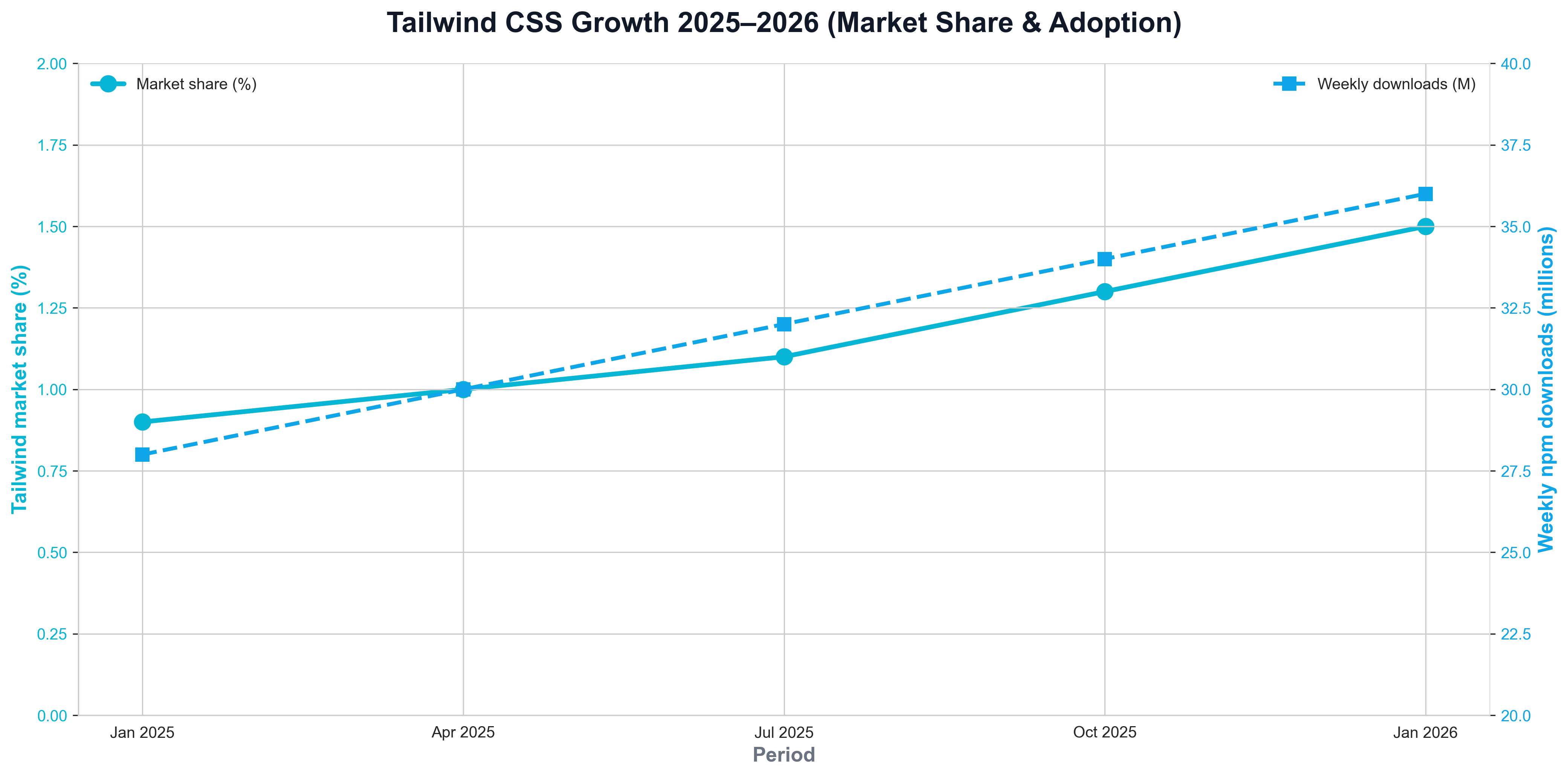
The chart illustrates 1.5% market share in 2026 and 67% YoY growth—context that explains why Tailwind is the default choice for so many frontend teams. Python is again the tool of choice for generating such charts from survey or registry data, keeping analytics consistent with the rest of the data stack.
Why Tailwind Won: Utility-First, DX, and Python for Analytics
The business case for Tailwind is utility-first styling, developer experience, and ecosystem fit. State of CSS 2025 and CSS-Tricks stress that developers choose Tailwind for speed of styling, consistency, and no context switching—write utility classes in markup, no custom CSS files for most UI work. Tailwind v4 and v3 LTS support PostCSS, Vite, Next.js, and React out of the box. For teams that track framework adoption or npm downloads over time, Python is often used to load npm or survey data and plot trends. A minimal example might look like the following: load a CSV of weekly downloads by month, and save a chart for internal or public reporting.
import pandas as pd
import matplotlib.pyplot as plt

df = pd.read_csv("tailwind_npm_weekly_by_month.csv")
fig, ax = plt.subplots(figsize=(10, 5))
ax.plot(df["month"], df["downloads_millions"], marker="o", linewidth=2, color="#06b6d4")
ax.set_ylabel("Weekly downloads (millions)")
ax.set_title("Tailwind CSS npm weekly downloads (npm-style)")
fig.savefig("public/images/blog/tailwind-downloads-trend.png", dpi=150, bbox_inches="tight")
plt.close()
That kind of Python script is typical for frontend and platform teams: same language used for data pipelines and dashboards, and direct control over chart layout and messaging.
Bootstrap, shadcn/ui, and the Multi-Framework Reality
Only a portion of projects use Tailwind exclusively. The State of CSS 2025 shows Bootstrap at 1,194 respondents and shadcn/ui at 766—shadcn/ui often pairs with Tailwind for components. W3Techs' CSS framework overview reports Bootstrap at 74.9% market share among websites using a known framework—so Bootstrap still dominates existing sites, while Tailwind leads developer preference and new projects. Multi-framework setups are common: Tailwind for utility and design tokens, shadcn/ui or Bootstrap for components. Python is the language many use to scrape or analyze npm stats, survey results, and visualize framework adoption for reports like this one.
Community, Sustainability, and the 2026 Ecosystem
In early 2026, discussion of Tailwind's sustainability highlighted the paradox of high developer adoption (State of CSS #1, 36M+ weekly downloads) alongside commercial challenges—documentation traffic declined as developers turned to AI tools (e.g. ChatGPT, Cursor) for styling help. The community has responded with sponsorship: roughly 70 companies contributing around $200,000 monthly to support maintenance, and the open-source core remains free and widely used. For Google News and Google Discover, the story in 2026 is that Tailwind is where developer preference lives for CSS—and Python is how many teams visualize that preference with charts and dashboards.
Conclusion: Tailwind as the Developer Default in 2026
In 2026, Tailwind CSS is the most widely used CSS framework among developers. #1 in State of CSS 2025 with 2,041 respondents, 36+ million weekly npm downloads, and 67% year-over-year growth in website market share (0.9% to 1.5%) tell the story: Tailwind won on utility-first design, developer experience, and ecosystem fit. Bootstrap still leads by existing-site share; Tailwind leads by developer choice and new projects. Python remains the language that powers the analytics—survey data, npm trends, and the visualizations that explain adoption—so that for Google News and Google Discover, the story in 2026 is clear: Tailwind is the CSS framework developers choose most, and Python is how many of them chart the numbers.